三、阅读理解(16 分)
A
Mr and Mrs Miller live in a small house in the city centre. Now, they want to buy a big one. They look for information of houses online. Here's the information they get.
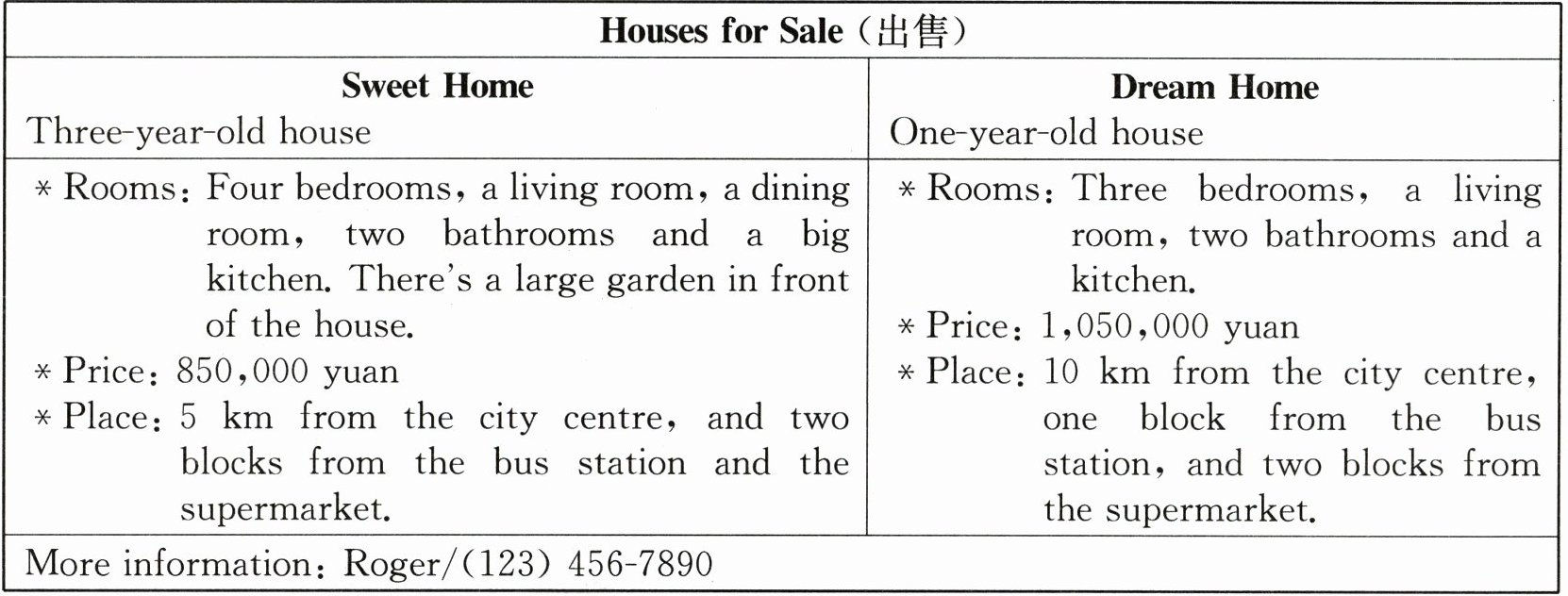
Mrs Miller likes growing flowers, so she likes Sweet Home. But Mr Miller thinks the house is too big for them to clean. For him, Dream Home is better. It takes him a shorter time to go to the bus station. It's really hard for them to choose.
(
A. older
B. smaller
C. more expensive
D. cleaner
(
A. there are many bedrooms
B. the kitchen is big
C. it's close to the bus station
D. she can grow flowers in its garden
(
A. The park.
B. The city centre.
C. The bus station.
D. The supermarket.
(
A. Email Roger.
B. Call Roger.
C. Write to Roger.
D. Go to Roger's office.
A
Mr and Mrs Miller live in a small house in the city centre. Now, they want to buy a big one. They look for information of houses online. Here's the information they get.
Mrs Miller likes growing flowers, so she likes Sweet Home. But Mr Miller thinks the house is too big for them to clean. For him, Dream Home is better. It takes him a shorter time to go to the bus station. It's really hard for them to choose.
(
A
) 1. Sweet Home is than Dream Home.A. older
B. smaller
C. more expensive
D. cleaner
(
D
) 2. Mrs Miller likes Sweet Home because .A. there are many bedrooms
B. the kitchen is big
C. it's close to the bus station
D. she can grow flowers in its garden
(
C
) 3. Which place is Dream Home closer (更近的) to than Sweet Home?A. The park.
B. The city centre.
C. The bus station.
D. The supermarket.
(
B
) 4. What can Mr and Mrs Miller do for more information?A. Email Roger.
B. Call Roger.
C. Write to Roger.
D. Go to Roger's office.
答案:1.A 2.D 3.C 4.B
解析:
【分析】
本题为英语阅读理解细节题,需结合表格中的房屋信息及短文内容逐一分析题目:
1. 第1题需对比Sweet Home和Dream Home的房龄,从表格中提取对应信息;
2. 第2题需定位Mrs Miller喜欢Sweet Home的原因,结合她种花的需求和表格里的花园信息;
3. 第3题需对比两者到各地点的距离,找到Dream Home更近的地点;
4. 第4题需查找获取更多信息的方式,对应表格里的联系方式。
【解析】
1. 第1题:根据表格,Sweet Home是Three-year-old house(房龄3年),Dream Home是One-year-old house(房龄1年),因此Sweet Home更老,选A。
2. 第2题:短文提到Mrs Miller likes growing flowers,表格中Sweet Home有a large garden,所以她能在花园种花,选D。
3. 第3题:对比两者到公交站的距离,Sweet Home离公交站two blocks,Dream Home离公交站one block,因此Dream Home更近公交站,选C。
4. 第4题:表格里More information标注了Roger的电话,所以可以打电话给Roger,选B。
【答案】
1.A 2.D 3.C 4.B
【知识点】
英语阅读理解、细节信息查找
【点评】
本题为基础细节类阅读理解题,主要考查学生从文本中提取关键信息的能力,难度较低,只要仔细阅读表格和短文即可正确作答。
【难度系数】
0.8
本题为英语阅读理解细节题,需结合表格中的房屋信息及短文内容逐一分析题目:
1. 第1题需对比Sweet Home和Dream Home的房龄,从表格中提取对应信息;
2. 第2题需定位Mrs Miller喜欢Sweet Home的原因,结合她种花的需求和表格里的花园信息;
3. 第3题需对比两者到各地点的距离,找到Dream Home更近的地点;
4. 第4题需查找获取更多信息的方式,对应表格里的联系方式。
【解析】
1. 第1题:根据表格,Sweet Home是Three-year-old house(房龄3年),Dream Home是One-year-old house(房龄1年),因此Sweet Home更老,选A。
2. 第2题:短文提到Mrs Miller likes growing flowers,表格中Sweet Home有a large garden,所以她能在花园种花,选D。
3. 第3题:对比两者到公交站的距离,Sweet Home离公交站two blocks,Dream Home离公交站one block,因此Dream Home更近公交站,选C。
4. 第4题:表格里More information标注了Roger的电话,所以可以打电话给Roger,选B。
【答案】
1.A 2.D 3.C 4.B
【知识点】
英语阅读理解、细节信息查找
【点评】
本题为基础细节类阅读理解题,主要考查学生从文本中提取关键信息的能力,难度较低,只要仔细阅读表格和短文即可正确作答。
【难度系数】
0.8
B
People in most villages in North China spend winters doing nothing till the planting season comes in spring. But not so for the villagers of Yandunjiao Village in Rongcheng City, Shandong Province.
"We are much busier in winter than in summer," Gao Yongjin says.
Gao runs the village's biggest guest house (民宿), which is less than 10 metres from the sea. Every year a lot of swans (天鹅) fly from Siberia (西伯利亚) and other areas and stay there from November to April.
"Visitors come to see the swans in winter," Gao says. "They like to stay in our village for several days to enjoy seaside life."
Over 60 of the village's 220 families manage guest houses.
"You can see our village is so clean," Gao says. "We volunteer to keep our village clean because we know what a clean environment (环境) means to us."
After the swans leave for their summer places, Gao and other villagers greet travellers who come to Yandunjiao to paint the sea views. Summertime visitors can also fish.
"We're busy all year round," Gao says. "This year, the village has welcomed over 80,000 travellers and made 10 million yuan."
Now Rongcheng is among the second list of 97 demonstration zones (示范区) for developing tourism (旅游业) by using local resources.
(
A. They plant many trees.
B. They do nothing in winter.
C. They do farm work in winter.
D. They are much busier in winter.
(
A. The owner of the swans.
B. A visitor from Siberia.
C. The owner of a village guest house.
D. A visitor from North China.
(
A. Because of the warm weather.
B. Because of the beautiful sea views and the clean environment.
C. Because the villagers keep many beautiful swans.
D. Because all the local families manage guest houses.
(
A. Animals.
B. Travel.
C. Culture.
D. Health.
People in most villages in North China spend winters doing nothing till the planting season comes in spring. But not so for the villagers of Yandunjiao Village in Rongcheng City, Shandong Province.
"We are much busier in winter than in summer," Gao Yongjin says.
Gao runs the village's biggest guest house (民宿), which is less than 10 metres from the sea. Every year a lot of swans (天鹅) fly from Siberia (西伯利亚) and other areas and stay there from November to April.
"Visitors come to see the swans in winter," Gao says. "They like to stay in our village for several days to enjoy seaside life."
Over 60 of the village's 220 families manage guest houses.
"You can see our village is so clean," Gao says. "We volunteer to keep our village clean because we know what a clean environment (环境) means to us."
After the swans leave for their summer places, Gao and other villagers greet travellers who come to Yandunjiao to paint the sea views. Summertime visitors can also fish.
"We're busy all year round," Gao says. "This year, the village has welcomed over 80,000 travellers and made 10 million yuan."
Now Rongcheng is among the second list of 97 demonstration zones (示范区) for developing tourism (旅游业) by using local resources.
(
D
) 5. What's special about the villagers in Yandunjiao Village?A. They plant many trees.
B. They do nothing in winter.
C. They do farm work in winter.
D. They are much busier in winter.
(
C
) 6. Who is Gao Yongjin?A. The owner of the swans.
B. A visitor from Siberia.
C. The owner of a village guest house.
D. A visitor from North China.
(
B
) 7. Why could the village welcome over 80,000 travellers in a year?A. Because of the warm weather.
B. Because of the beautiful sea views and the clean environment.
C. Because the villagers keep many beautiful swans.
D. Because all the local families manage guest houses.
(
B
) 8. In which part of the newspaper can we read the passage?A. Animals.
B. Travel.
C. Culture.
D. Health.
答案:5.D 6.C 7.B 8.B
解析:
【分析】
首先通读全文,把握文章主旨:山东烟墩角村依托天鹅资源发展特色旅游业,村民全年忙碌,成为旅游示范区。针对每道题的问题,回到原文定位关键信息,逐一比对选项,排除错误选项,选出正确答案。
【解析】
5. 细节理解题。根据原文第二段Gao Yongjin所说“We are much busier in winter than in summer”,可知烟墩角村村民冬天比夏天忙,这是他们的特别之处,故选D。
6. 细节理解题。根据原文第三段“Gao runs the village's biggest guest house (民宿)”,可知Gao Yongjin是村里最大民宿的老板,故选C。
7. 细节理解题。原文提到村民维护干净的环境,夏天游客来欣赏海景,这些是吸引游客的核心原因。选项B“美丽的海景和干净的环境”符合原文;A未提及温暖天气,C村民不养天鹅(天鹅是越冬迁徙而来),D是超过60家而非全部家庭经营民宿,故选B。
8. 主旨大意题。全文围绕烟墩角村发展旅游业的情况展开,属于旅游相关内容,因此会出现在报纸的旅游板块,故选B。
【答案】
5.D 6.C 7.B 8.B
【知识点】
阅读理解、细节理解题、主旨大意题
【点评】
本文是一篇介绍乡村特色旅游发展的文章,题目以细节理解为主,少量主旨理解,难度适中,学生通过定位原文关键信息即可解答,主要考查学生的信息提取能力。
【难度系数】
0.6
首先通读全文,把握文章主旨:山东烟墩角村依托天鹅资源发展特色旅游业,村民全年忙碌,成为旅游示范区。针对每道题的问题,回到原文定位关键信息,逐一比对选项,排除错误选项,选出正确答案。
【解析】
5. 细节理解题。根据原文第二段Gao Yongjin所说“We are much busier in winter than in summer”,可知烟墩角村村民冬天比夏天忙,这是他们的特别之处,故选D。
6. 细节理解题。根据原文第三段“Gao runs the village's biggest guest house (民宿)”,可知Gao Yongjin是村里最大民宿的老板,故选C。
7. 细节理解题。原文提到村民维护干净的环境,夏天游客来欣赏海景,这些是吸引游客的核心原因。选项B“美丽的海景和干净的环境”符合原文;A未提及温暖天气,C村民不养天鹅(天鹅是越冬迁徙而来),D是超过60家而非全部家庭经营民宿,故选B。
8. 主旨大意题。全文围绕烟墩角村发展旅游业的情况展开,属于旅游相关内容,因此会出现在报纸的旅游板块,故选B。
【答案】
5.D 6.C 7.B 8.B
【知识点】
阅读理解、细节理解题、主旨大意题
【点评】
本文是一篇介绍乡村特色旅游发展的文章,题目以细节理解为主,少量主旨理解,难度适中,学生通过定位原文关键信息即可解答,主要考查学生的信息提取能力。
【难度系数】
0.6