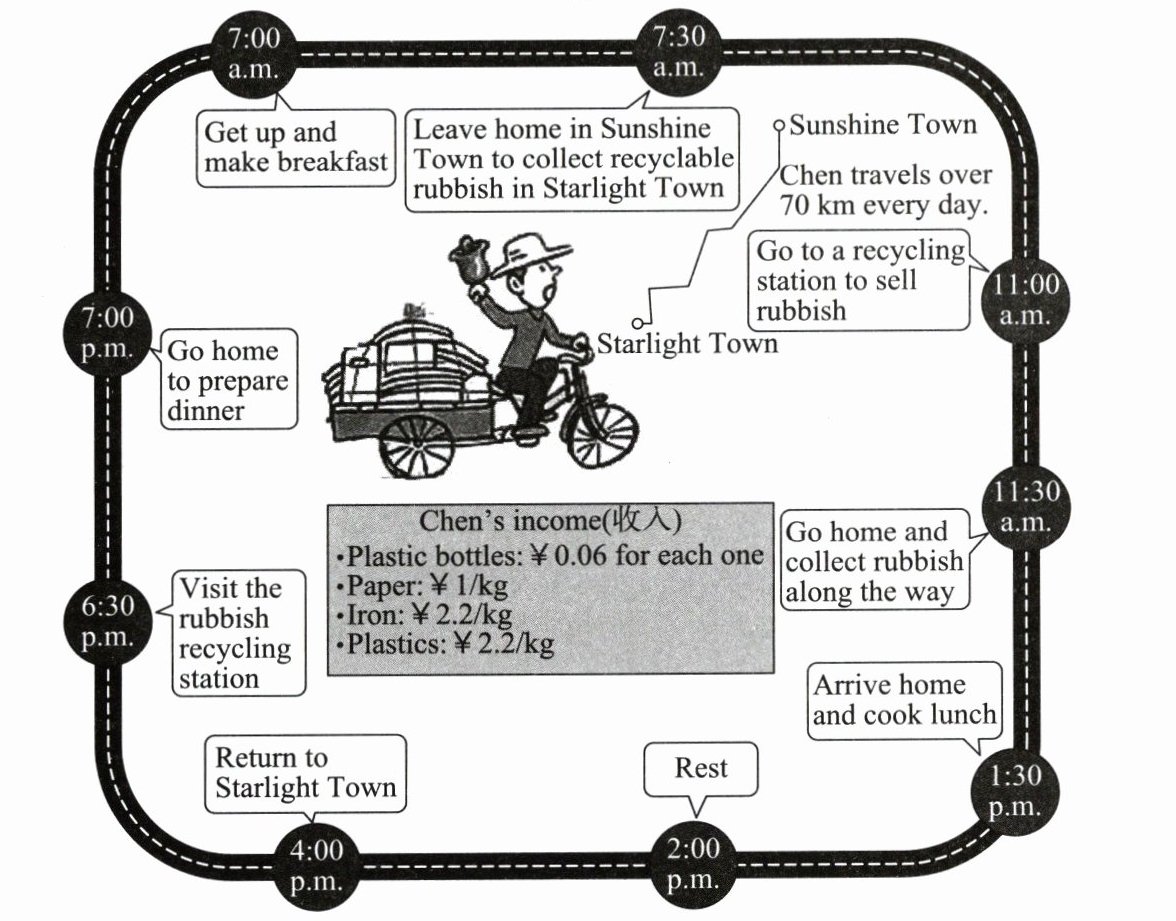
(
C
) 1. It's about 11:50 a.m. now. Chen may be C
.A. resting at home B. having lunch outside
C. collecting rubbish D. on his way to Starlight Town
(
B
) 2. Chen visits the rubbish recycling station B
a day.A. once B. twice C. three times D. four times
(
C
) 3. What can we infer from the picture about Chen's life?A. Chen has a very relaxing job. B. Chen is bored with his life.
C. Chen's work is tiring but meaningful. D. Chen can make a lot of money easily.
(
D
) 4. The text is about Chen's D
.A. interest B. job C. total income D. daily timetable
答案:1.C 2.B 3.C 4.D
解析:
【解析】
1. 对照日程时间线:11:00a.m.陈前往回收站卖垃圾,11:30a.m.回家沿路收集垃圾,11:50处于该时间段内,因此陈可能在收集垃圾,选C。
2. 统计到访回收站的次数:上午11:00去回收站卖垃圾,下午6:30再次到访回收站,一天共去2次,选B。
3. 推理判断:由陈每天骑行超70公里、早出晚归的行程可知工作辛苦,回收可回收垃圾的工作具备环保价值,可知陈的工作劳累但有意义,选C;A“工作轻松”、B“厌烦生活”、D“容易赚很多钱”均无文本依据。
4. 主旨归纳:图示完整展示了陈从早到晚的全天时间安排,核心内容是陈的日常时间表,选D;兴趣、工作、总收入都只是图示的部分内容,不能概括全文。
【答案】
1.C 2.B 3.C 4.D
【知识点】
图文信息提取,细节理解,推理判断
【点评】
本题为图文结合的阅读理解题,需结合日程时间线梳理信息,侧重考查学生提取细节信息、归纳主旨和推理判断的能力,认真对照时间线即可正确作答。
【难度系数】
0.7
1. 对照日程时间线:11:00a.m.陈前往回收站卖垃圾,11:30a.m.回家沿路收集垃圾,11:50处于该时间段内,因此陈可能在收集垃圾,选C。
2. 统计到访回收站的次数:上午11:00去回收站卖垃圾,下午6:30再次到访回收站,一天共去2次,选B。
3. 推理判断:由陈每天骑行超70公里、早出晚归的行程可知工作辛苦,回收可回收垃圾的工作具备环保价值,可知陈的工作劳累但有意义,选C;A“工作轻松”、B“厌烦生活”、D“容易赚很多钱”均无文本依据。
4. 主旨归纳:图示完整展示了陈从早到晚的全天时间安排,核心内容是陈的日常时间表,选D;兴趣、工作、总收入都只是图示的部分内容,不能概括全文。
【答案】
1.C 2.B 3.C 4.D
【知识点】
图文信息提取,细节理解,推理判断
【点评】
本题为图文结合的阅读理解题,需结合日程时间线梳理信息,侧重考查学生提取细节信息、归纳主旨和推理判断的能力,认真对照时间线即可正确作答。
【难度系数】
0.7
(B)
Don't worry about your waste. Reuse and recycle your things with Ridwell!
How it works
We give you bags to store your stuff like batteries, plastic, worn clothes, light bulbs and
more! These are things you throw away without good recycling or reuse way.
We come to your front door every two weeks to get back the bag and make sure your stuff
finds a new home.
Together, Ridwell members save tons from the landfill every year to
support our community, keep our oceans clean and build a brighter future.
▲
I love, love, love being able to recycle stuff that would be thrown away and end up in a
landfill! Thanks for giving us the chance to do something for the environment! — Teri
Keeping waste out of our landfill needs knowledge, time, and hard work. Ridwell makes it
easy to recycle and pass along things we no longer need.
— Lisa
Our story
We began with a father and a son trying to do the right thing with dead batteries and seeing
how hard it was. Later, they offered pickups to their neighbours to help those
around them waste less. This turned into Ridwell, a large community of people sharing new
ideas and bringing positive effects.
(
A. To tell people not to use plastic bags.
B. To encourage people to pick up rubbish outside.
C. To help get back the wasted things. D. To throw away the waste.
(
A. What our members say B. When Ridwell starts
C. How you can join us D. Where our members work
(
A. Teri is a member of Ridwell and loves to help recycle things.
B. Lisa finds it is an easy task to keep waste out of the landfill.
C. The father and his neighbours started Ridwell together.
D. The father picked up the rubbish in the neighbourhood to keep it clean.
(
A. No trading, no killing. B. Wasting less, made easy.
C. Saving water, saving ourselves. D. Every tree has its life.
Don't worry about your waste. Reuse and recycle your things with Ridwell!
How it works
We give you bags to store your stuff like batteries, plastic, worn clothes, light bulbs and
more! These are things you throw away without good recycling or reuse way.
We come to your front door every two weeks to get back the bag and make sure your stuff
finds a new home.
Together, Ridwell members save tons from the landfill every year to
support our community, keep our oceans clean and build a brighter future.
▲
I love, love, love being able to recycle stuff that would be thrown away and end up in a
landfill! Thanks for giving us the chance to do something for the environment! — Teri
Keeping waste out of our landfill needs knowledge, time, and hard work. Ridwell makes it
easy to recycle and pass along things we no longer need.
— Lisa
Our story
We began with a father and a son trying to do the right thing with dead batteries and seeing
how hard it was. Later, they offered pickups to their neighbours to help those
around them waste less. This turned into Ridwell, a large community of people sharing new
ideas and bringing positive effects.
(
C
) 5. Why does Ridwell give out Ridwell bags?A. To tell people not to use plastic bags.
B. To encourage people to pick up rubbish outside.
C. To help get back the wasted things. D. To throw away the waste.
(
A
) 6. Which can be best to fill in the blank " ▲ "?A. What our members say B. When Ridwell starts
C. How you can join us D. Where our members work
(
A
) 7. What can we learn according to the text?A. Teri is a member of Ridwell and loves to help recycle things.
B. Lisa finds it is an easy task to keep waste out of the landfill.
C. The father and his neighbours started Ridwell together.
D. The father picked up the rubbish in the neighbourhood to keep it clean.
(
B
) 8. Which of the following might be the slogan of Ridwell?A. No trading, no killing. B. Wasting less, made easy.
C. Saving water, saving ourselves. D. Every tree has its life.
答案:5.C 6.A 7.A 8.B
解析:
【分析】
这是一篇介绍环保回收服务Ridwell的应用文阅读理解,解题思路如下:首先通读全文,梳理清楚文章的结构:分别介绍Ridwell的运作模式、用户评价、发展起源,之后带着每道题的题干关键词回原文定位对应段落,逐一比对选项和原文信息,排除偷换概念、无中生有的错误选项,最终选出正确答案。
【解析】
1. 第5题:定位到原文"How it works"板块,文中提到Ridwell给用户发放袋子用来收纳电池、旧衣物等没有合适回收渠道的废弃物,之后会上门收回袋子完成回收,可知发放袋子的目的是方便后续回收取回废弃物。A选项“告诉人们不要用塑料袋”、B选项“鼓励人们外出捡垃圾”、D选项“用来扔垃圾”均不符合原文描述,因此选C。
2. 第6题:空白后的内容是两位用户Teri和Lisa对Ridwell的正面评价留言,对应的小标题应当是“我们会员的感言”,B选项“Ridwell的成立时间”、C选项“如何加入我们”、D选项“我们的会员在哪工作”都和后文内容不匹配,因此选A。
3. 第7题:逐一核对选项:
A选项:Teri的发言明确表示自己非常喜欢可以回收原本会被填埋的废弃物,说明她是Ridwell的会员,热爱参与回收工作,表述正确。
B选项:Lisa的原话是“把垃圾挡在填埋场之外本来需要知识、时间和大量精力,是Ridwell让回收变简单”,并非Lisa认为这件事本身很容易,表述错误。
C选项:原文提到Ridwell最初是由一对父子发起,之后才为邻居提供回收服务,并非父亲和邻居共同创办,表述错误。
D选项:父子最初的初衷是处理废电池,后续是提供上门回收服务,并非在社区捡垃圾保洁,表述错误。
因此选A。
4. 第8题:全文核心是Ridwell降低了普通人践行减塑回收的门槛,让减少浪费变得简单。A选项是保护动物相关标语、C选项是节约用水相关标语、D选项是保护树木相关标语,都和文章核心无关,只有B选项“减少浪费,轻松实现”完全匹配Ridwell的服务定位,因此选B。
【答案】
5.C 6.A 7.A 8.B
【知识点】
阅读理解细节查找,阅读理解主旨大意,应用文信息提取
【点评】
本题属于难度适中的应用文阅读,考点以细节理解为主,少量涉及主旨匹配,解题的核心技巧是带着题干关键词精准回文定位,仔细比对选项和原文的表述差异,就能快速排除干扰项选出正确答案,适合用来锻炼学生快速提取实用文本信息的能力。
【难度系数】
0.75
这是一篇介绍环保回收服务Ridwell的应用文阅读理解,解题思路如下:首先通读全文,梳理清楚文章的结构:分别介绍Ridwell的运作模式、用户评价、发展起源,之后带着每道题的题干关键词回原文定位对应段落,逐一比对选项和原文信息,排除偷换概念、无中生有的错误选项,最终选出正确答案。
【解析】
1. 第5题:定位到原文"How it works"板块,文中提到Ridwell给用户发放袋子用来收纳电池、旧衣物等没有合适回收渠道的废弃物,之后会上门收回袋子完成回收,可知发放袋子的目的是方便后续回收取回废弃物。A选项“告诉人们不要用塑料袋”、B选项“鼓励人们外出捡垃圾”、D选项“用来扔垃圾”均不符合原文描述,因此选C。
2. 第6题:空白后的内容是两位用户Teri和Lisa对Ridwell的正面评价留言,对应的小标题应当是“我们会员的感言”,B选项“Ridwell的成立时间”、C选项“如何加入我们”、D选项“我们的会员在哪工作”都和后文内容不匹配,因此选A。
3. 第7题:逐一核对选项:
A选项:Teri的发言明确表示自己非常喜欢可以回收原本会被填埋的废弃物,说明她是Ridwell的会员,热爱参与回收工作,表述正确。
B选项:Lisa的原话是“把垃圾挡在填埋场之外本来需要知识、时间和大量精力,是Ridwell让回收变简单”,并非Lisa认为这件事本身很容易,表述错误。
C选项:原文提到Ridwell最初是由一对父子发起,之后才为邻居提供回收服务,并非父亲和邻居共同创办,表述错误。
D选项:父子最初的初衷是处理废电池,后续是提供上门回收服务,并非在社区捡垃圾保洁,表述错误。
因此选A。
4. 第8题:全文核心是Ridwell降低了普通人践行减塑回收的门槛,让减少浪费变得简单。A选项是保护动物相关标语、C选项是节约用水相关标语、D选项是保护树木相关标语,都和文章核心无关,只有B选项“减少浪费,轻松实现”完全匹配Ridwell的服务定位,因此选B。
【答案】
5.C 6.A 7.A 8.B
【知识点】
阅读理解细节查找,阅读理解主旨大意,应用文信息提取
【点评】
本题属于难度适中的应用文阅读,考点以细节理解为主,少量涉及主旨匹配,解题的核心技巧是带着题干关键词精准回文定位,仔细比对选项和原文的表述差异,就能快速排除干扰项选出正确答案,适合用来锻炼学生快速提取实用文本信息的能力。
【难度系数】
0.75