第二节 请认真阅读下面短文,从短文后所给的六个选项中选出五个可以填入空白处的最佳选项。
Do you like wearing bright and colourful clothes? Today, we can get all kinds of colourful clothes easily in stores. But how about people in ancient times? 41.
One old method that was very popular in China was tie-dye(扎染). Tie-dye is a traditional Chinese method of dyeing clothes. 42.
43.
In 2006, the tie-dye skill became China's National Intangible Cultural Heritage (国家非物质文化遗产). Anning City in Yunnan Province is well-known for its tie-dye skills.
Yang Cheng learned this traditional skill from his mother in the 1980s. Since then, he has been working hard to improve it. 44.
Nowadays he still dyes clothes and teaches his daughter this skill. His love for the art and hard work make him a great teacher. 45.
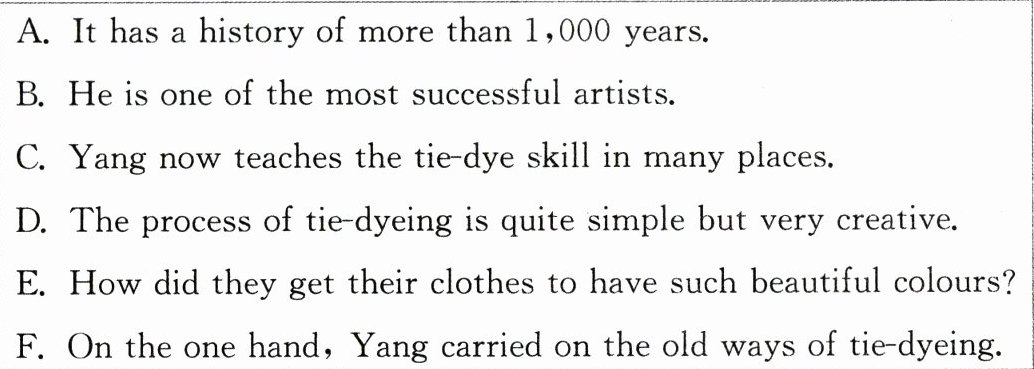
A. It has a history of more than 1,000 years.
B. He is one of the most successful artists.
C. Yang now teaches the tie-dye skill in many places.
D. The process of tie-dyeing is quite simple but very creative.
E. How did they get their clothes to have such beautiful colours?
F. On the one hand, Yang carried on the old ways of tie-dyeing.
第Ⅱ卷(非选择题 共60分)
Do you like wearing bright and colourful clothes? Today, we can get all kinds of colourful clothes easily in stores. But how about people in ancient times? 41.
E
One old method that was very popular in China was tie-dye(扎染). Tie-dye is a traditional Chinese method of dyeing clothes. 42.
A
During the Tang and Song periods, people presented tie-dyed clothes to the emperors as valuable gifts. People in those days made dye(染料) by hand, and blue dyes usually came from special plants.43.
D
First, you need to use ropes to tie your cloth together. Then you put the cloth into the dye. As the cloth is folded and dyed, some parts of the cloth will become dark colours, while other parts will be lighter in colour. When you open the cloth, you'll see beautiful shapes and colours.In 2006, the tie-dye skill became China's National Intangible Cultural Heritage (国家非物质文化遗产). Anning City in Yunnan Province is well-known for its tie-dye skills.
Yang Cheng learned this traditional skill from his mother in the 1980s. Since then, he has been working hard to improve it. 44.
F
On the other hand, he studied new skills from other countries.Nowadays he still dyes clothes and teaches his daughter this skill. His love for the art and hard work make him a great teacher. 45.
C
More than 60,000 people have learned from him. His love and efforts have kept this old art form alive and popular in modern times.A. It has a history of more than 1,000 years.
B. He is one of the most successful artists.
C. Yang now teaches the tie-dye skill in many places.
D. The process of tie-dyeing is quite simple but very creative.
E. How did they get their clothes to have such beautiful colours?
F. On the one hand, Yang carried on the old ways of tie-dyeing.
第Ⅱ卷(非选择题 共60分)
答案:第二节[语篇解读] 本文主要介绍了中国传统扎染技艺的悠久历史与制作特点,并讲述了这一技艺的传承人不断创新、广泛教学,使其重焕生机。
41. E 根据“But how about people in ancient times?”可知,这里提到的是古代人如何获得色彩鲜艳的衣服,选项 E“他们是如何让衣服拥有如此美丽的颜色的?”符合语境。
42. A 根据“Tie-dye is a traditional Chinese method of dyeing clothes. ”可知,这里提到的是扎染的历史,选项 A“它有 1 000 多年的历史。”符合语境。
43. D 根据“First, you need to use ropes to tie your cloth together. ”可知,这里描述的是扎染的过程,选项 D“扎染的过程非常简单但非常有创意。”符合语境。
44. F 根据“Since then, he has been working hard to improve it. ”可知,这里提到的是杨成如何改进扎染技艺,选项 F“一方面,杨成继承了传统的扎染技艺。”符合语境。
45. C 根据“More than 60,000 people have learned from him. ”可知,这里提到的是杨成教授扎染技艺的影响,选项 C“杨成现在在许多地方教授扎染技艺。”符合语境。
41. E 根据“But how about people in ancient times?”可知,这里提到的是古代人如何获得色彩鲜艳的衣服,选项 E“他们是如何让衣服拥有如此美丽的颜色的?”符合语境。
42. A 根据“Tie-dye is a traditional Chinese method of dyeing clothes. ”可知,这里提到的是扎染的历史,选项 A“它有 1 000 多年的历史。”符合语境。
43. D 根据“First, you need to use ropes to tie your cloth together. ”可知,这里描述的是扎染的过程,选项 D“扎染的过程非常简单但非常有创意。”符合语境。
44. F 根据“Since then, he has been working hard to improve it. ”可知,这里提到的是杨成如何改进扎染技艺,选项 F“一方面,杨成继承了传统的扎染技艺。”符合语境。
45. C 根据“More than 60,000 people have learned from him. ”可知,这里提到的是杨成教授扎染技艺的影响,选项 C“杨成现在在许多地方教授扎染技艺。”符合语境。
解析:
【分析】
本题为英语七选五题型,解题核心是结合上下文语境,分析句子间的逻辑关系(如设问呼应、时间补充、过程概括、并列结构等),逐一匹配选项。具体思路:41题需承接对古代人获取彩色衣服方式的疑问;42题需补充扎染的历史信息;43题需概括扎染过程的特点;44题需与后文的“on the other hand”形成并列结构;45题需解释后文“很多人向他学习”的原因。
【解析】
41. 空前句“But how about people in ancient times?”提出古代人如何获得彩色衣服的疑问,选项E“How did they get their clothes to have such beautiful colours?”正好承接该疑问,符合语境,故选E。
42. 空前句介绍扎染是中国传统染布方法,后句提及唐宋时期的扎染应用,选项A“It has a history of more than 1,000 years.”补充了扎染的历史时长,符合语境,故选A。
43. 空后句详细描述扎染的制作步骤,选项D“The process of tie-dyeing is quite simple but very creative.”概括了扎染过程的特点,引出下文步骤,故选D。
44. 空后句“On the other hand...”表并列,选项F“On the one hand, Yang carried on the old ways of tie-dyeing.”与后文形成“on one hand...on the other hand...”的对应结构,符合逻辑,故选F。
45. 空前句提到杨成是伟大的老师,后句说明很多人向他学习,选项C“Yang now teaches the tie-dye skill in many places.”解释了他能吸引学习者的原因,符合语境,故选C。
【答案】
41. E 42. A 43. D 44. F 45. C
【知识点】
英语阅读理解、七选五题型、语篇逻辑衔接
【点评】
本题围绕中国传统扎染技艺展开,考查学生对语篇上下文语境、逻辑关系的理解能力,解题关键是抓住前后句的线索,难度适中,适合中等水平学生作答。
【难度系数】
0.6
本题为英语七选五题型,解题核心是结合上下文语境,分析句子间的逻辑关系(如设问呼应、时间补充、过程概括、并列结构等),逐一匹配选项。具体思路:41题需承接对古代人获取彩色衣服方式的疑问;42题需补充扎染的历史信息;43题需概括扎染过程的特点;44题需与后文的“on the other hand”形成并列结构;45题需解释后文“很多人向他学习”的原因。
【解析】
41. 空前句“But how about people in ancient times?”提出古代人如何获得彩色衣服的疑问,选项E“How did they get their clothes to have such beautiful colours?”正好承接该疑问,符合语境,故选E。
42. 空前句介绍扎染是中国传统染布方法,后句提及唐宋时期的扎染应用,选项A“It has a history of more than 1,000 years.”补充了扎染的历史时长,符合语境,故选A。
43. 空后句详细描述扎染的制作步骤,选项D“The process of tie-dyeing is quite simple but very creative.”概括了扎染过程的特点,引出下文步骤,故选D。
44. 空后句“On the other hand...”表并列,选项F“On the one hand, Yang carried on the old ways of tie-dyeing.”与后文形成“on one hand...on the other hand...”的对应结构,符合逻辑,故选F。
45. 空前句提到杨成是伟大的老师,后句说明很多人向他学习,选项C“Yang now teaches the tie-dye skill in many places.”解释了他能吸引学习者的原因,符合语境,故选C。
【答案】
41. E 42. A 43. D 44. F 45. C
【知识点】
英语阅读理解、七选五题型、语篇逻辑衔接
【点评】
本题围绕中国传统扎染技艺展开,考查学生对语篇上下文语境、逻辑关系的理解能力,解题关键是抓住前后句的线索,难度适中,适合中等水平学生作答。
【难度系数】
0.6