( )8.[2026 南通市海安市十三校模拟]Which of the following sentences has the same structure as "The flowers smell wonderful in the park."?
A.My parents and I visited an old village last weekend.
B.Those farmers in the countryside work very hard every single day.
C.Those hard-working farmers in the countryside are helpful people.
D.The tall and strong teacher will make a practical tool for the students.
A.My parents and I visited an old village last weekend.
B.Those farmers in the countryside work very hard every single day.
C.Those hard-working farmers in the countryside are helpful people.
D.The tall and strong teacher will make a practical tool for the students.
答案:C
解析:
【解析】
首先分析原句"The flowers smell wonderful in the park."的句子结构:主语The flowers + 系动词smell(感官系动词)+ 表语wonderful + 地点状语in the park,属于主系表结构。
再逐一分析选项:
A选项:主语My parents and I + 谓语visited + 宾语an old village + 时间状语last weekend,属于主谓宾状结构。
B选项:主语Those farmers in the countryside + 谓语work + 状语very hard every single day,属于主谓状结构。
C选项:主语Those hard-working farmers in the countryside + 系动词are + 表语helpful people,属于主系表结构,和原句结构一致。
D选项:主语The tall and strong teacher + 谓语will make + 直接宾语a practical tool + 间接宾语for the students,属于主谓双宾结构。
【答案】
C
【知识点】
句子结构辨析 主系表句型
【点评】
本题考查英语基本句子结构的区分,核心是识别感官系动词引导的主系表结构,要求学生熟练掌握五大基本句型的特征,能够准确区分谓语动词的类别、判断句子成分。
【难度系数】
0.6
首先分析原句"The flowers smell wonderful in the park."的句子结构:主语The flowers + 系动词smell(感官系动词)+ 表语wonderful + 地点状语in the park,属于主系表结构。
再逐一分析选项:
A选项:主语My parents and I + 谓语visited + 宾语an old village + 时间状语last weekend,属于主谓宾状结构。
B选项:主语Those farmers in the countryside + 谓语work + 状语very hard every single day,属于主谓状结构。
C选项:主语Those hard-working farmers in the countryside + 系动词are + 表语helpful people,属于主系表结构,和原句结构一致。
D选项:主语The tall and strong teacher + 谓语will make + 直接宾语a practical tool + 间接宾语for the students,属于主谓双宾结构。
【答案】
C
【知识点】
句子结构辨析 主系表句型
【点评】
本题考查英语基本句子结构的区分,核心是识别感官系动词引导的主系表结构,要求学生熟练掌握五大基本句型的特征,能够准确区分谓语动词的类别、判断句子成分。
【难度系数】
0.6
( )9.[2026 南通期末]Which is the best title (solar term) for the poem according to the description?
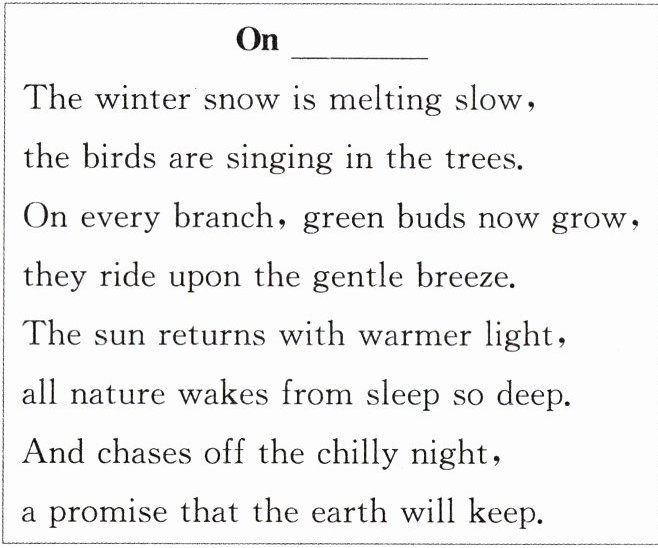
A.Beginning of Spring
B.Summer Solstice(夏至)
C.Beginning of Autumn
D.Winter Solstice
A.Beginning of Spring
B.Summer Solstice(夏至)
C.Beginning of Autumn
D.Winter Solstice
答案:9.A
解析:
【解析】
先解读诗歌内容:诗歌描述冬雪缓慢消融、鸟儿林间鸣唱、枝头冒出绿芽、阳光回暖、万物从沉睡中苏醒的景象,符合立春时节冬尽春来、万物萌动的特征。再逐一分析选项:A选项Beginning of Spring(立春)契合诗歌描述的物候特点;B选项夏至是盛夏节气,无融雪、新芽初萌的特征;C选项立秋是秋季开端,和冬雪消融的场景不符;D选项冬至是隆冬节气,万物尚未复苏,不符合诗歌描述。因此答案选A。
【答案】
A
【知识点】
文本信息匹配;节气常识
【点评】
本题结合英文诗歌和中国传统二十四节气知识,既考查学生从文本中提取关键物候信息的能力,也要求学生了解不同节气的典型特征,题型新颖,兼顾语言理解和文化常识的考查。
【难度系数】
0.7
先解读诗歌内容:诗歌描述冬雪缓慢消融、鸟儿林间鸣唱、枝头冒出绿芽、阳光回暖、万物从沉睡中苏醒的景象,符合立春时节冬尽春来、万物萌动的特征。再逐一分析选项:A选项Beginning of Spring(立春)契合诗歌描述的物候特点;B选项夏至是盛夏节气,无融雪、新芽初萌的特征;C选项立秋是秋季开端,和冬雪消融的场景不符;D选项冬至是隆冬节气,万物尚未复苏,不符合诗歌描述。因此答案选A。
【答案】
A
【知识点】
文本信息匹配;节气常识
【点评】
本题结合英文诗歌和中国传统二十四节气知识,既考查学生从文本中提取关键物候信息的能力,也要求学生了解不同节气的典型特征,题型新颖,兼顾语言理解和文化常识的考查。
【难度系数】
0.7
(
—
A.I will call back again.
B.Yes, I'm Suzy.
C.No, I can't hear you.
D.This is Suzy speaking.
D
)10.— Hello, may I speak to Suzy?—
A.I will call back again.
B.Yes, I'm Suzy.
C.No, I can't hear you.
D.This is Suzy speaking.
答案:10.D
解析:
【分析】
这是一道电话交际用语题,解题思路是牢记英语中打电话的标准表达:接电话时若自己就是对方要找的人,需用“This is + 姓名 + speaking”表明身份,而非“I'm + 姓名”。通过逐一分析选项,排除不符合电话用语的选项,选出正确答案。
【解析】
本题考查电话交际用语。英语打电话时,表明自身身份的正确表达为“This is + 姓名 + speaking”,而非“I'm + 姓名”。逐一分析选项:A选项“我会再回电话”,不符合对话语境;B选项“I'm Suzy”不是电话中的正确身份表达;C选项“不,我听不到你”与问句无关;D选项“This is Suzy speaking”是电话中表明身份的标准表达,契合语境。
【答案】
D
【知识点】
日常交际用语、电话用语
【点评】
本题考查电话场景下的基础交际表达,属于日常英语应用的基础题型,需学生掌握打电话时的标准用语,难度较低。
【难度系数】
0.8
这是一道电话交际用语题,解题思路是牢记英语中打电话的标准表达:接电话时若自己就是对方要找的人,需用“This is + 姓名 + speaking”表明身份,而非“I'm + 姓名”。通过逐一分析选项,排除不符合电话用语的选项,选出正确答案。
【解析】
本题考查电话交际用语。英语打电话时,表明自身身份的正确表达为“This is + 姓名 + speaking”,而非“I'm + 姓名”。逐一分析选项:A选项“我会再回电话”,不符合对话语境;B选项“I'm Suzy”不是电话中的正确身份表达;C选项“不,我听不到你”与问句无关;D选项“This is Suzy speaking”是电话中表明身份的标准表达,契合语境。
【答案】
D
【知识点】
日常交际用语、电话用语
【点评】
本题考查电话场景下的基础交际表达,属于日常英语应用的基础题型,需学生掌握打电话时的标准用语,难度较低。
【难度系数】
0.8
二、核心素养 中华优秀传统文化 完形填空(本题共 15 小题;每小题1 分,满分 15 分)
请认真阅读下面短文,从短文后各题所给的 A、B、C、D 四个选项中,选出最佳选项。
Do you know about Grain in Ear? It is one of the 2$4 Solar Terms. When the weather gets \underline${$\quad$1$1\quad$}, the rain starts to fall and grain gets ripe(成熟的$), we know Grain in Ear is just around the corner. This year, it \underline{\quad12\quad} on June 5.$
$The arrival of Grain in Ear means \underline${$\quad$13$\quad$} time is coming. Wheat becomes ripe, and so do plums(梅子$). \underline${$\quad$14$\quad$}$ the day of Grain in Ear, people will boil and eat green plums. It is said that this tradition started \underline${$\quad$15$\quad$}$ two famous people—Cao Cao and Liu Bei. There is a famous story. Cao and Liu \underline${$\quad$16$\quad$} the heroes of their time while boiling wine and eating green plums.
$When the plums are ripe, the plum rains come. After Grain in Ear, the \underline${$\quad$17$\quad$}$ in the middle and lower reaches of the Yangtze River will enter the plum rain season. The long period of \underline${$\quad$18$\quad$}$ and cloudy weather will last \underline${$\quad$19$\quad$} June and July.
$The plum rain season is a good time for \underline${$\quad$2$0\quad$}$ rice, vegetables and fruits, but it also means the falling of \underline${$\quad$21$\quad$}. During Grain in Ear, people have ceremonies(仪式$) to say \underline${$\quad$2$2\quad$} to the Flower Goddess.
$Today we seldom see this tradition in most parts of China. \underline${$\quad$23$\quad$}$ people can feel the excitement of the ceremony in the famous \underline${$\quad$24$\quad$} *A Dream of Red Mansions* by Cao Xueqin. The girls of the Jia family usually make flowers and willow branches(柳枝$) into small toys. They also put silk on trees with \underline${$\quad$25$\quad$} threads(线).
With its busy harvests and natural beauty, Grain in Ear is really a great time of the year.
(
(
(
(
(
(
(
(
(
(
(
(
(
(
(
请认真阅读下面短文,从短文后各题所给的 A、B、C、D 四个选项中,选出最佳选项。
Do you know about Grain in Ear? It is one of the 2$4 Solar Terms. When the weather gets \underline${$\quad$1$1\quad$}, the rain starts to fall and grain gets ripe(成熟的$), we know Grain in Ear is just around the corner. This year, it \underline{\quad12\quad} on June 5.$
$The arrival of Grain in Ear means \underline${$\quad$13$\quad$} time is coming. Wheat becomes ripe, and so do plums(梅子$). \underline${$\quad$14$\quad$}$ the day of Grain in Ear, people will boil and eat green plums. It is said that this tradition started \underline${$\quad$15$\quad$}$ two famous people—Cao Cao and Liu Bei. There is a famous story. Cao and Liu \underline${$\quad$16$\quad$} the heroes of their time while boiling wine and eating green plums.
$When the plums are ripe, the plum rains come. After Grain in Ear, the \underline${$\quad$17$\quad$}$ in the middle and lower reaches of the Yangtze River will enter the plum rain season. The long period of \underline${$\quad$18$\quad$}$ and cloudy weather will last \underline${$\quad$19$\quad$} June and July.
$The plum rain season is a good time for \underline${$\quad$2$0\quad$}$ rice, vegetables and fruits, but it also means the falling of \underline${$\quad$21$\quad$}. During Grain in Ear, people have ceremonies(仪式$) to say \underline${$\quad$2$2\quad$} to the Flower Goddess.
$Today we seldom see this tradition in most parts of China. \underline${$\quad$23$\quad$}$ people can feel the excitement of the ceremony in the famous \underline${$\quad$24$\quad$} *A Dream of Red Mansions* by Cao Xueqin. The girls of the Jia family usually make flowers and willow branches(柳枝$) into small toys. They also put silk on trees with \underline${$\quad$25$\quad$} threads(线).
With its busy harvests and natural beauty, Grain in Ear is really a great time of the year.
(
C
)11. A. warmer B. cooler C. hotter D. colder(
B
)12. A. reaches B. falls C. shows D. rises(
A
)13. A. harvest B. tour C. hope D. joy(
B
)14. A. For B. On C. At D. In(
D
)15. A. instead of B. in order to C. in front of D. because of(
C
)16. A. protected B. recorded C. discussed D. advised(
A
)17. A. areas B. plans C. numbers D. seasons(
D
)18. A. foggy B. snowy C. sunny D. rainy(
B
)19. A. both B. through C. with D. before(
C
)20. A. selling B. saving C. growing D. collecting(
C
)21. A. sticks B. leaves C. flowers D. clouds(
D
)22. A. hi B. fine C. hello D. goodbye(
C
)23. A. Or B. And C. But D. So(
A
)24. A. work B. fight C. memory D. trip(
B
)25. A. broken B. colourful C. patient D. awful答案:11. C
12. B
13. A 根据后句中Wheat becomes ripe可知,“芒种”是收获的时节。harvest意为“收获”。
14. B
15. D 句意:据说这个传统因曹操和刘备这两位名人而起。instead of代替;in order to为了;in front of在……前面;because of因为。
16. C 根据历史和文学常识可知,曹操和刘备是青梅煮酒论英雄。
17. A 此处指长江中下游区域进入梅雨季节。area意为“区域”。
18. D
19. B 此处是指梅雨天气将贯穿整个六月和七月。through意为“从头至尾”。
20. C 根据后面的转折“but it also means the falling of ... During Grain in Ear, people have ceremonies to say ... to the Flower Goddess.”可知,此处是形成对比,表示“梅雨季节是种植稻米、蔬菜和水果的好时节,而这也意味着花朵的凋落”。
21. C 22. D 23. C 24. A 25. B
12. B
13. A 根据后句中Wheat becomes ripe可知,“芒种”是收获的时节。harvest意为“收获”。
14. B
15. D 句意:据说这个传统因曹操和刘备这两位名人而起。instead of代替;in order to为了;in front of在……前面;because of因为。
16. C 根据历史和文学常识可知,曹操和刘备是青梅煮酒论英雄。
17. A 此处指长江中下游区域进入梅雨季节。area意为“区域”。
18. D
19. B 此处是指梅雨天气将贯穿整个六月和七月。through意为“从头至尾”。
20. C 根据后面的转折“but it also means the falling of ... During Grain in Ear, people have ceremonies to say ... to the Flower Goddess.”可知,此处是形成对比,表示“梅雨季节是种植稻米、蔬菜和水果的好时节,而这也意味着花朵的凋落”。
21. C 22. D 23. C 24. A 25. B
解析:
【分析】
做完形填空需先通读全文把握主旨,再逐题结合语境、词汇辨析、固定搭配及文化常识分析选项:
1. 先理解短文围绕“芒种”节气展开,涉及节气特点、传统习俗等内容;
2. 针对每道题,先分析空格前后语境,再对比选项词义,结合语法、常识选出最符合文意的答案;
3. 遇到文化类题目,需结合中国传统节气、历史故事等常识辅助判断。
【解析】
11. 句意:当天气变得更热,雨水落下、谷物成熟时,我们知道芒种临近了。结合常识,芒种时节气温升高,hotter符合,选C。
12. 句意:今年它在6月5日。“fall on”表示(节日等)适逢,此处指芒种的日期,选B。
13. 句意:芒种的到来意味着收获时节来临。后句提到麦子成熟,harvest(收获)符合语境,选A。
14. 句意:在芒种当天,人们会煮青梅。具体某一天前用介词on,选B。
15. 句意:据说这个传统因曹操和刘备这两位名人而起。because of(因为)符合句意,选D。
16. 句意:曹操和刘备煮酒吃青梅时讨论当时的英雄。结合“青梅煮酒论英雄”的历史常识,discussed符合,选C。
17. 句意:长江中下游区域将进入梅雨季节。areas(区域)符合语境,选A。
18. 句意:长时间的阴雨和多云天气将持续……。梅雨季节是雨天,rainy符合,选D。
19. 句意:梅雨天气贯穿六月和七月。through表示“从头至尾”,符合语境,选B。
20. 句意:梅雨季节是种植稻米、蔬菜和水果的好时节。growing(种植)符合语境,选C。
21. 句意:但它也意味着花朵的凋落。结合送花神的习俗,flowers符合,选C。
22. 句意:人们举行仪式向花神告别。say goodbye to(向……告别)符合,选D。
23. 句意:如今中国大部分地区很少见这个传统,但人们能在《红楼梦》中感受到仪式的热闹。前后是转折关系,but符合,选C。
24. 《红楼梦》是曹雪芹的作品,work(作品)符合,选A。
25. 句意:她们把丝绸和彩色的线绑在树上。colourful(彩色的)符合语境,选B。
【答案】
11.C 12.B 13.A 14.B 15.D 16.C 17.A 18.D 19.B 20.C 21.C 22.D 23.C 24.A 25.B
【知识点】
完形填空、词汇辨析、文化常识
【点评】
本题结合中华优秀传统文化(芒种节气、《红楼梦》等)考查完形填空,既考查英语语言知识,又渗透文化素养,需学生结合语境与常识解题,整体难度适中。
【难度系数】
0.6
做完形填空需先通读全文把握主旨,再逐题结合语境、词汇辨析、固定搭配及文化常识分析选项:
1. 先理解短文围绕“芒种”节气展开,涉及节气特点、传统习俗等内容;
2. 针对每道题,先分析空格前后语境,再对比选项词义,结合语法、常识选出最符合文意的答案;
3. 遇到文化类题目,需结合中国传统节气、历史故事等常识辅助判断。
【解析】
11. 句意:当天气变得更热,雨水落下、谷物成熟时,我们知道芒种临近了。结合常识,芒种时节气温升高,hotter符合,选C。
12. 句意:今年它在6月5日。“fall on”表示(节日等)适逢,此处指芒种的日期,选B。
13. 句意:芒种的到来意味着收获时节来临。后句提到麦子成熟,harvest(收获)符合语境,选A。
14. 句意:在芒种当天,人们会煮青梅。具体某一天前用介词on,选B。
15. 句意:据说这个传统因曹操和刘备这两位名人而起。because of(因为)符合句意,选D。
16. 句意:曹操和刘备煮酒吃青梅时讨论当时的英雄。结合“青梅煮酒论英雄”的历史常识,discussed符合,选C。
17. 句意:长江中下游区域将进入梅雨季节。areas(区域)符合语境,选A。
18. 句意:长时间的阴雨和多云天气将持续……。梅雨季节是雨天,rainy符合,选D。
19. 句意:梅雨天气贯穿六月和七月。through表示“从头至尾”,符合语境,选B。
20. 句意:梅雨季节是种植稻米、蔬菜和水果的好时节。growing(种植)符合语境,选C。
21. 句意:但它也意味着花朵的凋落。结合送花神的习俗,flowers符合,选C。
22. 句意:人们举行仪式向花神告别。say goodbye to(向……告别)符合,选D。
23. 句意:如今中国大部分地区很少见这个传统,但人们能在《红楼梦》中感受到仪式的热闹。前后是转折关系,but符合,选C。
24. 《红楼梦》是曹雪芹的作品,work(作品)符合,选A。
25. 句意:她们把丝绸和彩色的线绑在树上。colourful(彩色的)符合语境,选B。
【答案】
11.C 12.B 13.A 14.B 15.D 16.C 17.A 18.D 19.B 20.C 21.C 22.D 23.C 24.A 25.B
【知识点】
完形填空、词汇辨析、文化常识
【点评】
本题结合中华优秀传统文化(芒种节气、《红楼梦》等)考查完形填空,既考查英语语言知识,又渗透文化素养,需学生结合语境与常识解题,整体难度适中。
【难度系数】
0.6