(
A.is; 60 percents; are
B.is; 60 percent; are
C.are; 60 percent; is
D.are; 60 percents; are
B
)8.The number of the students in our class fifty. of them boys.A.is; 60 percents; are
B.is; 60 percent; are
C.are; 60 percent; is
D.are; 60 percents; are
答案:8.B
解析:
【分析】本题需掌握两个核心知识点:一是“the number of...”的主谓一致规则,二是“percent”的用法。第一步,判断第一空:“the number of +复数名词”表示“……的数量”,作主语时谓语动词用单数,据此排除C、D选项;第二步,判断第二空:“percent”表示“百分比”时,无论前面数字多大,都用原形,无复数形式,据此排除A选项;第三步,验证第三空:“of them”指代复数名词students,谓语动词需用are,符合B选项结构,因此确定答案。
【解析】1. 第一空:“the number of +可数名词复数”作主语,谓语动词用单数,故填is,排除C、D;2. 第二空:“percent”表百分比时无复数形式,用原形,故填60 percent,排除A;3. 第三空:“of them”指代复数的students,谓语动词用are,综上选B。
【答案】B
【知识点】主谓一致、percent的用法
【点评】本题考查英语基础语法知识点,涉及主谓一致和百分比表达,属于常规基础题,需牢记固定搭配规则即可解答。
【难度系数】0.3
【解析】1. 第一空:“the number of +可数名词复数”作主语,谓语动词用单数,故填is,排除C、D;2. 第二空:“percent”表百分比时无复数形式,用原形,故填60 percent,排除A;3. 第三空:“of them”指代复数的students,谓语动词用are,综上选B。
【答案】B
【知识点】主谓一致、percent的用法
【点评】本题考查英语基础语法知识点,涉及主谓一致和百分比表达,属于常规基础题,需牢记固定搭配规则即可解答。
【难度系数】0.3
(
A.Spring is the music of energy and colour.
B.Summer offers us long and sunny days.
C.Autumn winds blow the golden leaves.
D.The first snow paints the world white.
D
)9.[2026 南通期末]Which sentence has the same structure as "I find seasons really beautiful."?A.Spring is the music of energy and colour.
B.Summer offers us long and sunny days.
C.Autumn winds blow the golden leaves.
D.The first snow paints the world white.
答案:9.D
解析:
【解析】
首先分析原句"I find seasons really beautiful."的句子结构:主语I + 谓语find + 宾语seasons + 宾语补足语really beautiful,属于主谓宾宾补结构。
逐一分析选项:
A. 句子"Spring is the music of energy and colour."结构为:主语Spring + 系动词is + 表语the music of energy and colour,属于主系表结构。
B. 句子"Summer offers us long and sunny days."结构为:主语Summer + 谓语offers + 间接宾语us + 直接宾语long and sunny days,属于主谓双宾结构。
C. 句子"Autumn winds blow the golden leaves."结构为:主语Autumn winds + 谓语blow + 宾语the golden leaves,属于主谓宾结构。
D. 句子"The first snow paints the world white."结构为:主语The first snow + 谓语paints + 宾语the world + 宾语补足语white,属于主谓宾宾补结构,和原句结构一致。
【答案】
D
【知识点】
句子结构辨析
【点评】
本题考查英语常见基本句型的区分,要求学生准确掌握主系表、主谓宾、主谓双宾、主谓宾宾补等基础句型的特征,能够快速拆解句子成分判断结构,属于英语句法的基础应用型题目。
【难度系数】
0.6
首先分析原句"I find seasons really beautiful."的句子结构:主语I + 谓语find + 宾语seasons + 宾语补足语really beautiful,属于主谓宾宾补结构。
逐一分析选项:
A. 句子"Spring is the music of energy and colour."结构为:主语Spring + 系动词is + 表语the music of energy and colour,属于主系表结构。
B. 句子"Summer offers us long and sunny days."结构为:主语Summer + 谓语offers + 间接宾语us + 直接宾语long and sunny days,属于主谓双宾结构。
C. 句子"Autumn winds blow the golden leaves."结构为:主语Autumn winds + 谓语blow + 宾语the golden leaves,属于主谓宾结构。
D. 句子"The first snow paints the world white."结构为:主语The first snow + 谓语paints + 宾语the world + 宾语补足语white,属于主谓宾宾补结构,和原句结构一致。
【答案】
D
【知识点】
句子结构辨析
【点评】
本题考查英语常见基本句型的区分,要求学生准确掌握主系表、主谓宾、主谓双宾、主谓宾宾补等基础句型的特征,能够快速拆解句子成分判断结构,属于英语句法的基础应用型题目。
【难度系数】
0.6
(
A.ask people to protect wetland plants
B.tell people how to swim safely
C.show the best time to visit the wetland
D.remind people to take photos
A
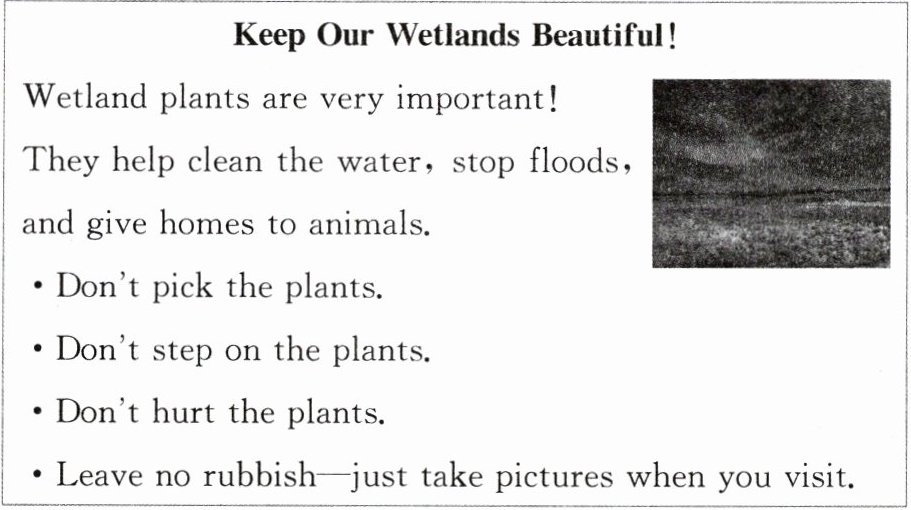
)10.The purpose of the sign below is to .A.ask people to protect wetland plants
B.tell people how to swim safely
C.show the best time to visit the wetland
D.remind people to take photos
答案:10.A
解析:
【分析】首先明确题目要求:判断该标志的目的。先阅读文本,标题为“Keep Our Wetlands Beautiful!”,内容先说明湿地植物的重要性,随后列出保护湿地植物的具体做法,核心围绕保护湿地植物展开。再逐一分析选项,排除不符合的选项,选出正确答案。
【解析】1. 梳理文本核心:文本围绕湿地植物的重要性,给出保护湿地植物的相关要求,整体目的是呼吁人们保护湿地植物。2. 分析选项:A选项“ask people to protect wetland plants”契合文本主旨;B选项“tell people how to swim safely”与文本内容无关;C选项“show the best time to visit the wetland”文本未提及;D选项“remind people to take photos”仅为文本中的细节,并非核心目的。因此正确答案为A。
【答案】A
【知识点】阅读理解、主旨大意
【点评】本题考查对文本主旨的理解,需抓住标题和核心内容,排除干扰选项,难度较低。
【难度系数】0.2
【解析】1. 梳理文本核心:文本围绕湿地植物的重要性,给出保护湿地植物的相关要求,整体目的是呼吁人们保护湿地植物。2. 分析选项:A选项“ask people to protect wetland plants”契合文本主旨;B选项“tell people how to swim safely”与文本内容无关;C选项“show the best time to visit the wetland”文本未提及;D选项“remind people to take photos”仅为文本中的细节,并非核心目的。因此正确答案为A。
【答案】A
【知识点】阅读理解、主旨大意
【点评】本题考查对文本主旨的理解,需抓住标题和核心内容,排除干扰选项,难度较低。
【难度系数】0.2
二、完形填空(本题共15小题;每小题1分,满分15分)
请认真阅读下面短文,从短文后各题所给的A、B、C、D四个选项中,选出最佳选项。
[2026 扬州期末]I love the ocean. I live far away from the ocean. It makes the ocean just like a $\underline{\mathbf{11}}$ for me and I try to visit at least once a year. I've been visiting the ocean for almost 20 years.
When I was young, I would $\underline{\mathbf{12}}$ shells and rocks, and bring them back home. So I had tons of them in my room. $\underline{\mathbf{13}}$, as I visited the ocean more and more, I started picking up the $\underline{\mathbf{14}}$ left by people instead of picking up ocean treasures.
I made such a $\underline{\mathbf{15}}$ after I questioned myself about my old habit. It made me aware that a $\underline{\mathbf{16}}$ you find in the ocean has a wonderful colour that makes you pick it up. But then, when it becomes $\underline{\mathbf{17}}$, you don't find it lovely anymore, so $\underline{\mathbf{18}}$ do you pick it up in the first place? Anyway, I came to understand that natural things are $\underline{\mathbf{19}}$ in their natural environment. If everybody picked up every shell from the ocean and $\underline{\mathbf{20}}$ the rubbish out there, the beach would become something not so nice very shortly. A clean and lively beach is a gift all of us should $\underline{\mathbf{21}}$. To treat the ocean kindly is to treat humans kindly.
So I made a $\underline{\mathbf{22}}$ that day—I would just "borrow" things from the ocean and bring them back after a while, since the $\underline{\mathbf{23}}$ of shells does so much good for me. I take photos to keep their charm in my heart so I don't $\underline{\mathbf{24}}$ so many shells and rocks and just keep them to a minimum(最少量).
So if you've seen a lady picking up rubbish and $\underline{\mathbf{25}}$ shells back into the ocean, from a box or a bag, don't be surprised! It was probably me.
(
(
(
(
(
(
(
(
(
(
(
(
(
(
(
请认真阅读下面短文,从短文后各题所给的A、B、C、D四个选项中,选出最佳选项。
[2026 扬州期末]I love the ocean. I live far away from the ocean. It makes the ocean just like a $\underline{\mathbf{11}}$ for me and I try to visit at least once a year. I've been visiting the ocean for almost 20 years.
When I was young, I would $\underline{\mathbf{12}}$ shells and rocks, and bring them back home. So I had tons of them in my room. $\underline{\mathbf{13}}$, as I visited the ocean more and more, I started picking up the $\underline{\mathbf{14}}$ left by people instead of picking up ocean treasures.
I made such a $\underline{\mathbf{15}}$ after I questioned myself about my old habit. It made me aware that a $\underline{\mathbf{16}}$ you find in the ocean has a wonderful colour that makes you pick it up. But then, when it becomes $\underline{\mathbf{17}}$, you don't find it lovely anymore, so $\underline{\mathbf{18}}$ do you pick it up in the first place? Anyway, I came to understand that natural things are $\underline{\mathbf{19}}$ in their natural environment. If everybody picked up every shell from the ocean and $\underline{\mathbf{20}}$ the rubbish out there, the beach would become something not so nice very shortly. A clean and lively beach is a gift all of us should $\underline{\mathbf{21}}$. To treat the ocean kindly is to treat humans kindly.
So I made a $\underline{\mathbf{22}}$ that day—I would just "borrow" things from the ocean and bring them back after a while, since the $\underline{\mathbf{23}}$ of shells does so much good for me. I take photos to keep their charm in my heart so I don't $\underline{\mathbf{24}}$ so many shells and rocks and just keep them to a minimum(最少量).
So if you've seen a lady picking up rubbish and $\underline{\mathbf{25}}$ shells back into the ocean, from a box or a bag, don't be surprised! It was probably me.
(
B
)11. A. home B. dreamland C. reserve D. memory(
A
)12. A. pick up B. take up C. set up D. put up(
D
)13. A. Besides B. Therefore C. Anyway D. However(
B
)14. A. gifts B. rubbish C. money D. rocks(
C
)15. A. programme B. speech C. change D. chance(
D
)16. A. brick B. plastic C. fish D. shell(
C
)17. A. warm B. cold C. dry D. wet(
B
)18. A. how B. why C. where D. when(
A
)19. A. nice B. quiet C. strange D. right(
C
)20. A. searched B. collected C. left D. cleared(
C
)21. A. predict B. fight C. protect D. prevent(
D
)22. A. mistake B. difference C. report D. decision(
A
)23. A. beauty B. price C. size D. weight(
B
)24. A. offer B. need C. accept D. suggest(
A
)25. A. throwing B. breaking C. falling D. holding答案:[语篇解读]本文主要讲述了作者从捡贝壳和岩石到意识到保护海洋环境的重要性的过程,并且做出改变,保护海洋的故事。
11. B 根据“I live far away from the ocean.”和 try to visit at least once a year 可知,因为住得远,海洋对作者来说像一个难得的、充满美好想象的梦境。
12. A 根据 bring them back home 可知,是先捡起贝壳和岩石再带回家。pick up 捡起;take up 开始从事;set up 建立;put up 张贴。
13. D
14. B 根据 left by people 以及语境可知,这里指人们留下的垃圾。
15. C 作者在反思了自己过去的习惯后,做出了这样一个改变。programme 计划;speech 演讲;change 改变;chance 机会。
16. D 根据前文提到的 shells and rocks 以及语境可知,这里指贝壳。
17. C 但当它变干时,就不再觉得它可爱了。dry 干燥的。
18. B 既然贝壳变干就不会觉得它可爱了,那么,你一开始为什么要捡起它呢?how 怎样;why 为什么;where 哪里;when 何时。
19. A 作者明白了自然的东西在它们的自然环境里才是美好的。nice 美好的;quiet 安静的;strange 奇怪的;right 正确的。
20. C 21. C
22. D 根据“I would just ‘borrow’ things from the ocean and bring them back after a while”可知,这是作者做的一个决定。mistake 错误;difference 不同;report 报告;decision 决定。
23. A 贝壳的美丽对作者来说意义非凡。beauty 美丽;price 价格;size 尺寸;weight 重量。
24. B 根据 just keep them to a minimum 可知,作者不需要那么多贝壳和岩石。offer 提供;need 需要;accept 接受;suggest 建议。
25. A
11. B 根据“I live far away from the ocean.”和 try to visit at least once a year 可知,因为住得远,海洋对作者来说像一个难得的、充满美好想象的梦境。
12. A 根据 bring them back home 可知,是先捡起贝壳和岩石再带回家。pick up 捡起;take up 开始从事;set up 建立;put up 张贴。
13. D
14. B 根据 left by people 以及语境可知,这里指人们留下的垃圾。
15. C 作者在反思了自己过去的习惯后,做出了这样一个改变。programme 计划;speech 演讲;change 改变;chance 机会。
16. D 根据前文提到的 shells and rocks 以及语境可知,这里指贝壳。
17. C 但当它变干时,就不再觉得它可爱了。dry 干燥的。
18. B 既然贝壳变干就不会觉得它可爱了,那么,你一开始为什么要捡起它呢?how 怎样;why 为什么;where 哪里;when 何时。
19. A 作者明白了自然的东西在它们的自然环境里才是美好的。nice 美好的;quiet 安静的;strange 奇怪的;right 正确的。
20. C 21. C
22. D 根据“I would just ‘borrow’ things from the ocean and bring them back after a while”可知,这是作者做的一个决定。mistake 错误;difference 不同;report 报告;decision 决定。
23. A 贝壳的美丽对作者来说意义非凡。beauty 美丽;price 价格;size 尺寸;weight 重量。
24. B 根据 just keep them to a minimum 可知,作者不需要那么多贝壳和岩石。offer 提供;need 需要;accept 接受;suggest 建议。
25. A
解析:
【分析】
本文是一篇以环保为主题的完形填空,解题思路为:先通读全文把握主旨(作者从捡拾海洋物品到意识到保护海洋的重要性并做出改变),再结合上下文语境、词汇词义辨析逐一分析每个空:11题根据“住得远却每年至少去一次”判断海洋像“梦境”;12题根据“带回家”判断是“捡起”动作;13题是前后行为的转折关系,选转折副词;14题结合“人们留下的”和环保主题判断是“垃圾”;15题是反思旧习惯后的“改变”;16题对应前文提到的“贝壳”;17题是贝壳离开水后的状态“干”;18题根据语境问“为什么一开始捡”;19题明确自然事物在原生环境的状态“美好”;20题对应“留下”垃圾的表达;21题是“保护”海滩;22题是作者做出的“决定”;23题指贝壳的“美丽”;24题根据“保持最少”判断“不需要”;25题是“扔回”海洋的动作。
【解析】
11. B:根据前文“我住得离海洋很远,但每年至少去一次”,可知海洋对作者来说像一个充满美好想象的梦境,故选B(dreamland)。
12. A:根据“把它们带回家”,可知是先捡起贝壳和岩石,pick up意为“捡起”,符合语境,故选A。
13. D:前文是捡拾海洋珍宝,后文是捡拾人们留下的垃圾,前后为转折关系,however表转折,故选D。
14. B:结合“人们留下的”及后文环保主题,此处指人们丢弃的垃圾,故选B。
15. C:作者反思自己的旧习惯后,做出了行为上的改变,change意为“改变”,符合语境,故选C。
16. D:前文反复提到捡拾贝壳,此处指贝壳,故选D。
17. C:贝壳离开海洋后会变干燥,dry意为“干燥的”,故选C。
18. B:贝壳变干后不再可爱,此处询问“为什么一开始要捡起它”,why表原因,故选B。
19. A:作者明白自然事物在原生环境中才是美好的,nice意为“美好的”,故选A。
20. C:此处表达“留下垃圾”,left符合语境,故选C。
21. C:干净的海滩是我们应该保护的礼物,protect意为“保护”,故选C。
22. D:根据“我要从海洋‘借’东西,之后再归还”,可知这是作者做出的决定,decision意为“决定”,故选D。
23. A:贝壳的美丽对作者意义重大,beauty意为“美丽”,故选A。
24. B:根据“保持在最少量”,可知作者不需要太多贝壳和岩石,need意为“需要”,故选B。
25. A:结合语境,作者把贝壳扔回海洋,throwing意为“扔”,故选A。
【答案】
11.B 12.A 13.D 14.B 15.C 16.D 17.C 18.B 19.A 20.C 21.C 22.D 23.A 24.B 25.A
【知识点】
完形填空语境理解、词义辨析、环保主题
【点评】
本文通过作者对海洋态度的转变,传递了保护海洋环境的理念,解题时需注重语篇逻辑和词汇在语境中的运用,适合考查学生的语篇理解能力和词汇掌握程度。
【难度系数】
0.6
本文是一篇以环保为主题的完形填空,解题思路为:先通读全文把握主旨(作者从捡拾海洋物品到意识到保护海洋的重要性并做出改变),再结合上下文语境、词汇词义辨析逐一分析每个空:11题根据“住得远却每年至少去一次”判断海洋像“梦境”;12题根据“带回家”判断是“捡起”动作;13题是前后行为的转折关系,选转折副词;14题结合“人们留下的”和环保主题判断是“垃圾”;15题是反思旧习惯后的“改变”;16题对应前文提到的“贝壳”;17题是贝壳离开水后的状态“干”;18题根据语境问“为什么一开始捡”;19题明确自然事物在原生环境的状态“美好”;20题对应“留下”垃圾的表达;21题是“保护”海滩;22题是作者做出的“决定”;23题指贝壳的“美丽”;24题根据“保持最少”判断“不需要”;25题是“扔回”海洋的动作。
【解析】
11. B:根据前文“我住得离海洋很远,但每年至少去一次”,可知海洋对作者来说像一个充满美好想象的梦境,故选B(dreamland)。
12. A:根据“把它们带回家”,可知是先捡起贝壳和岩石,pick up意为“捡起”,符合语境,故选A。
13. D:前文是捡拾海洋珍宝,后文是捡拾人们留下的垃圾,前后为转折关系,however表转折,故选D。
14. B:结合“人们留下的”及后文环保主题,此处指人们丢弃的垃圾,故选B。
15. C:作者反思自己的旧习惯后,做出了行为上的改变,change意为“改变”,符合语境,故选C。
16. D:前文反复提到捡拾贝壳,此处指贝壳,故选D。
17. C:贝壳离开海洋后会变干燥,dry意为“干燥的”,故选C。
18. B:贝壳变干后不再可爱,此处询问“为什么一开始要捡起它”,why表原因,故选B。
19. A:作者明白自然事物在原生环境中才是美好的,nice意为“美好的”,故选A。
20. C:此处表达“留下垃圾”,left符合语境,故选C。
21. C:干净的海滩是我们应该保护的礼物,protect意为“保护”,故选C。
22. D:根据“我要从海洋‘借’东西,之后再归还”,可知这是作者做出的决定,decision意为“决定”,故选D。
23. A:贝壳的美丽对作者意义重大,beauty意为“美丽”,故选A。
24. B:根据“保持在最少量”,可知作者不需要太多贝壳和岩石,need意为“需要”,故选B。
25. A:结合语境,作者把贝壳扔回海洋,throwing意为“扔”,故选A。
【答案】
11.B 12.A 13.D 14.B 15.C 16.D 17.C 18.B 19.A 20.C 21.C 22.D 23.A 24.B 25.A
【知识点】
完形填空语境理解、词义辨析、环保主题
【点评】
本文通过作者对海洋态度的转变,传递了保护海洋环境的理念,解题时需注重语篇逻辑和词汇在语境中的运用,适合考查学生的语篇理解能力和词汇掌握程度。
【难度系数】
0.6