四、新趋势 思维运用 读一读节日海报上的内容,完成下面的集合圈。
Chinese New Year
Chinese New Year is an important Chinese festival. People also call it the Spring Festival.
• Time: Chinese New Year comes in January or February every year.
• Traditional food: Families have a big dinner together. They often eat jiaozi on Chinese New Year’s Eve.
• Activities: People visit their friends and relatives. Children often get red packets with some money in them.
Christmas
Christmas is an important festival in many Western countries.
• Time: Christmas is on 25th December every year.
• Traditional food: People have a big dinner on Christmas Eve. They usually eat turkey and Christmas pudding.
• Activities: People give gifts to each other. They usually decorate their Christmas trees.
Differences
Time 1.
Food 2.
Activities • 3.
• give/get red packets
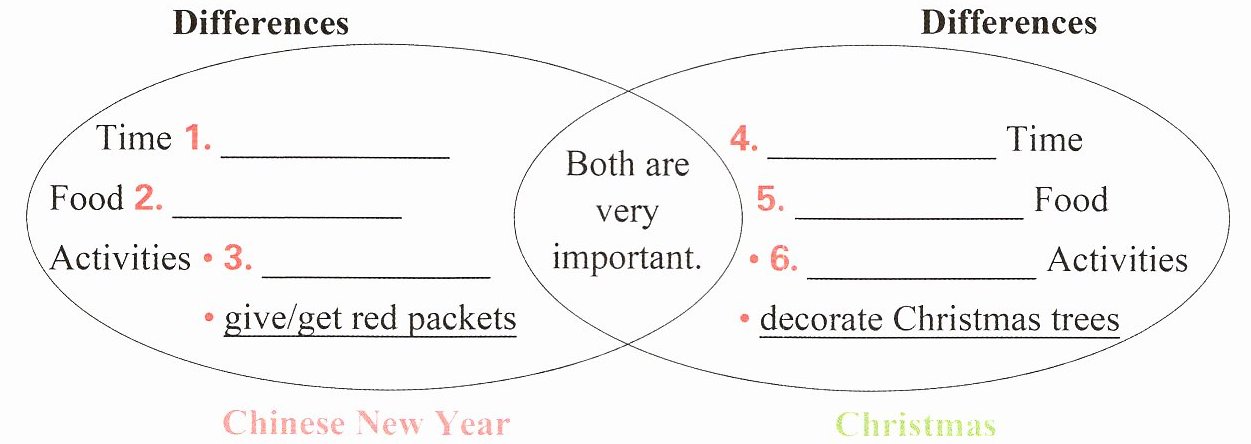
Both are very important.
Differences
4.
5.
• 6.
• decorate Christmas trees
Chinese New Year
Christmas
Chinese New Year
Chinese New Year is an important Chinese festival. People also call it the Spring Festival.
• Time: Chinese New Year comes in January or February every year.
• Traditional food: Families have a big dinner together. They often eat jiaozi on Chinese New Year’s Eve.
• Activities: People visit their friends and relatives. Children often get red packets with some money in them.
Christmas
Christmas is an important festival in many Western countries.
• Time: Christmas is on 25th December every year.
• Traditional food: People have a big dinner on Christmas Eve. They usually eat turkey and Christmas pudding.
• Activities: People give gifts to each other. They usually decorate their Christmas trees.
Differences
Time 1.
in January or February
Food 2.
jiaozi
Activities • 3.
visit friends and relatives
• give/get red packets
Both are very important.
Differences
4.
on 25th December
Time5.
turkey and Christmas pudding
Food• 6.
give gifts to each other
Activities• decorate Christmas trees
Chinese New Year
Christmas
答案:1. in January or February 2. jiaozi
3. visit friends and relatives 4. on 25th December 5. turkey and Christmas pudding
6. give gifts to each other
3. visit friends and relatives 4. on 25th December 5. turkey and Christmas pudding
6. give gifts to each other
解析:
【分析】
本题是对比中国新年和圣诞节的差异,需从两个节日的介绍文本中,分别提取对应时间、食物、活动的信息填空。解题时先明确左侧是中国新年的差异,右侧是圣诞节的差异,再逐一匹配文本中的对应内容即可。
【解析】
1. 中国新年的时间:根据文本“Chinese New Year comes in January or February every year”,可知填in January or February;
2. 中国新年的传统食物:根据文本“They often eat jiaozi on Chinese New Year’s Eve”,可知填jiaozi;
3. 中国新年的活动(除给红包外):根据文本“People visit their friends and relatives”,可知填visit friends and relatives;
4. 圣诞节的时间:根据文本“Christmas is on 25th December every year”,可知填on 25th December;
5. 圣诞节的传统食物:根据文本“They usually eat turkey and Christmas pudding”,可知填turkey and Christmas pudding;
6. 圣诞节的活动(除装饰圣诞树外):根据文本“People give gifts to each other”,可知填give gifts to each other。
【答案】
1. in January or February 2. jiaozi 3. visit friends and relatives 4. on 25th December 5. turkey and Christmas pudding 6. give gifts to each other
【知识点】
节日文化、信息提取、词汇运用
【点评】
本题通过对比中西方重要节日的差异,考查学生从文本中提取关键信息的能力,帮助学生了解中西方文化差异,属于基础的信息匹配类题目。
【难度系数】
0.3
本题是对比中国新年和圣诞节的差异,需从两个节日的介绍文本中,分别提取对应时间、食物、活动的信息填空。解题时先明确左侧是中国新年的差异,右侧是圣诞节的差异,再逐一匹配文本中的对应内容即可。
【解析】
1. 中国新年的时间:根据文本“Chinese New Year comes in January or February every year”,可知填in January or February;
2. 中国新年的传统食物:根据文本“They often eat jiaozi on Chinese New Year’s Eve”,可知填jiaozi;
3. 中国新年的活动(除给红包外):根据文本“People visit their friends and relatives”,可知填visit friends and relatives;
4. 圣诞节的时间:根据文本“Christmas is on 25th December every year”,可知填on 25th December;
5. 圣诞节的传统食物:根据文本“They usually eat turkey and Christmas pudding”,可知填turkey and Christmas pudding;
6. 圣诞节的活动(除装饰圣诞树外):根据文本“People give gifts to each other”,可知填give gifts to each other。
【答案】
1. in January or February 2. jiaozi 3. visit friends and relatives 4. on 25th December 5. turkey and Christmas pudding 6. give gifts to each other
【知识点】
节日文化、信息提取、词汇运用
【点评】
本题通过对比中西方重要节日的差异,考查学生从文本中提取关键信息的能力,帮助学生了解中西方文化差异,属于基础的信息匹配类题目。
【难度系数】
0.3
五、新素养 文化意识 阅读短文,判断正(T)误(F)。
There are four seasons in a year. They are spring, summer, autumn and winter. In China, we usually feel warm in spring, hot in summer, cool in autumn and cold in winter.
But different places have different seasons. The seasons in Australia are different from ours. When it is winter in China, it's summer there. When it's spring in China, it is autumn there. Because China is in the Northern Hemisphere(北半球), but Australia is in the Southern Hemisphere. The Earth goes around the Sun. Places at different latitudes(纬度) get different amounts of sunlight. When we enjoy a cold Christmas party in China, the UK or the US, Australians are wearing T-shirts and sunglasses on the beach. So if you go to Australia, make sure to bring the right clothes.
(
(
(
(
(
There are four seasons in a year. They are spring, summer, autumn and winter. In China, we usually feel warm in spring, hot in summer, cool in autumn and cold in winter.
But different places have different seasons. The seasons in Australia are different from ours. When it is winter in China, it's summer there. When it's spring in China, it is autumn there. Because China is in the Northern Hemisphere(北半球), but Australia is in the Southern Hemisphere. The Earth goes around the Sun. Places at different latitudes(纬度) get different amounts of sunlight. When we enjoy a cold Christmas party in China, the UK or the US, Australians are wearing T-shirts and sunglasses on the beach. So if you go to Australia, make sure to bring the right clothes.
(
F
)1. The seasons in every place are the same in a year.(
T
)2. When it's spring in Australia, it's autumn in China.(
F
)3. Places at different latitudes get the same amount of sunlight.(
T
)4. Christmas Day is always in summer in Australia.(
T
)5. If you go to Australia at Christmas, you should bring cool clothes.答案:1. F 2. T 3. F 4. T 5. T
解析:
【分析】做此类判断正误题,需逐题定位原文对应内容,对比题干表述与原文信息是否一致,每道题的判断都要有原文依据,不可主观臆断。
【解析】1. 原文第二段明确提到“different places have different seasons”,即不同地方季节不同,题干“每个地方季节都一样”与原文不符,故为F;2. 原文表述“When it's spring in China, it is autumn there(there指澳大利亚)”,可推知澳大利亚春天对应中国秋天,题干表述正确,故为T;3. 原文提到“Places at different latitudes get different amounts of sunlight”,即不同纬度地区获得的阳光量不同,题干“获得相同阳光”与原文不符,故为F;4. 圣诞节在12月,中国处于冬季,原文提到澳大利亚圣诞节时穿T恤,说明此时澳大利亚是夏季,题干表述正确,故为T;5. 澳大利亚圣诞节是夏季,需带凉快衣服,题干表述正确,故为T。
【答案】1.F 2.T 3.F 4.T 5.T
【知识点】英语阅读理解(判断正误)、南北半球季节差异、纬度与光照的关系
【点评】本题融合英语阅读与地理基础常识,侧重考查学生的信息定位与细节理解能力,需准确把握原文中关于南北半球季节相反的关键表述,整体难度适中,适合巩固基础。
【难度系数】0.7
【解析】1. 原文第二段明确提到“different places have different seasons”,即不同地方季节不同,题干“每个地方季节都一样”与原文不符,故为F;2. 原文表述“When it's spring in China, it is autumn there(there指澳大利亚)”,可推知澳大利亚春天对应中国秋天,题干表述正确,故为T;3. 原文提到“Places at different latitudes get different amounts of sunlight”,即不同纬度地区获得的阳光量不同,题干“获得相同阳光”与原文不符,故为F;4. 圣诞节在12月,中国处于冬季,原文提到澳大利亚圣诞节时穿T恤,说明此时澳大利亚是夏季,题干表述正确,故为T;5. 澳大利亚圣诞节是夏季,需带凉快衣服,题干表述正确,故为T。
【答案】1.F 2.T 3.F 4.T 5.T
【知识点】英语阅读理解(判断正误)、南北半球季节差异、纬度与光照的关系
【点评】本题融合英语阅读与地理基础常识,侧重考查学生的信息定位与细节理解能力,需准确把握原文中关于南北半球季节相反的关键表述,整体难度适中,适合巩固基础。
【难度系数】0.7