阅读电子邮件,判断正(T)误(F)并回答问题。
To: Hehe
From: Tangtang
Subject: My trip to a car museum
Date: June 28, 2026
Last weekend, I went to a car museum with my dad. We went there by subway. It was a wonderful day!
First, I saw many old cars. They looked very different from today’s cars.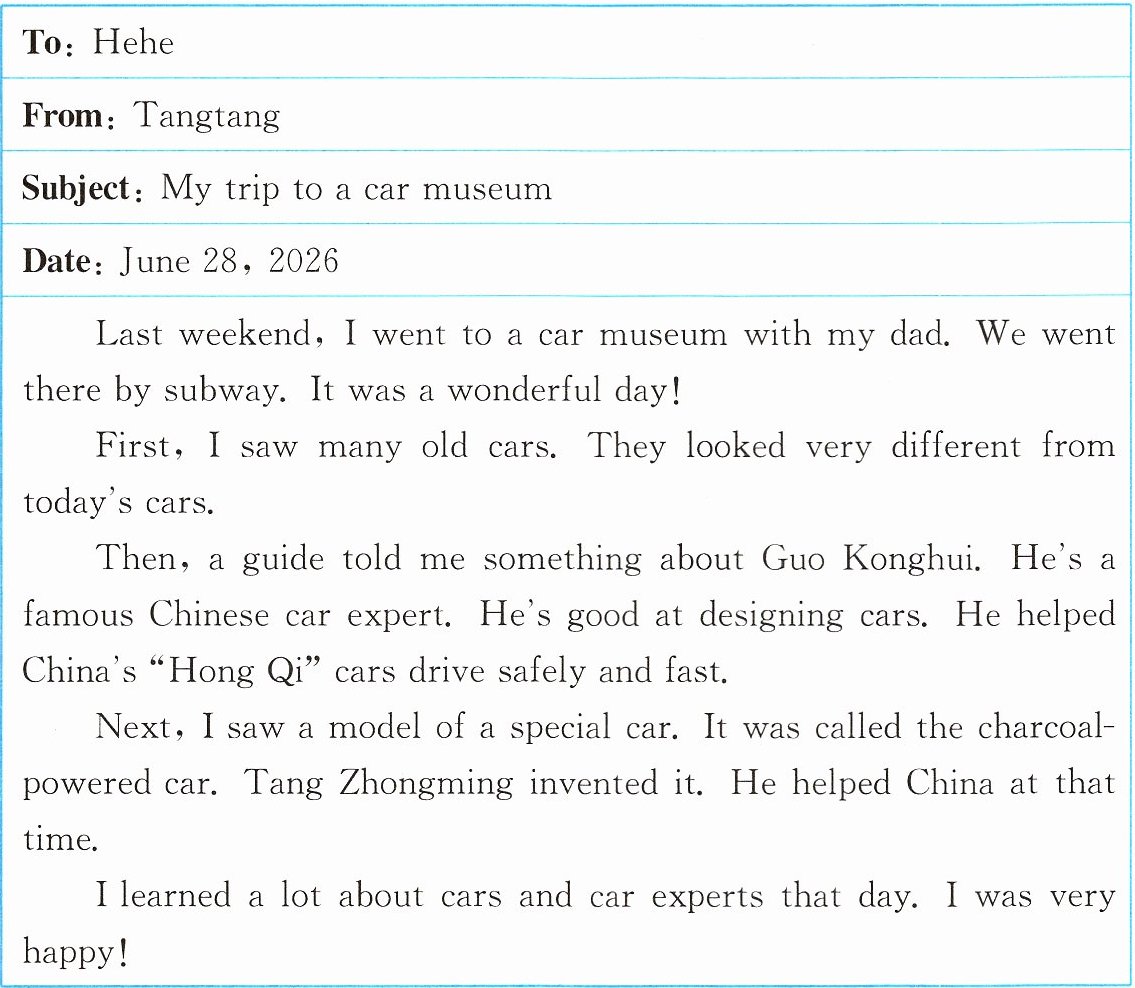
Then, a guide told me something about Guo Konghui. He’s a famous Chinese car expert. He’s good at designing cars. He helped China’s “Hong Qi” cars drive safely and fast.
Next, I saw a model of a special car. It was called the charcoal-powered car. Tang Zhongming invented it. He helped China at that time.
I learned a lot about cars and car experts that day. I was very happy!
(
(
(
(
5. Where did Tangtang go last weekend?
To: Hehe
From: Tangtang
Subject: My trip to a car museum
Date: June 28, 2026
Last weekend, I went to a car museum with my dad. We went there by subway. It was a wonderful day!
First, I saw many old cars. They looked very different from today’s cars.
Then, a guide told me something about Guo Konghui. He’s a famous Chinese car expert. He’s good at designing cars. He helped China’s “Hong Qi” cars drive safely and fast.
Next, I saw a model of a special car. It was called the charcoal-powered car. Tang Zhongming invented it. He helped China at that time.
I learned a lot about cars and car experts that day. I was very happy!
(
T
)1. Tangtang wrote this email to Hehe.(
F
)2. The old cars looked the same as today’s cars.(
F
)3. Guo Konghui invented the charcoal-powered car.(
T
)4. Tangtang was happy because he learned a lot about cars and car experts that day.5. Where did Tangtang go last weekend?
To a car museum.
答案:1. T 解析 根据邮件中“To: Hehe”和“From: Tangtang”可知,这封电子邮件是Tangtang写给Hehe的。故填T。
2. F 解析 根据邮件中“First, I saw many old cars. They looked very different from today's cars.”可知,老式汽车和如今的汽车大不相同。故填F。
3. F 解析 根据邮件中“It was called the charcoal-powered car. Tang Zhongming invented it.”可知,是汤仲明发明了木炭汽车,不是郭孔辉。故填F。
4. T 解析 根据邮件中“I learned a lot about cars and car experts that day. I was very happy!”可知,Tangtang因为那天学到了许多有关汽车和汽车专家的知识而感到开心。故填T。
5. To a car museum.
2. F 解析 根据邮件中“First, I saw many old cars. They looked very different from today's cars.”可知,老式汽车和如今的汽车大不相同。故填F。
3. F 解析 根据邮件中“It was called the charcoal-powered car. Tang Zhongming invented it.”可知,是汤仲明发明了木炭汽车,不是郭孔辉。故填F。
4. T 解析 根据邮件中“I learned a lot about cars and car experts that day. I was very happy!”可知,Tangtang因为那天学到了许多有关汽车和汽车专家的知识而感到开心。故填T。
5. To a car museum.
解析:
【分析】
本题为英语阅读理解题型,包含判断正误和回答问题两部分。解题时需先通读邮件内容,明确邮件的发送者、接收者及核心事件;针对判断正误题,需定位每个小题对应的原文细节,对比信息后判断对错;针对回答问题,需找到问题对应的原文语句,提取准确信息作答。
【解析】
1. 根据邮件开头“To: Hehe”和“From: Tangtang”可知,这封邮件是Tangtang写给Hehe的,故判断为T。
2. 根据邮件中“First, I saw many old cars. They looked very different from today’s cars.”可知,老式汽车与如今的汽车不同,故判断为F。
3. 根据邮件中“It was called the charcoal-powered car. Tang Zhongming invented it.”可知,木炭汽车是汤仲明发明的,不是郭孔辉,故判断为F。
4. 根据邮件中“I learned a lot about cars and car experts that day. I was very happy!”可知,Tangtang因学到很多相关知识而开心,故判断为T。
5. 根据邮件第一句“Last weekend, I went to a car museum with my dad.”可知,Tangtang上周末去了汽车博物馆,故回答To a car museum.
【答案】
1.T 2.F 3.F 4.T 5.To a car museum.
【知识点】
英语阅读理解、细节理解题、判断正误题
【点评】
本题考查学生对英语邮件内容的细节理解能力,题型基础,需准确抓取原文关键信息,适合巩固英语阅读的基础题型。
【难度系数】
0.6
本题为英语阅读理解题型,包含判断正误和回答问题两部分。解题时需先通读邮件内容,明确邮件的发送者、接收者及核心事件;针对判断正误题,需定位每个小题对应的原文细节,对比信息后判断对错;针对回答问题,需找到问题对应的原文语句,提取准确信息作答。
【解析】
1. 根据邮件开头“To: Hehe”和“From: Tangtang”可知,这封邮件是Tangtang写给Hehe的,故判断为T。
2. 根据邮件中“First, I saw many old cars. They looked very different from today’s cars.”可知,老式汽车与如今的汽车不同,故判断为F。
3. 根据邮件中“It was called the charcoal-powered car. Tang Zhongming invented it.”可知,木炭汽车是汤仲明发明的,不是郭孔辉,故判断为F。
4. 根据邮件中“I learned a lot about cars and car experts that day. I was very happy!”可知,Tangtang因学到很多相关知识而开心,故判断为T。
5. 根据邮件第一句“Last weekend, I went to a car museum with my dad.”可知,Tangtang上周末去了汽车博物馆,故回答To a car museum.
【答案】
1.T 2.F 3.F 4.T 5.To a car museum.
【知识点】
英语阅读理解、细节理解题、判断正误题
【点评】
本题考查学生对英语邮件内容的细节理解能力,题型基础,需准确抓取原文关键信息,适合巩固英语阅读的基础题型。
【难度系数】
0.6
练习 按要求完成句子。
1. There isn't anything in the room.(改为同义句)
There
2. Someone is singing here.(改为一般疑问句)
1. There isn't anything in the room.(改为同义句)
There
is
nothing
in the room.2. Someone is singing here.(改为一般疑问句)
Is
anyone
singing here?答案:1. is nothing
2. Is anyone
2. Is anyone
解析:
【分析】
1. 第一题:原句是There be句型的否定句,“not anything”可替换为不定代词“nothing”,以此构成同义句;2. 第二题:陈述句变一般疑问句,需将be动词提前,同时肯定句中的不定代词“someone”在疑问句中要改为“anyone”,据此完成转换。
【解析】
1. 原句中“isn't anything”表示“没有任何东西”,等同于“is nothing”,将其替换后得到同义句:There is nothing in the room.
2. 陈述句变一般疑问句时,需把be动词“is”提至句首,且肯定句里的“someone”在疑问句中改为“anyone”,转换后为:Is anyone singing here?
【答案】
1. is nothing
2. Is anyone
【知识点】
不定代词用法、句型转换
【点评】
本题考查英语基础句型转换及不定代词的句式变化,属于初中英语核心基础题型,需牢记不定代词在不同句式中的形式差异,以及“not anything”与“nothing”的同义替换规则。
【难度系数】
0.8
1. 第一题:原句是There be句型的否定句,“not anything”可替换为不定代词“nothing”,以此构成同义句;2. 第二题:陈述句变一般疑问句,需将be动词提前,同时肯定句中的不定代词“someone”在疑问句中要改为“anyone”,据此完成转换。
【解析】
1. 原句中“isn't anything”表示“没有任何东西”,等同于“is nothing”,将其替换后得到同义句:There is nothing in the room.
2. 陈述句变一般疑问句时,需把be动词“is”提至句首,且肯定句里的“someone”在疑问句中改为“anyone”,转换后为:Is anyone singing here?
【答案】
1. is nothing
2. Is anyone
【知识点】
不定代词用法、句型转换
【点评】
本题考查英语基础句型转换及不定代词的句式变化,属于初中英语核心基础题型,需牢记不定代词在不同句式中的形式差异,以及“not anything”与“nothing”的同义替换规则。
【难度系数】
0.8