五、新情境 时文热点 选词填空,补全材料。
Life changes of different generations
The 1970s generation
(70后)
People
The 1980s generation
(80后)
There
The 1990s generation
(90后)
They liked showing themselves,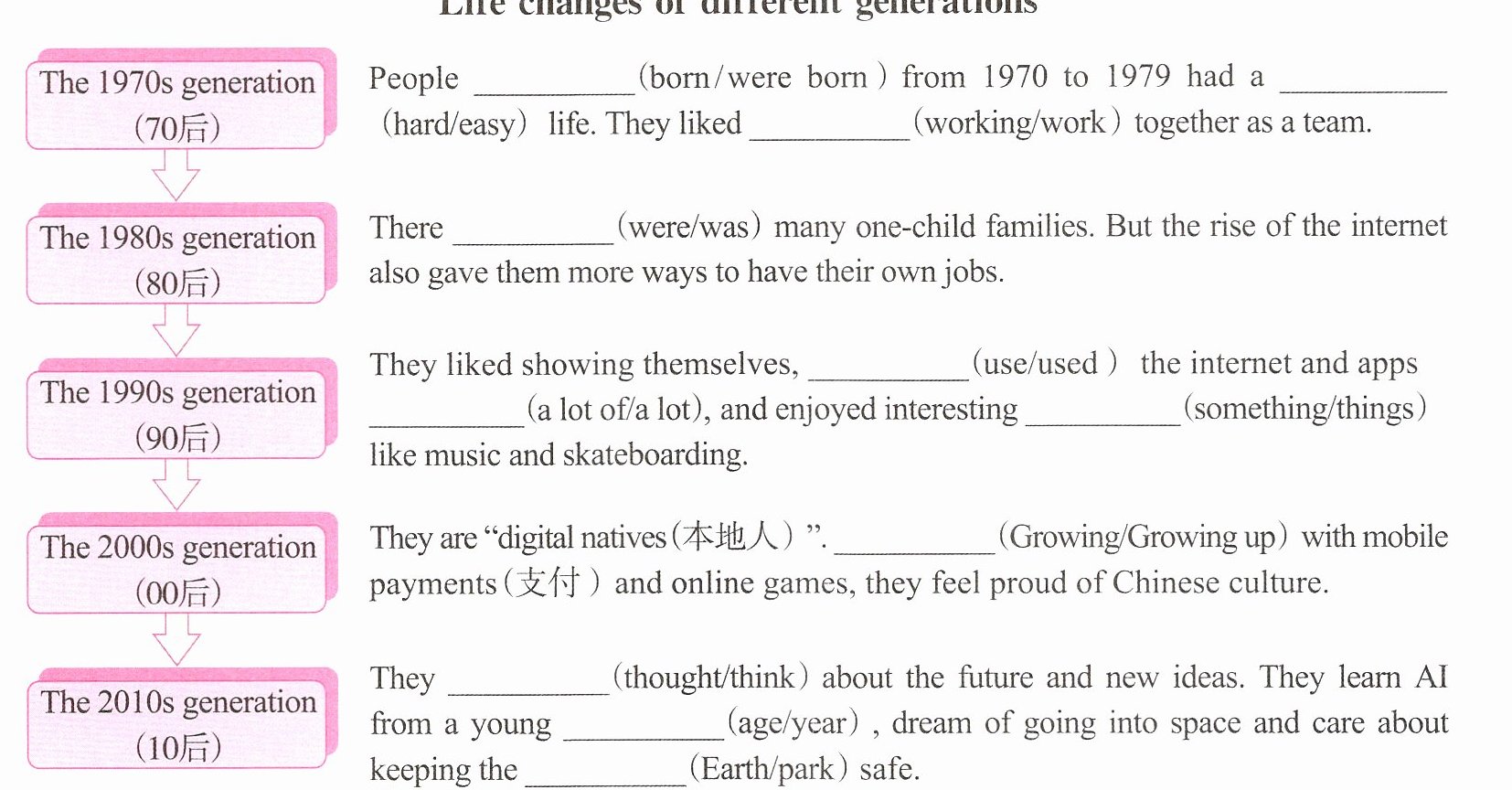 enjoyed interesting
The 2000s generation
(00后)
They are “digital natives(本地人)”.
The 2010s generation
(10后)
They
Life changes of different generations
The 1970s generation
(70后)
People
born
(born/were born ) from 1970 to 1979 had a hard
(hard/easy) life. They liked working
(working/work) together as a team.The 1980s generation
(80后)
There
were
(were/was) many one-child families. But the rise of the internet also gave them more ways to have their own jobs.The 1990s generation
(90后)
They liked showing themselves,
used
(use/used ) the internet and apps a lot
(a lot of/a lot), enjoyed interesting things
(something/things) like music and skateboarding.The 2000s generation
(00后)
They are “digital natives(本地人)”.
Growing up
(Growing/Growing up) with mobile payments(支付) and online games, they feel proud of Chinese culture.The 2010s generation
(10后)
They
think
(thought/think) about the future and new ideas. They learn AI from a young age
(age/year), dream of going into space and care about keeping the Earth
(Earth/park) safe.答案:born, hard, working, were, used, a lot, things, Growing up, think, age, Earth
解析:
【分析】
这是一道结合不同年代生活的选词填空题,需根据语境、语法规则及固定搭配逐一分析每个空:
1. 第一个空:句子已有谓语动词had,此处需用过去分词born作后置定语修饰People,表“出生于……的人”,无需额外谓语,故选born;
2. 第二个空:结合常识,70后生活条件艰苦,hard符合语境;
3. 第三个空:固定搭配like doing sth表“喜欢做某事”,故用working;
4. 第四个空:there be句型遵循就近原则,主语many one-child families是复数,be动词用were;
5. 第五个空:此处与前面的liked是并列谓语,需用过去式used,构成并列动作;
6. 第六个空:修饰动词use需用副词短语a lot,a lot of用于修饰名词,不符合此处用法;
7. 第七个空:interesting后接可数名词复数things,表“有趣的事物”,something是不定代词,不符合语境;
8. 第八个空:现在分词短语Growing up作状语,与主语they是主动关系,表“在……中长大”;
9. 第九个空:句子描述10后的现状,用一般现在时,主语they对应动词原形think;
10. 第十个空:固定搭配from a young age表“从很小的时候”,选age;
11. 第十一个空:结合语境,keep the Earth safe表“保护地球安全”,选Earth。
【解析】
根据上述分析,各空依次选择:
1. 过去分词作后置定语,选born;
2. 结合70后生活背景,选hard;
3. like doing固定搭配,选working;
4. there be复数主语,选were;
5. 并列谓语过去式,选used;
6. 副词短语修饰动词,选a lot;
7. 名词复数作宾语,选things;
8. 现在分词作状语,选Growing up;
9. 一般现在时谓语,选think;
10. 固定搭配from a young age,选age;
11. 语境中地球,选Earth。
【答案】
born, hard, working, were, used, a lot, things, Growing up, think, age, Earth
【知识点】
非谓语动词、there be句型、固定搭配
【点评】
本题结合不同年代的生活情境,考查基础语法和常用词汇搭配,贴近生活,难度适中,能帮助学生巩固基础知识点。
【难度系数】
0.6
这是一道结合不同年代生活的选词填空题,需根据语境、语法规则及固定搭配逐一分析每个空:
1. 第一个空:句子已有谓语动词had,此处需用过去分词born作后置定语修饰People,表“出生于……的人”,无需额外谓语,故选born;
2. 第二个空:结合常识,70后生活条件艰苦,hard符合语境;
3. 第三个空:固定搭配like doing sth表“喜欢做某事”,故用working;
4. 第四个空:there be句型遵循就近原则,主语many one-child families是复数,be动词用were;
5. 第五个空:此处与前面的liked是并列谓语,需用过去式used,构成并列动作;
6. 第六个空:修饰动词use需用副词短语a lot,a lot of用于修饰名词,不符合此处用法;
7. 第七个空:interesting后接可数名词复数things,表“有趣的事物”,something是不定代词,不符合语境;
8. 第八个空:现在分词短语Growing up作状语,与主语they是主动关系,表“在……中长大”;
9. 第九个空:句子描述10后的现状,用一般现在时,主语they对应动词原形think;
10. 第十个空:固定搭配from a young age表“从很小的时候”,选age;
11. 第十一个空:结合语境,keep the Earth safe表“保护地球安全”,选Earth。
【解析】
根据上述分析,各空依次选择:
1. 过去分词作后置定语,选born;
2. 结合70后生活背景,选hard;
3. like doing固定搭配,选working;
4. there be复数主语,选were;
5. 并列谓语过去式,选used;
6. 副词短语修饰动词,选a lot;
7. 名词复数作宾语,选things;
8. 现在分词作状语,选Growing up;
9. 一般现在时谓语,选think;
10. 固定搭配from a young age,选age;
11. 语境中地球,选Earth。
【答案】
born, hard, working, were, used, a lot, things, Growing up, think, age, Earth
【知识点】
非谓语动词、there be句型、固定搭配
【点评】
本题结合不同年代的生活情境,考查基础语法和常用词汇搭配,贴近生活,难度适中,能帮助学生巩固基础知识点。
【难度系数】
0.6
六、(广东深圳市期末)阅读材料,选择正确的答案。
The natural world is our home—rivers, forests, oceans and animals all live together. We often do small things without thinking, but these habits can hurt the environment. Let's look at these “hidden harms(隐藏伤害)” and learn why we need to change them.
| Forgetting reusable bags | Many people still use plastic bags when shopping, even though reusable bags are easy to carry. Every year, billions of plastic bags end up in forests and oceans. Animals often mistake(把……错当成) them for food and eat them, which can kill them. Plastic bags take over 100 years to degrade(降解)—they stay in the natural world, polluting soil and water. |
| Wasting water | Leaving the tap running while brushing teeth or taking long showers—these small acts waste tons of water every day. Fresh water(淡水) is very important. Over time, water waste makes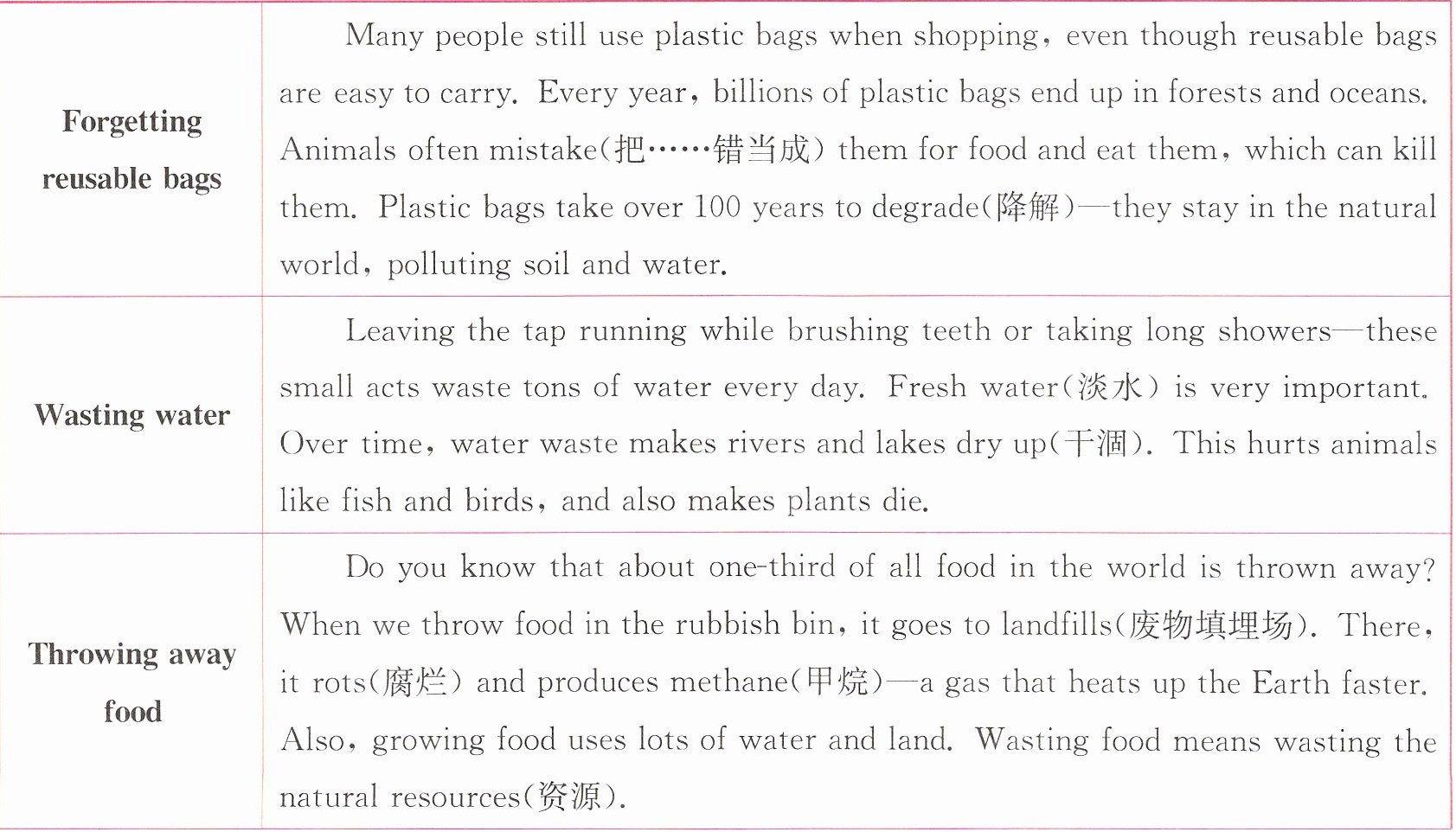 rivers and lakes dry up(干涸). This hurts animals like fish and birds, and also makes plants die. |
| Throwing away food | Do you know that about one-third of all food in the world is thrown away? When we throw food in the rubbish bin, it goes to landfills(废物填埋场). There, it rots(腐烂) and produces methane(甲烷)—a gas that heats up the Earth faster. Also, growing food uses lots of water and land. Wasting food means wasting the natural resources(资源). |
续表
| Using many disposable items | Disposable chopsticks and plastic straws are convenient(方便的), but they harm nature. Making disposable chopsticks requires cutting down trees—each year, millions of trees are cut down. Plastic straws often end up in oceans, hurting sea animals that get tangled(缠绕) in them. These items are used for a few minutes but stay in the environment for years. |
| Littering small rubbish | A plastic bottle cap(瓶盖) or a piece of paper—many people throw these kinds of rubbish on the ground. Over time, the rubbish piles up in parks, forests and rivers. It will make the city messy and dirty. |
Small habits can cause big harm, but small changes can also help! Bring reusable bags, turn off the tap when not using water, eat up your food, use reusable items and throw rubbish in bins. Let's protect our only home.
(
A. Animals can't see them in the water.
B. Plastic bags make animals feel cold.
C. Animals mistake them for food and eat them.
(
A. It produces methane, which heats up the Earth.
B. It turns into fresh water for plants.
C. It helps animals find more food.
(
A. Lots of water from rivers.
B. Plastic from factories.
C. Trees that are cut down.
(
A. Planting trees in parks.
B. Using a reusable water bottle.
C. Throwing a plastic bottle cap on the ground.
(
A. Take long showers every day.
B. Throw food we don't like in the bin.
C. Bring reusable bags when shopping.
The natural world is our home—rivers, forests, oceans and animals all live together. We often do small things without thinking, but these habits can hurt the environment. Let's look at these “hidden harms(隐藏伤害)” and learn why we need to change them.
| Forgetting reusable bags | Many people still use plastic bags when shopping, even though reusable bags are easy to carry. Every year, billions of plastic bags end up in forests and oceans. Animals often mistake(把……错当成) them for food and eat them, which can kill them. Plastic bags take over 100 years to degrade(降解)—they stay in the natural world, polluting soil and water. |
| Wasting water | Leaving the tap running while brushing teeth or taking long showers—these small acts waste tons of water every day. Fresh water(淡水) is very important. Over time, water waste makes
rivers and lakes dry up(干涸). This hurts animals like fish and birds, and also makes plants die. || Throwing away food | Do you know that about one-third of all food in the world is thrown away? When we throw food in the rubbish bin, it goes to landfills(废物填埋场). There, it rots(腐烂) and produces methane(甲烷)—a gas that heats up the Earth faster. Also, growing food uses lots of water and land. Wasting food means wasting the natural resources(资源). |
续表
| Using many disposable items | Disposable chopsticks and plastic straws are convenient(方便的), but they harm nature. Making disposable chopsticks requires cutting down trees—each year, millions of trees are cut down. Plastic straws often end up in oceans, hurting sea animals that get tangled(缠绕) in them. These items are used for a few minutes but stay in the environment for years. |
| Littering small rubbish | A plastic bottle cap(瓶盖) or a piece of paper—many people throw these kinds of rubbish on the ground. Over time, the rubbish piles up in parks, forests and rivers. It will make the city messy and dirty. |
Small habits can cause big harm, but small changes can also help! Bring reusable bags, turn off the tap when not using water, eat up your food, use reusable items and throw rubbish in bins. Let's protect our only home.
(
C
)1. Why are plastic bags harmful to animals?A. Animals can't see them in the water.
B. Plastic bags make animals feel cold.
C. Animals mistake them for food and eat them.
(
A
)2. What happens when food rots in landfills?A. It produces methane, which heats up the Earth.
B. It turns into fresh water for plants.
C. It helps animals find more food.
(
C
)3. What do we need to make disposable chopsticks?A. Lots of water from rivers.
B. Plastic from factories.
C. Trees that are cut down.
(
C
)4. Which of the following is a “hidden harm” to the natural world?A. Planting trees in parks.
B. Using a reusable water bottle.
C. Throwing a plastic bottle cap on the ground.
(
C
)5. How can we help protect the natural world?A. Take long showers every day.
B. Throw food we don't like in the bin.
C. Bring reusable bags when shopping.
答案:1. C
2. A 解析 由材料中“When we throw food in the rubbish bin, it goes to landfills. There, it rots and produces methane—a gas that heats up the Earth faster.”可知,食物在废物填埋场腐烂后会产生甲烷,这种气体会使地球变暖。故选 A。
3. C
4. C 解析 由材料中“A plastic bottle cap or a piece of paper—many people throw these kinds of rubbish on the ground. Over time, the rubbish piles up in parks, forests and rivers. It will make the city messy and dirty.”可知,把塑料瓶盖扔在地上属于乱扔小垃圾,会造成污染,对自然界来说是一种“隐藏的伤害”。故选 C。
5. C 解析 由材料中“Small habits can cause big harm, but small changes can also help! Bring reusable bags ...”可知,我们可以在购物时携带可重复使用的购物袋来帮助保护自然环境。故选 C。
2. A 解析 由材料中“When we throw food in the rubbish bin, it goes to landfills. There, it rots and produces methane—a gas that heats up the Earth faster.”可知,食物在废物填埋场腐烂后会产生甲烷,这种气体会使地球变暖。故选 A。
3. C
4. C 解析 由材料中“A plastic bottle cap or a piece of paper—many people throw these kinds of rubbish on the ground. Over time, the rubbish piles up in parks, forests and rivers. It will make the city messy and dirty.”可知,把塑料瓶盖扔在地上属于乱扔小垃圾,会造成污染,对自然界来说是一种“隐藏的伤害”。故选 C。
5. C 解析 由材料中“Small habits can cause big harm, but small changes can also help! Bring reusable bags ...”可知,我们可以在购物时携带可重复使用的购物袋来帮助保护自然环境。故选 C。
解析:
【分析】本题为英语阅读理解的细节理解题,解题思路是根据题干中的关键词定位到原文对应段落,找到相关信息后匹配选项即可。具体来说:第1题关键词是plastic bags和animals,定位到“Forgetting reusable bags”部分;第2题关键词是food rots in landfills,定位到“Throwing away food”部分;第3题关键词是disposable chopsticks,定位到“Using many disposable items”部分;第4题关键词是hidden harm,定位到“Littering small rubbish”部分;第5题关键词是protect the natural world,定位到最后一段,通过定位原文信息选出正确答案。
【解析】1. 根据“Forgetting reusable bags”部分的“Animals often mistake them for food and eat them, which can kill them.”可知,塑料袋对动物有害是因为动物把它们错当成食物吃掉,故选C。
2. 根据“Throwing away food”部分的“When we throw food in the rubbish bin, it goes to landfills. There, it rots and produces methane—a gas that heats up the Earth faster.”可知,食物在填埋场腐烂会产生甲烷,加速地球变暖,故选A。
3. 根据“Using many disposable items”部分的“Making disposable chopsticks requires cutting down trees”可知,制作一次性筷子需要砍伐树木,故选C。
4. 根据“Littering small rubbish”部分的“A plastic bottle cap or a piece of paper—many people throw these kinds of rubbish on the ground... It will make the city messy and dirty.”可知,扔塑料瓶盖属于对自然的“隐藏伤害”,故选C。
5. 根据最后一段“Small habits can cause big harm... Bring reusable bags, turn off the tap when not using water, eat up your food, use reusable items and throw rubbish in bins. Let's protect our only home.”可知,购物时带可重复使用的袋子是保护自然的方法,故选C。
【答案】1.C 2.A 3.C 4.C 5.C
【知识点】英语阅读理解、细节理解题、环保主题阅读
【点评】本题是一篇环保主题的英语阅读理解,题目均为细节理解题,解题核心是准确定位原文对应信息,难度适中,适合学生巩固英语阅读的细节查找能力,同时传递环保意识。
【难度系数】0.8
【解析】1. 根据“Forgetting reusable bags”部分的“Animals often mistake them for food and eat them, which can kill them.”可知,塑料袋对动物有害是因为动物把它们错当成食物吃掉,故选C。
2. 根据“Throwing away food”部分的“When we throw food in the rubbish bin, it goes to landfills. There, it rots and produces methane—a gas that heats up the Earth faster.”可知,食物在填埋场腐烂会产生甲烷,加速地球变暖,故选A。
3. 根据“Using many disposable items”部分的“Making disposable chopsticks requires cutting down trees”可知,制作一次性筷子需要砍伐树木,故选C。
4. 根据“Littering small rubbish”部分的“A plastic bottle cap or a piece of paper—many people throw these kinds of rubbish on the ground... It will make the city messy and dirty.”可知,扔塑料瓶盖属于对自然的“隐藏伤害”,故选C。
5. 根据最后一段“Small habits can cause big harm... Bring reusable bags, turn off the tap when not using water, eat up your food, use reusable items and throw rubbish in bins. Let's protect our only home.”可知,购物时带可重复使用的袋子是保护自然的方法,故选C。
【答案】1.C 2.A 3.C 4.C 5.C
【知识点】英语阅读理解、细节理解题、环保主题阅读
【点评】本题是一篇环保主题的英语阅读理解,题目均为细节理解题,解题核心是准确定位原文对应信息,难度适中,适合学生巩固英语阅读的细节查找能力,同时传递环保意识。
【难度系数】0.8