三、阅读理解(共20小题;每小题2分,满分40分)
A)阅读下面四篇短文,从短文后各题所给的 A、B、C、D 四个选项中,选择最佳选项。
A(2026·江苏扬州期末)
During ancient times, children didn't have smartphones, iPads or computers to entertain themselves. Instead, they came up with interesting games to play in their childhood. Let's take a look.
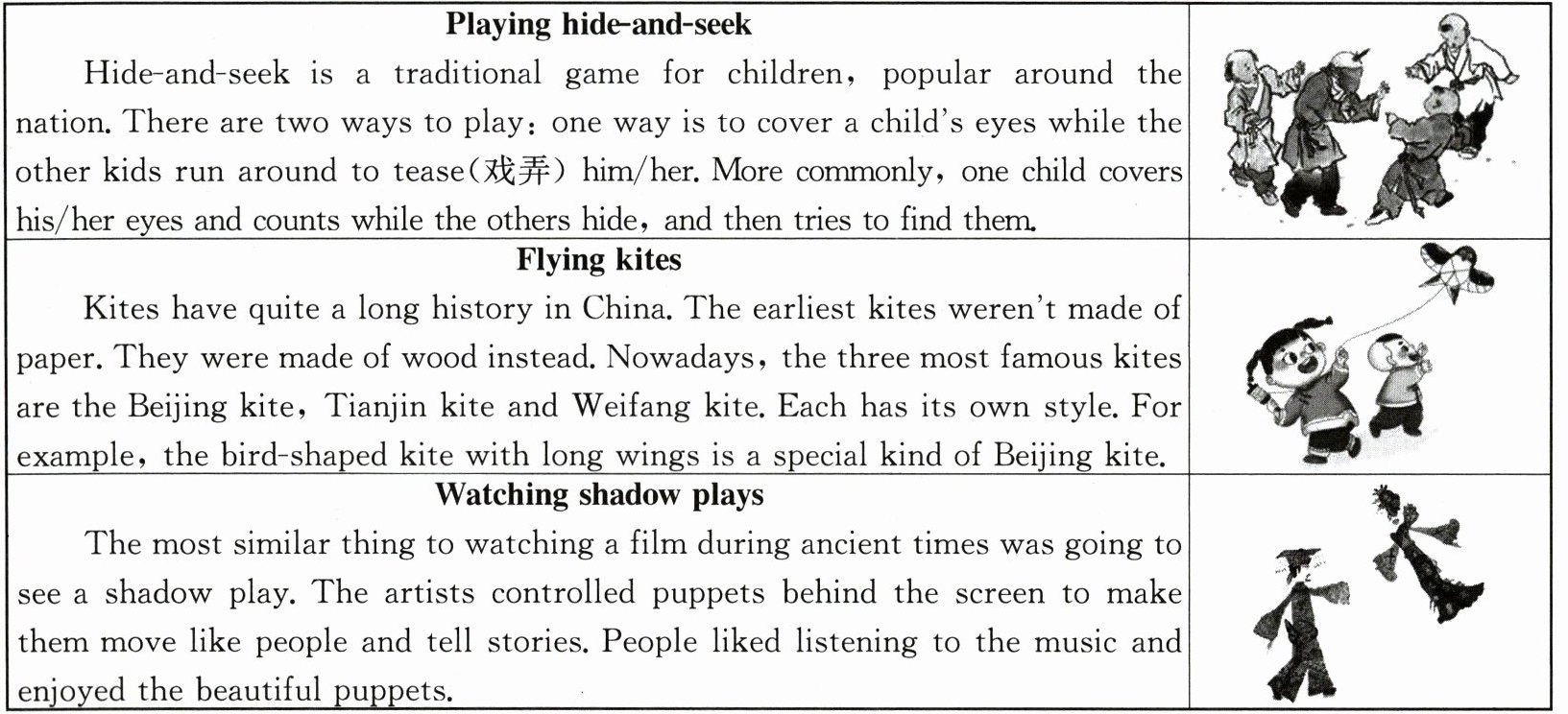
(
A. They were paper-made and light.
B. They were made of wood.
C. They had bird-shaped designs.
D. They were produced in Beijing.
(
A. Because puppets were controlled by machines.
B. Because it was the only way to listen to stories.
C. Because artists performed in front of the screen.
D. Because of the music and beautiful puppets.
(
A. How hide-and-seek, kite-flying and shadow plays are played.
B. The history of kites and shadow plays in China.
C. Traditional entertainment activities for ancient Chinese children.
D. The differences between ancient and modern children's games.
A)阅读下面四篇短文,从短文后各题所给的 A、B、C、D 四个选项中,选择最佳选项。
A(2026·江苏扬州期末)
During ancient times, children didn't have smartphones, iPads or computers to entertain themselves. Instead, they came up with interesting games to play in their childhood. Let's take a look.
(
B
)1. What was a special feature of the earliest kites in China?A. They were paper-made and light.
B. They were made of wood.
C. They had bird-shaped designs.
D. They were produced in Beijing.
(
D
)2. Why did people enjoy watching shadow plays in ancient times?A. Because puppets were controlled by machines.
B. Because it was the only way to listen to stories.
C. Because artists performed in front of the screen.
D. Because of the music and beautiful puppets.
(
C
)3. What is the main idea of the passage?A. How hide-and-seek, kite-flying and shadow plays are played.
B. The history of kites and shadow plays in China.
C. Traditional entertainment activities for ancient Chinese children.
D. The differences between ancient and modern children's games.
答案:1. B 【点拨】根据“Flying kites”部分“The earliest kites weren't made of paper. They were made of wood instead.”可知,中国最早的风筝不是纸做的,而是木制的。故选 B。
2. D 【点拨】根据“Watching shadow plays”部分“People liked listening to the music and enjoyed the beautiful puppets.”可知,古人喜欢皮影戏的原因就是喜欢里面的音乐和精美的木偶。故选 D。
3. C 【点拨】文章开篇点明古代孩子没有电子设备,而是有很多有趣的传统游戏,随后依次介绍了捉迷藏、放风筝、看皮影戏三种古代孩子的传统娱乐方式;选项 C“古代中国孩子的传统娱乐活动”精准概括本文主旨。故选 C。
2. D 【点拨】根据“Watching shadow plays”部分“People liked listening to the music and enjoyed the beautiful puppets.”可知,古人喜欢皮影戏的原因就是喜欢里面的音乐和精美的木偶。故选 D。
3. C 【点拨】文章开篇点明古代孩子没有电子设备,而是有很多有趣的传统游戏,随后依次介绍了捉迷藏、放风筝、看皮影戏三种古代孩子的传统娱乐方式;选项 C“古代中国孩子的传统娱乐活动”精准概括本文主旨。故选 C。
解析:
【分析】
本题为阅读理解题,需根据短文内容定位关键信息解答。第1题考查细节,需找到关于最早风筝的描述;第2题考查细节,需找到喜欢皮影戏的原因;第3题考查主旨,需通读全文总结核心内容。
【解析】
1. 根据“Flying kites”部分“The earliest kites weren't made of paper. They were made of wood instead.”可知,中国最早的风筝是木制的,对应选项B。
2. 根据“Watching shadow plays”部分“People liked listening to the music and enjoyed the beautiful puppets.”可知,古人喜欢皮影戏是因为音乐和精美的木偶,对应选项D。
3. 文章开篇点明古代儿童没有电子设备,而是有传统游戏,随后介绍了捉迷藏、放风筝、看皮影戏三种古代儿童的传统娱乐活动,核心主旨是古代中国孩子的传统娱乐活动,对应选项C。
【答案】
1.B 2.D 3.C
【知识点】
阅读理解(细节理解、主旨大意)
【点评】
本文围绕古代中国儿童的传统娱乐活动展开,题目设置包含细节理解和主旨大意,需学生准确提取原文信息并总结主旨,是常见的初中阅读理解题型。
【难度系数】
0.6
本题为阅读理解题,需根据短文内容定位关键信息解答。第1题考查细节,需找到关于最早风筝的描述;第2题考查细节,需找到喜欢皮影戏的原因;第3题考查主旨,需通读全文总结核心内容。
【解析】
1. 根据“Flying kites”部分“The earliest kites weren't made of paper. They were made of wood instead.”可知,中国最早的风筝是木制的,对应选项B。
2. 根据“Watching shadow plays”部分“People liked listening to the music and enjoyed the beautiful puppets.”可知,古人喜欢皮影戏是因为音乐和精美的木偶,对应选项D。
3. 文章开篇点明古代儿童没有电子设备,而是有传统游戏,随后介绍了捉迷藏、放风筝、看皮影戏三种古代儿童的传统娱乐活动,核心主旨是古代中国孩子的传统娱乐活动,对应选项C。
【答案】
1.B 2.D 3.C
【知识点】
阅读理解(细节理解、主旨大意)
【点评】
本文围绕古代中国儿童的传统娱乐活动展开,题目设置包含细节理解和主旨大意,需学生准确提取原文信息并总结主旨,是常见的初中阅读理解题型。
【难度系数】
0.6
B 传统文化
Pingshu, a traditional Chinese storytelling art, has a history dating back to the Qing Dynasty.
Performers usually tell stories in teahouses or small theatres, attracting viewers with their lively voices and gestures(姿态).
To master Pingshu, artists need years of training. Most learn by studying under their teachers—usually experienced performers. As one famous artist, Yuan Kuocheng said, “Pingshu is work both on body and mind. Performers must memorize long stories and add their own explanations to make the stories more attractive. They also need to understand the deeper meanings of the stories and share their thoughts with the viewers.”
During performances, artists stand behind a table. They use tools like a folding fan and a wooden block called Xingmu(醒木). The fan helps act out scenes, like “drawing a sword(剑)”. The Xingmu is knocked on the table to mark the start of the story or to highlight(突出) exciting moments.
Modern technology has brought both challenges and chances to Pingshu. While young people today prefer online entertainment(娱乐), technology allows artists to record their performances. These recordings can be shared widely, helping more people discover Pingshu. They also protect this art for future young people.
More often than not, those who listen to Pingshu stories are older people. While most young people spend hours online, a small number still find value in Pingshu, drawn by its cultural richness and storytelling traditions.
Pingshu is not just entertainment—it carries Chinese culture and wisdom. Through stories, performers connect the past with the present, offering viewers both fun and life lessons.
(
A. Learners usually look for teachers before learning Pingshu skills.
B. Memorizing stories is less important than physical gestures.
C. Pingshu artists can master the skill within a few months.
D. Performers seldom share their personal opinions during shows.
(
A. A folding fan to act out scenes.
B. A wooden block to mark key moments.
C. A table to stand behind while performing.
D. A microphone to make their voices louder.
(
A. It allows artists to perform with less training.
B. It reduces the need for performers to memorize stories.
C. It spreads Pingshu to more people and protects its future.
D. It forces performers to use online tools during shows.
(
A. Pingshu performers use tools like folding fans and Xingmu in shows.
B. Pingshu, a traditional Chinese art, faces challenges from modern technology.
C. Pingshu has a long history, unique performance ways and cultural value.
D. Older people are the main audience of Pingshu because of its rich stories.
Pingshu, a traditional Chinese storytelling art, has a history dating back to the Qing Dynasty.
Performers usually tell stories in teahouses or small theatres, attracting viewers with their lively voices and gestures(姿态).
To master Pingshu, artists need years of training. Most learn by studying under their teachers—usually experienced performers. As one famous artist, Yuan Kuocheng said, “Pingshu is work both on body and mind. Performers must memorize long stories and add their own explanations to make the stories more attractive. They also need to understand the deeper meanings of the stories and share their thoughts with the viewers.”
During performances, artists stand behind a table. They use tools like a folding fan and a wooden block called Xingmu(醒木). The fan helps act out scenes, like “drawing a sword(剑)”. The Xingmu is knocked on the table to mark the start of the story or to highlight(突出) exciting moments.
Modern technology has brought both challenges and chances to Pingshu. While young people today prefer online entertainment(娱乐), technology allows artists to record their performances. These recordings can be shared widely, helping more people discover Pingshu. They also protect this art for future young people.
More often than not, those who listen to Pingshu stories are older people. While most young people spend hours online, a small number still find value in Pingshu, drawn by its cultural richness and storytelling traditions.
Pingshu is not just entertainment—it carries Chinese culture and wisdom. Through stories, performers connect the past with the present, offering viewers both fun and life lessons.
(
A
)4. What can we infer from the third paragraph?A. Learners usually look for teachers before learning Pingshu skills.
B. Memorizing stories is less important than physical gestures.
C. Pingshu artists can master the skill within a few months.
D. Performers seldom share their personal opinions during shows.
(
D
)5. What tool is NOT mentioned for a Pingshu performance?A. A folding fan to act out scenes.
B. A wooden block to mark key moments.
C. A table to stand behind while performing.
D. A microphone to make their voices louder.
(
C
)6. What is modern technology’s influence on Pingshu?A. It allows artists to perform with less training.
B. It reduces the need for performers to memorize stories.
C. It spreads Pingshu to more people and protects its future.
D. It forces performers to use online tools during shows.
(
C
)7. What is the main idea of the passage?A. Pingshu performers use tools like folding fans and Xingmu in shows.
B. Pingshu, a traditional Chinese art, faces challenges from modern technology.
C. Pingshu has a long history, unique performance ways and cultural value.
D. Older people are the main audience of Pingshu because of its rich stories.
答案:4. A 【点拨】根据“Most learn by studying under their teachers—usually experienced performers.”可知,学习评书的人通常会师从有经验的表演者,也就是会先找老师学习。故选 A。
5. D 【点拨】根据“During performances, artists stand behind a table. They use tools like a folding fan and a wooden block called Xingmu(醒木).”可知,文中提及的评书表演相关物品有桌子、折扇和醒木,没有提到麦克风。故选 D。
6. C 【点拨】根据“These recordings can be shared widely, helping more people discover Pingshu. They also protect this art for future young people.”可知,现代科技能让评书被更多人了解,同时也能为后人保护这项艺术。故选 C。
7. C 【点拨】第一段介绍评书的历史与表演场景,第二段讲传承与训练,第三、四段讲述表演工具及方式,第五段谈现代境遇,最后两段强调其文化价值与意义,C 项概括了文章主旨。故选 C。
5. D 【点拨】根据“During performances, artists stand behind a table. They use tools like a folding fan and a wooden block called Xingmu(醒木).”可知,文中提及的评书表演相关物品有桌子、折扇和醒木,没有提到麦克风。故选 D。
6. C 【点拨】根据“These recordings can be shared widely, helping more people discover Pingshu. They also protect this art for future young people.”可知,现代科技能让评书被更多人了解,同时也能为后人保护这项艺术。故选 C。
7. C 【点拨】第一段介绍评书的历史与表演场景,第二段讲传承与训练,第三、四段讲述表演工具及方式,第五段谈现代境遇,最后两段强调其文化价值与意义,C 项概括了文章主旨。故选 C。
解析:
【分析】
本题为英语阅读理解题,包含细节理解、推理判断、主旨大意三类题型,解题思路如下:1. 第4题(推理判断题):定位对应段落提取评书学习的关键信息,逐一比对选项排除错误答案;2. 第5题(细节理解题):定位原文中评书表演工具的内容,找出文中提及的工具,确定未提及的选项;3. 第6题(细节理解题):定位现代科技对评书影响的段落,提取关键信息匹配选项;4. 第7题(主旨大意题):梳理全文各段核心内容,概括文章整体主旨,选出最全面的选项。
【解析】
4. 定位原文第三段关键句“Most learn by studying under their teachers—usually experienced performers.”,可知学习评书的人通常会找有经验的老师学习,对应选项A;选项B与原文“Performers must memorize long stories and add their own explanations”矛盾,选项C与原文“need years of training”矛盾,选项D与原文“add their own explanations”矛盾,故选A。
5. 定位原文第四段关键句“During performances, artists stand behind a table. They use tools like a folding fan and a wooden block called Xingmu(醒木).”,可知文中提及的表演相关物品有桌子、折扇、醒木,未提到麦克风,故选D。
6. 定位原文第五段关键句“These recordings can be shared widely, helping more people discover Pingshu. They also protect this art for future young people.”,可知现代科技能让更多人了解评书,同时保护评书的未来,对应选项C;选项A、B、D均与原文不符,故选C。
7. 梳理全文:第一段介绍评书的历史与表演场景,第二段讲评书的传承与训练要求,第三、四段讲评书的表演工具与方式,第五段讲现代科技对评书的影响,最后两段强调评书的文化价值,选项C全面概括了文章主旨;选项A为细节内容,B、D概括不全面,故选C。
【答案】
4. A
5. D
6. C
7. C
【知识点】
英语阅读理解(细节理解、推理判断、主旨大意)
【点评】
本题围绕中国传统艺术评书展开,涵盖英语阅读常见题型,要求学生精准定位原文信息、梳理文章结构,难度适中,可帮助学生巩固英语阅读解题技巧。
【难度系数】
0.6
本题为英语阅读理解题,包含细节理解、推理判断、主旨大意三类题型,解题思路如下:1. 第4题(推理判断题):定位对应段落提取评书学习的关键信息,逐一比对选项排除错误答案;2. 第5题(细节理解题):定位原文中评书表演工具的内容,找出文中提及的工具,确定未提及的选项;3. 第6题(细节理解题):定位现代科技对评书影响的段落,提取关键信息匹配选项;4. 第7题(主旨大意题):梳理全文各段核心内容,概括文章整体主旨,选出最全面的选项。
【解析】
4. 定位原文第三段关键句“Most learn by studying under their teachers—usually experienced performers.”,可知学习评书的人通常会找有经验的老师学习,对应选项A;选项B与原文“Performers must memorize long stories and add their own explanations”矛盾,选项C与原文“need years of training”矛盾,选项D与原文“add their own explanations”矛盾,故选A。
5. 定位原文第四段关键句“During performances, artists stand behind a table. They use tools like a folding fan and a wooden block called Xingmu(醒木).”,可知文中提及的表演相关物品有桌子、折扇、醒木,未提到麦克风,故选D。
6. 定位原文第五段关键句“These recordings can be shared widely, helping more people discover Pingshu. They also protect this art for future young people.”,可知现代科技能让更多人了解评书,同时保护评书的未来,对应选项C;选项A、B、D均与原文不符,故选C。
7. 梳理全文:第一段介绍评书的历史与表演场景,第二段讲评书的传承与训练要求,第三、四段讲评书的表演工具与方式,第五段讲现代科技对评书的影响,最后两段强调评书的文化价值,选项C全面概括了文章主旨;选项A为细节内容,B、D概括不全面,故选C。
【答案】
4. A
5. D
6. C
7. C
【知识点】
英语阅读理解(细节理解、推理判断、主旨大意)
【点评】
本题围绕中国传统艺术评书展开,涵盖英语阅读常见题型,要求学生精准定位原文信息、梳理文章结构,难度适中,可帮助学生巩固英语阅读解题技巧。
【难度系数】
0.6