六、完形填空。
Last summer holiday, I visited the Longping Rice Museum in Changsha. It’s the first rice museum in the world.
In the museum, I learned a lot about the famous 1, Yuan Longping. He was the 2 of hybrid rice in China. He was 3 in Beijing in 1930. In the 1960s, many people in China did not have enough food to 4. He decided to find a way to 5 more rice. He 6 many years studying rice. Finally, he 7 a new type of rice—hybrid rice. His work helped to 8 more people in China and around the world. People 9 Yuan Longping for his work.
Yuan Longping was a(n) 10 in China. I want to be a great scientist like him in the future.
(
(
(
(
(
(
(
(
(
(
Last summer holiday, I visited the Longping Rice Museum in Changsha. It’s the first rice museum in the world.
In the museum, I learned a lot about the famous 1, Yuan Longping. He was the 2 of hybrid rice in China. He was 3 in Beijing in 1930. In the 1960s, many people in China did not have enough food to 4. He decided to find a way to 5 more rice. He 6 many years studying rice. Finally, he 7 a new type of rice—hybrid rice. His work helped to 8 more people in China and around the world. People 9 Yuan Longping for his work.
Yuan Longping was a(n) 10 in China. I want to be a great scientist like him in the future.
(
A
) 1. A. scientist B. farmer C. villager(
A
) 2. A. father B. top C. man(
C
) 3. A. died B. lived C. born(
B
) 4. A. give B. eat C. feed(
A
) 5. A. grow B. find C. invent(
C
) 6. A. used B. kept C. spent(
A
) 7. A. developed B. worked C. studied(
A
) 8. A. feed B. give C. change(
B
) 9. A. need B. thank C. talk(
B
) 10. A. actor B. hero C. inventor答案:1.A 2.A 3.C 4.B 5.A 6.C 7.A 8.A 9.B 10.B
解析:
【分析】
先通读全文,明确文章主题是介绍“杂交水稻之父”袁隆平的相关事迹,围绕他的身份、出生、贡献等内容展开。解题时,需结合每个空的上下文语境,分析词汇的词义、固定搭配,排除不符合语境的选项,选出最恰当的答案。
【解析】
1. 空1:袁隆平是著名的科学家,A选项scientist(科学家)符合身份;B选项farmer(农民)、C选项villager(村民)不符合,故选A。
2. 空2:“杂交水稻之父”是固定表述,A选项father(奠基人、之父)符合;B选项top(顶端)、C选项man(男人)不符合,故选A。
3. 空3:be born in是固定搭配,意为“出生于”,C选项born符合;A选项died(去世)、B选项lived(居住)不符合,故选C。
4. 空4:语境为“没有足够的食物吃”,B选项eat(吃)符合;A选项give(给)、C选项feed(喂养)不符合,故选B。
5. 空5:语境为“种更多水稻”,A选项grow(种植)符合;B选项find(找到)、C选项invent(发明)不符合,故选A。
6. 空6:spend time (in) doing sth是固定搭配,意为“花费时间做某事”,C选项spent符合;A选项used(使用)、B选项kept(保持)不符合,故选C。
7. 空7:语境为“培育出新型杂交水稻”,A选项developed(开发、培育)符合;B选项worked(工作)、C选项studied(学习)不符合,故选A。
8. 空8:语境为“养活更多人”,A选项feed(养活)符合;B选项give(给)、C选项change(改变)不符合,故选A。
9. 空9:语境为“人们感谢他的工作”,B选项thank(感谢)符合;A选项need(需要)、C选项talk(谈论)不符合,故选B。
10. 空10:袁隆平是中国的英雄,B选项hero(英雄)符合;A选项actor(演员)、C选项inventor(发明家)不符合,故选B。
【答案】
1.A 2.A 3.C 4.B 5.A 6.C 7.A 8.A 9.B 10.B
【知识点】
完形填空词汇辨析、语境理解、固定搭配
【点评】
本题围绕袁隆平的事迹展开,考查学生对基础词汇、固定搭配及上下文语境的理解,是常见的完形填空题型,难度适中,学生结合日常积累和语境分析即可完成。
【难度系数】
0.7
先通读全文,明确文章主题是介绍“杂交水稻之父”袁隆平的相关事迹,围绕他的身份、出生、贡献等内容展开。解题时,需结合每个空的上下文语境,分析词汇的词义、固定搭配,排除不符合语境的选项,选出最恰当的答案。
【解析】
1. 空1:袁隆平是著名的科学家,A选项scientist(科学家)符合身份;B选项farmer(农民)、C选项villager(村民)不符合,故选A。
2. 空2:“杂交水稻之父”是固定表述,A选项father(奠基人、之父)符合;B选项top(顶端)、C选项man(男人)不符合,故选A。
3. 空3:be born in是固定搭配,意为“出生于”,C选项born符合;A选项died(去世)、B选项lived(居住)不符合,故选C。
4. 空4:语境为“没有足够的食物吃”,B选项eat(吃)符合;A选项give(给)、C选项feed(喂养)不符合,故选B。
5. 空5:语境为“种更多水稻”,A选项grow(种植)符合;B选项find(找到)、C选项invent(发明)不符合,故选A。
6. 空6:spend time (in) doing sth是固定搭配,意为“花费时间做某事”,C选项spent符合;A选项used(使用)、B选项kept(保持)不符合,故选C。
7. 空7:语境为“培育出新型杂交水稻”,A选项developed(开发、培育)符合;B选项worked(工作)、C选项studied(学习)不符合,故选A。
8. 空8:语境为“养活更多人”,A选项feed(养活)符合;B选项give(给)、C选项change(改变)不符合,故选A。
9. 空9:语境为“人们感谢他的工作”,B选项thank(感谢)符合;A选项need(需要)、C选项talk(谈论)不符合,故选B。
10. 空10:袁隆平是中国的英雄,B选项hero(英雄)符合;A选项actor(演员)、C选项inventor(发明家)不符合,故选B。
【答案】
1.A 2.A 3.C 4.B 5.A 6.C 7.A 8.A 9.B 10.B
【知识点】
完形填空词汇辨析、语境理解、固定搭配
【点评】
本题围绕袁隆平的事迹展开,考查学生对基础词汇、固定搭配及上下文语境的理解,是常见的完形填空题型,难度适中,学生结合日常积累和语境分析即可完成。
【难度系数】
0.7
七、阅读图文,选择正确的答案。

A long time ago, during the Eastern Jin Dynasty, there was a little boy named Wang Xizhi.
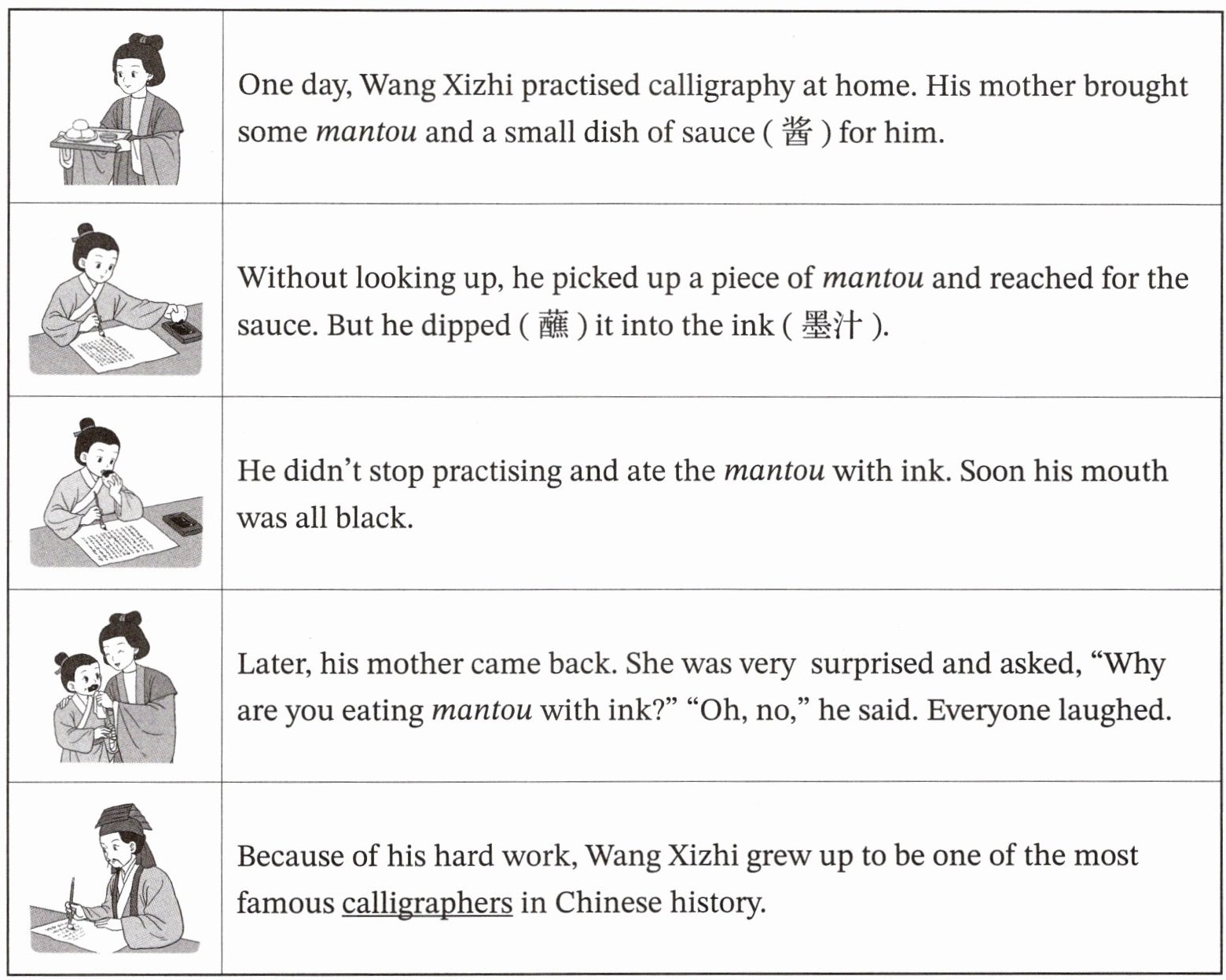
One day, Wang Xizhi practised calligraphy at home. His mother brought some mantou and a small dish of sauce (酱) for him.
Without looking up, he picked up a piece of mantou and reached for the sauce. But he dipped (蘸) it into the ink (墨汁).
He didn’t stop practising and ate the mantou with ink. Soon his mouth was all black.
Later, his mother came back. She was very surprised and asked, “Why are you eating mantou with ink?” “Oh, no,” he said. Everyone laughed.
Because of his hard work, Wang Xizhi grew up to be one of the most famous calligraphers in Chinese history.
(
A. Eastern Jin B. Tang C. Song
(
A. eating mantou with ink B. calligraphy C. reading
(
A. angry B. sad C. surprised
(
A. 画家 B. 书法家 C. 作家
(
A. Wang Xizhi’s mother asked him to eat mantou with ink.
B. We can read the story from a fairy tale.
C. Wang Xizhi is a hard-working person.
A long time ago, during the Eastern Jin Dynasty, there was a little boy named Wang Xizhi.
One day, Wang Xizhi practised calligraphy at home. His mother brought some mantou and a small dish of sauce (酱) for him.
Without looking up, he picked up a piece of mantou and reached for the sauce. But he dipped (蘸) it into the ink (墨汁).
He didn’t stop practising and ate the mantou with ink. Soon his mouth was all black.
Later, his mother came back. She was very surprised and asked, “Why are you eating mantou with ink?” “Oh, no,” he said. Everyone laughed.
Because of his hard work, Wang Xizhi grew up to be one of the most famous calligraphers in Chinese history.
(
A
) 1. Wang Xizhi lived in the Dynasty.A. Eastern Jin B. Tang C. Song
(
B
) 2. Wang Xizhi was interested in .A. eating mantou with ink B. calligraphy C. reading
(
C
) 3. Wang Xizhi’s mother felt when she saw his black mouth.A. angry B. sad C. surprised
(
B
) 4. What does the underlined word “calligraphers” mean?A. 画家 B. 书法家 C. 作家
(
C
) 5. Which sentence is right?A. Wang Xizhi’s mother asked him to eat mantou with ink.
B. We can read the story from a fairy tale.
C. Wang Xizhi is a hard-working person.
答案:1.A 2.B 3.C 4.B 5.C
解析:
【分析】
本题为英语阅读理解题,解题思路如下:1. 先通读全文,掌握文章大意(讲述东晋王羲之因刻苦练习书法,误将墨汁当酱蘸馒头吃的故事);2. 逐题分析,带着问题回到原文定位关键信息;3. 结合原文内容,逐一核对选项,排除错误答案,选出正确选项。
【解析】
1. 题干问王羲之生活的朝代,原文第一句明确提到“during the Eastern Jin Dynasty”,对应选项A,故选A。
2. 题干问王羲之的兴趣,原文提到他“practised calligraphy”(练习书法),说明他对书法感兴趣,对应选项B,故选B。
3. 题干问妈妈看到他黑嘴巴的感受,原文提到“His mother... She was very surprised”,对应选项C,故选C。
4. 题干猜测“calligraphers”的词义,结合文章中王羲之练习书法、成为著名人物的背景,可知该词意为“书法家”,对应选项B,故选B。
5. 题干找正确句子:A选项原文未提及妈妈让他蘸墨,错误;B选项故事是真实历史人物的事迹,不是童话,错误;C选项原文提到“Because of his hard work”,说明王羲之勤奋,正确,故选C。
【答案】
1.A 2.B 3.C 4.B 5.C
【知识点】
英语阅读理解、细节理解、词义猜测
【点评】
本题为英语基础阅读理解题,考查学生提取原文信息、猜测词义及判断句子正误的能力,内容贴近学生熟悉的历史人物故事,难度适中,适合巩固英语阅读基础。
【难度系数】
0.7
本题为英语阅读理解题,解题思路如下:1. 先通读全文,掌握文章大意(讲述东晋王羲之因刻苦练习书法,误将墨汁当酱蘸馒头吃的故事);2. 逐题分析,带着问题回到原文定位关键信息;3. 结合原文内容,逐一核对选项,排除错误答案,选出正确选项。
【解析】
1. 题干问王羲之生活的朝代,原文第一句明确提到“during the Eastern Jin Dynasty”,对应选项A,故选A。
2. 题干问王羲之的兴趣,原文提到他“practised calligraphy”(练习书法),说明他对书法感兴趣,对应选项B,故选B。
3. 题干问妈妈看到他黑嘴巴的感受,原文提到“His mother... She was very surprised”,对应选项C,故选C。
4. 题干猜测“calligraphers”的词义,结合文章中王羲之练习书法、成为著名人物的背景,可知该词意为“书法家”,对应选项B,故选B。
5. 题干找正确句子:A选项原文未提及妈妈让他蘸墨,错误;B选项故事是真实历史人物的事迹,不是童话,错误;C选项原文提到“Because of his hard work”,说明王羲之勤奋,正确,故选C。
【答案】
1.A 2.B 3.C 4.B 5.C
【知识点】
英语阅读理解、细节理解、词义猜测
【点评】
本题为英语基础阅读理解题,考查学生提取原文信息、猜测词义及判断句子正误的能力,内容贴近学生熟悉的历史人物故事,难度适中,适合巩固英语阅读基础。
【难度系数】
0.7