三、阅读理解(16分)
A
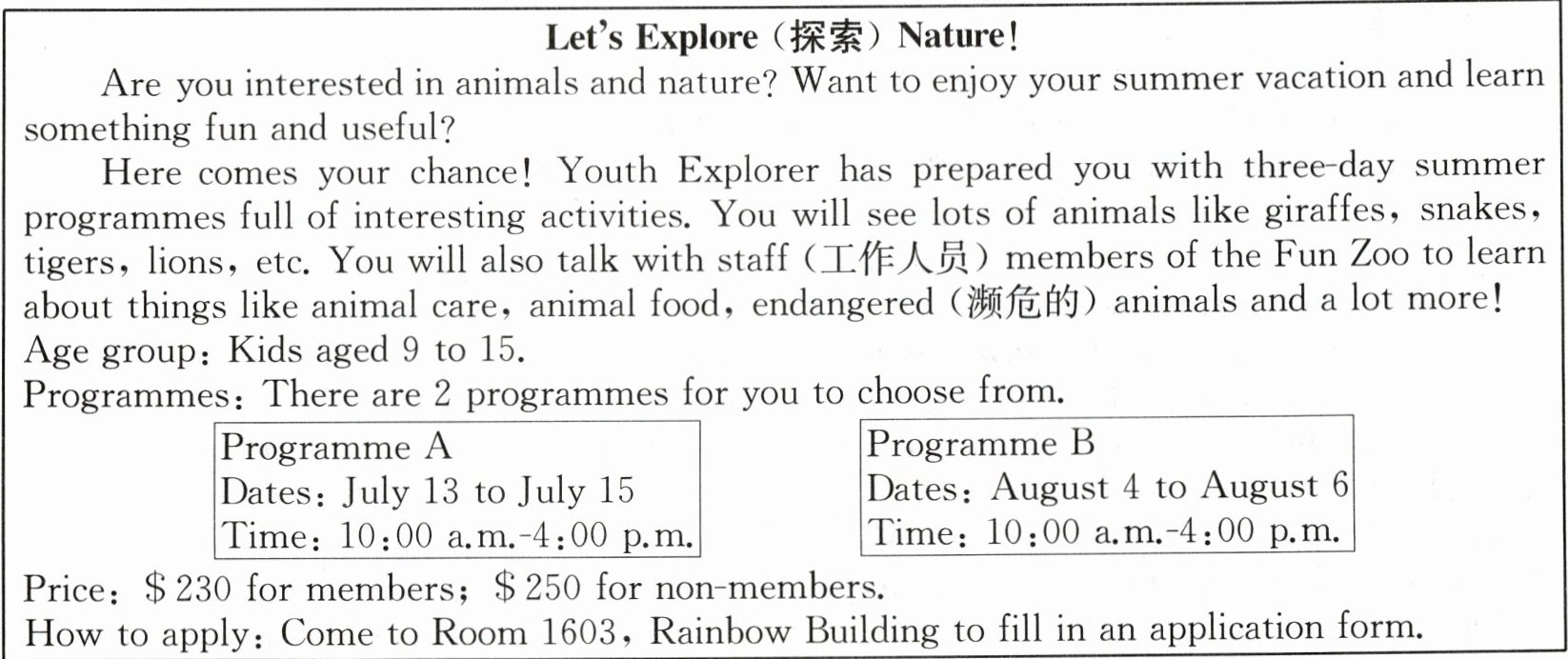
(
A. A boy of 7 B. A kid of 15 C. A girl of 18 D. A man of 26
(
A. $230. B. $460. C. $480. D. $500.
(
A. How we can look after animals. B. What animals in the zoo live on.
C. Where we can buy these animals. D. Some animals are in danger.
(
A. www.wildlifeprotection.com B. www.foreignculture.com
C. www.teenagehealth.com D. www.youthholiday.com
A
(
B
)1. can take part in the three-day summer programmes.A. A boy of 7 B. A kid of 15 C. A girl of 18 D. A man of 26
(
D
)2. Neither(两者都不)of David’s two children is a member of Youth Explorer. How much should he pay to let them join in Programme A together?A. $230. B. $460. C. $480. D. $500.
(
C
)3. Which of the following can’t you learn about according to the material?A. How we can look after animals. B. What animals in the zoo live on.
C. Where we can buy these animals. D. Some animals are in danger.
(
D
)4. Which of the following websites may the material from?A. www.wildlifeprotection.com B. www.foreignculture.com
C. www.teenagehealth.com D. www.youthholiday.com
答案:1. B
2. D
3. C
4. D
2. D
3. C
4. D
解析:
【分析】
本题为应用文阅读理解题,需根据材料中的关键信息逐一解答各小题:
1. 第1题需定位项目参与的年龄范围,匹配对应选项;
2. 第2题需明确非会员的项目价格,计算两个孩子的总费用;
3. 第3题需找出材料中未提及的学习内容;
4. 第4题需根据材料主题判断其来源网站。
【解析】
1. 第1题:根据材料中“Age group: Kids aged 9 to 15”,可知参与项目的年龄为9-15岁,选项中仅15岁的孩子符合要求,故选B。
2. 第2题:材料显示非会员每人费用为250,David的两个孩子均为非会员,参加Programme A,总费用为250×2=500美元,故选D。
3. 第3题:材料提到学习内容包括动物照顾(A项)、动物食物(对应B项)、濒危动物(D项),未提及购买动物的地点,故选C。
4. 第4题:材料是面向青少年的暑期自然探索项目,主题属于青少年假期活动,因此最可能来自青少年假期相关网站,故选D。
【答案】
1.B 2.D 3.C 4.D
【知识点】
应用文阅读、细节理解、信息推理
【点评】
本题为应用文阅读理解题,考查学生提取文章关键信息的能力,题目设置较为基础,仔细阅读材料定位对应信息即可解答。
【难度系数】
0.8
本题为应用文阅读理解题,需根据材料中的关键信息逐一解答各小题:
1. 第1题需定位项目参与的年龄范围,匹配对应选项;
2. 第2题需明确非会员的项目价格,计算两个孩子的总费用;
3. 第3题需找出材料中未提及的学习内容;
4. 第4题需根据材料主题判断其来源网站。
【解析】
1. 第1题:根据材料中“Age group: Kids aged 9 to 15”,可知参与项目的年龄为9-15岁,选项中仅15岁的孩子符合要求,故选B。
2. 第2题:材料显示非会员每人费用为250,David的两个孩子均为非会员,参加Programme A,总费用为250×2=500美元,故选D。
3. 第3题:材料提到学习内容包括动物照顾(A项)、动物食物(对应B项)、濒危动物(D项),未提及购买动物的地点,故选C。
4. 第4题:材料是面向青少年的暑期自然探索项目,主题属于青少年假期活动,因此最可能来自青少年假期相关网站,故选D。
【答案】
1.B 2.D 3.C 4.D
【知识点】
应用文阅读、细节理解、信息推理
【点评】
本题为应用文阅读理解题,考查学生提取文章关键信息的能力,题目设置较为基础,仔细阅读材料定位对应信息即可解答。
【难度系数】
0.8
B
Wild beavers(海狸) are back! Experts(专家)say that the wild beaver families are doing well. The beavers are even boosting wildlife and the environment!
Over ten years ago, a family of beavers turned up in a part of the river Otter, in Devon. No one knew where they came from. It was a big surprise, as wild beavers hadn’t lived in England for around 400 years!
In 2015, the government allowed the beavers to stay there as part of a trial(试验). They wanted to see if these animals could be reintroduced to the wild. The trial lasted for five years. Some scientists from the University of Exeter say the beavers help the wildlife in the area. One scientist called it “an amazing story”.
A lot of this is because of dams(坝). Beavers build dams along the river. This creates deep pools in the riverbed and slows the water down. Scientists say this is perfect for many different types of plants and animals! Many plants are growing near the beavers. The number of different types of animals is also becoming larger in the river. Beavers also help reduce flooding, scientists say. The beavers’ dams slow down the running of the river, especially(尤其)after heavy rain.
There are, however, some problems. Beavers gnaw(咬,啃)on trees and this can harm them. Sometimes, their dams can also create floods on people’s land.
Beavers aren’t the only animals that are reintroduced to the wild! In 2019, red squirrels were brought back to an area of the Scottish Highlands. Further away, the world’s rarest duck, the Madagascar pochard, is making a comeback. It was set free into the wild on the African island in 2019 and is doing well.
Who knows what other animals might be making a comeback?
(
A. helping B. spreading C. harming D. inventing
(
A. To grow more plants along the river. B. To introduce the beavers to the wild.
C. To build dams for the beavers in the wild.
D. To see if the beavers could be reintroduced to the wild.
(
A. They bring heavy rain and floods. B. They gnaw on trees and harm them.
C. Their dams create floods on people's land.
D. They help plants grow and stop flooding.
(
A. Angry. B. Satisfied. C. Sorry. D. Worried.
Wild beavers(海狸) are back! Experts(专家)say that the wild beaver families are doing well. The beavers are even boosting wildlife and the environment!
Over ten years ago, a family of beavers turned up in a part of the river Otter, in Devon. No one knew where they came from. It was a big surprise, as wild beavers hadn’t lived in England for around 400 years!
In 2015, the government allowed the beavers to stay there as part of a trial(试验). They wanted to see if these animals could be reintroduced to the wild. The trial lasted for five years. Some scientists from the University of Exeter say the beavers help the wildlife in the area. One scientist called it “an amazing story”.
A lot of this is because of dams(坝). Beavers build dams along the river. This creates deep pools in the riverbed and slows the water down. Scientists say this is perfect for many different types of plants and animals! Many plants are growing near the beavers. The number of different types of animals is also becoming larger in the river. Beavers also help reduce flooding, scientists say. The beavers’ dams slow down the running of the river, especially(尤其)after heavy rain.
There are, however, some problems. Beavers gnaw(咬,啃)on trees and this can harm them. Sometimes, their dams can also create floods on people’s land.
Beavers aren’t the only animals that are reintroduced to the wild! In 2019, red squirrels were brought back to an area of the Scottish Highlands. Further away, the world’s rarest duck, the Madagascar pochard, is making a comeback. It was set free into the wild on the African island in 2019 and is doing well.
Who knows what other animals might be making a comeback?
(
A
) 5. The underlined word "boosting" in Paragraph 1 most probably means "".A. helping B. spreading C. harming D. inventing
(
D
) 6. Why did the government want a trial first?A. To grow more plants along the river. B. To introduce the beavers to the wild.
C. To build dams for the beavers in the wild.
D. To see if the beavers could be reintroduced to the wild.
(
D
) 7. What are the good things about wild beavers living on the river Otter?A. They bring heavy rain and floods. B. They gnaw on trees and harm them.
C. Their dams create floods on people's land.
D. They help plants grow and stop flooding.
(
B
) 8. How do you think animal lovers feel about the news?A. Angry. B. Satisfied. C. Sorry. D. Worried.
答案:5. A
6. D
7. D
8. B
6. D
7. D
8. B
解析:
【分析】
1. 第5题是词义猜测题,需结合上下文语境推断划线词含义:第一段提到海狸回归后对野生动物和环境有积极影响,后文明确指出海狸帮助当地野生动物,由此可推断“boosting”意为“帮助”。
2. 第6题是细节理解题,需定位原文找政府做试验的目的:根据第三段内容,政府开展试验是为了确认能否将海狸重新引入野外。
3. 第7题是细节理解题,需筛选海狸的积极作用:第四段提到海狸帮助植物生长、减少洪水,这是其好处。
4. 第8题是推理判断题,需结合文章主旨推断情感:文章介绍多种动物成功回归野外,动物爱好者对此应感到满意。
【解析】
5. 词义猜测题:由第一段后文“the beavers help the wildlife in the area”及第四段海狸对动植物的积极作用可知,“boosting”表示“帮助”,对应选项A。
6. 细节理解题:根据第三段“In 2015, the government allowed the beavers to stay there as part of a trial... They wanted to see if these animals could be reintroduced to the wild.”可知,政府做试验的目的是确认海狸能否被重新引入野外,选D。
7. 细节理解题:根据第四段“Many plants are growing near the beavers... Beavers also help reduce flooding”可知,海狸的好处是帮助植物生长和阻止洪水,选D。
8. 推理判断题:文章讲述多种动物成功回归野外且状况良好,因此动物爱好者会感到满意,选B。
【答案】
5. A 6. D 7. D 8. B
【知识点】
词义猜测题、细节理解题、推理判断题
【点评】
本题围绕野生动物回归主题,考查学生对阅读理解中词义、细节及推理类题型的掌握,需结合原文信息逐一分析选项,难度适中。
【难度系数】
0.7
1. 第5题是词义猜测题,需结合上下文语境推断划线词含义:第一段提到海狸回归后对野生动物和环境有积极影响,后文明确指出海狸帮助当地野生动物,由此可推断“boosting”意为“帮助”。
2. 第6题是细节理解题,需定位原文找政府做试验的目的:根据第三段内容,政府开展试验是为了确认能否将海狸重新引入野外。
3. 第7题是细节理解题,需筛选海狸的积极作用:第四段提到海狸帮助植物生长、减少洪水,这是其好处。
4. 第8题是推理判断题,需结合文章主旨推断情感:文章介绍多种动物成功回归野外,动物爱好者对此应感到满意。
【解析】
5. 词义猜测题:由第一段后文“the beavers help the wildlife in the area”及第四段海狸对动植物的积极作用可知,“boosting”表示“帮助”,对应选项A。
6. 细节理解题:根据第三段“In 2015, the government allowed the beavers to stay there as part of a trial... They wanted to see if these animals could be reintroduced to the wild.”可知,政府做试验的目的是确认海狸能否被重新引入野外,选D。
7. 细节理解题:根据第四段“Many plants are growing near the beavers... Beavers also help reduce flooding”可知,海狸的好处是帮助植物生长和阻止洪水,选D。
8. 推理判断题:文章讲述多种动物成功回归野外且状况良好,因此动物爱好者会感到满意,选B。
【答案】
5. A 6. D 7. D 8. B
【知识点】
词义猜测题、细节理解题、推理判断题
【点评】
本题围绕野生动物回归主题,考查学生对阅读理解中词义、细节及推理类题型的掌握,需结合原文信息逐一分析选项,难度适中。
【难度系数】
0.7