B
Whenever we face any challenge, we stop and ask, “What if?” What if we challenge the rules and start thinking outside the box?
Thinking outside the box is a metaphor(隐喻)often used to describe different or creative thinking. It shows up in simple things like using paper to make artworks, instead of just writing on them.
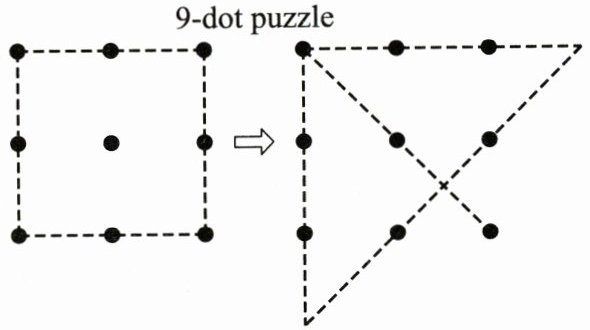
Once a teacher gave the students a 9-dot puzzle(谜)and asked them to connect the dots with only 4 lines. Naturally, this task requires some lateral thinking(跨界思维), so the teacher encouraged the students to “think outside the box”. In this case, students needed to look beyond the box and create something else.
One thing stands out for us from this exercise. At first, you see a box. To draw those 4 lines, you have to first use up all the ways within the box. Only then can you realize that the problem is the box itself. You understand the box and discover its limitations(限制). To think outside the box is to fully understand the situation—then challenge it.
Thinking outside the box helps you solve challenging problems. It allows you to look beyond a narrow view to find answers. This way of thinking also pushes you to explore new possibilities. Trying new things, imagining different answers, and daring to make mistakes help people improve. Thinking small keeps us small. When we stay within our comfort zone(舒适区), taking risks, growing, and challenging all make us feel scared. To become a good leader, or a team member, think outside the box.
Whatever you do, think twice: First in the box, then outside the box. Outside-the-box thinking often breaks the habits and may sound strange at first. But without thinking outside the box, these people, like Thomas Edison, Isaac Newton, wouldn’t have changed the world in the way they did. Master the basic rules of your craft, use them properly and if they’re not bringing results, allow yourself to start thinking outside the box. You’ll be glad you did.
(
A. Watching TV in the evening.
B. Buying milk at a supermarket.
C. Taking the bus to the office.
D. Using a plastic bottle as a bird bowl.
(
A. Small thinking helps achieve big success.
B. Avoiding challenges and risks limits personal growth.
C. Big thinking leads to unnecessary risks and problems.
D. Small thinking is the key to staying safe and comfortable.
(
A. Throwing away all old rules.
B. Learning ideas from others.
C. Giving up all common methods.
D. Fully understanding the situation.
(
A. To discuss unusual methods.
B. To doubt creative thinking.
C. To explain ways to avoid risks.
D. To encourage us to think creatively.
Whenever we face any challenge, we stop and ask, “What if?” What if we challenge the rules and start thinking outside the box?
Thinking outside the box is a metaphor(隐喻)often used to describe different or creative thinking. It shows up in simple things like using paper to make artworks, instead of just writing on them.
Once a teacher gave the students a 9-dot puzzle(谜)and asked them to connect the dots with only 4 lines. Naturally, this task requires some lateral thinking(跨界思维), so the teacher encouraged the students to “think outside the box”. In this case, students needed to look beyond the box and create something else.
One thing stands out for us from this exercise. At first, you see a box. To draw those 4 lines, you have to first use up all the ways within the box. Only then can you realize that the problem is the box itself. You understand the box and discover its limitations(限制). To think outside the box is to fully understand the situation—then challenge it.
Thinking outside the box helps you solve challenging problems. It allows you to look beyond a narrow view to find answers. This way of thinking also pushes you to explore new possibilities. Trying new things, imagining different answers, and daring to make mistakes help people improve. Thinking small keeps us small. When we stay within our comfort zone(舒适区), taking risks, growing, and challenging all make us feel scared. To become a good leader, or a team member, think outside the box.
Whatever you do, think twice: First in the box, then outside the box. Outside-the-box thinking often breaks the habits and may sound strange at first. But without thinking outside the box, these people, like Thomas Edison, Isaac Newton, wouldn’t have changed the world in the way they did. Master the basic rules of your craft, use them properly and if they’re not bringing results, allow yourself to start thinking outside the box. You’ll be glad you did.
(
D
)5. Which of the following is an example of the “lateral thinking”?A. Watching TV in the evening.
B. Buying milk at a supermarket.
C. Taking the bus to the office.
D. Using a plastic bottle as a bird bowl.
(
B
)6. What does the sentence “Thinking small keeps us small.” mean in paragraph 5?A. Small thinking helps achieve big success.
B. Avoiding challenges and risks limits personal growth.
C. Big thinking leads to unnecessary risks and problems.
D. Small thinking is the key to staying safe and comfortable.
(
D
)7. What is the first step to truly think outside the box according to paragraph 4?A. Throwing away all old rules.
B. Learning ideas from others.
C. Giving up all common methods.
D. Fully understanding the situation.
(
D
)8. What’s the main purpose of writing this passage?A. To discuss unusual methods.
B. To doubt creative thinking.
C. To explain ways to avoid risks.
D. To encourage us to think creatively.
答案:5. D
6. B
7. D
8. D
6. B
7. D
8. D
解析:
【分析】
本题为英语阅读理解题,围绕“跳出思维定式(think outside the box)”的主题设置4道选择题,需结合原文细节逐一分析:第5题考查对“跨界思维(lateral thinking)”的实例判断,需匹配原文对创造性思维的定义;第6题考查句意理解,需结合第五段语境分析句子含义;第7题考查细节定位,需找到跳出思维定式的第一步;第8题考查主旨大意,需总结全文核心意图。
【解析】
5. 细节理解题:根据原文第二段,跨界思维(创造性思维)指用非常规方式处理事物,如用纸张做艺术品而非仅写字。选项D“用塑料瓶当鸟碗”是对物品的非常规创造性使用,符合跨界思维的例子,故选D。
6. 句意猜测题:第五段提到“待在舒适区会害怕冒险、成长和挑战”,“Thinking small keeps us small”意为局限于小的想法(避免挑战和风险)会限制个人成长,对应选项B,故选B。
7. 细节理解题:第四段明确指出“To think outside the box is to fully understand the situation—then challenge it”,说明真正跳出思维定式的第一步是充分理解情况,故选D。
8. 主旨大意题:全文通过9点谜题的实例,阐述创造性思维的重要性,最后鼓励读者跳出思维定式、进行创造性思考,核心目的是鼓励创造性思考,故选D。
【答案】
5.D 6.B 7.D 8.D
【知识点】
英语阅读理解、细节理解、句意猜测、主旨大意
【点评】
文章结合生动实例讲解创造性思维的内涵与意义,题目类型全面,需学生准确抓取原文信息并理解语境,是典型的英语阅读理解题,难度适中。
【难度系数】
0.6
本题为英语阅读理解题,围绕“跳出思维定式(think outside the box)”的主题设置4道选择题,需结合原文细节逐一分析:第5题考查对“跨界思维(lateral thinking)”的实例判断,需匹配原文对创造性思维的定义;第6题考查句意理解,需结合第五段语境分析句子含义;第7题考查细节定位,需找到跳出思维定式的第一步;第8题考查主旨大意,需总结全文核心意图。
【解析】
5. 细节理解题:根据原文第二段,跨界思维(创造性思维)指用非常规方式处理事物,如用纸张做艺术品而非仅写字。选项D“用塑料瓶当鸟碗”是对物品的非常规创造性使用,符合跨界思维的例子,故选D。
6. 句意猜测题:第五段提到“待在舒适区会害怕冒险、成长和挑战”,“Thinking small keeps us small”意为局限于小的想法(避免挑战和风险)会限制个人成长,对应选项B,故选B。
7. 细节理解题:第四段明确指出“To think outside the box is to fully understand the situation—then challenge it”,说明真正跳出思维定式的第一步是充分理解情况,故选D。
8. 主旨大意题:全文通过9点谜题的实例,阐述创造性思维的重要性,最后鼓励读者跳出思维定式、进行创造性思考,核心目的是鼓励创造性思考,故选D。
【答案】
5.D 6.B 7.D 8.D
【知识点】
英语阅读理解、细节理解、句意猜测、主旨大意
【点评】
文章结合生动实例讲解创造性思维的内涵与意义,题目类型全面,需学生准确抓取原文信息并理解语境,是典型的英语阅读理解题,难度适中。
【难度系数】
0.6
三、信息还原(10分)
Peonies are highly-prized flowers native to China. They have been blooming and withering(凋谢)for thousands of years. 1.
2.
3.
4.
Today, peonies are still one of the favourite flowers for the Chinese. Countless parks across the country plant large areas of peonies for visitors to admire. 5.
A. Peonies can only grow in northern China.
B. They usually open fully in late April every year.
C. Tang poets wrote many poems about peonies.
D. They often stand for gentle and beautiful ladies.
E. Peonies have big, bright and sweet-smelling flowers.
F. People also found many hidden valuable uses of peonies.
G. The Chinese used to compare flowers to different kinds of people.
Peonies are highly-prized flowers native to China. They have been blooming and withering(凋谢)for thousands of years. 1.
E
Therefore, people consider the flowers as the symbol of wealth and good luck.2.
G
For example, the plum(梅)flower is the symbol of people with forbearance(忍耐)and the lotus flower represents people with high standards. Peonies have a symbolic meaning as well.3.
D
They also carry the meaning of happiness and beauty for Chinese people. These lovely symbolic meanings make peonies hold a special place in Chinese traditional culture.4.
F
Herbal Classic of Shen Nong listed peonies as medical herbs(草药). People even made peony-based herbal drinks to keep healthy. During the Sui and Tang Dynasties, peonies were widely grown for beauty, while their roots were still used as common herbal medicine.Today, peonies are still one of the favourite flowers for the Chinese. Countless parks across the country plant large areas of peonies for visitors to admire. 5.
B
This is the best time to enjoy these beautiful flowers.A. Peonies can only grow in northern China.
B. They usually open fully in late April every year.
C. Tang poets wrote many poems about peonies.
D. They often stand for gentle and beautiful ladies.
E. Peonies have big, bright and sweet-smelling flowers.
F. People also found many hidden valuable uses of peonies.
G. The Chinese used to compare flowers to different kinds of people.
答案:1. E
2. G
3. D
4. F
5. B
2. G
3. D
4. F
5. B
解析:
【分析】
本题为英语信息还原题,需结合上下文的逻辑关系(总起、举例、语义衔接、时间对应等)匹配句子。解题时先通读全文明确每段主题,再根据每个空前后的提示内容,寻找语义衔接的选项:第1空后提到牡丹是财富好运的象征,需选描述牡丹外观特点的选项;第2空后举例花象征不同的人,需选总起“花与人的类比”的选项;第3空后讲牡丹的其他象征意义,需选具体象征内容的选项;第4空后讲牡丹的药用价值,需选总起“牡丹的珍贵用途”的选项;第5空后提到赏花最佳时间,需选牡丹盛开时间的选项。
【解析】
1. 第1空:前文介绍牡丹是中国名花、历史悠久,后文说明其象征意义,E选项描述牡丹“花大、鲜艳、芳香”的外观特点,符合从花的特征过渡到象征意义的逻辑,故选E。
2. 第2空:后文举例梅花、莲花分别象征不同品格的人,G选项提出“中国人常把花比作不同的人”,是后文举例的总起句,故选G。
3. 第3空:后文提到牡丹有幸福、美丽的意义,D选项说明牡丹“代表温柔美丽的女士”,是具体的象征内容,与后文的“also carry”形成语义递进,故选D。
4. 第4空:后文讲述牡丹被列为草药、有药用价值,F选项提出“人们发现牡丹的隐藏珍贵用途”,是对后文药用内容的总起,故选F。
5. 第5空:后文提到“这是赏花的最佳时间”,B选项说明牡丹“通常每年四月底盛开”,对应赏花的时间,故选B。
【答案】
1.E 2.G 3.D 4.F 5.B
【知识点】
信息还原、语篇衔接、逻辑推理
【点评】
本题考查英语语篇理解与逻辑衔接能力,要求学生通过分析上下文的语义关系匹配句子,是初中英语常见题型,难度适中,需学生仔细梳理每段的逻辑层次。
【难度系数】
0.5
本题为英语信息还原题,需结合上下文的逻辑关系(总起、举例、语义衔接、时间对应等)匹配句子。解题时先通读全文明确每段主题,再根据每个空前后的提示内容,寻找语义衔接的选项:第1空后提到牡丹是财富好运的象征,需选描述牡丹外观特点的选项;第2空后举例花象征不同的人,需选总起“花与人的类比”的选项;第3空后讲牡丹的其他象征意义,需选具体象征内容的选项;第4空后讲牡丹的药用价值,需选总起“牡丹的珍贵用途”的选项;第5空后提到赏花最佳时间,需选牡丹盛开时间的选项。
【解析】
1. 第1空:前文介绍牡丹是中国名花、历史悠久,后文说明其象征意义,E选项描述牡丹“花大、鲜艳、芳香”的外观特点,符合从花的特征过渡到象征意义的逻辑,故选E。
2. 第2空:后文举例梅花、莲花分别象征不同品格的人,G选项提出“中国人常把花比作不同的人”,是后文举例的总起句,故选G。
3. 第3空:后文提到牡丹有幸福、美丽的意义,D选项说明牡丹“代表温柔美丽的女士”,是具体的象征内容,与后文的“also carry”形成语义递进,故选D。
4. 第4空:后文讲述牡丹被列为草药、有药用价值,F选项提出“人们发现牡丹的隐藏珍贵用途”,是对后文药用内容的总起,故选F。
5. 第5空:后文提到“这是赏花的最佳时间”,B选项说明牡丹“通常每年四月底盛开”,对应赏花的时间,故选B。
【答案】
1.E 2.G 3.D 4.F 5.B
【知识点】
信息还原、语篇衔接、逻辑推理
【点评】
本题考查英语语篇理解与逻辑衔接能力,要求学生通过分析上下文的语义关系匹配句子,是初中英语常见题型,难度适中,需学生仔细梳理每段的逻辑层次。
【难度系数】
0.5