五、综合填空
Today, it's popular for people 1.
With this new way of shopping online, shopping gets much easier. People don't need to go to a mall far 3. a
Livestreaming selling(销售)becomes an important 8. p
The internet also changes our way of 10.
Today, it's popular for people 1.
to buy
(buy) things from livestreaming(直播)rooms in China. When people go into one livestreaming room, they can see some streamers(主播)2. introducing
(introduce) products(产品)happily.With this new way of shopping online, shopping gets much easier. People don't need to go to a mall far 3. a
away
from their homes. And the products 4. usually
(usual) cost less than those in the malls. People think this helps 5. save
(save) their money. For some of them, watching the livestream even becomes a part of their 6. daily
(day) lives. They watch it not only for shopping, but also for relaxing(放松)7. aafter
a hard day's work.Livestreaming selling(销售)becomes an important 8. p
part
in increasing sales(增加销售额)of the products. Now, many 9. countries
(country) learn from China and hope to sell the products through livestreaming.The internet also changes our way of 10.
paying
(pay). Can you name the changes?答案:1. to buy 2. introducing 3. away 4. usually 5. save
6. daily 7. after 8. part 9. countries 10. paying
6. daily 7. after 8. part 9. countries 10. paying
解析:
【分析】
这是一道英语综合填空题,需结合固定搭配、词性转换、语境语义等知识解题。解题思路如下:
1. 第1空:考查固定句型“It's + adj + for sb to do sth”,意为“对某人来说做某事是……的”,需用动词不定式;
2. 第2空:考查固定搭配“see sb doing sth”,表示看到某人正在做某事,此处指主播正在介绍产品,用动名词;
3. 第3空:考查固定短语“far away from”,意为“远离”,结合语境填对应单词;
4. 第4空:修饰动词cost需用副词,转换形容词为副词形式;
5. 第5空:考查固定搭配“help (to) do sth”,需用动词原形;
6. 第6空:修饰名词lives需用形容词,转换名词为形容词形式;
7. 第7空:结合语境“辛苦工作之后”,填对应介词;
8. 第8空:结合语义“重要部分”,填对应名词;
9. 第9空:many后接可数名词复数,转换单数名词为复数形式;
10. 第10空:考查固定搭配“way of doing sth”,of后接动名词。
【解析】
根据语法规则、固定搭配及语境逐一分析:
1. 固定句型“It's popular for people to do sth”,故填to buy;
2. “see sb doing sth”表动作正在进行,故填introducing;
3. “far away from”是固定短语,故填away;
4. 修饰动词cost用副词,usual的副词形式为usually;
5. “help do sth”是固定用法,故填save;
6. 修饰名词lives用形容词,day的形容词形式为daily;
7. 结合语境“在辛苦工作之后”,填介词after;
8. 语义为“重要部分”,故填part;
9. many后接可数名词复数,country的复数形式为countries;
10. “way of doing sth”中of后接动名词,故填paying。
【答案】
1. to buy 2. introducing 3. away 4. usually 5. save 6. daily 7. after 8. part 9. countries 10. paying
【知识点】
固定句型、非谓语动词、词性转换
【点评】
本题考查初中英语基础知识的综合运用,涵盖固定搭配、词性变化、语境理解等核心考点,是英语综合填空的典型题型,侧重基础能力考查。
【难度系数】
0.6
这是一道英语综合填空题,需结合固定搭配、词性转换、语境语义等知识解题。解题思路如下:
1. 第1空:考查固定句型“It's + adj + for sb to do sth”,意为“对某人来说做某事是……的”,需用动词不定式;
2. 第2空:考查固定搭配“see sb doing sth”,表示看到某人正在做某事,此处指主播正在介绍产品,用动名词;
3. 第3空:考查固定短语“far away from”,意为“远离”,结合语境填对应单词;
4. 第4空:修饰动词cost需用副词,转换形容词为副词形式;
5. 第5空:考查固定搭配“help (to) do sth”,需用动词原形;
6. 第6空:修饰名词lives需用形容词,转换名词为形容词形式;
7. 第7空:结合语境“辛苦工作之后”,填对应介词;
8. 第8空:结合语义“重要部分”,填对应名词;
9. 第9空:many后接可数名词复数,转换单数名词为复数形式;
10. 第10空:考查固定搭配“way of doing sth”,of后接动名词。
【解析】
根据语法规则、固定搭配及语境逐一分析:
1. 固定句型“It's popular for people to do sth”,故填to buy;
2. “see sb doing sth”表动作正在进行,故填introducing;
3. “far away from”是固定短语,故填away;
4. 修饰动词cost用副词,usual的副词形式为usually;
5. “help do sth”是固定用法,故填save;
6. 修饰名词lives用形容词,day的形容词形式为daily;
7. 结合语境“在辛苦工作之后”,填介词after;
8. 语义为“重要部分”,故填part;
9. many后接可数名词复数,country的复数形式为countries;
10. “way of doing sth”中of后接动名词,故填paying。
【答案】
1. to buy 2. introducing 3. away 4. usually 5. save 6. daily 7. after 8. part 9. countries 10. paying
【知识点】
固定句型、非谓语动词、词性转换
【点评】
本题考查初中英语基础知识的综合运用,涵盖固定搭配、词性变化、语境理解等核心考点,是英语综合填空的典型题型,侧重基础能力考查。
【难度系数】
0.6
六、阅读理解
Three people are sitting around a table in a restaurant in London. How much do you think they will tip (给小费)?
The English says, “We usually tip 10%.” The American woman cries, “Oh, I’m planning to leave 20%!” And the Chinese asks, “What’s a tip?”
People seldom tip in China, but tipping is a big thing in some Western (西方的) countries. Usually, people give tips to a waiter (服务员) when they eat in a restaurant. In America, waiters hope to get 20% to 25% of the total bill(账单). So if you buy $100 of food, you need to pay your waiter about $120 in all.
But why is this? Many waiters get low wages(工资). Because of tips, they can get more money. Tips are not just for waiters. Hotel maids, hairdressers and taxi drivers also usually work for tips to make more money.
Tipping is also popular in some South-east Asian (东南亚的) countries, such as Indonesia and Thailand. But in Japan, there is a no-tipping custom(习俗). Waiters may feel angry if you try to give them money.
So how should we tip in different countries? We should do as the Romans do (入乡随俗).
(
A. £150
B. £165
C. £175
D. £180
(
① the UK ② the US ③ China ④ Indonesia ⑤ Thailand ⑥ Japan
A. ①②④⑤
B. ①②③⑤
C. ②③④⑥
D. ③④⑤⑥
(
A. Because it becomes a custom.
B. Because waiters work very hard.
C. Because people are happy to give tips.
D. Because people give tips to show their love.
(
A. it is OK to tip a waiter in Japan
B. people in Asian countries don’t tip
C. tipping is popular in every country around the world
D. how much people tip is different in different countries
Three people are sitting around a table in a restaurant in London. How much do you think they will tip (给小费)?
The English says, “We usually tip 10%.” The American woman cries, “Oh, I’m planning to leave 20%!” And the Chinese asks, “What’s a tip?”
People seldom tip in China, but tipping is a big thing in some Western (西方的) countries. Usually, people give tips to a waiter (服务员) when they eat in a restaurant. In America, waiters hope to get 20% to 25% of the total bill(账单). So if you buy $100 of food, you need to pay your waiter about $120 in all.
But why is this? Many waiters get low wages(工资). Because of tips, they can get more money. Tips are not just for waiters. Hotel maids, hairdressers and taxi drivers also usually work for tips to make more money.
Tipping is also popular in some South-east Asian (东南亚的) countries, such as Indonesia and Thailand. But in Japan, there is a no-tipping custom(习俗). Waiters may feel angry if you try to give them money.
So how should we tip in different countries? We should do as the Romans do (入乡随俗).
(
B
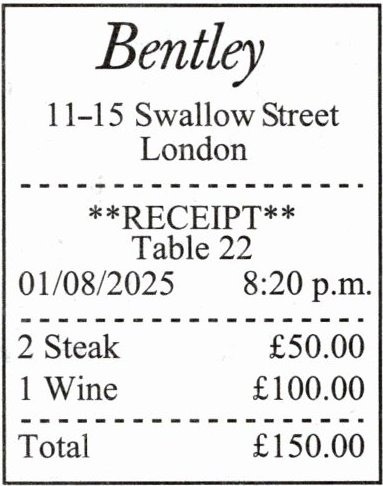
) 1. Look at the picture of the bill in the text, the three people should pay in all.A. £150
B. £165
C. £175
D. £180
(
A
) 2. People in usually give tips.① the UK ② the US ③ China ④ Indonesia ⑤ Thailand ⑥ Japan
A. ①②④⑤
B. ①②③⑤
C. ②③④⑥
D. ③④⑤⑥
(
A
) 3. Why is tipping popular in some countries?A. Because it becomes a custom.
B. Because waiters work very hard.
C. Because people are happy to give tips.
D. Because people give tips to show their love.
(
D
) 4. From the passage, we can learn that .A. it is OK to tip a waiter in Japan
B. people in Asian countries don’t tip
C. tipping is popular in every country around the world
D. how much people tip is different in different countries
答案:1.B 2.A 3.A 4.D
解析:
【分析】
这是一篇关于不同国家小费习俗的阅读理解题,需结合原文细节逐一分析各题目:
1. 第1题:先确定账单总费用,再结合英国人给10%小费的习惯计算总支付金额,对应选项。
2. 第2题:从原文提取哪些国家有给小费的习俗,排除不给小费的国家后匹配选项。
3. 第3题:根据原文关于小费的原因描述,结合选项判断正确答案。
4. 第4题:逐一排除错误选项,找到符合原文内容的正确表述。
【解析】
1. 第1题:根据账单可知总账单为£150,原文提到英国人通常给10%的小费,因此总支付金额=账单+小费=150 + 150×10% = 165,故选B。
2. 第2题:原文指出:英国通常给小费,美国服务员希望得到20%-25%小费,东南亚的印尼、泰国给小费,中国很少给,日本不给,因此给小费的国家是①②④⑤,故选A。
3. 第3题:原文提到小费是不同国家的习俗,且最后强调“入乡随俗”,A选项“成为习俗”符合文意,B、C、D选项无原文依据,故选A。
4. 第4题:A项日本不给小费,错误;B项亚洲部分国家给小费,错误;C项并非所有国家都给小费,错误;D项不同国家小费金额不同,符合原文内容,故选D。
【答案】
1.B 2.A 3.A 4.D
【知识点】
阅读理解、细节理解、推理判断
【点评】
本题围绕不同国家的小费习俗展开,考查学生对原文细节的提取与理解能力,需仔细阅读原文定位关键信息,通过排除错误选项得出答案。
【难度系数】
0.6
这是一篇关于不同国家小费习俗的阅读理解题,需结合原文细节逐一分析各题目:
1. 第1题:先确定账单总费用,再结合英国人给10%小费的习惯计算总支付金额,对应选项。
2. 第2题:从原文提取哪些国家有给小费的习俗,排除不给小费的国家后匹配选项。
3. 第3题:根据原文关于小费的原因描述,结合选项判断正确答案。
4. 第4题:逐一排除错误选项,找到符合原文内容的正确表述。
【解析】
1. 第1题:根据账单可知总账单为£150,原文提到英国人通常给10%的小费,因此总支付金额=账单+小费=150 + 150×10% = 165,故选B。
2. 第2题:原文指出:英国通常给小费,美国服务员希望得到20%-25%小费,东南亚的印尼、泰国给小费,中国很少给,日本不给,因此给小费的国家是①②④⑤,故选A。
3. 第3题:原文提到小费是不同国家的习俗,且最后强调“入乡随俗”,A选项“成为习俗”符合文意,B、C、D选项无原文依据,故选A。
4. 第4题:A项日本不给小费,错误;B项亚洲部分国家给小费,错误;C项并非所有国家都给小费,错误;D项不同国家小费金额不同,符合原文内容,故选D。
【答案】
1.B 2.A 3.A 4.D
【知识点】
阅读理解、细节理解、推理判断
【点评】
本题围绕不同国家的小费习俗展开,考查学生对原文细节的提取与理解能力,需仔细阅读原文定位关键信息,通过排除错误选项得出答案。
【难度系数】
0.6