四、综合填空
ASK ME
I'm Maddy King. I come 1. f
Dear Maddy,
My mom has a quick temper(急脾气), 3. b
Rachel, 11, Shanghai
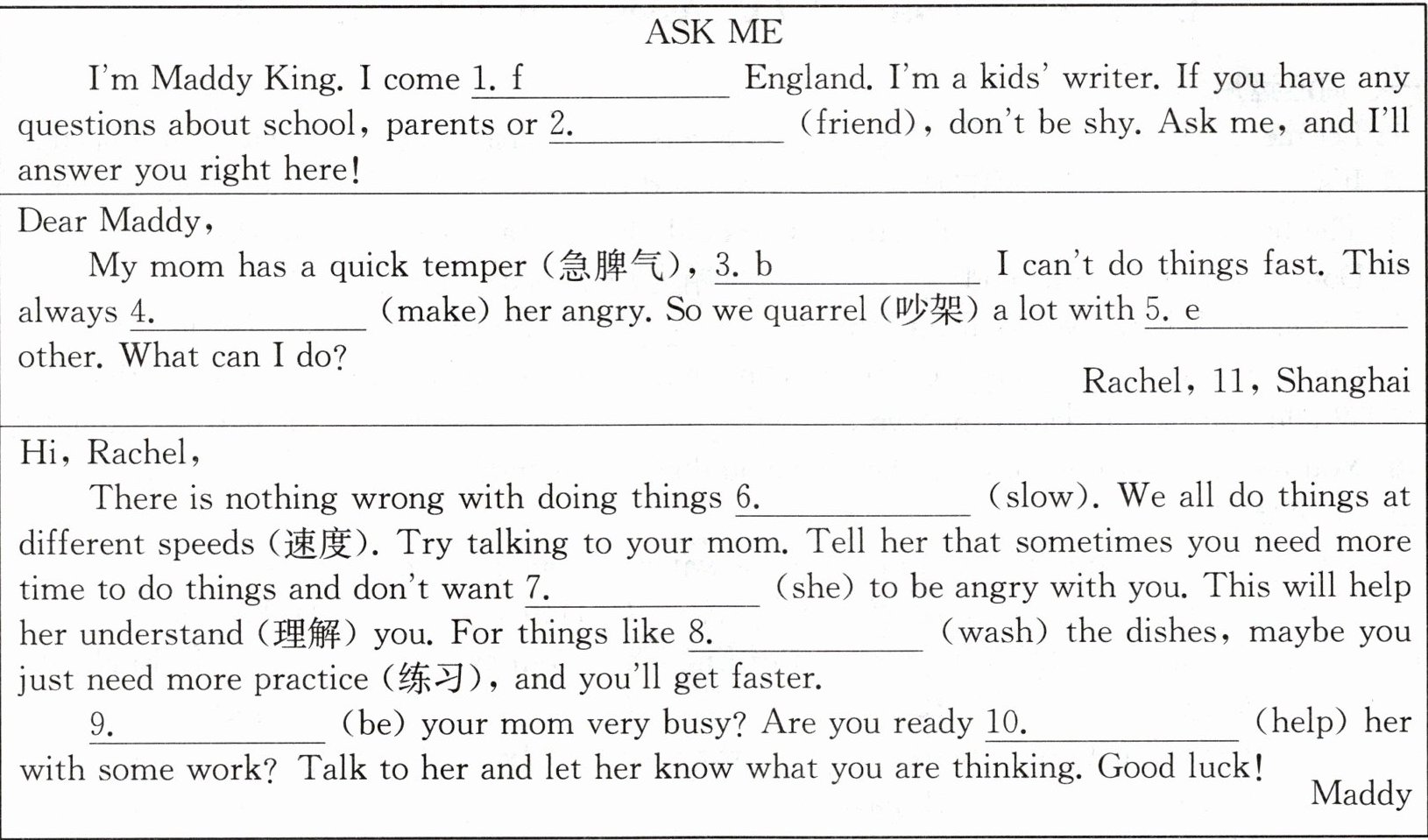
Hi, Rachel,
There is nothing wrong with doing things 6.
9.
Maddy
ASK ME
I'm Maddy King. I come 1. f
rom
England. I'm a kids' writer. If you have any questions about school, parents or 2.friends
(friend), don't be shy. Ask me, and I'll answer you right here!Dear Maddy,
My mom has a quick temper(急脾气), 3. b
ut
I can't do things fast. This always 4.makes
(make) her angry. So we quarrel(吵架)a lot with 5. each
other. What can I do?Rachel, 11, Shanghai
Hi, Rachel,
There is nothing wrong with doing things 6.
slowly
(slow). We all do things at different speeds(速度). Try talking to your mom. Tell her that sometimes you need more time to do things and don't want 7.her
(she) to be angry with you. This will help her understand(理解)you. For things like 8.washing
(wash) the dishes, maybe you just need more practice(练习), and you'll get faster.9.
Is
(be) your mom very busy? Are you ready 10.to help
(help) her with some work? Talk to her and let her know what you are thinking. Good luck!Maddy
答案:1. from 2. friends 3. but 4. makes 5. each
6. slowly 7. her 8. washing 9. Is 10. to help
6. slowly 7. her 8. washing 9. Is 10. to help
解析:
【分析】
这是一篇英语综合填空题,需结合上下文语境、固定搭配、词性变化、语法规则等知识解题。先通读全文理解大意,再逐个分析空格:1. 考查固定搭配“来自”;2. 泛指朋友需用名词复数;3. 前后句为转折关系选连词;4. 主语是第三人称单数,谓语动词用三单形式;5. 考查固定短语“互相”;6. 修饰动词用副词;7. 动词后接人称代词宾格;8. 介词后接动名词;9. 第三人称单数主语的一般疑问句用be动词Is;10. 考查固定搭配“准备做某事”。
【解析】
1. 固定搭配:come from表示“来自”,故填from;
2. 名词复数:此处泛指多个朋友,friend的复数为friends,故填friends;
3. 连词用法:前后句为转折关系,用but连接,故填but;
4. 主谓一致:主语this是第三人称单数,一般现在时谓语用三单形式,make的三单是makes,故填makes;
5. 固定短语:each other意为“互相”,符合语境,故填each;
6. 词性转换:修饰动词doing需用副词,slow的副词是slowly,故填slowly;
7. 代词宾格:want是动词,后接宾格,she的宾格是her,故填her;
8. 动名词:like是介词,后接动名词,wash的动名词是washing,故填washing;
9. 主谓一致:主语your mom是第三人称单数,一般现在时一般疑问句用Is,故填Is;
10. 固定搭配:be ready to do sth是固定搭配,意为“准备做某事”,故填to help;
【答案】
1. from 2. friends 3. but 4. makes 5. each 6. slowly 7. her 8. washing 9. Is 10. to help
【知识点】
固定搭配、词性转换、主谓一致
【点评】
本题考查英语基础语言知识的综合运用,涵盖固定短语、词性变化、语法规则等,是初中英语常见基础题型,需结合语境分析作答。
【难度系数】
0.6
这是一篇英语综合填空题,需结合上下文语境、固定搭配、词性变化、语法规则等知识解题。先通读全文理解大意,再逐个分析空格:1. 考查固定搭配“来自”;2. 泛指朋友需用名词复数;3. 前后句为转折关系选连词;4. 主语是第三人称单数,谓语动词用三单形式;5. 考查固定短语“互相”;6. 修饰动词用副词;7. 动词后接人称代词宾格;8. 介词后接动名词;9. 第三人称单数主语的一般疑问句用be动词Is;10. 考查固定搭配“准备做某事”。
【解析】
1. 固定搭配:come from表示“来自”,故填from;
2. 名词复数:此处泛指多个朋友,friend的复数为friends,故填friends;
3. 连词用法:前后句为转折关系,用but连接,故填but;
4. 主谓一致:主语this是第三人称单数,一般现在时谓语用三单形式,make的三单是makes,故填makes;
5. 固定短语:each other意为“互相”,符合语境,故填each;
6. 词性转换:修饰动词doing需用副词,slow的副词是slowly,故填slowly;
7. 代词宾格:want是动词,后接宾格,she的宾格是her,故填her;
8. 动名词:like是介词,后接动名词,wash的动名词是washing,故填washing;
9. 主谓一致:主语your mom是第三人称单数,一般现在时一般疑问句用Is,故填Is;
10. 固定搭配:be ready to do sth是固定搭配,意为“准备做某事”,故填to help;
【答案】
1. from 2. friends 3. but 4. makes 5. each 6. slowly 7. her 8. washing 9. Is 10. to help
【知识点】
固定搭配、词性转换、主谓一致
【点评】
本题考查英语基础语言知识的综合运用,涵盖固定短语、词性变化、语法规则等,是初中英语常见基础题型,需结合语境分析作答。
【难度系数】
0.6
五、阅读短文,回答问题
Baijiaxing is a book in the early Northern Song dynasty(北宋朝代). It is a book of Chinese family names. There are 504 common(常见的)family names in it. 444 of them have only one character(汉字), and 60 have two characters. It is very important when Chinese children are learning about names.
The names of Chinese people have their own traditions(传统). Different from countries in the West, the family name in China is put first, and then the given name. Chinese names always show the best wishes to the new babies.
Now, the Chinese have about 3 500 one-character family names and more than(比)2 000 two-character family names.
Chinese family names have a history(历史)of more than 4 000 years. Chinese family names are not just the characters that Chinese people put before their given names, but a special part(部分)of the Chinese culture(文化).
1. What is the book Baijiaxing about?
2. Do people around the world all put family names first when writing their names?
3. What do Chinese names show?
4. What is the most common family name according to the chart(图表)?
5. What's your family name? And given name? Why do your parents give the name to you?

Baijiaxing is a book in the early Northern Song dynasty(北宋朝代). It is a book of Chinese family names. There are 504 common(常见的)family names in it. 444 of them have only one character(汉字), and 60 have two characters. It is very important when Chinese children are learning about names.
The names of Chinese people have their own traditions(传统). Different from countries in the West, the family name in China is put first, and then the given name. Chinese names always show the best wishes to the new babies.
Now, the Chinese have about 3 500 one-character family names and more than(比)2 000 two-character family names.
Chinese family names have a history(历史)of more than 4 000 years. Chinese family names are not just the characters that Chinese people put before their given names, but a special part(部分)of the Chinese culture(文化).
1. What is the book Baijiaxing about?
Chinese family names.
2. Do people around the world all put family names first when writing their names?
No, they don't.
3. What do Chinese names show?
The best wishes to the new babies.
4. What is the most common family name according to the chart(图表)?
Wang.
5. What's your family name? And given name? Why do your parents give the name to you?
Wang. Min. Because they want me to be clever. (Any reasonable answer is OK.)
答案:1. Chinese family names. 2. No, they don't.
3. The best wishes to the new babies. 4. Wang.
5. Wang. Min. Because they want me to be clever. (Any reasonable answer is OK.)
3. The best wishes to the new babies. 4. Wang.
5. Wang. Min. Because they want me to be clever. (Any reasonable answer is OK.)
解析:
【分析】
本题是英语阅读理解题,解题思路为:先通读短文和图表理解内容,再针对每个问题定位对应信息:第1题定位《百家姓》的内容描述;第2题对比中西方姓氏顺序的表述;第3题提取中国名字的意义;第4题观察柱状图的最高占比;第5题为开放性问题,结合实际合理作答即可。
【解析】
1. 根据短文第一段“It is a book of Chinese family names.”可知,《百家姓》是关于中国姓氏的书,故答案为Chinese family names.
2. 根据短文第二段“Different from countries in the West, the family name in China is put first”可知,并非全世界都将姓氏放在名字前,故回答No, they don't.
3. 根据短文第二段最后一句“Chinese names always show the best wishes to the new babies.”可知,中国名字表达对新生儿的美好祝愿,故答案为The best wishes to the new babies.
4. 观察柱状图,Wang的占比7.94%为最高,因此最常见的姓氏是Wang,故答案为Wang.
5. 本题为开放性试题,结合自身实际情况作答,合理即可,示例答案如:Wang. Min. Because they want me to be clever.
【答案】
1. Chinese family names.
2. No, they don't.
3. The best wishes to the new babies.
4. Wang.
5. Wang. Min. Because they want me to be clever. (Any reasonable answer is OK.)
【知识点】
英语阅读理解,信息提取,图表解读
【点评】
本题结合文本阅读与图表考查学生的英语信息处理能力,基础题目可考查学生的定位能力,开放题可锻炼学生的实际应用能力,整体难度适中。
【难度系数】
0.5
本题是英语阅读理解题,解题思路为:先通读短文和图表理解内容,再针对每个问题定位对应信息:第1题定位《百家姓》的内容描述;第2题对比中西方姓氏顺序的表述;第3题提取中国名字的意义;第4题观察柱状图的最高占比;第5题为开放性问题,结合实际合理作答即可。
【解析】
1. 根据短文第一段“It is a book of Chinese family names.”可知,《百家姓》是关于中国姓氏的书,故答案为Chinese family names.
2. 根据短文第二段“Different from countries in the West, the family name in China is put first”可知,并非全世界都将姓氏放在名字前,故回答No, they don't.
3. 根据短文第二段最后一句“Chinese names always show the best wishes to the new babies.”可知,中国名字表达对新生儿的美好祝愿,故答案为The best wishes to the new babies.
4. 观察柱状图,Wang的占比7.94%为最高,因此最常见的姓氏是Wang,故答案为Wang.
5. 本题为开放性试题,结合自身实际情况作答,合理即可,示例答案如:Wang. Min. Because they want me to be clever.
【答案】
1. Chinese family names.
2. No, they don't.
3. The best wishes to the new babies.
4. Wang.
5. Wang. Min. Because they want me to be clever. (Any reasonable answer is OK.)
【知识点】
英语阅读理解,信息提取,图表解读
【点评】
本题结合文本阅读与图表考查学生的英语信息处理能力,基础题目可考查学生的定位能力,开放题可锻炼学生的实际应用能力,整体难度适中。
【难度系数】
0.5