三、阅读理解(16分)
A
Chinese Painting Course—Discover the Beauty of Art
Join our exciting Chinese painting course, a special part of this year’s City Art Month.
Place: The meeting room in Happy Community Club
Dates & Time: August 12th-15th; from 9:00 to 12:00
August 16th-19th; from 14:00 to 17:00
What to bring: Brushes & Ink (Xuan paper is provided for free.)
☆What you will learn: Basic brush strokes; Ink control; Use of space and emptiness
Costs: Early Bird Discount Price (before August 5th): 65 yuan
Regular Price (August 6th-11th): 85 yuan
You can pre-order the beginner’s tool set with all the materials for only 30 yuan during the early bird registration (登记) period.
If you think painting is a difficult skill, see what our students say.
Liu Han: I thought it was hard to learn at first as I had no excellent painting skills. But the teacher gave me step-by-step instructions to help me practise. I learned quickly!
Zhang Lei: Learning Chinese painting is enjoyable. It helps me relax, and others are often touched by my work. I feel more confident than before.
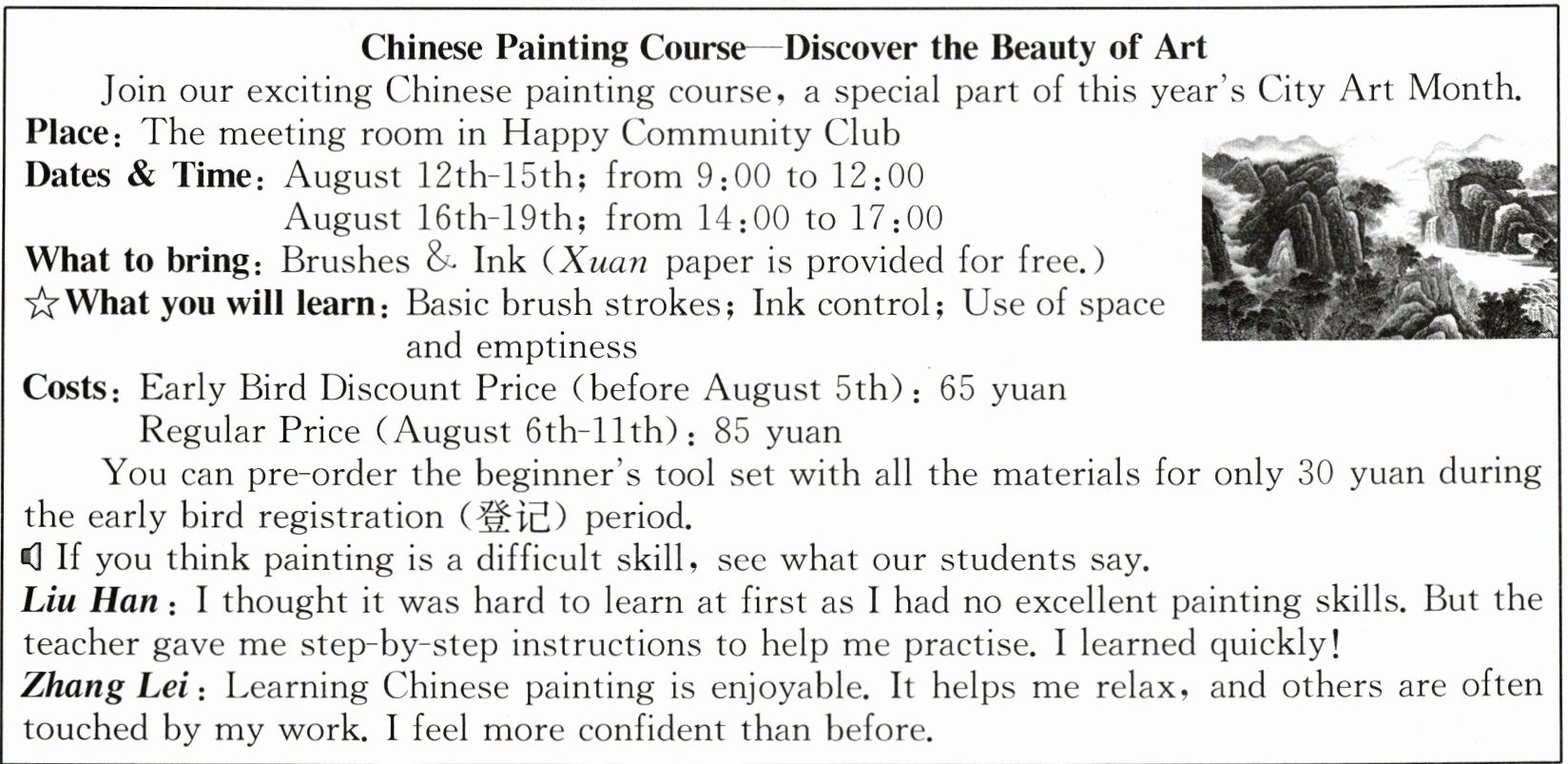
(
A. 20 yuan. B. 40 yuan. C. 70 yuan. D. 130 yuan.
(
A. They both have excellent painting skills.
B. They both think Chinese painting is quite difficult.
C. They both consider the course a good experience.
D. They both believe Chinese painting needs a lot of practice.
(
A. An advertisement. B. A report. C. A notice. D. A study.
A
Chinese Painting Course—Discover the Beauty of Art
Join our exciting Chinese painting course, a special part of this year’s City Art Month.
Place: The meeting room in Happy Community Club
Dates & Time: August 12th-15th; from 9:00 to 12:00
August 16th-19th; from 14:00 to 17:00
What to bring: Brushes & Ink (Xuan paper is provided for free.)
☆What you will learn: Basic brush strokes; Ink control; Use of space and emptiness
Costs: Early Bird Discount Price (before August 5th): 65 yuan
Regular Price (August 6th-11th): 85 yuan
You can pre-order the beginner’s tool set with all the materials for only 30 yuan during the early bird registration (登记) period.
If you think painting is a difficult skill, see what our students say.
Liu Han: I thought it was hard to learn at first as I had no excellent painting skills. But the teacher gave me step-by-step instructions to help me practise. I learned quickly!
Zhang Lei: Learning Chinese painting is enjoyable. It helps me relax, and others are often touched by my work. I feel more confident than before.
(
B
) 1. How much will Mr Li save if his twin sons sign up before August 5th?A. 20 yuan. B. 40 yuan. C. 70 yuan. D. 130 yuan.
(
C
) 2. What do the two students have in common?A. They both have excellent painting skills.
B. They both think Chinese painting is quite difficult.
C. They both consider the course a good experience.
D. They both believe Chinese painting needs a lot of practice.
(
A
) 3. What’s the text?A. An advertisement. B. A report. C. A notice. D. A study.
答案:1. B
2. C
3. A
2. C
3. A
解析:
【分析】
本题为应用文阅读理解题,包含细节计算、细节对比、文体判断三类题型。解题思路:1. 第1题需先定位课程的早鸟价和常规价,计算单个孩子的费用差后,乘以2(双胞胎)得出总节省金额;2. 第2题需分别提取两位学生的观点,对比选项找出共同点;3. 第3题需根据文本的宣传性质判断文体。
【解析】
1. 第1题:根据文本,早鸟价(8月5日前)为65元,常规价(8月6-11日)为85元,单个孩子节省85-65=20元,双胞胎共节省20×2=40元,对应选项B。
2. 第2题:Liu Han提到虽起初觉得难但在老师指导下学得快,Zhang Lei提到课程有趣、让人放松、增强自信,均认为课程是好的体验,对应选项C;A项与Liu Han“起初无优秀绘画技能”不符,B项与Zhang Lei观点不符,D项Zhang Lei未提及,故排除。
3. 第3题:文本是对中国画课程的宣传推广,属于广告,对应选项A;B项报告、C项通知、D项研究均不符合文本性质,排除。
【答案】
1. B 2. C 3. A
【知识点】
阅读理解细节理解、阅读理解主旨大意、应用文文体判断
【点评】
本题考查学生对应用文信息的提取、分析及文体判断能力,题型基础,贴近生活,适合学生练习。
【难度系数】
0.6
本题为应用文阅读理解题,包含细节计算、细节对比、文体判断三类题型。解题思路:1. 第1题需先定位课程的早鸟价和常规价,计算单个孩子的费用差后,乘以2(双胞胎)得出总节省金额;2. 第2题需分别提取两位学生的观点,对比选项找出共同点;3. 第3题需根据文本的宣传性质判断文体。
【解析】
1. 第1题:根据文本,早鸟价(8月5日前)为65元,常规价(8月6-11日)为85元,单个孩子节省85-65=20元,双胞胎共节省20×2=40元,对应选项B。
2. 第2题:Liu Han提到虽起初觉得难但在老师指导下学得快,Zhang Lei提到课程有趣、让人放松、增强自信,均认为课程是好的体验,对应选项C;A项与Liu Han“起初无优秀绘画技能”不符,B项与Zhang Lei观点不符,D项Zhang Lei未提及,故排除。
3. 第3题:文本是对中国画课程的宣传推广,属于广告,对应选项A;B项报告、C项通知、D项研究均不符合文本性质,排除。
【答案】
1. B 2. C 3. A
【知识点】
阅读理解细节理解、阅读理解主旨大意、应用文文体判断
【点评】
本题考查学生对应用文信息的提取、分析及文体判断能力,题型基础,贴近生活,适合学生练习。
【难度系数】
0.6
B
Alia was disappointed. She had been sick when everyone else chose their courses. She had hoped for science, but by the time she chose, the science classes were already full. She had to take the art class. Alia loves science because it uses facts and rules to explain how things work, but art feels so unscientific.
The first class project was drawing self-portraits(自画像). Some students drew using mirrors, while others worked from photos. She saw her classmates looking carefully at their faces and then drawing slowly. Alia, however, felt out of place.
The teacher walked over and said, “Every portrait starts with a circle. Then we add lines and a triangle to place the eyes, nose, and mouth.” He drew a few small portraits to show the detailed steps. Alia noticed the features on the faces of the portraits were in almost the same places. Alia nervously began her own self-portrait. She found it interesting to measure(测量) where to put her eyes and mouth. She drew the basic shape of a head, and then used lines to add the features. She had to pay attention to every detail. One wrong line could mess everything up.
Alia was surprised by how much effort drawing required. It required measuring, noticing details, and showing the basic nature of something. It made her realize that art could be scientific in its own way. She understood that art also had its rules and steps, just like science. By the end of the project, Alia felt thankful for the experience. It allowed her to see art in a new light.
(
A. She forgot to bring any tools.
B. Her classmates laughed at her skills.
C. She preferred science at that time.
D. The teacher’s instructions were hard to follow.
(
A. He provided her with nice drawing tools.
B. He allowed her to change to the science class.
C. He showed her drawing methods step by step.
D. He drew a self-portrait for her as an example.
(
A. Sad→excited→nervous→surprised
B. Satisfied→angry→curious→regretful
C. Bored→relaxed→worried→proud
D. Down→uncomfortable→interested→thankful
(
A. She would give up science to learn art.
B. Art has its own scientific ways and rules.
C. Science is easier to learn than art.
D. Drawing is useless for science lovers.
(
A. A Challenging Art Project
B. Alia’s New View of Art
C. How to Draw Self-portraits
D. The Similarities Between Science and Art
Alia was disappointed. She had been sick when everyone else chose their courses. She had hoped for science, but by the time she chose, the science classes were already full. She had to take the art class. Alia loves science because it uses facts and rules to explain how things work, but art feels so unscientific.
The first class project was drawing self-portraits(自画像). Some students drew using mirrors, while others worked from photos. She saw her classmates looking carefully at their faces and then drawing slowly. Alia, however, felt out of place.
The teacher walked over and said, “Every portrait starts with a circle. Then we add lines and a triangle to place the eyes, nose, and mouth.” He drew a few small portraits to show the detailed steps. Alia noticed the features on the faces of the portraits were in almost the same places. Alia nervously began her own self-portrait. She found it interesting to measure(测量) where to put her eyes and mouth. She drew the basic shape of a head, and then used lines to add the features. She had to pay attention to every detail. One wrong line could mess everything up.
Alia was surprised by how much effort drawing required. It required measuring, noticing details, and showing the basic nature of something. It made her realize that art could be scientific in its own way. She understood that art also had its rules and steps, just like science. By the end of the project, Alia felt thankful for the experience. It allowed her to see art in a new light.
(
C
)4. What made Alia feel out of place in the first art class?A. She forgot to bring any tools.
B. Her classmates laughed at her skills.
C. She preferred science at that time.
D. The teacher’s instructions were hard to follow.
(
C
)5. How did the teacher help Alia with the project?A. He provided her with nice drawing tools.
B. He allowed her to change to the science class.
C. He showed her drawing methods step by step.
D. He drew a self-portrait for her as an example.
(
D
)6. What’s the change in Alia’s feelings during the art class?A. Sad→excited→nervous→surprised
B. Satisfied→angry→curious→regretful
C. Bored→relaxed→worried→proud
D. Down→uncomfortable→interested→thankful
(
B
)7. What can we infer from Alia’s experience?A. She would give up science to learn art.
B. Art has its own scientific ways and rules.
C. Science is easier to learn than art.
D. Drawing is useless for science lovers.
(
B
)8. What’s the best title for the text?A. A Challenging Art Project
B. Alia’s New View of Art
C. How to Draw Self-portraits
D. The Similarities Between Science and Art
答案:4. C
5. C
6. D
7. B
8. B
5. C
6. D
7. B
8. B
解析:
【分析】
这是一篇记叙文阅读理解,需通过定位原文细节、梳理情感变化、把握主旨来解答各题:
1. 第4题:定位Alia的情感与态度,她原本热爱科学,认为艺术不科学,在艺术课上看到同学作画时感到格格不入,对应选项C。
2. 第5题:定位老师的帮助行为,老师通过画小肖像展示详细步骤,即逐步教授绘画方法,对应选项C。
3. 第6题:梳理Alia的情感变化:从最初的失望(对应down)→课中格格不入(对应uncomfortable)→绘画时觉得有趣(对应interested)→项目结束后感恩(对应thankful),对应选项D。
4. 第7题:根据原文最后一段的表述,推断出艺术有自身的规则和步骤,类似科学,对应选项B。
5. 第8题:全文围绕Alia对艺术的看法转变展开,核心是她对艺术的新视角,对应选项B。
【解析】
4. 细节理解题:根据第一段“Alia loves science because it uses facts and rules to explain how things work, but art feels so unscientific.”及第二段“Alia, however, felt out of place.”可知,Alia因当时更喜欢科学,在艺术课上感到格格不入,故选C。
5. 细节理解题:根据第三段“He drew a few small portraits to show the detailed steps.”可知,老师通过逐步展示绘画方法帮助Alia,故选C。
6. 细节理解题:梳理Alia的情感变化:开头失望→课中不适→绘画时感兴趣→最后感恩,对应选项D,故选D。
7. 推理判断题:根据最后一段“It made her realize that art could be scientific in its own way. She understood that art also had its rules and steps, just like science.”可推断出艺术有自己的科学方法和规则,故选B。
8. 主旨大意题:全文讲述Alia因错过科学课选了艺术课,通过艺术课经历对艺术产生了新看法,故最佳标题为“Alia’s New View of Art”,故选B。
【答案】
4. C
5. C
6. D
7. B
8. B
【知识点】
阅读理解细节理解、阅读理解推理判断、阅读理解主旨大意
【点评】
本文通过Alia的艺术课经历,考查学生对记叙文细节查找、情感梳理、推理及主旨把握的能力,题型全面,贴近学生生活,易于理解。
【难度系数】
0.7
这是一篇记叙文阅读理解,需通过定位原文细节、梳理情感变化、把握主旨来解答各题:
1. 第4题:定位Alia的情感与态度,她原本热爱科学,认为艺术不科学,在艺术课上看到同学作画时感到格格不入,对应选项C。
2. 第5题:定位老师的帮助行为,老师通过画小肖像展示详细步骤,即逐步教授绘画方法,对应选项C。
3. 第6题:梳理Alia的情感变化:从最初的失望(对应down)→课中格格不入(对应uncomfortable)→绘画时觉得有趣(对应interested)→项目结束后感恩(对应thankful),对应选项D。
4. 第7题:根据原文最后一段的表述,推断出艺术有自身的规则和步骤,类似科学,对应选项B。
5. 第8题:全文围绕Alia对艺术的看法转变展开,核心是她对艺术的新视角,对应选项B。
【解析】
4. 细节理解题:根据第一段“Alia loves science because it uses facts and rules to explain how things work, but art feels so unscientific.”及第二段“Alia, however, felt out of place.”可知,Alia因当时更喜欢科学,在艺术课上感到格格不入,故选C。
5. 细节理解题:根据第三段“He drew a few small portraits to show the detailed steps.”可知,老师通过逐步展示绘画方法帮助Alia,故选C。
6. 细节理解题:梳理Alia的情感变化:开头失望→课中不适→绘画时感兴趣→最后感恩,对应选项D,故选D。
7. 推理判断题:根据最后一段“It made her realize that art could be scientific in its own way. She understood that art also had its rules and steps, just like science.”可推断出艺术有自己的科学方法和规则,故选B。
8. 主旨大意题:全文讲述Alia因错过科学课选了艺术课,通过艺术课经历对艺术产生了新看法,故最佳标题为“Alia’s New View of Art”,故选B。
【答案】
4. C
5. C
6. D
7. B
8. B
【知识点】
阅读理解细节理解、阅读理解推理判断、阅读理解主旨大意
【点评】
本文通过Alia的艺术课经历,考查学生对记叙文细节查找、情感梳理、推理及主旨把握的能力,题型全面,贴近学生生活,易于理解。
【难度系数】
0.7