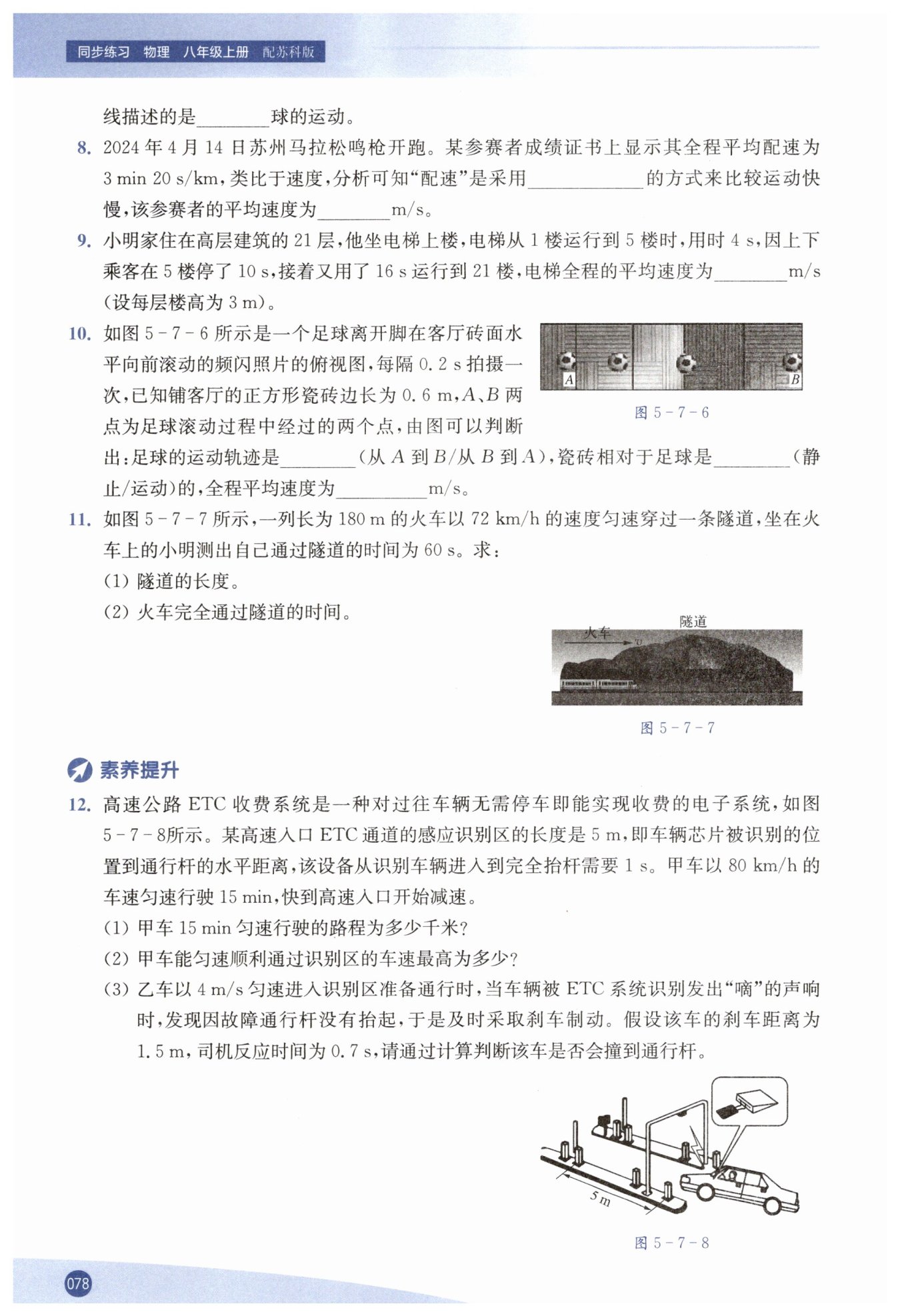
第78页

信息发布者:
A
相同路程比时间
5
2
从B到A
运动
4
(1)火车的速度$v = 72\ \text{km/h} = 72\times\frac{1000}{3600}\ \text{m/s} = 20\ \text{m/s}。$
小明通过隧道的时间$t_1 = 60\ \text{s},$小明通过隧道的路程等于隧道长度$L,$由$v = \frac{s}{t}$可得:
$L = vt_1 = 20\ \text{m/s} \times 60\ \text{s} = 1200\ \text{m}。$
(2)火车完全通过隧道的路程$s = L + L_{\text{车}} = 1200\ \text{m} + 180\ \text{m} = 1380\ \text{m},$
则完全通过隧道的时间$t_2 = \frac{s}{v} = \frac{1380\ \text{m}}{20\ \text{m/s}} = 69\ \text{s}。$
(1)已知甲车匀速行驶的速度$v = 80\ \text{km/h},$行驶时间$t = 15\ \text{min} = 15\times\frac{1}{60}\ \text{h} = 0.25\ \text{h},$根据路程公式$s=vt,$可得甲车15 min匀速行驶的路程为:$s = 80\ \text{km/h}\times0.25\ \text{h}=20\ \text{km}。$(2)感应识别区的长度$s'=5\ \text{m},$设备从识别到完全抬杆需要时间$t' = 1\ \text{s},$根据速度公式$v=\frac{s}{t},$可得最高车速$v_{\text{max}}=\frac{s'}{t'}=\frac{5\ \text{m}}{1\ \text{s}} = 5\ \text{m/s},$因为$1\ \text{m/s}=3.6\ \text{km/h},$所以$5\ \text{m/s}=5\times3.6\ \text{km/h}=18\ \text{km/h}。$(3)乙车速度$v_{\text{乙}} = 4\ \text{m/s},$司机反应时间$t_{\text{反}}=0.7\ \text{s},$根据$s=vt,$反应时间内行驶的路程$s_{\text{反}}=v_{\text{乙}}t_{\text{反}}=4\ \text{m/s}\times0.7\ \text{s}=2.8\ \text{m},$刹车距离$s_{\text{刹}}=1.5\ \text{m},$则总距离$s_{\text{总}}=s_{\text{反}}+s_{\text{刹}}=2.8\ \text{m}+1.5\ \text{m}=4.3\ \text{m},$因为$4.3\ \text{m}<5\ \text{m},$所以该车不会撞到通行杆。
电梯运行的总路程:从1楼到21楼,共经过$21 - 1 = 20$层,每层楼高3m,所以总路程$s=20×3 = 60\,m$。
电梯运行的总时间:从1楼到5楼用时4s,在5楼停10s,从5楼到21楼用时16s,总时间$t=4 + 10 + 16=30\,s$。
平均速度$v=\frac{s}{t}=\frac{60}{30}=2\,m/s$。
2