解:
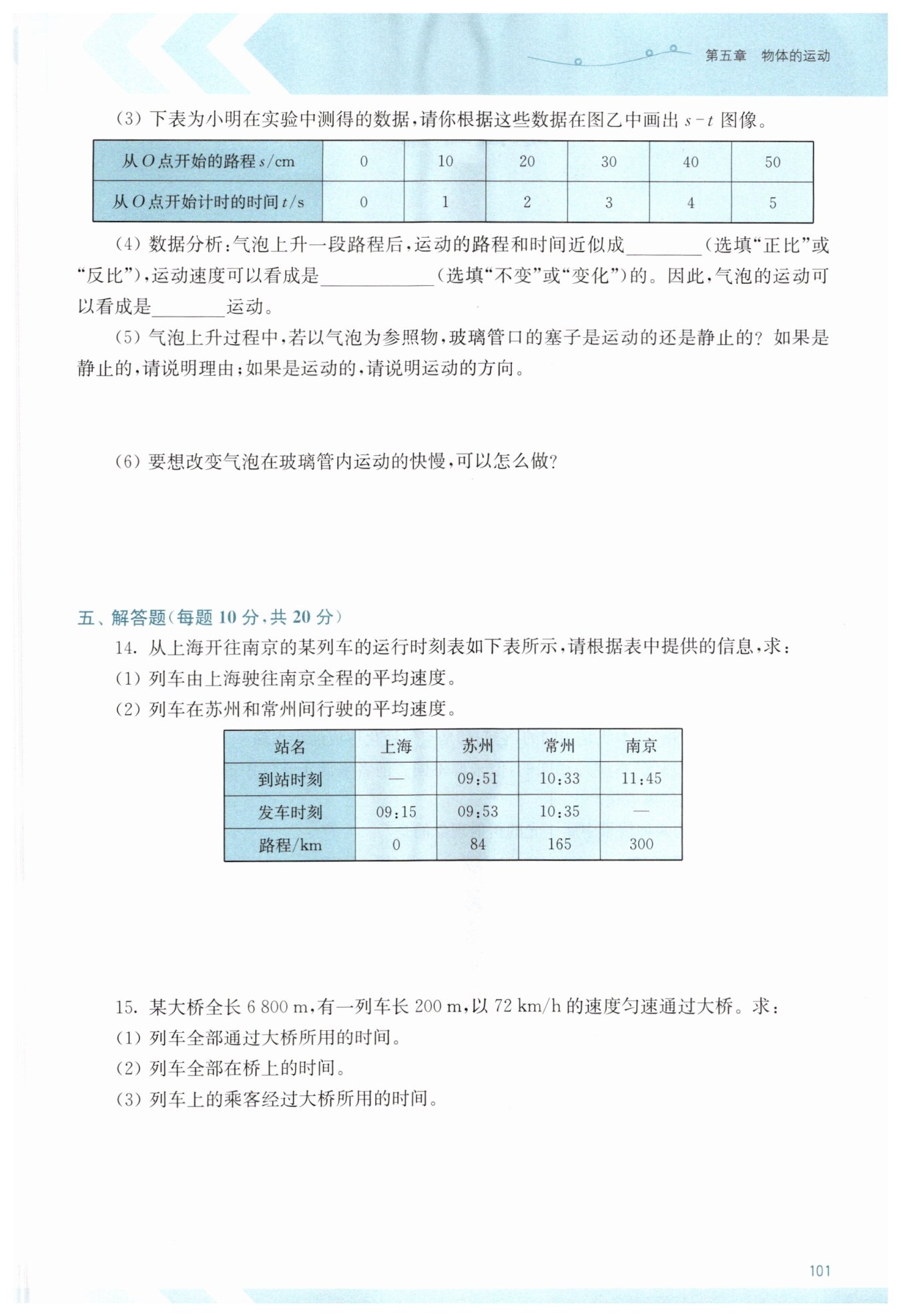
(1)列车全部通过大桥所行驶的路程为大桥的长度与列车自身长度之和,即$s = 6800\ \text{m} + 200\ \text{m} = 7000\ \text{m}。$
列车速度$v = 72\ \text{km/h} = 72\times\frac{1000}{3600}\ \text{m/s} = 20\ \text{m/s}。$
根据$t=\frac{s}{v},$可得列车全部通过大桥所用的时间$t = \frac{7000\ \text{m}}{20\ \text{m/s}} = 350\ \text{s}。$
(2)列车全部在桥上时行驶的路程为大桥的长度减去列车自身长度,即$s' = 6800\ \text{m} - 200\ \text{m} = 6600\ \text{m}。$
则列车全部在桥上的时间$t' = \frac{6600\ \text{m}}{20\ \text{m/s}} = 330\ \text{s}。$
(3)列车上的乘客经过大桥,乘客行驶的路程为大桥的长度,即$s'' = 6800\ \text{m}。$
所以乘客经过大桥所用的时间$t'' = \frac{6800\ \text{m}}{20\ \text{m/s}} = 340\ \text{s}。$
答:(1)列车全部通过大桥所用的时间为$350\ \text{s};$(2)列车全部在桥上的时间为$330\ \text{s};$(3)列车上的乘客经过大桥所用的时间为$340\ \text{s}。$