第54页

信息发布者:
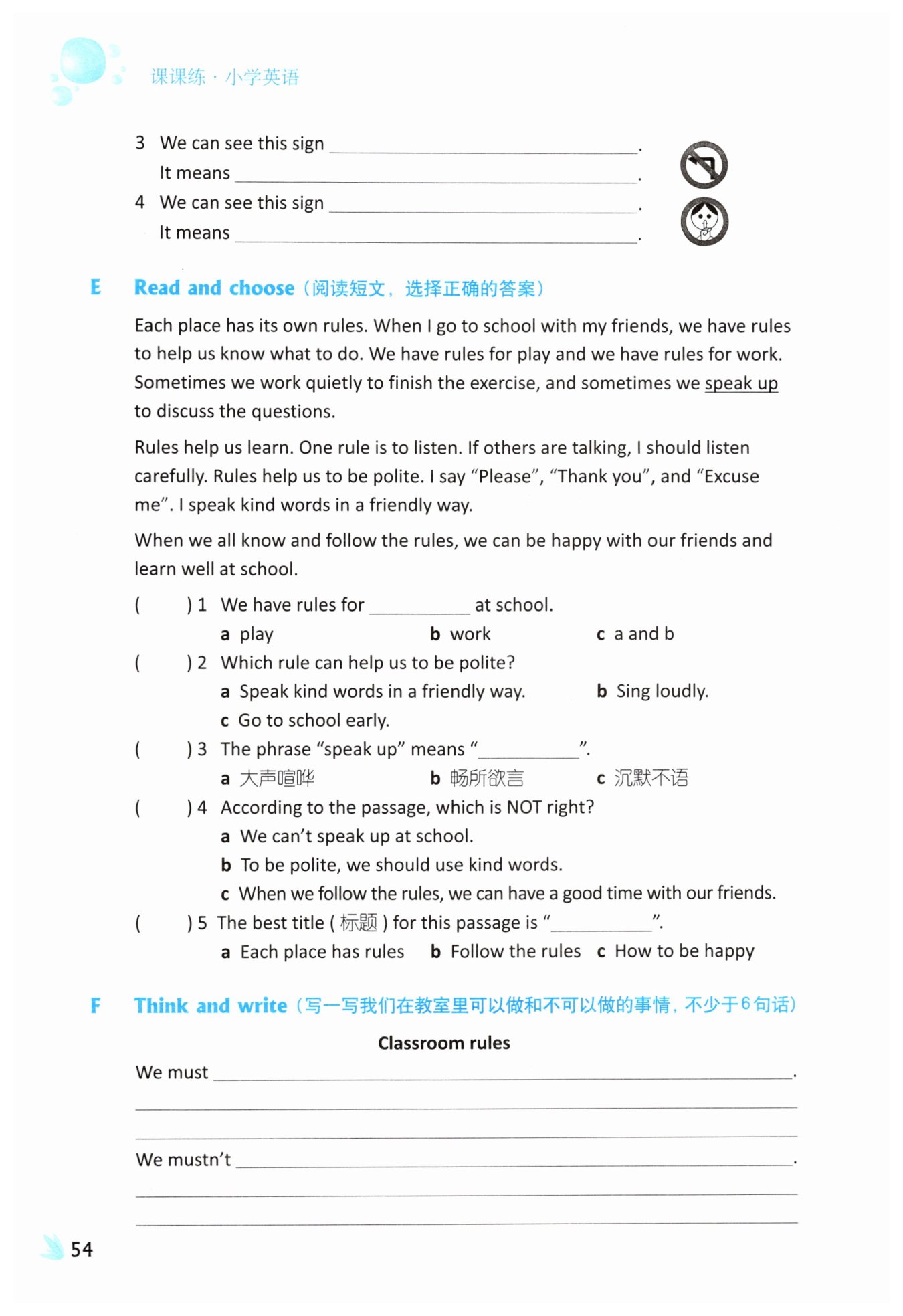
in the street/on the road
we can't/mustn't/shouldn't turn left
in the library/reading room
we can't/mustn't/shouldn't talk loudly there
c
a
b
a
b
b
be friendly to our classmates. And we must listen to our teachers carefully
It's kind of you to help others.

talk loudly in class. It's impolite. Don't run in the classroom.
We mustn't eat or drink in class.

【解析】
1. 图1为草坪相关标识,表达禁止在草坪行走的含义,需用表禁止的情态动词can't/mustn't/shouldn't加动词原形walk来补全。
2. 禁吃喝类标识常见于图书馆、地铁、书店等场所,含义为我们不能在该场所吃喝。
3. 禁左转标识通常设置在街道、马路上,含义为我们不能在此处左转。
4. 禁大声喧哗标识多出现于图书馆、阅览室,含义为我们不能在该场所大声交谈。
【答案】
1 can't/mustn't/shouldn't walk
2 in the library/on the metro/in a bookshop, we can't/mustn't/shouldn't eat or drink there
3 in the street/on the road, we can't/mustn't/ shouldn't turn left
4 in the library/reading room, we can't/mustn't/ shouldn't talk loudly there
【知识点】
公共标识英语表达、情态动词否定用法、场景英语运用
【点评】
本题考查常见公共标识的英文表达及语境运用,需结合生活场景理解标识含义,掌握情态动词表禁止的多种表达形式,提升英语在生活场景中的运用能力。
【难度系数】
0.6
【解析】
1. 根据短文第一段“We have rules for play and we have rules for work.”可知,学校里既有玩耍的规则也有学习的规则,故选c。
2. 由第二段“Rules help us to be polite... I speak kind words in a friendly way.”可知,用友好的方式说友善的话是帮助我们有礼貌的规则,故选a。
3. 结合句子“sometimes we speak up to discuss the questions”的语境,讨论问题时需要畅所欲言,所以“speak up”意为“畅所欲言”,故选b。
4. 文中提到“sometimes we speak up to discuss the questions”,说明在学校有时可以畅所欲言,a选项“We can’t speak up at school.”表述错误,故选a。
5. 短文主要讲述了规则的作用以及遵守规则的好处,最佳标题是“Follow the rules”,故选b。
【答案】
1. c 2. a 3. b 4. a 5. b
【知识点】
阅读理解细节查找;短语词义猜测;主旨大意归纳
【点评】
本文围绕校园规则展开,题目涵盖细节理解、词义猜测、主旨归纳等题型,考查学生的综合阅读能力,有助于学生养成关注文本细节、归纳主旨的阅读习惯。
【难度系数】
0.7