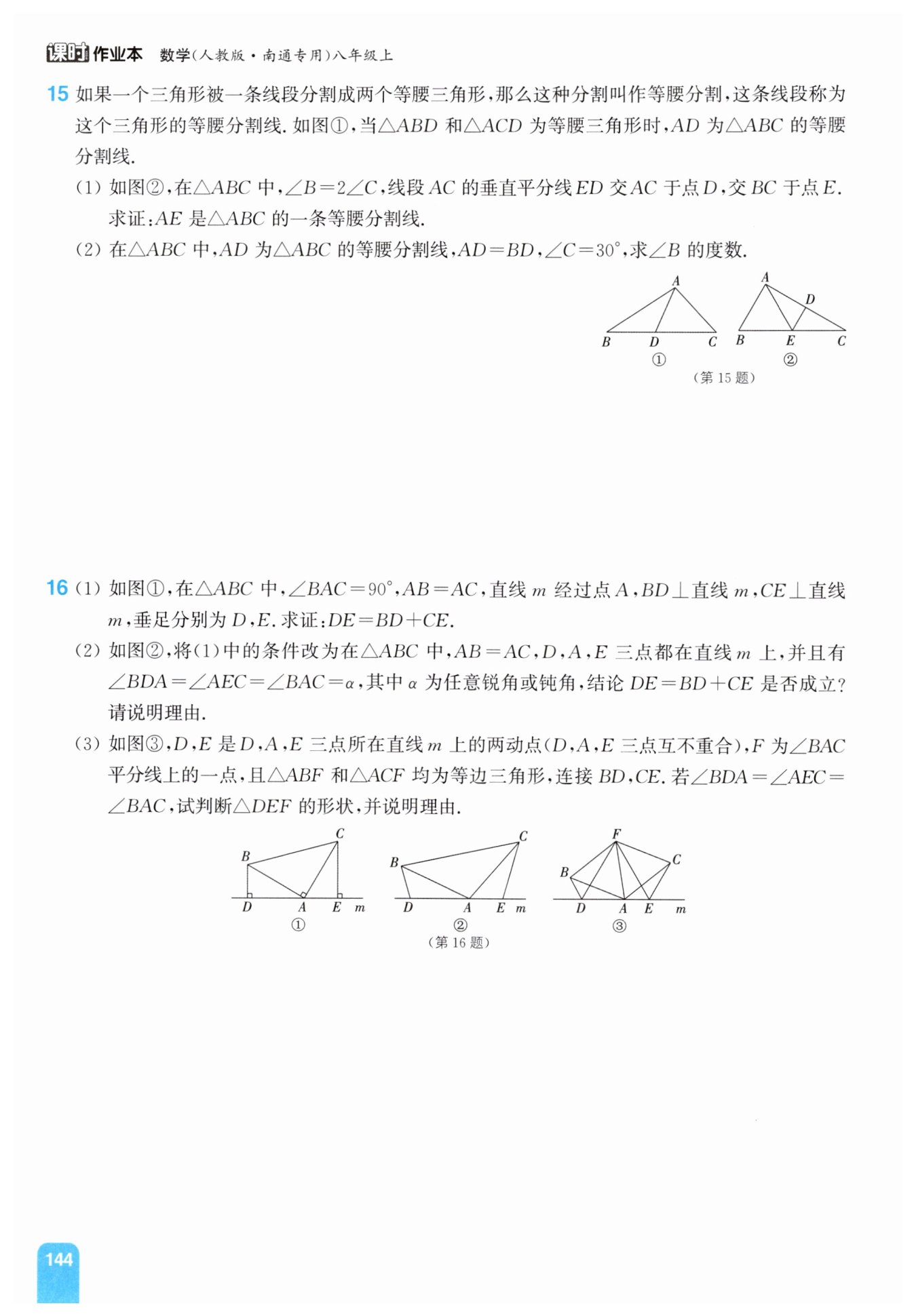
证明:(1) $\because BD⊥$直线$m,$$CE⊥$直线$m,$$\therefore ∠ BDA=∠ AEC=90°。$
$\because ∠ BAC=90°,$$\therefore ∠ BAD+∠ CAE=90°。$
$\because ∠ BAD+∠ ABD=90°,$$\therefore ∠ CAE=∠ ABD。$
又$\because AB=CA,$$\therefore △ ADB≌△ CEA。$
$\therefore BD=AE,$$AD=CE。$
$\therefore DE=AE+AD=BD+CE。$
(2) 解:成立,理由如下:
$\because ∠ BDA=∠ BAC=α,$
$\therefore ∠ DBA+∠ BAD=∠ BAD+∠ EAC=180°-α。$
$\therefore ∠ DBA=∠ EAC。$
又$\because ∠ BDA=∠ AEC=α,$$AB=CA,$
$\therefore △ ADB≌△ CEA。$
$\therefore BD=AE,$$AD=CE。$
$\therefore DE=AE+AD=BD+CE。$
(3) 解:$△ DEF$为等边三角形,理由如下:
由(2)知$∠ DBA=∠ EAC,$$△ ADB≌△ CEA,$$\therefore BD=AE。$
$\because △ ABF$和$△ ACF$均为等边三角形,
$\therefore BF=AF,$$∠ BFA=∠ ABF=∠ CAF=60°。$
$\therefore ∠ DBA+∠ ABF=∠ EAC+∠ CAF,$即$∠ DBF=∠ EAF。$
又$\because BF=AF,$$BD=AE,$$\therefore △ DBF≌△ EAF。$
$\therefore DF=EF,$$∠ BFD=∠ AFE。$
$\therefore ∠ DFE=∠ DFA+∠ AFE=∠ DFA+∠ BFD=∠ BFA=60°。$
$\therefore △ DEF$为等边三角形。