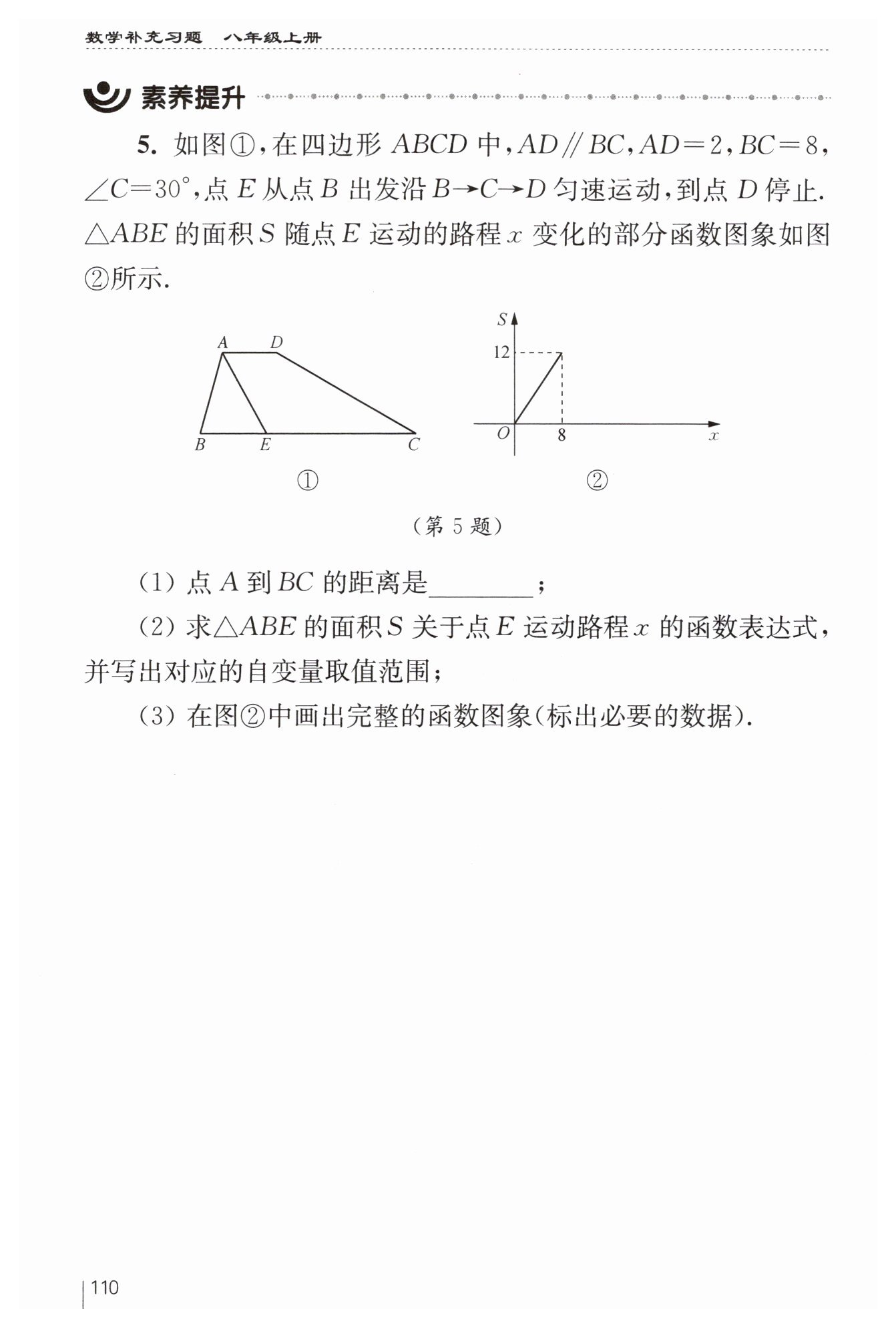
解:分两种情况讨论:
①当点E在BC上运动,即$0≤ x≤ 8$时,
点A到BC的距离为3,因此$S=\dfrac{1}{2} · x · 3 = \dfrac{3}{2}x;$
②当点E在CD上运动时,
过点D作$DF⊥ BC$于F,可得$DF=3,$
$\because ∠ C=30°,$$\therefore CD=2DF=6,$
点E运动到D点时的总路程为$BC+CD=8+6=14,$即自变量取值范围是$8< x≤ 14。$
当点E在点C处时,$S=12;$当点E在点D处时,
$\because AD// BC,$$AD=2,$点B到直线AD的距离为3,
$\therefore S_{△ ABD}=\dfrac{1}{2} × 2 × 3=3。$
设该段函数表达式为$S=kx+b,$将$(8,12),$$(14,3)$代入得:
$\begin{cases} 8k + b = 12 \\ 14k + b = 3 \end{cases}$
解得$\begin{cases} k=-\dfrac{3}{2} \\ b=24 \end{cases}$
$\therefore S=-\dfrac{3}{2}x +24。$
综上,$△ ABE$的面积S关于x的函数表达式为
$S=\begin{cases} \dfrac{3}{2}x & (0≤ x≤ 8) \\ -\dfrac{3}{2}x +24 & (8< x≤ 14) \end{cases}$
完整函数图象:连接原点$(0,0)$与点$(8,12),$再连接点$(8,12)$与点$(14,3),$标注端点坐标$(14,3)$即可。