一、词汇运用
1. The volunteers
2. Sometimes, just a small mistake might lead to
3. It snowed
4. Because of too much work, my mother is always in a nervous
5. My head was
6. There were several car a
7. When the teacher asked about the broken window, all of us kept s
8. The local museum is open to the tourists e
1. The volunteers
cleared
(清理) the plastic waste on the beach after the festival.2. Sometimes, just a small mistake might lead to
terrible
(可怕的) problems.3. It snowed
heavily
(大量地) overnight, covering the town in a thick white blanket.4. Because of too much work, my mother is always in a nervous
state
(状态).5. My head was
aching
(疼痛) all night, so I couldn't fall asleep until early this morning.6. There were several car a
ccidents
on the road, so we were trapped for 20 minutes.7. When the teacher asked about the broken window, all of us kept s
ilent
.8. The local museum is open to the tourists e
xcept
on Monday.答案:1. cleared 2. terrible 3. heavily 4. state 5. aching 6. accidents 7. silent 8. except
解析:
翻译:
一、词汇运用
1. 节日过后,志愿者们清理了海滩上的塑料垃圾。
2. 有时候,仅仅一个小错误就可能导致可怕的问题。
3. 一夜之间雪下得很大,整个城镇都被厚厚的白色积雪覆盖。
4. 因为工作太多,我的妈妈总是处于紧张的状态。
5. 我的头整晚都在疼,所以直到今天凌晨我才睡着。
6. 路上发生了几起车祸,所以我们被困了20分钟。
7. 当老师询问关于破碎的窗户的事情时,我们所有人都保持沉默。
8. 当地的博物馆除了周一都对游客开放。
一、词汇运用
1. 节日过后,志愿者们清理了海滩上的塑料垃圾。
2. 有时候,仅仅一个小错误就可能导致可怕的问题。
3. 一夜之间雪下得很大,整个城镇都被厚厚的白色积雪覆盖。
4. 因为工作太多,我的妈妈总是处于紧张的状态。
5. 我的头整晚都在疼,所以直到今天凌晨我才睡着。
6. 路上发生了几起车祸,所以我们被困了20分钟。
7. 当老师询问关于破碎的窗户的事情时,我们所有人都保持沉默。
8. 当地的博物馆除了周一都对游客开放。
(
— Sorry, I have no sense of ______, especially (尤其) in a new place.
A.instruction
B.action
C.information
D.direction
D
) 1. — Oh, no! We've come to a wrong place.— Sorry, I have no sense of ______, especially (尤其) in a new place.
A.instruction
B.action
C.information
D.direction
答案:1. D
解析:
翻译:
(
——对不起,我没有方向感,尤其是在一个新地方。
A. 指示
B. 行动
C. 信息
D. 方向
(
D
)1. ——哦,不!我们来错地方了。——对不起,我没有方向感,尤其是在一个新地方。
A. 指示
B. 行动
C. 信息
D. 方向
(
A.so
B.and
C.or
D.since
D
) 2. Don't worry too much about your son ______ you already know where he goes.A.so
B.and
C.or
D.since
答案:2. D
解析:
翻译:
(
A. 所以
B. 和;并且
C. 或者;否则
D. 既然
(
D
)2. 不要太担心你的儿子,______你已经知道他去哪里了。A. 所以
B. 和;并且
C. 或者;否则
D. 既然
(
A.will come; comes
B.comes; is coming
C.is coming; will come
D.comes; will come
A
) 3. I wonder if she ______ to the party tonight. If she ______, we can surprise her with a cake.A.will come; comes
B.comes; is coming
C.is coming; will come
D.comes; will come
答案:3. A
解析:
翻译:
(
A. 会来;来
B. 来;要来
C. 要来;会来
D. 来;会来
(
A
)3. 我想知道她今晚是否会来参加派对。如果她来的话,我们可以用一个蛋糕给她一个惊喜。A. 会来;来
B. 来;要来
C. 要来;会来
D. 来;会来
(
A.silent
B.broken
C.sound
D.weak
C
) 4. After the careful check, the engineer told us that the bridge was still ______ after years of heavy use.A.silent
B.broken
C.sound
D.weak
答案:4. C
解析:
翻译:
(
A. 安静的
B. 损坏的
C. 完好的
D. 脆弱的
(
C
)4. 经过仔细检查,工程师告诉我们,这座桥经过多年的频繁使用后仍然______。A. 安静的
B. 损坏的
C. 完好的
D. 脆弱的
(
A.are using
B.were using
C.used
D.will use
B
) 5. — Oh, dear! A power cut! — Sorry, I didn't know you ______ the washing machine.A.are using
B.were using
C.used
D.will use
答案:5. B
解析:
翻译:
(
A.正在使用(现在进行时)
B.正在使用(过去进行时)
C.使用(一般过去时)
D.将要使用(一般将来时)
(
B
)5. ——哦,天哪!停电了!——对不起,我不知道你正在使用洗衣机。A.正在使用(现在进行时)
B.正在使用(过去进行时)
C.使用(一般过去时)
D.将要使用(一般将来时)
(
— No, we can't. Our parents always warn us ______ in the river. It's too dangerous.
A.don't swim
B.not swimming
C.to not swim
D.not to swim
D
) 6. — It is so hot today. Why not swim in the river?— No, we can't. Our parents always warn us ______ in the river. It's too dangerous.
A.don't swim
B.not swimming
C.to not swim
D.not to swim
答案:6. D
解析:
翻译:
(
——不,我们不能。我们的父母总是警告我们不要在河里游泳。那太危险了。
A. 不要游泳
B. 不游泳(动名词形式)
C. 语法错误(正确形式应为“not to swim”)
D. 不要游泳(动词不定式的否定形式)
(
D
)6. ——今天天气太热了。为什么不在河里游泳呢?——不,我们不能。我们的父母总是警告我们不要在河里游泳。那太危险了。
A. 不要游泳
B. 不游泳(动名词形式)
C. 语法错误(正确形式应为“not to swim”)
D. 不要游泳(动词不定式的否定形式)
(
— But you'd better ______. Being too excited isn't good for your health.
A.come on
B.tidy up
C.get off
D.calm down
D
) 7. — What a wonderful volleyball match! I just can't stop cheering and shouting.— But you'd better ______. Being too excited isn't good for your health.
A.come on
B.tidy up
C.get off
D.calm down
答案:7. D
解析:
翻译:
(
——但你最好______。过于兴奋对你的健康不利。
A. 加油
B. 整理
C. 下车
D. 冷静下来
(
D
)7. ——多么精彩的一场排球比赛啊!我简直忍不住欢呼呐喊。——但你最好______。过于兴奋对你的健康不利。
A. 加油
B. 整理
C. 下车
D. 冷静下来
三、动词填空
1. — You looked worried when I saw you last time. What troubled you?
— Well, I
2. The doctor pressed a piece of cloth on the wound to stop it
3. As the sun rose, the fog
4. I
5. Mum always watches us
6. — Is there any mistake in your homework, Jim?
— I'm not sure. I
7. I had my finger cut when I
8. What way can you think of
1. — You looked worried when I saw you last time. What troubled you?
— Well, I
was thinking
(think) about how to write my self-introduction.2. The doctor pressed a piece of cloth on the wound to stop it
bleeding
(bleed).3. As the sun rose, the fog
went
(go) away from the top of the mountain.4. I
was counting
(count) down the seconds to the New Year when I got his phone call.5. Mum always watches us
to make
(make) sure we are safe when we play in the yard.6. — Is there any mistake in your homework, Jim?
— I'm not sure. I
didn’t check
(not check) it carefully.7. I had my finger cut when I
was dividing
(divide) the watermelon into pieces.8. What way can you think of
to help
(help) local people improve their living conditions?答案:1. was thinking 2. bleeding 3. went 4. was counting 5. to make 6. didn’t check 7. was dividing 8. to help
解析:
翻译:
三、动词填空
1. ——我上次见到你时,你看起来很焦虑。什么事困扰你了?
——嗯,我正在思考如何写我的自我介绍。
2. 医生把一块布按在伤口上以阻止它流血。
3. 随着太阳升起,雾从山顶消散了。
4. 当我接到他的电话时,我正在倒数迎接新年的秒数。
5. 当我们在院子里玩耍时,妈妈总是看着我们以确保我们的安全。
6. ——吉姆,你的作业里有错误吗?
——我不确定。我没有仔细检查它。
7. 当我把西瓜切成块的时候,我的手指被割伤了。
8. 你能想到什么方法来帮助当地居民改善他们的生活条件?
三、动词填空
1. ——我上次见到你时,你看起来很焦虑。什么事困扰你了?
——嗯,我正在思考如何写我的自我介绍。
2. 医生把一块布按在伤口上以阻止它流血。
3. 随着太阳升起,雾从山顶消散了。
4. 当我接到他的电话时,我正在倒数迎接新年的秒数。
5. 当我们在院子里玩耍时,妈妈总是看着我们以确保我们的安全。
6. ——吉姆,你的作业里有错误吗?
——我不确定。我没有仔细检查它。
7. 当我把西瓜切成块的时候,我的手指被割伤了。
8. 你能想到什么方法来帮助当地居民改善他们的生活条件?
四、信息还原
Natural disasters may happen at any time. When natural disasters happen, you might find yourself without water, food or power. 1.
First, know what disasters may happen in your area. You should learn about the types of disasters, such as earthquakes, floods, or typhoons. It is also a good way to follow local news and weather reports. 2.
Second, make an emergency plan. Plan a way to get your family members together if they can't find each other when the disaster happens. 3.
Third, get a family survival kit (救生包) ready. 4.
Finally, practise the plan you have made. Practise with your family and make sure that everyone knows exactly what to do.
5.
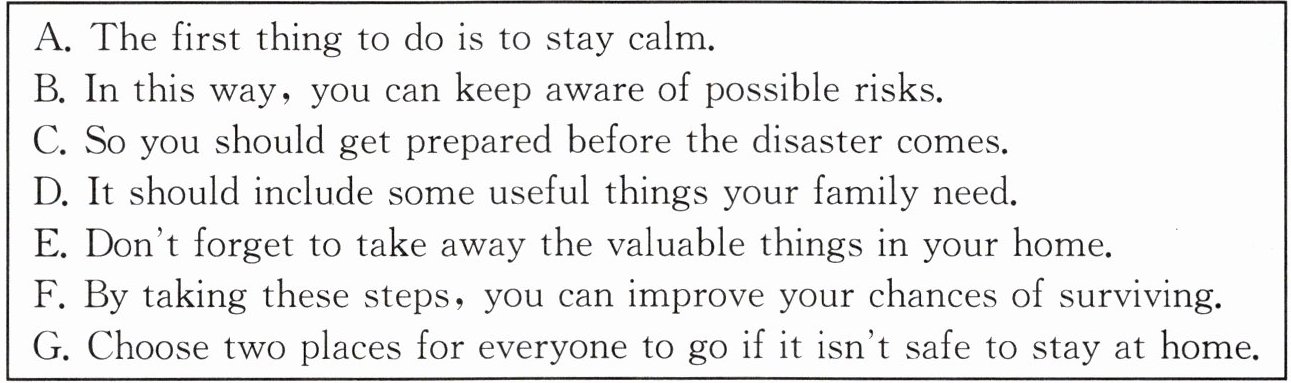
Natural disasters may happen at any time. When natural disasters happen, you might find yourself without water, food or power. 1.
C
Here are some suggestions.First, know what disasters may happen in your area. You should learn about the types of disasters, such as earthquakes, floods, or typhoons. It is also a good way to follow local news and weather reports. 2.
B
Second, make an emergency plan. Plan a way to get your family members together if they can't find each other when the disaster happens. 3.
G
Pick one place right outside your home for sudden emergencies and the other one outside of your neighbourhood.Third, get a family survival kit (救生包) ready. 4.
D
For example, water, food, medicine and some tools. Pack some special things for the old or the young of your family.Finally, practise the plan you have made. Practise with your family and make sure that everyone knows exactly what to do.
5.
F
It is impossible to stop natural disasters, but with more preparation, you can protect yourself and your loved ones better.答案:1. C 2. B 3. G 4. D 5. F
解析:
翻译:
### 四、信息还原
自然灾害可能随时发生。当自然灾害发生时,你可能会发现自己没有水、食物或电力供应。1. 这里有一些建议。
首先,了解你所在地区可能发生的灾害。你应该了解灾害的类型,如地震、洪水或台风。关注当地新闻和天气预报也是一个好方法。2.
其次,制定一个应急计划。计划一种在灾难发生时如果家人找不到彼此的情况下让他们团聚的方法。3. 为突发紧急情况选择一个就在你家外面的地方,另一个在你的街区之外。
第三,准备一个家庭救生包。4. 例如,水、食物、药品和一些工具。为你家里的老人或小孩准备一些特殊的东西。
最后,练习你制定的计划。和你的家人一起练习,确保每个人都确切地知道该做什么。
5. 阻止自然灾害是不可能的,但通过更多的准备,你可以更好地保护自己和你爱的人。
### 四、信息还原
自然灾害可能随时发生。当自然灾害发生时,你可能会发现自己没有水、食物或电力供应。1. 这里有一些建议。
首先,了解你所在地区可能发生的灾害。你应该了解灾害的类型,如地震、洪水或台风。关注当地新闻和天气预报也是一个好方法。2.
其次,制定一个应急计划。计划一种在灾难发生时如果家人找不到彼此的情况下让他们团聚的方法。3. 为突发紧急情况选择一个就在你家外面的地方,另一个在你的街区之外。
第三,准备一个家庭救生包。4. 例如,水、食物、药品和一些工具。为你家里的老人或小孩准备一些特殊的东西。
最后,练习你制定的计划。和你的家人一起练习,确保每个人都确切地知道该做什么。
5. 阻止自然灾害是不可能的,但通过更多的准备,你可以更好地保护自己和你爱的人。