一、词汇运用
1. Kate has a tight (不宽裕的)
2. Life is like a
3. Does your grandma know how to open a WeChat
4. Things made in China are popular around the world because they are of high quality (品质), but not
5. Money isn’t everything, but it
6. They met at the gate of Nanjing Museum on a
7. How about
8. The key (关键) to learning a language well is to use it in our
1. Kate has a tight (不宽裕的)
budget
(预算), but she still plans to buy her best friend a birthday gift.2. Life is like a
bank
(银行). If you put a lot of happiness in it, you can enjoy some when you feel sad.3. Does your grandma know how to open a WeChat
account
(账户)?4. Things made in China are popular around the world because they are of high quality (品质), but not
expensive
(昂贵的).5. Money isn’t everything, but it
matters
(要紧) a lot to the poor.6. They met at the gate of Nanjing Museum on a
rainy
(rain) morning.7. How about
saving
(save) some money for a sweeping robot?8. The key (关键) to learning a language well is to use it in our
daily
(day) lives.答案:1.budget 2.bank 3.account 4.expensive 5.matters 6.rainy 7.saving 8.daily
解析:
翻译:
一、词汇运用
1. 凯特的预算不宽裕,但她仍然计划给她最好的朋友买一份生日礼物。
2. 生活就像一家银行。如果你在里面存入很多快乐,当你感到悲伤时,你就可以享受一些(快乐)。
3. 你的奶奶知道如何开通一个微信账户吗?
4. 中国制造的产品在世界各地都很受欢迎,因为它们品质高,但并不昂贵。
5. 钱不是万能的,但对穷人来说它很要紧。
6. 他们在一个下雨的早晨在南京博物院的门口相遇了。
7. 攒些钱买一个扫地机器人怎么样?
8. 学好一门语言的关键是在我们的日常生活中使用它。
一、词汇运用
1. 凯特的预算不宽裕,但她仍然计划给她最好的朋友买一份生日礼物。
2. 生活就像一家银行。如果你在里面存入很多快乐,当你感到悲伤时,你就可以享受一些(快乐)。
3. 你的奶奶知道如何开通一个微信账户吗?
4. 中国制造的产品在世界各地都很受欢迎,因为它们品质高,但并不昂贵。
5. 钱不是万能的,但对穷人来说它很要紧。
6. 他们在一个下雨的早晨在南京博物院的门口相遇了。
7. 攒些钱买一个扫地机器人怎么样?
8. 学好一门语言的关键是在我们的日常生活中使用它。
(
A.have
B.has
C.having
D.to have
A
) 1.40 per cent of the students in my class __________ a computer.A.have
B.has
C.having
D.to have
答案:1.A
解析:
翻译:
我班上40%的学生______一台电脑。
A. 有(动词原形)
B. 有(动词的第三人称单数形式)
C. 有(动名词或现在分词形式)
D. 有(动词不定式形式)
我班上40%的学生______一台电脑。
A. 有(动词原形)
B. 有(动词的第三人称单数形式)
C. 有(动名词或现在分词形式)
D. 有(动词不定式形式)
(
A.spend; on
B.take; on
C.pay; for
D.cost; in
C
) 2.I have to __________ 3 000 yuan __________ the house rent (房租) every month.A.spend; on
B.take; on
C.pay; for
D.cost; in
答案:2.C
解析:
翻译:
(
A.花费;在……上
B.花费(时间等);在……上
C.支付;为……
D.花费(物作主语);在……里
(
C
)2.我每个月得______3000元______房租。A.花费;在……上
B.花费(时间等);在……上
C.支付;为……
D.花费(物作主语);在……里
(
A.must
B.can
C.need
D.should
B
) 3.Don’t forget (忘记) to carry an umbrella when you go to visit Shanghai in July. It __________ be really rainy in that time.A.must
B.can
C.need
D.should
答案:3.B
解析:
翻译:
(
A. 一定
B. 可能
C. 需要
D. 应该
(
B
)3. 当你七月去游览上海时,别忘了带一把雨伞。那个时候天气______真的多雨。A. 一定
B. 可能
C. 需要
D. 应该
(
A.finishes
B.reads
C.means
D.covers
D
) 4.All inclusive package (一价全包) tours are popular now. The price (价格) usually __________ everything in the travelling and people needn’t pay more.A.finishes
B.reads
C.means
D.covers
答案:4.D
解析:
翻译:
(
A.完成
B.阅读
C.意味着
D.包含
(
D
)4.一价全包的旅行团现在很受欢迎。这个价格通常____旅行中的所有费用,人们不需要再支付更多费用。A.完成
B.阅读
C.意味着
D.包含
(
— __________.
A.No, you are busy too
B.You are welcome
C.Thanks, but I can manage
D.Help yourself
C
) 5.— Annie, there’s a lot to do to get ready for the dinner. Let me help you.— __________.
A.No, you are busy too
B.You are welcome
C.Thanks, but I can manage
D.Help yourself
答案:5.C
解析:
翻译:
(
——__________。
A. 不,你也很忙
B. 不客气
C. 谢谢,但我能应付
D. 请自便
(
C
)5. ——安妮,为晚餐做准备有很多事要做。让我来帮你。——__________。
A. 不,你也很忙
B. 不客气
C. 谢谢,但我能应付
D. 请自便
三、完成句子
1. 这条牛仔裤太贵了。我想要试穿另一条。
This pair of jeans _____________________ __________. I’d like _______ __________ __________.
2. 这个家庭花费百分之五十的预算在孩子的教育上。
The family spends 50 ______________ their child’s education.
3. 妈妈在她的银行账户中存了20 000元,以备不时之需。
Mum saves 20 000 yuan ______________ __________ __________.
4. 在日常生活中,你常常会做预算吗?
Do you often ______________ in your ______________?__________________________________________
1. 这条牛仔裤太贵了。我想要试穿另一条。
This pair of jeans _____________________ __________. I’d like _______ __________ __________.
2. 这个家庭花费百分之五十的预算在孩子的教育上。
The family spends 50 ______________ their child’s education.
3. 妈妈在她的银行账户中存了20 000元,以备不时之需。
Mum saves 20 000 yuan ______________ __________ __________.
4. 在日常生活中,你常常会做预算吗?
Do you often ______________ in your ______________?__________________________________________
答案:1.is too expensive/costs too much,to try another pair on 2.per cent of the budget on 3.in her bank account,a rainy day 4.make a budget,daily life
解析:
翻译:
三、完成句子
1. 这条牛仔裤太贵了。我想要试穿另一条。
这条牛仔裤太贵了。我想要试穿另一条。
2. 这个家庭花费百分之五十的预算在孩子的教育上。
这个家庭把百分之五十的预算花在孩子的教育上。
3. 妈妈在她的银行账户中存了20 000元,以备不时之需。
妈妈在她的银行账户里存了20000元,以备不时之需。
4. 在日常生活中,你常常会做预算吗?
在日常生活中,你经常做预算吗?
三、完成句子
1. 这条牛仔裤太贵了。我想要试穿另一条。
这条牛仔裤太贵了。我想要试穿另一条。
2. 这个家庭花费百分之五十的预算在孩子的教育上。
这个家庭把百分之五十的预算花在孩子的教育上。
3. 妈妈在她的银行账户中存了20 000元,以备不时之需。
妈妈在她的银行账户里存了20000元,以备不时之需。
4. 在日常生活中,你常常会做预算吗?
在日常生活中,你经常做预算吗?
四、阅读理解
The Spring Festival is a time for children to get lucky money. Do you think parents should keep their children’s lucky money? Here, some middle school students are sharing their ideas.
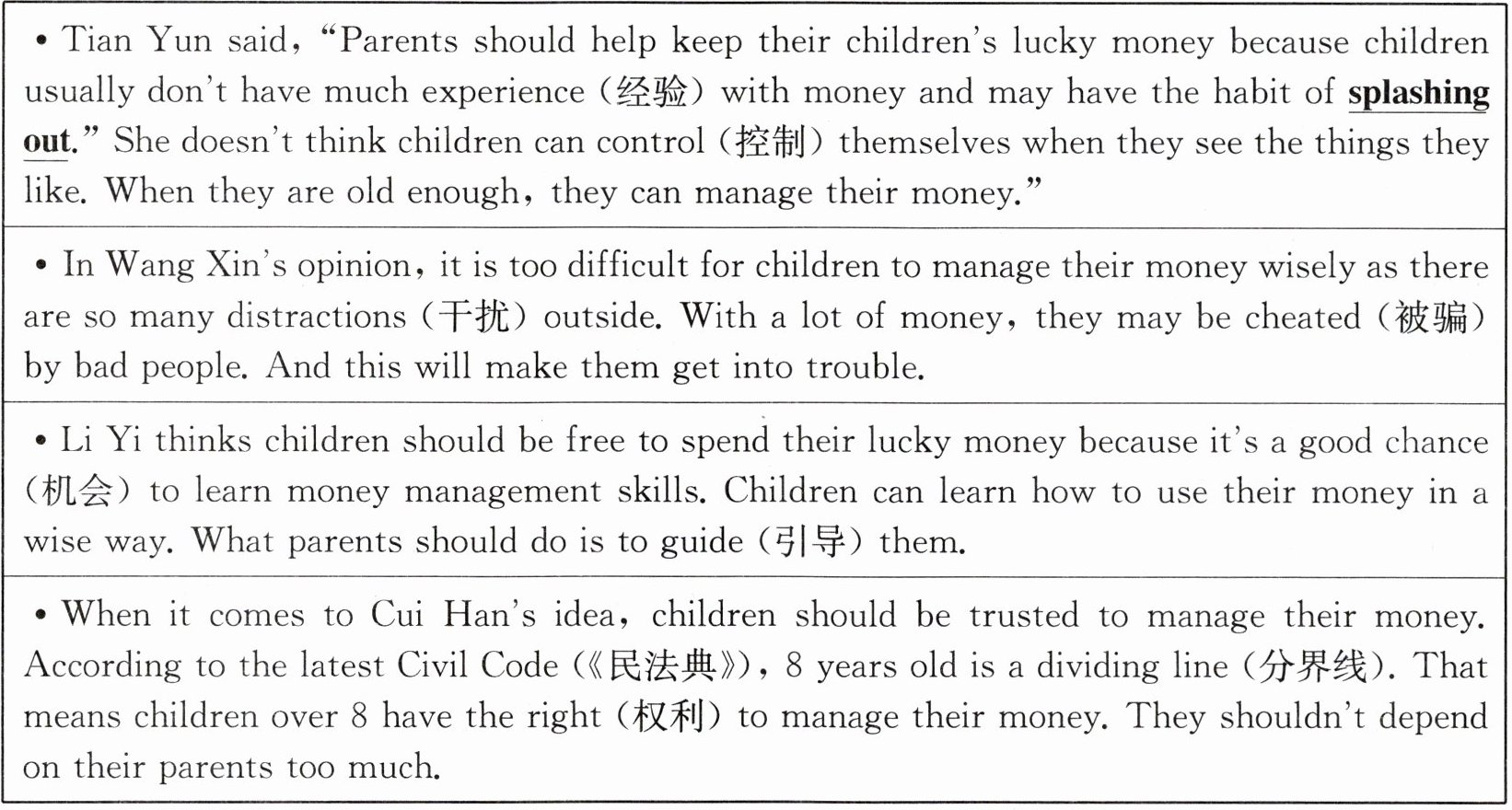
(
A. Saving money. B. Borrowing money from others.
C. Giving money to others. D. Spending money like running water.
(
① Tian Yun ② Wang Xin ③ Li Yi ④ Cui Han
a. Children may be cheated if they have a lot of money.
b. Children older than eight can manage their money.
c. Parents can guide children to spend money in a right way.
d. Children can manage their money when they grow up.
A. ①-a; ②-d; ③-b; ④-c B. ①-d; ②-a; ③-c; ④-b
C. ①-d; ②-b; ③-a; ④-c D. ①-a; ②-c; ③-d; ④-b
(
A. Who can keep lucky money. B. Where to save lucky money.
C. How to use lucky money. D. When to get lucky money.
(
A. Health and exercise. B. Family and society (社会).
C. Nature and history. D. Festivals and traditions.
The Spring Festival is a time for children to get lucky money. Do you think parents should keep their children’s lucky money? Here, some middle school students are sharing their ideas.
(
D
) 1. What do the underlined words “splashing out” probably mean?A. Saving money. B. Borrowing money from others.
C. Giving money to others. D. Spending money like running water.
(
B
) 2. Match the students with their ideas and choose the right answer.① Tian Yun ② Wang Xin ③ Li Yi ④ Cui Han
a. Children may be cheated if they have a lot of money.
b. Children older than eight can manage their money.
c. Parents can guide children to spend money in a right way.
d. Children can manage their money when they grow up.
A. ①-a; ②-d; ③-b; ④-c B. ①-d; ②-a; ③-c; ④-b
C. ①-d; ②-b; ③-a; ④-c D. ①-a; ②-c; ③-d; ④-b
(
A
) 3. What are the students talking about?A. Who can keep lucky money. B. Where to save lucky money.
C. How to use lucky money. D. When to get lucky money.
(
B
) 4. In which part of a magazine can you read the text?A. Health and exercise. B. Family and society (社会).
C. Nature and history. D. Festivals and traditions.
答案:1.D 2.B 3.A 4.B
解析:
翻译:
### 四、阅读理解
春节是孩子们收压岁钱的日子。你认为父母应该保管孩子的压岁钱吗?这里,一些中学生正在分享他们的想法。
(D)1. 划线单词“splashing out”可能是什么意思?
A. 存钱。
B. 向别人借钱。
C. 把钱给别人。
D. 花钱如流水。
(B)2. 将学生和他们的观点进行匹配,并选择正确答案。
① 田云 ② 王欣 ③ 李毅 ④ 崔晗
a. 如果孩子有很多钱,他们可能会被骗。
b. 八岁以上的孩子可以管理自己的钱。
c. 父母可以引导孩子正确花钱。
d. 孩子长大后可以管理自己的钱。
A. ① - a;② - d;③ - b;④ - c
B. ① - d;② - a;③ - c;④ - b
C. ① - d;② - b;③ - a;④ - c
D. ① - a;② - c;③ - d;④ - b
(A)3. 学生们在谈论什么?
A. 谁可以保管压岁钱。
B. 把压岁钱存到哪里。
C. 如何使用压岁钱。
D. 什么时候收压岁钱。
(B)4. 你可以在杂志的哪个部分读到这篇文章?
A. 健康与锻炼。
B. 家庭与社会。
C. 自然与历史。
D. 节日与传统。
### 四、阅读理解
春节是孩子们收压岁钱的日子。你认为父母应该保管孩子的压岁钱吗?这里,一些中学生正在分享他们的想法。
(D)1. 划线单词“splashing out”可能是什么意思?
A. 存钱。
B. 向别人借钱。
C. 把钱给别人。
D. 花钱如流水。
(B)2. 将学生和他们的观点进行匹配,并选择正确答案。
① 田云 ② 王欣 ③ 李毅 ④ 崔晗
a. 如果孩子有很多钱,他们可能会被骗。
b. 八岁以上的孩子可以管理自己的钱。
c. 父母可以引导孩子正确花钱。
d. 孩子长大后可以管理自己的钱。
A. ① - a;② - d;③ - b;④ - c
B. ① - d;② - a;③ - c;④ - b
C. ① - d;② - b;③ - a;④ - c
D. ① - a;② - c;③ - d;④ - b
(A)3. 学生们在谈论什么?
A. 谁可以保管压岁钱。
B. 把压岁钱存到哪里。
C. 如何使用压岁钱。
D. 什么时候收压岁钱。
(B)4. 你可以在杂志的哪个部分读到这篇文章?
A. 健康与锻炼。
B. 家庭与社会。
C. 自然与历史。
D. 节日与传统。