A
(
A. By trying the food. B. By visiting the red house.
C. By taking a food passport. D. By getting seven stamps.
(
① Indian dance ② Violin performance ③ Australian dance
④ Piano performance ⑤ African dance
A. ①②③ B. ①④⑤ C. ②③④ D. ③④⑤
(
A. 10 yuan. B. 50 yuan. C. 60 yuan. D. 75 yuan.
(
A. In a storybook. B. Online. C. On a poster. D. In a magazine.
(
D
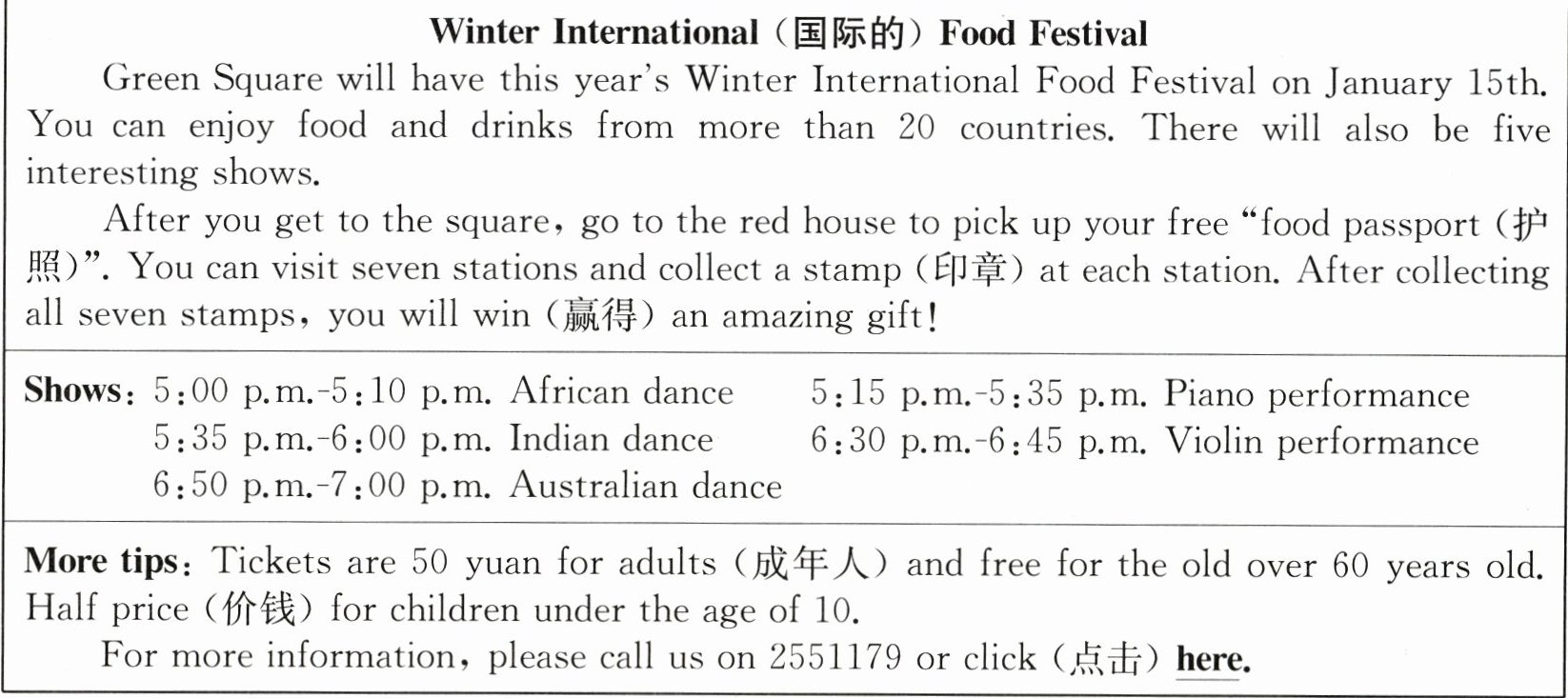
) 1. How can people win a gift?A. By trying the food. B. By visiting the red house.
C. By taking a food passport. D. By getting seven stamps.
(
A
) 2. If John has free time after 5:35 p.m., which shows can he watch?① Indian dance ② Violin performance ③ Australian dance
④ Piano performance ⑤ African dance
A. ①②③ B. ①④⑤ C. ②③④ D. ③④⑤
(
D
) 3. If Mike takes part in this festival with his 8-year-old son, how much should he pay?A. 10 yuan. B. 50 yuan. C. 60 yuan. D. 75 yuan.
(
B
) 4. Where can you probably read the passage?A. In a storybook. B. Online. C. On a poster. D. In a magazine.
答案:1-4 DADB
解析:
翻译:
(D)1. 人们怎样能赢得一份礼物?
A. 通过品尝食物。B. 通过参观红房子。
C. 通过拿一本美食护照。D. 通过获得七枚印章。
(A)2. 如果约翰下午5:35之后有空,他可以看哪些表演?
① 印度舞蹈 ② 小提琴演奏 ③ 澳大利亚舞蹈
④ 钢琴演奏 ⑤ 非洲舞蹈
A. ①②③ B. ①④⑤ C. ②③④ D. ③④⑤
(D)3. 如果迈克和他8岁的儿子参加这个节日,他应该付多少钱?
A. 10元。B. 50元。C. 60元。D. 75元。
(B)4. 你可能在哪里读到这篇文章?
A. 在一本故事书里。B. 在网上。C. 在一张海报上。D. 在一本杂志里。
(D)1. 人们怎样能赢得一份礼物?
A. 通过品尝食物。B. 通过参观红房子。
C. 通过拿一本美食护照。D. 通过获得七枚印章。
(A)2. 如果约翰下午5:35之后有空,他可以看哪些表演?
① 印度舞蹈 ② 小提琴演奏 ③ 澳大利亚舞蹈
④ 钢琴演奏 ⑤ 非洲舞蹈
A. ①②③ B. ①④⑤ C. ②③④ D. ③④⑤
(D)3. 如果迈克和他8岁的儿子参加这个节日,他应该付多少钱?
A. 10元。B. 50元。C. 60元。D. 75元。
(B)4. 你可能在哪里读到这篇文章?
A. 在一本故事书里。B. 在网上。C. 在一张海报上。D. 在一本杂志里。
B
Today, people all over China are celebrating the Laba Festival. It is a traditional Chinese festival. It is on the eighth day of the 12th lunar(农历)month. What does this festival mean to Chinese people? It just tells people to prepare for celebrating the coming New Year’s Day and wanderers to go back home to get together with their family.
Long long ago, Laba Festival was a day of thanks for a good harvest(收成). On this day, people usually ate Laba porridge. Many temples(寺庙)today also give out Laba porridge to people. The sweet, red porridge is believed to bring good luck and joy.
The festival is also the day for people to put garlic in vinegar(醋). The garlic turns green then, and have a special taste. People like to eat it with dumplings. In the past, it was used to let people remember to give back the money they borrowed, as “garlic” sounds the same as suan in Chinese, which means “calculate(计算)”.
Customs(风俗) are quite different across the country. People in Qianxian eat the Laba tofu a few days before. In Xining City, people eat porridge with beef and mutton.
(
A. the eighth day of December B. the eighth day of January
C. the eighth day of the twelfth month D. the eighth day of the twelfth lunar month
(
A. Christmas B. May Day C. Thanksgiving Day D. Water Festival
(
A. 奇迹 B. 漂泊者 C. 学者 D. 怀疑者
(
A. The garlic is a green vegetable.
B. People usually give back money before a new year comes.
C. People usually put garlic in vinegar on New Year’s Day.
D. People eat the Laba garlic before the Laba Festival.
Today, people all over China are celebrating the Laba Festival. It is a traditional Chinese festival. It is on the eighth day of the 12th lunar(农历)month. What does this festival mean to Chinese people? It just tells people to prepare for celebrating the coming New Year’s Day and wanderers to go back home to get together with their family.
Long long ago, Laba Festival was a day of thanks for a good harvest(收成). On this day, people usually ate Laba porridge. Many temples(寺庙)today also give out Laba porridge to people. The sweet, red porridge is believed to bring good luck and joy.
The festival is also the day for people to put garlic in vinegar(醋). The garlic turns green then, and have a special taste. People like to eat it with dumplings. In the past, it was used to let people remember to give back the money they borrowed, as “garlic” sounds the same as suan in Chinese, which means “calculate(计算)”.
Customs(风俗) are quite different across the country. People in Qianxian eat the Laba tofu a few days before. In Xining City, people eat porridge with beef and mutton.
(
D
) 5. The Laba Festival is on ______.A. the eighth day of December B. the eighth day of January
C. the eighth day of the twelfth month D. the eighth day of the twelfth lunar month
(
C
) 6. Laba Festival is similar to ______.A. Christmas B. May Day C. Thanksgiving Day D. Water Festival
(
B
) 7. The underlined word “wanderers” probably means “______” in Chinese.A. 奇迹 B. 漂泊者 C. 学者 D. 怀疑者
(
B
) 8. What can we learn from Paragraph 3?A. The garlic is a green vegetable.
B. People usually give back money before a new year comes.
C. People usually put garlic in vinegar on New Year’s Day.
D. People eat the Laba garlic before the Laba Festival.
答案:5-8 DCBB
解析:
翻译:
B
如今,全中国的人们都在庆祝腊八节。它是一个中国传统节日,在农历十二月初八。这个节日对中国人意味着什么呢?它只是告诉人们要为庆祝即将到来的新年做准备,也让漂泊者回家与家人团聚。
很久以前,腊八节是一个感恩丰收的日子。在这一天,人们通常会喝腊八粥。如今许多寺庙也会给人们分发腊八粥。这种甜甜的、红红的粥被认为会带来好运和欢乐。
这个节日也是人们把大蒜泡在醋里的日子。之后大蒜会变绿,并且有一种特殊的味道。人们喜欢就着饺子吃它。在过去,它被用来提醒人们归还借的钱,因为“蒜”在汉语中听起来和“算”一样,“算”的意思是“计算”。
全国各地的风俗大不相同。乾县的人们会在腊八节前几天吃腊八豆腐。在西宁市,人们会喝牛羊肉粥。
(D)5. 腊八节在______。
A. 12月8日
B. 1月8日
C. 12月8日
D. 农历十二月初八
(C)6. 腊八节与______相似。
A. 圣诞节
B. 五一劳动节
C. 感恩节
D. 泼水节
(B)7. 划线单词“wanderers”在汉语中可能的意思是“______”。
A. 奇迹
B. 漂泊者
C. 学者
D. 怀疑者
(B)8. 从第三段我们能了解到什么?
A. 大蒜是一种绿色蔬菜。
B. 人们通常在新年来临之前还钱。
C. 人们通常在新年那天把大蒜泡在醋里。
D. 人们在腊八节前吃腊八蒜。
B
如今,全中国的人们都在庆祝腊八节。它是一个中国传统节日,在农历十二月初八。这个节日对中国人意味着什么呢?它只是告诉人们要为庆祝即将到来的新年做准备,也让漂泊者回家与家人团聚。
很久以前,腊八节是一个感恩丰收的日子。在这一天,人们通常会喝腊八粥。如今许多寺庙也会给人们分发腊八粥。这种甜甜的、红红的粥被认为会带来好运和欢乐。
这个节日也是人们把大蒜泡在醋里的日子。之后大蒜会变绿,并且有一种特殊的味道。人们喜欢就着饺子吃它。在过去,它被用来提醒人们归还借的钱,因为“蒜”在汉语中听起来和“算”一样,“算”的意思是“计算”。
全国各地的风俗大不相同。乾县的人们会在腊八节前几天吃腊八豆腐。在西宁市,人们会喝牛羊肉粥。
(D)5. 腊八节在______。
A. 12月8日
B. 1月8日
C. 12月8日
D. 农历十二月初八
(C)6. 腊八节与______相似。
A. 圣诞节
B. 五一劳动节
C. 感恩节
D. 泼水节
(B)7. 划线单词“wanderers”在汉语中可能的意思是“______”。
A. 奇迹
B. 漂泊者
C. 学者
D. 怀疑者
(B)8. 从第三段我们能了解到什么?
A. 大蒜是一种绿色蔬菜。
B. 人们通常在新年来临之前还钱。
C. 人们通常在新年那天把大蒜泡在醋里。
D. 人们在腊八节前吃腊八蒜。