二、英汉词组互译
1. a business suit
2. do some reading
3. go wrong
4. look as good as new
5. catch a virus
6. no longer
7. in a mess
8. 太忙而没时间放松
9. 从某处订购某物
10. 使他的生活容易得多
11. 整理
12. 总的来说
13. 满足某人的需求
14. 撒满一地
1. a business suit
2. do some reading
3. go wrong
4. look as good as new
5. catch a virus
6. no longer
7. in a mess
8. 太忙而没时间放松
9. 从某处订购某物
10. 使他的生活容易得多
11. 整理
12. 总的来说
13. 满足某人的需求
14. 撒满一地
答案:1. 一套西装
2. 读点书;进行阅读
3. 出故障;出问题
4. 看起来和新的一样好
5. 感染病毒
6. 不再
7. 乱七八糟;一团糟
8. too busy to relax
9. order sth. from someplace
10. make his life much easier
11. tidy up
12. in general / all in all
13. meet one's needs
14. be all over the floor
2. 读点书;进行阅读
3. 出故障;出问题
4. 看起来和新的一样好
5. 感染病毒
6. 不再
7. 乱七八糟;一团糟
8. too busy to relax
9. order sth. from someplace
10. make his life much easier
11. tidy up
12. in general / all in all
13. meet one's needs
14. be all over the floor
解析:
本题考查译林版九年级下册相关的词组互译,需结合课本所学的固定搭配与常用表达,准确完成英汉、汉英的对应转换,注意词组的规范译法。
三、用方框中所给词组的适当形式填空
find their way
climb up
in the future
hold together
work together
connect with
form a bridge
a group of
Engineers in the US have created a group of robots that are able to work together to overcome obstacles (克服障碍).
“When ants collect or carry objects, if one comes upon an obstacle, the group of ants
(1) to overcome that obstacle,” explained Dr Ozkan-Aydin, who led the research. “If there’s a gap on the road, for example, some of them will (2) by holding together so the other ants can travel across. That is the inspiration for this study.”
Ozkan-Aydin and her workmates 3D-printed (3) four-legged robots. They have touch sensors (传感器) at the front and back, so that they could sense and
(4) other robots in the group. The robots were under tests of
(5) over different surfaces, including grass and rocky ground. Ozkan-Aydin also made some obstacles for them to (6) . If a robot couldn’t find its way out, it would send a signal (信号) to the other robots. Then, they would (7) with their touch sensors.
Ozkan-Aydin said this technology could be used (8) to make groups of robots to help look for people in accidents, carry things over rocky surfaces and do research in dangerous places. However, for that to become a reality, she says battery technology will need improving so that the robots can work for up to 10 hours without running out of power.
find their way
climb up
in the future
hold together
work together
connect with
form a bridge
a group of
Engineers in the US have created a group of robots that are able to work together to overcome obstacles (克服障碍).
“When ants collect or carry objects, if one comes upon an obstacle, the group of ants
(1) to overcome that obstacle,” explained Dr Ozkan-Aydin, who led the research. “If there’s a gap on the road, for example, some of them will (2) by holding together so the other ants can travel across. That is the inspiration for this study.”
Ozkan-Aydin and her workmates 3D-printed (3) four-legged robots. They have touch sensors (传感器) at the front and back, so that they could sense and
(4) other robots in the group. The robots were under tests of
(5) over different surfaces, including grass and rocky ground. Ozkan-Aydin also made some obstacles for them to (6) . If a robot couldn’t find its way out, it would send a signal (信号) to the other robots. Then, they would (7) with their touch sensors.
Ozkan-Aydin said this technology could be used (8) to make groups of robots to help look for people in accidents, carry things over rocky surfaces and do research in dangerous places. However, for that to become a reality, she says battery technology will need improving so that the robots can work for up to 10 hours without running out of power.
答案:(1) work together
(2) form a bridge
(3) a group of
(4) connect with
(5) climbing up
(6) find their way
(7) hold together
(8) in the future
(2) form a bridge
(3) a group of
(4) connect with
(5) climbing up
(6) find their way
(7) hold together
(8) in the future
解析:
1. 根据语境,蚂蚁遇到障碍时会群体协作克服,主语为复数,句子用一般现在时,故填work together。
2. 蚂蚁遇到路的缺口时会组成桥让其他蚂蚁通行,will后接动词原形,故填form a bridge。
3. 此处表示“一群四足机器人”,用a group of。
4. 机器人的传感器用来感知并连接群体内的其他机器人,could后接动词原形,故填connect with。
5. 介词of后接动名词形式,此处指测试机器人爬过不同表面,故填climbing up。
6. 制造障碍让机器人找到出路,to后接动词原形,故填find their way。
7. 当迷路的机器人发信号后,其他机器人会通过传感器团结在一起,would后接动词原形,故填hold together。
8. 此处表示这项技术在未来的应用,故填in the future。
2. 蚂蚁遇到路的缺口时会组成桥让其他蚂蚁通行,will后接动词原形,故填form a bridge。
3. 此处表示“一群四足机器人”,用a group of。
4. 机器人的传感器用来感知并连接群体内的其他机器人,could后接动词原形,故填connect with。
5. 介词of后接动名词形式,此处指测试机器人爬过不同表面,故填climbing up。
6. 制造障碍让机器人找到出路,to后接动词原形,故填find their way。
7. 当迷路的机器人发信号后,其他机器人会通过传感器团结在一起,would后接动词原形,故填hold together。
8. 此处表示这项技术在未来的应用,故填in the future。
阅读短文,根据文中信息完成表格(每空一词)
A child-like robot, Wakamaru, developed by a Japanese tech company and joining the roles of a nurse and safety guard, will soon be on the market to look after the growing number of old people with no one to look after them.
Cameras fixed under the “eyebrows” of the robot enable it to “see” as it moves around in a house. The images can be sent to mobile phones. Wakamaru speaks with the voice of either a boy or a girl. It is also designed to provide companionship (陪伴) for people, saying hello to its “papa” when he comes home. Based on a vocabulary of around 10,000 words, it is the first household robot which is able to hold simple conversations. It can not only speak, but also understand answers and react accordingly. It will ask “Are you all right?” if its owner doesn’t move for some time. If the answer is no, or there is no answer, it will dial certain numbers, send images and work as a speakerphone. It can recognize up to ten faces and be set to remind forgetful people to take medicine, eat and sleep.
However, like most robots, it cannot climb stairs. The company developed Wakamaru from robots which have already been made to go around some facilities. “Looking at the aging of society and the falling birth rate, we decided that this could work as a business. We want to offer it as a product that helps society,” said the project chief. The developers plan to sell the robot from April this year at between 5,000 and 6,000 pounds.
The life expectancy (寿命) of Japanese women has been up to almost 85, the highest in the world. At the same time, large families are being replaced by small ones. This has left many Japanese worried about their elderly parents. So the technology has got nation-wide attention in Japan.
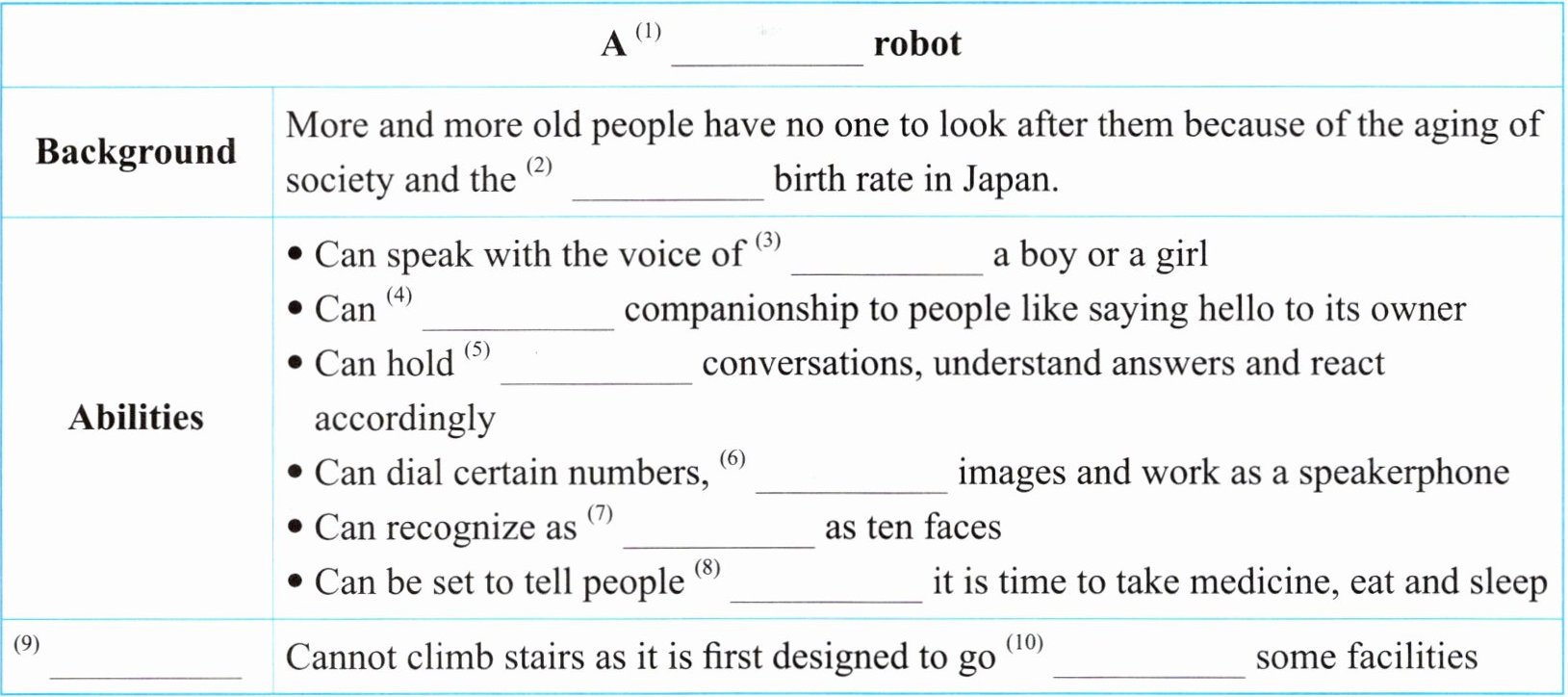
• Can (4) companionship to people like saying hello to its owner
• Can hold (5) conversations, understand answers and react accordingly
• Can dial certain numbers, (6) images and work as a speakerphone
• Can recognize as (7) as ten faces
A child-like robot, Wakamaru, developed by a Japanese tech company and joining the roles of a nurse and safety guard, will soon be on the market to look after the growing number of old people with no one to look after them.
Cameras fixed under the “eyebrows” of the robot enable it to “see” as it moves around in a house. The images can be sent to mobile phones. Wakamaru speaks with the voice of either a boy or a girl. It is also designed to provide companionship (陪伴) for people, saying hello to its “papa” when he comes home. Based on a vocabulary of around 10,000 words, it is the first household robot which is able to hold simple conversations. It can not only speak, but also understand answers and react accordingly. It will ask “Are you all right?” if its owner doesn’t move for some time. If the answer is no, or there is no answer, it will dial certain numbers, send images and work as a speakerphone. It can recognize up to ten faces and be set to remind forgetful people to take medicine, eat and sleep.
However, like most robots, it cannot climb stairs. The company developed Wakamaru from robots which have already been made to go around some facilities. “Looking at the aging of society and the falling birth rate, we decided that this could work as a business. We want to offer it as a product that helps society,” said the project chief. The developers plan to sell the robot from April this year at between 5,000 and 6,000 pounds.
The life expectancy (寿命) of Japanese women has been up to almost 85, the highest in the world. At the same time, large families are being replaced by small ones. This has left many Japanese worried about their elderly parents. So the technology has got nation-wide attention in Japan.
• Can (4) companionship to people like saying hello to its owner
• Can hold (5) conversations, understand answers and react accordingly
• Can dial certain numbers, (6) images and work as a speakerphone
• Can recognize as (7) as ten faces
答案:(1) child-like
(2) falling
(3) either
(4) provide
(5) simple
(6) send
(7) many
(8) when
(9) Disadvantages
(10) around
(2) falling
(3) either
(4) provide
(5) simple
(6) send
(7) many
(8) when
(9) Disadvantages
(10) around
解析:
本题需结合短文内容,定位原文对应信息提取关键词填空:
1. 根据原文首句“A child-like robot, Wakamaru”,可知第(1)空填child-like;
2. 根据原文“the falling birth rate”,可知第(2)空填falling;
3. 根据原文“Wakamaru speaks with the voice of either a boy or a girl.”,可知第(3)空填either;
4. 根据原文“it is also designed to provide companionship for people”,可知第(4)空填provide;
5. 根据原文“able to hold simple conversations”,可知第(5)空填simple;
6. 根据原文“send images”,可知第(6)空填send;
7. 根据原文“It can recognize up to ten faces”,up to与as many as表意一致,可知第(7)空填many;
8. 根据原文“remind forgetful people to take medicine, eat and sleep”,即该机器人可告知人们何时做这些事,可知第(8)空填when;
9. 此栏对应机器人的缺陷,原文介绍了它无法爬楼梯的不足,故第(9)空填Disadvantages;
10. 根据原文“go around some facilities”,可知第(10)空填around。
1. 根据原文首句“A child-like robot, Wakamaru”,可知第(1)空填child-like;
2. 根据原文“the falling birth rate”,可知第(2)空填falling;
3. 根据原文“Wakamaru speaks with the voice of either a boy or a girl.”,可知第(3)空填either;
4. 根据原文“it is also designed to provide companionship for people”,可知第(4)空填provide;
5. 根据原文“able to hold simple conversations”,可知第(5)空填simple;
6. 根据原文“send images”,可知第(6)空填send;
7. 根据原文“It can recognize up to ten faces”,up to与as many as表意一致,可知第(7)空填many;
8. 根据原文“remind forgetful people to take medicine, eat and sleep”,即该机器人可告知人们何时做这些事,可知第(8)空填when;
9. 此栏对应机器人的缺陷,原文介绍了它无法爬楼梯的不足,故第(9)空填Disadvantages;
10. 根据原文“go around some facilities”,可知第(10)空填around。