一、(2023·常州市金坛区二模)综合填空。
Cardboard boxes. Broken glass. Old doors. Painted handrails(栏杆). This is American artist Redic’s home in Shanghai. You might think he is living in a rubbish dump(垃圾场). But Redic calls his house a gallery.
Up to now, the artist
Redic started to create art
Now, Redic is always happy
This year, Redic is heading off to Europe with some of his works. The artist wants to share his
The next time you want to throw something away, give it
Cardboard boxes. Broken glass. Old doors. Painted handrails(栏杆). This is American artist Redic’s home in Shanghai. You might think he is living in a rubbish dump(垃圾场). But Redic calls his house a gallery.
Up to now, the artist
has stayed
1 (stay) in Shanghai for 13 years. He likes to walk around the city and collect “rubbish”. Later, he will turn these “useless
2 (use)” items into artworks.Redic started to create art
with
3 recycled materials when he was in college. He first came to China to visit the 2010 Shanghai Expo. After staying in the city for several days, however, he decided that he didn’t want to leave. He had fallen completely
4 (complete) in love with Shanghai.Now, Redic is always happy
to give
5 (give) people a tour of his “gallery”. He explains the backstories of each piece of work. Take “Doors of Life” for example. Redic collected the doors from different corners of Shanghai. He covered them in his own modern art. While creating these artworks, the artist often came up with some poetry lines (诗句). And then these poetry lines were painted
6 (paint) on the doors. Redic has always been interested in doors. He says doors deliver “important messages as one door closes, another opens”.This year, Redic is heading off to Europe with some of his works. The artist wants to share his
experiences
7 (experience) in Shanghai with the world. “All these works are like my family members. I will never stop creating
8 (create) art with recycled materials,” he says.The next time you want to throw something away, give it
a
9 second look.As
10 Redic has said, we should always “leave the door open”.答案:1. has stayed 2. useless 3. with
4. completely 5. to give 6. were painted
7. experiences 8. creating 9. a 10. As
4. completely 5. to give 6. were painted
7. experiences 8. creating 9. a 10. As
二、阅读理解。
Babies don’t learn to talk just from hearing sounds. They are lip (嘴唇) readers too. It happens during the period when a baby's babbling(咿呀声) slowly changes from unclear voices into that first “mama” or “dada”. The babies have to find out how to shape their lips to make the sounds they are hearing, according to developmental psychologist David Lewkowicz of Florida Atlantic University, who led the study.
Clearly it doesn't take them too long to understand the movements that match basic sounds. By their first birthdays, babies start changing back to look at you in the eye again. It offers more clues that quality face-time with babies is very important for speech development more than, say, turning on the latest baby DVD.
But Lewkowicz went a step further. He and his student Amy Hansen Tift tested nearly 180 babies, groups of them at ages 4, 6, 8, 10 and 12 months. How? They showed videos of a woman speaking in English or French to babies of English speakers. They found that when the speaker used English, the 4-month-old babies gazed (凝视) mostly into her eyes. The 6-month-old babies spent equal amounts(数量) of time looking at the eyes and the mouth. The 8-month-old babies and 10-month-old babies
studied mostly the mouth. At 12 months, attention started changing back towards the speaker's eyes.
But what happened when these babies who are used to English heard French? The 12-month-old babies studied the mouth longer, just like younger babies. They needed the extra information to understand the new sounds. That fits with research into bilingualism(双语) that shows babies' brains adjust themselves to tell the differences between the sounds of their first language and other languages in the first year of life.
The continued lip reading shows the 1-year-old babies clearly still are fit for learning. Babies are so hard to study, says Duke University cognitive scientist Greg Appelbaum, who found the research so fantastic that he wants to know more.
1. According to the first paragraph, babies
A. might get its voice “mama” by lip reading
B. like to find out how to shape their lips
C. learn to talk just from hearing the sounds
D. communicate by using body language
2. What is necessary in developing babies' speech according to Lewkowicz?
A. Playing baby DVDs nearby.
B. Teaching babies to read English.
C. Speaking with babies face to face.
D. Speaking different languages in front of babies.
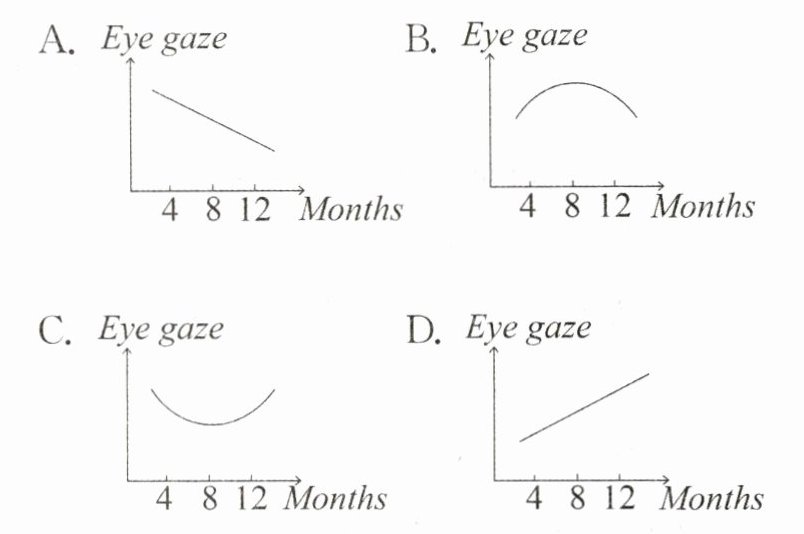
3. 新考法 学科融合 Which of the following shows the right change of babies' eye gaze according to the text?
4. What would be the best title of the text?
A. Babies have different methods to talk
B. Babies try lip-reading in learning to talk
C. Babies are suitable to learn two languages
D. Babies can easily accept a foreign language
Babies don’t learn to talk just from hearing sounds. They are lip (嘴唇) readers too. It happens during the period when a baby's babbling(咿呀声) slowly changes from unclear voices into that first “mama” or “dada”. The babies have to find out how to shape their lips to make the sounds they are hearing, according to developmental psychologist David Lewkowicz of Florida Atlantic University, who led the study.
Clearly it doesn't take them too long to understand the movements that match basic sounds. By their first birthdays, babies start changing back to look at you in the eye again. It offers more clues that quality face-time with babies is very important for speech development more than, say, turning on the latest baby DVD.
But Lewkowicz went a step further. He and his student Amy Hansen Tift tested nearly 180 babies, groups of them at ages 4, 6, 8, 10 and 12 months. How? They showed videos of a woman speaking in English or French to babies of English speakers. They found that when the speaker used English, the 4-month-old babies gazed (凝视) mostly into her eyes. The 6-month-old babies spent equal amounts(数量) of time looking at the eyes and the mouth. The 8-month-old babies and 10-month-old babies
studied mostly the mouth. At 12 months, attention started changing back towards the speaker's eyes.
But what happened when these babies who are used to English heard French? The 12-month-old babies studied the mouth longer, just like younger babies. They needed the extra information to understand the new sounds. That fits with research into bilingualism(双语) that shows babies' brains adjust themselves to tell the differences between the sounds of their first language and other languages in the first year of life.
The continued lip reading shows the 1-year-old babies clearly still are fit for learning. Babies are so hard to study, says Duke University cognitive scientist Greg Appelbaum, who found the research so fantastic that he wants to know more.
1. According to the first paragraph, babies
A
.A. might get its voice “mama” by lip reading
B. like to find out how to shape their lips
C. learn to talk just from hearing the sounds
D. communicate by using body language
2. What is necessary in developing babies' speech according to Lewkowicz?
A. Playing baby DVDs nearby.
B. Teaching babies to read English.
C. Speaking with babies face to face.
D. Speaking different languages in front of babies.
3. 新考法 学科融合 Which of the following shows the right change of babies' eye gaze according to the text?
4. What would be the best title of the text?
A. Babies have different methods to talk
B. Babies try lip-reading in learning to talk
C. Babies are suitable to learn two languages
D. Babies can easily accept a foreign language
答案:1. A 2. C
3. C 【解析】根据第三段内容可知,4个月大的婴儿主要盯着眼睛;6个月大的婴儿花了同样多的时间看眼睛和嘴巴;8个月和10个月大的婴儿主要研究嘴巴;12个月大的婴儿注意力又转向眼睛。C项图示符合文意。
4. B
3. C 【解析】根据第三段内容可知,4个月大的婴儿主要盯着眼睛;6个月大的婴儿花了同样多的时间看眼睛和嘴巴;8个月和10个月大的婴儿主要研究嘴巴;12个月大的婴儿注意力又转向眼睛。C项图示符合文意。
4. B