B

体裁 议论文 话题 放下手机
难度 ★★★☆☆ 建议用时 7'
If our time is our most valuable thing,
maybe we should be surprised how willingly
we waste it.
I've read when smokers give up the habit,
29
their lungs(肺) begin to repair themselves. So
could it be true that our brains are bored by
hours of phone use?
One day, something in me touched me
and I decided to stop my phone addiction(上瘾) habit to live my life fully.
Of course, a complete change was
impossible because the phone was part of our
daily lives. My new rules allowed for basic
uses such as texting, calling, checking the
news and making planned searches. Also,
online shopping and social media use should be
limited. But my No.1 rule was simple: Do
not pick up the phone as a reflex(反射动作) to
kill boredom.
Reducing my screen time has caused a
lot, which is quite interesting. Just a few days
after giving up the habit, I've read two books
and I've had more creative ideas for writing
projects in the last week than I had in the last
year. More interestingly, I've also had more
active communication with someone I don't
know, whether it's giving out a praise,
laughing at something funny, or taking an
extra moment to hold a door open.
We've given the little computers in our
hands far more of our time and attention than
they should. They've become crutches(拐杖),
giving us excuses. But the funny thing is,
when we put them down, we'll fill our time in
a wise way.
And we may just discover a new
enjoyment of old pleasures or new ones,
which makes our brains fresh and new instead
of being weak in ways we'd almost forgotten.
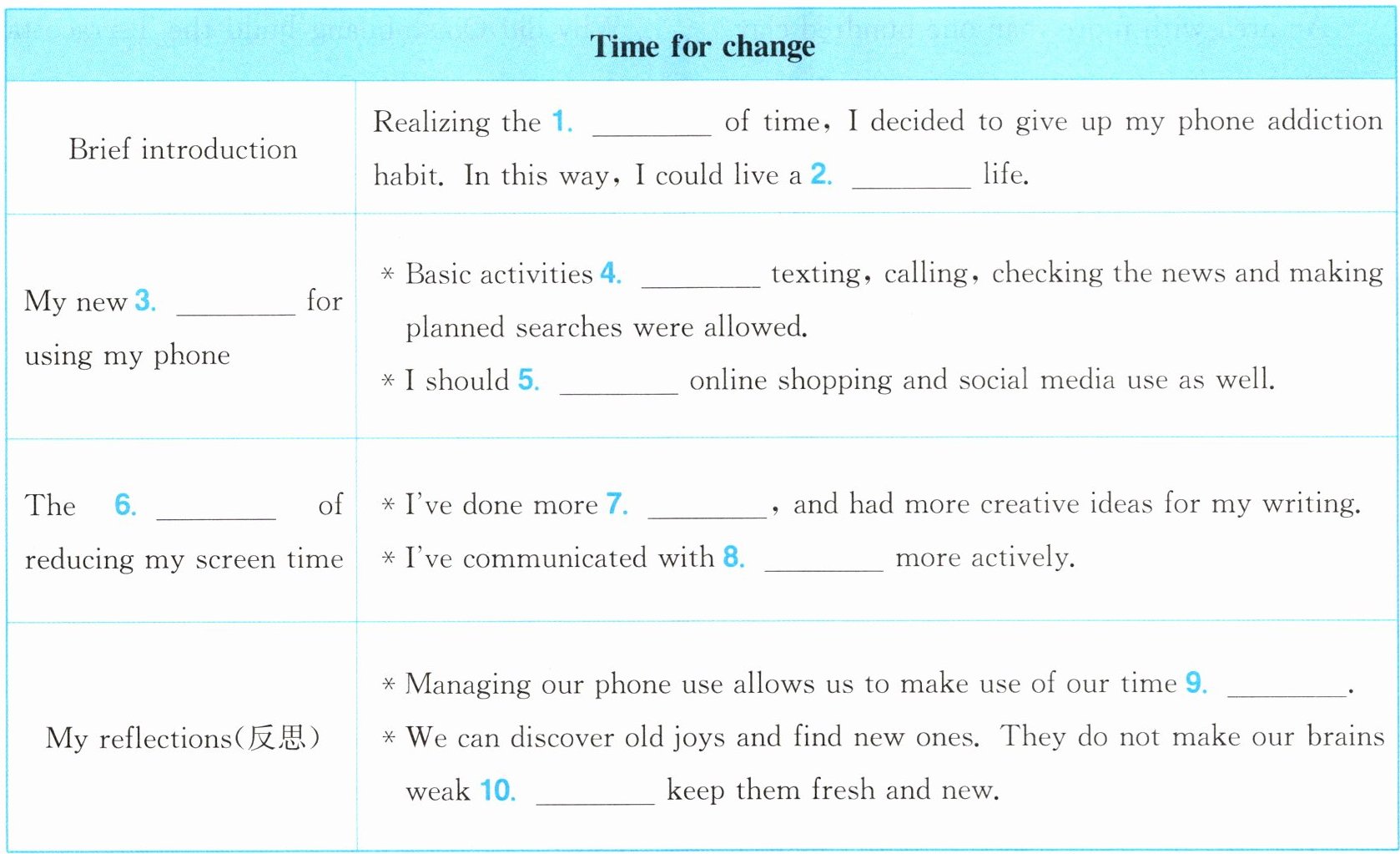
Time for change
Brief introduction
Realizing the 1.
My new 3.
Basic activities 4.
I should 5.
The 6.
I've done more 7.
I've communicated with 8.
My reflections(反思)
Managing our phone use allows us to make use of our time 9.
We can discover old joys and find new ones. They do not make our brains weak 10.
体裁 议论文 话题 放下手机
难度 ★★★☆☆ 建议用时 7'
If our time is our most valuable thing,
maybe we should be surprised how willingly
we waste it.
I've read when smokers give up the habit,
29
their lungs(肺) begin to repair themselves. So
could it be true that our brains are bored by
hours of phone use?
One day, something in me touched me
and I decided to stop my phone addiction(上瘾) habit to live my life fully.
Of course, a complete change was
impossible because the phone was part of our
daily lives. My new rules allowed for basic
uses such as texting, calling, checking the
news and making planned searches. Also,
online shopping and social media use should be
limited. But my No.1 rule was simple: Do
not pick up the phone as a reflex(反射动作) to
kill boredom.
Reducing my screen time has caused a
lot, which is quite interesting. Just a few days
after giving up the habit, I've read two books
and I've had more creative ideas for writing
projects in the last week than I had in the last
year. More interestingly, I've also had more
active communication with someone I don't
know, whether it's giving out a praise,
laughing at something funny, or taking an
extra moment to hold a door open.
We've given the little computers in our
hands far more of our time and attention than
they should. They've become crutches(拐杖),
giving us excuses. But the funny thing is,
when we put them down, we'll fill our time in
a wise way.
And we may just discover a new
enjoyment of old pleasures or new ones,
which makes our brains fresh and new instead
of being weak in ways we'd almost forgotten.
Time for change
Brief introduction
Realizing the 1.
value
of time, I decided to give up my phone addiction habit. In this way, I could live a 2. full
life.My new 3.
rules
for using my phoneBasic activities 4.
like/including
texting, calling, checking the news and making planned searches were allowed.I should 5.
limit
online shopping and social media use as well.The 6.
results
of reducing my screen timeI've done more 7.
reading
, and had more creative ideas for my writing.I've communicated with 8.
strangers
more actively.My reflections(反思)
Managing our phone use allows us to make use of our time 9.
wisely
.We can discover old joys and find new ones. They do not make our brains weak 10.
but
keep them fresh and new.答案:1. value 2. full 3. rules 4. like/including
5. limit 6. results 7. reading 8. strangers
9. wisely 10. but
5. limit 6. results 7. reading 8. strangers
9. wisely 10. but