6. People shouldn't burn rubbish, for it can
A.protect
B.stop
C.give
D.produce
D
lots of smoke and pollute the air seriously.A.protect
B.stop
C.give
D.produce
答案:6. D 解析:选项 A“protect”意为“保护”;B“stop”意为“停止”;C“give”意为“给”;D“produce”意为“产生”。根据语境“燃烧垃圾会……烟雾”,“产生”符合语境,故选 D。
7. —Jack, you won the poetry competition. What is the secret?
—Hard work. It is one of the
A.relations
B.directions
C.conditions
D.traditions
—Hard work. It is one of the
C
to be successful (成功的).A.relations
B.directions
C.conditions
D.traditions
答案:7. C 解析:选项 A“relations”意为“关系”;B“directions”意为“方向”;C“conditions”意为“条件”;D“traditions”意为“传统”。根据语境“努力是成功的……之一”,“条件”符合语境,故选 C。
8. The rescue (救援) team found a little girl who was still
A.alive; survive on
B.living; survive
C.living; survive in
D.alive; survive
D
under a building three days after the earthquake. They wondered how she was able to D
the big earthquake.A.alive; survive on
B.living; survive
C.living; survive in
D.alive; survive
答案:8. D 解析:“alive”可作表语,“living”可作定语或表语;“survive”为及物动词,意为“幸存”,后直接接宾语。第一空作表语用“alive”;第二空“survive the earthquake”(从地震中幸存),故选 D。
9. —Can you imagine such a little insect can eat
—Yes. It's
A.such; so
B.so; so
C.so; such
D.such; such
C
much food a day?—Yes. It's
C
an amazing world!A.such; so
B.so; so
C.so; such
D.such; such
答案:9. C 解析:“so”修饰形容词或副词,“such”修饰名词短语。第一空“so much”(如此多)修饰不可数名词“food”;第二空“such an amazing world”(如此神奇的世界)修饰名词短语,故选 C。
Ⅳ. 句子翻译
1. 没有什么能阻挡河流的去路。
2. 我等不及想要过假期了。
3. 在加拿大北部,除了捕鱼没有别的事可做。
There is
4. 多好的主意啊!太令人惊讶了!
What
5. 海洋是数十万 (无数) 生物的家园。
The ocean
1. 没有什么能阻挡河流的去路。
Nothing can get in a river's way
.2. 我等不及想要过假期了。
I can't wait for/to spend
my holiday.3. 在加拿大北部,除了捕鱼没有别的事可做。
There is
nothing to do but fish in northern/in the north of/in the northern part of Canada
.4. 多好的主意啊!太令人惊讶了!
What
a good idea (it is)
! How amazing
!5. 海洋是数十万 (无数) 生物的家园。
The ocean
is home to hundreds of thousands of
living things.答案:1. Nothing can get in a river's way
2. I can't wait for/to spend
3. nothing to do but fish in northern/in the north of/in the northern part of Canada
4. a good idea (it is); How amazing
5. is home to hundreds of thousands of
2. I can't wait for/to spend
3. nothing to do but fish in northern/in the north of/in the northern part of Canada
4. a good idea (it is); How amazing
5. is home to hundreds of thousands of
解析:
【解析】
1. 对应中文句意,使用固定搭配get in one's way表示阻挡去路,翻译为Nothing can get in a river's way。
2. 运用固定结构can't wait to do/can't wait for sth.表示等不及做某事,填入I can't wait for/to spend。
3. 套用固定句型there is nothing to do but do表示除了做某事别无他事可做,同时可选用in northern/in the north of/in the northern part of Canada表达加拿大北部,完整内容为nothing to do but fish in northern/in the north of/in the northern part of Canada。
4. 第一空用what引导的感叹句结构What a/an + 形容词 + 可数名词(+主语+谓语),填入a good idea (it is);第二空用how引导的感叹句结构How + 形容词,填入How amazing。
5. 使用固定搭配be home to...表示是……的家园,短语hundreds of thousands of表示数十万,填入is home to hundreds of thousands of。
【答案】
1. Nothing can get in a river's way
2. I can't wait for/to spend
3. nothing to do but fish in northern/in the north of/in the northern part of Canada
4. a good idea (it is); How amazing
5. is home to hundreds of thousands of
【知识点】
固定短语搭配;感叹句结构;常用英语句型
【点评】
本题考查基础汉译英的常用表达,侧重固定短语和基础句式的识记,部分空有多种合理表达,难度适中,能够检验学生对课内核心短语的掌握程度。
【难度系数】
0.7
1. 对应中文句意,使用固定搭配get in one's way表示阻挡去路,翻译为Nothing can get in a river's way。
2. 运用固定结构can't wait to do/can't wait for sth.表示等不及做某事,填入I can't wait for/to spend。
3. 套用固定句型there is nothing to do but do表示除了做某事别无他事可做,同时可选用in northern/in the north of/in the northern part of Canada表达加拿大北部,完整内容为nothing to do but fish in northern/in the north of/in the northern part of Canada。
4. 第一空用what引导的感叹句结构What a/an + 形容词 + 可数名词(+主语+谓语),填入a good idea (it is);第二空用how引导的感叹句结构How + 形容词,填入How amazing。
5. 使用固定搭配be home to...表示是……的家园,短语hundreds of thousands of表示数十万,填入is home to hundreds of thousands of。
【答案】
1. Nothing can get in a river's way
2. I can't wait for/to spend
3. nothing to do but fish in northern/in the north of/in the northern part of Canada
4. a good idea (it is); How amazing
5. is home to hundreds of thousands of
【知识点】
固定短语搭配;感叹句结构;常用英语句型
【点评】
本题考查基础汉译英的常用表达,侧重固定短语和基础句式的识记,部分空有多种合理表达,难度适中,能够检验学生对课内核心短语的掌握程度。
【难度系数】
0.7
Ⅴ. 阅读理解
①The Xisha Islands are in the northwest part of the South China Sea. They are beautiful places with nice views and many resources (资源). This is how our primary school textbook describes them.
②Many Chinese people know about the South China Sea and the Xisha Islands, but only a few have been there. These islands are far away and have a weak ecosystem (生态系统). Because of this, most activities there are just fishing, protecting the environment, and doing scientific study. Visitors are mainly government workers, fishermen's relatives, and media (媒体) members.
③In 2007, the Chinese government set up Sansha City on Xisha's Yongxing Island. I once visited the Yongle Islands, part of Sansha. I thought the fishermen's homes would be simple, but they were very comfortable. The island had a vegetable garden, and green vegetables were seen on the local tables. I stayed in a hotel with a playground downstairs. After dinner, everyone got together to play games. Later, I walked along the island's paths, enjoying the sea view and peaceful moment.
④Fishermen told me they used traditional ways to fish. They knew exactly which fish could be caught because of their different sizes. As for smaller fish, fishermen released them back into the sea.
⑤One thing that I never forgot was an outdoor movie called Island Keeper. It was about a couple who guarded (保卫) the island for 32 years. Many fishermen were moved to tears. One fisherman said as life on the island improved, his family loved to stay on the island during the fishing season. He also drove a passenger boat, so he made more money even when he was not fishing.
⑥I think the careful management of the Xisha Islands limits (限制) tourism but gives job chances to local fishermen.
1. What does the word "them" in the first paragraph refer to?
A. Nice views.
B. The Xisha Islands.
C. Many resources.
D. The South China Sea.
2. What causes only a few people to visit the Xisha Islands?
①The islands are far away.
②Not many people know the islands.
③The ecosystem there is weak.
④The islands are used for scientific study.
A. ①②
B. ③④
C. ①③
D. ②④
3. What does the underlined word "released" in Paragraph 4 probably mean?
A. looked for
B. cut... down
C. took care of
D. let... go
4. What can we infer from the text?
A. Fishermen catch fish in modern ways.
B. Fishermen enjoy their lives on the islands.
C. More and more visitors come to the Xisha Islands now.
D. The living conditions of fishermen are poor and simple.
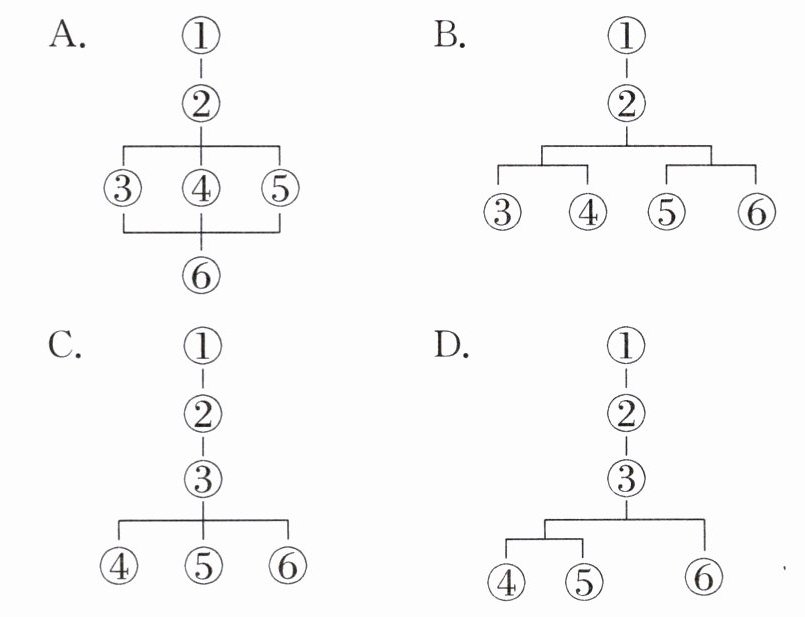
5. 新考法 篇章结构 Which of the following best shows the structure of the text?
A.
①
②
③④⑤
⑥
B.
①
②
③④⑤⑥
C.
①
②
③
④⑤⑥
D.
①
②
③
④⑤⑥
①The Xisha Islands are in the northwest part of the South China Sea. They are beautiful places with nice views and many resources (资源). This is how our primary school textbook describes them.
②Many Chinese people know about the South China Sea and the Xisha Islands, but only a few have been there. These islands are far away and have a weak ecosystem (生态系统). Because of this, most activities there are just fishing, protecting the environment, and doing scientific study. Visitors are mainly government workers, fishermen's relatives, and media (媒体) members.
③In 2007, the Chinese government set up Sansha City on Xisha's Yongxing Island. I once visited the Yongle Islands, part of Sansha. I thought the fishermen's homes would be simple, but they were very comfortable. The island had a vegetable garden, and green vegetables were seen on the local tables. I stayed in a hotel with a playground downstairs. After dinner, everyone got together to play games. Later, I walked along the island's paths, enjoying the sea view and peaceful moment.
④Fishermen told me they used traditional ways to fish. They knew exactly which fish could be caught because of their different sizes. As for smaller fish, fishermen released them back into the sea.
⑤One thing that I never forgot was an outdoor movie called Island Keeper. It was about a couple who guarded (保卫) the island for 32 years. Many fishermen were moved to tears. One fisherman said as life on the island improved, his family loved to stay on the island during the fishing season. He also drove a passenger boat, so he made more money even when he was not fishing.
⑥I think the careful management of the Xisha Islands limits (限制) tourism but gives job chances to local fishermen.
1. What does the word "them" in the first paragraph refer to?
A. Nice views.
B. The Xisha Islands.
C. Many resources.
D. The South China Sea.
2. What causes only a few people to visit the Xisha Islands?
①The islands are far away.
②Not many people know the islands.
③The ecosystem there is weak.
④The islands are used for scientific study.
A. ①②
B. ③④
C. ①③
D. ②④
3. What does the underlined word "released" in Paragraph 4 probably mean?
A. looked for
B. cut... down
C. took care of
D. let... go
4. What can we infer from the text?
A. Fishermen catch fish in modern ways.
B. Fishermen enjoy their lives on the islands.
C. More and more visitors come to the Xisha Islands now.
D. The living conditions of fishermen are poor and simple.
5. 新考法 篇章结构 Which of the following best shows the structure of the text?
A.
①
②
③④⑤
⑥
B.
①
②
③④⑤⑥
C.
①
②
③
④⑤⑥
D.
①
②
③
④⑤⑥
答案:1.B 2.C 3.D 4.B 5.A
【语篇解读】本文是一篇说明文,主要介绍了西沙群岛的风貌及渔民的生活。
1. B 解析:代词指代题。根据第一段“The Xisha Islands are... They are beautiful places... This is how our primary school textbook describes them.”可知,西沙群岛位于南海西北部,风景秀丽,资源丰富。小学课本上是这么描述它们的。故“them”指代“西沙群岛”。故选 B。
2. C 解析:细节理解题。根据第二段“These islands are far away and have a weak ecosystem.”可知,因为这些岛都很远、生态系统脆弱,故而只有很少人参观西沙群岛。故选 C。
3. D 解析:词义猜测题。根据第四段“As for smaller fish, fishermen released them back into the sea.”可知,渔民把更小的鱼放回大海里。故画线单词“released”意为“释放,放生”。let...go 与此意思相近。故选 D。
4. B 解析:推理判断题。根据第三段“the fishermen's homes... were very comfortable. The island had a vegetable garden, and green vegetables were seen on the local tables... After dinner, everyone got together to play games.”可知,渔民的家很舒适,岛上有菜园,晚饭后大家聚在一起玩游戏,故推测出渔民们在岛上享受着生活。故选 B。
5. A 解析:篇章结构题。通读全文可知,第一段介绍了小学课本上描述的西沙群岛,第二段介绍了现实生活中中国人对西沙群岛的认识;第三、四、五段分别描述了作者亲自去西沙群岛的所见所闻以及作者回忆有关《守岛人》的电影情节;最后一段总述政府对西沙群岛的管理认真和对当地渔民的工作扶持。故第一、二段为并列关系,总述了西沙群岛的面貌;第三、四、五段通过自身经历及间接经历来具体阐述西沙群岛上渔民的美好生活;最后一段总述。故选 A。
【语篇解读】本文是一篇说明文,主要介绍了西沙群岛的风貌及渔民的生活。
1. B 解析:代词指代题。根据第一段“The Xisha Islands are... They are beautiful places... This is how our primary school textbook describes them.”可知,西沙群岛位于南海西北部,风景秀丽,资源丰富。小学课本上是这么描述它们的。故“them”指代“西沙群岛”。故选 B。
2. C 解析:细节理解题。根据第二段“These islands are far away and have a weak ecosystem.”可知,因为这些岛都很远、生态系统脆弱,故而只有很少人参观西沙群岛。故选 C。
3. D 解析:词义猜测题。根据第四段“As for smaller fish, fishermen released them back into the sea.”可知,渔民把更小的鱼放回大海里。故画线单词“released”意为“释放,放生”。let...go 与此意思相近。故选 D。
4. B 解析:推理判断题。根据第三段“the fishermen's homes... were very comfortable. The island had a vegetable garden, and green vegetables were seen on the local tables... After dinner, everyone got together to play games.”可知,渔民的家很舒适,岛上有菜园,晚饭后大家聚在一起玩游戏,故推测出渔民们在岛上享受着生活。故选 B。
5. A 解析:篇章结构题。通读全文可知,第一段介绍了小学课本上描述的西沙群岛,第二段介绍了现实生活中中国人对西沙群岛的认识;第三、四、五段分别描述了作者亲自去西沙群岛的所见所闻以及作者回忆有关《守岛人》的电影情节;最后一段总述政府对西沙群岛的管理认真和对当地渔民的工作扶持。故第一、二段为并列关系,总述了西沙群岛的面貌;第三、四、五段通过自身经历及间接经历来具体阐述西沙群岛上渔民的美好生活;最后一段总述。故选 A。