Ⅵ. 阅读还原
从方框中选出能填入空白处的最佳选项,选项中有一项多余。
We all have a special feeling for our hometown. 1 Even if we move away, it stays with us forever. Why is that?
Our hometown is the very beginning of our life story. It is filled with our earliest memories! 2 For example, we took our first steps, met our first friends, went to our first school, and even learned to ride a bike for the first time in a park. All these "firsts" are like happy treasures in our minds, shining brightly no matter how much time passes.
3 We learned the local way of talking, celebrated hometown festivals, and understood our family's traditions. Through these experiences, we felt we truly belonged. This is how it helps us understand ourselves.
When we remember our childhood, our minds often think of happy, safe, and simple moments—playing outside, having family dinners, and getting excited about little things. 4
Even if our hometown isn't perfect, why does it still feel so special to us? 5 It is more than a place—it is a part of us, and will always be a warm, special corner.
A. It is like the home in our hearts.
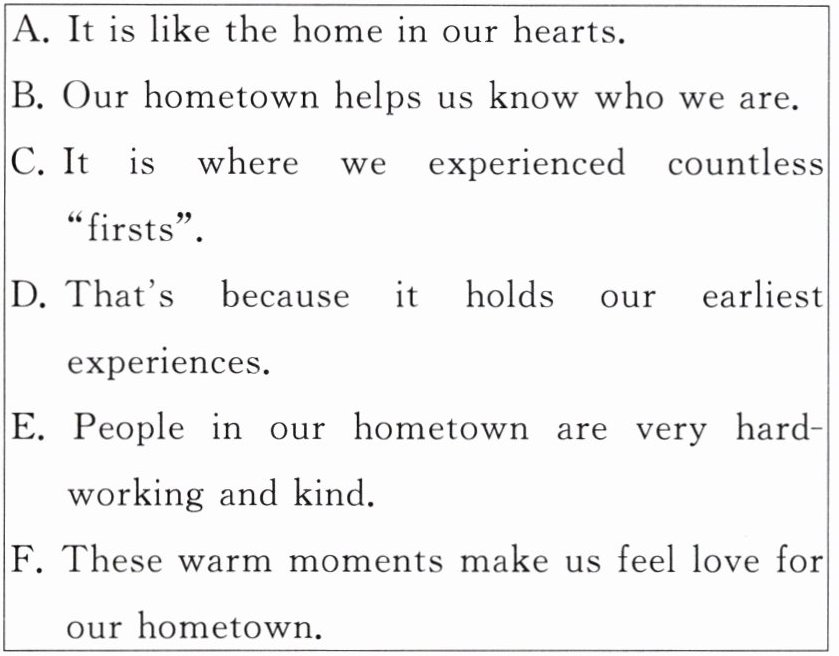
B. Our hometown helps us know who we are.
C. It is where we experienced countless "firsts".
D. That's because it holds our earliest experiences.
E. People in our hometown are very hard-working and kind.
F. These warm moments make us feel love for our hometown.
1. 2. 3. 4. 5.
从方框中选出能填入空白处的最佳选项,选项中有一项多余。
We all have a special feeling for our hometown. 1 Even if we move away, it stays with us forever. Why is that?
Our hometown is the very beginning of our life story. It is filled with our earliest memories! 2 For example, we took our first steps, met our first friends, went to our first school, and even learned to ride a bike for the first time in a park. All these "firsts" are like happy treasures in our minds, shining brightly no matter how much time passes.
3 We learned the local way of talking, celebrated hometown festivals, and understood our family's traditions. Through these experiences, we felt we truly belonged. This is how it helps us understand ourselves.
When we remember our childhood, our minds often think of happy, safe, and simple moments—playing outside, having family dinners, and getting excited about little things. 4
Even if our hometown isn't perfect, why does it still feel so special to us? 5 It is more than a place—it is a part of us, and will always be a warm, special corner.
A. It is like the home in our hearts.
B. Our hometown helps us know who we are.
C. It is where we experienced countless "firsts".
D. That's because it holds our earliest experiences.
E. People in our hometown are very hard-working and kind.
F. These warm moments make us feel love for our hometown.
1. 2. 3. 4. 5.
答案:1.A 2.C 3.B 4.F 5.D
【语篇解读】本文是一篇说明文,主要介绍了我们对家乡有着特殊的情感的原因。
【语篇解读】本文是一篇说明文,主要介绍了我们对家乡有着特殊的情感的原因。
解析:
【解析】
1. 空前句点明我们都对家乡有着特殊的情感,空后句说明即便我们搬走,这份情感也永远伴随我们,A选项“它就像我们心中的家”承接上下文,契合语境。
2. 空后列举了我们在故乡经历的诸多人生第一次,C选项“这是我们经历无数‘第一次’的地方”引出下文内容,逻辑连贯。
3. 空后内容讲述我们在故乡的各类经历帮助我们找到归属感、认清自我,B选项“家乡帮助我们了解自己是谁”作为本段总起句,统领全段。
4. 空前罗列了回忆童年时想到的诸多温暖、美好的瞬间,F选项“这些温暖的时刻让我们对家乡产生爱意”承接前文的描述,自然收尾。
5. 空前提出疑问:即便家乡并不完美,为什么它对我们来说依然很特别?D选项“那是因为它承载着我们最早的经历”直接回应问题,给出答案。
多余选项E的内容在全文中没有对应语境,无需选用。
【答案】
1.A 2.C 3.B 4.F 5.D
【知识点】
阅读还原 语篇逻辑衔接
【点评】
本题围绕“家乡的特殊意义”主题考查阅读还原能力,解题时需结合上下文的指代关系、段落主旨和逻辑关联匹配选项,排除多余干扰项,整体难度适中,能有效锻炼学生的语篇理解能力。
【难度系数】
0.7
1. 空前句点明我们都对家乡有着特殊的情感,空后句说明即便我们搬走,这份情感也永远伴随我们,A选项“它就像我们心中的家”承接上下文,契合语境。
2. 空后列举了我们在故乡经历的诸多人生第一次,C选项“这是我们经历无数‘第一次’的地方”引出下文内容,逻辑连贯。
3. 空后内容讲述我们在故乡的各类经历帮助我们找到归属感、认清自我,B选项“家乡帮助我们了解自己是谁”作为本段总起句,统领全段。
4. 空前罗列了回忆童年时想到的诸多温暖、美好的瞬间,F选项“这些温暖的时刻让我们对家乡产生爱意”承接前文的描述,自然收尾。
5. 空前提出疑问:即便家乡并不完美,为什么它对我们来说依然很特别?D选项“那是因为它承载着我们最早的经历”直接回应问题,给出答案。
多余选项E的内容在全文中没有对应语境,无需选用。
【答案】
1.A 2.C 3.B 4.F 5.D
【知识点】
阅读还原 语篇逻辑衔接
【点评】
本题围绕“家乡的特殊意义”主题考查阅读还原能力,解题时需结合上下文的指代关系、段落主旨和逻辑关联匹配选项,排除多余干扰项,整体难度适中,能有效锻炼学生的语篇理解能力。
【难度系数】
0.7
Ⅶ. 阅读与回答问题
根据短文内容,回答下列问题(每题答案不超过 6 个词)。
Now David lives in Beijing. It's been more than 8 years since he moved from the US to Beijing. When he went off to college, he and his parents also lived in different cities, but they still kept in touch with each other by phone and email. At that time, it was easy for him to call up his mum and catch up with her. But when David lives in Beijing, he feels it is difficult to stay in touch with his family.
They're separated not only by distance, but also by time. There is a 12-hour time difference between Beijing and the US. This means that when it's morning in Beijing, it's nighttime in his hometown. This can make it difficult for David to find a suitable time to contact (联系) his family.
But he and his family make it work anyway. They try to choose times that are convenient for both of them. This means David usually calls his mum late in the evening in Beijing time. At that time, his mother is taking her lunch break. They often talk about their work, the weather, and whatever else is happening in their lives.
And of course, David tries to visit his home from time to time. He'll fly back to the US to see his parents and sisters for the holidays once a year. It's uncommon for them to get the whole family together—but when they do, they have a lot of fun.
Like many other foreigners living in China, David does miss his family. He tries to stay in touch with his family as much as possible. In his opinion, it's important to talk with his family.
1. How long has David stayed in Beijing?
2. How does David feel when he wants to stay in touch with his family?
3. When does David usually call his mother?
4. How often does David visit his family?
5. Which English saying will you use to describe David according to the last paragraph?
根据短文内容,回答下列问题(每题答案不超过 6 个词)。
Now David lives in Beijing. It's been more than 8 years since he moved from the US to Beijing. When he went off to college, he and his parents also lived in different cities, but they still kept in touch with each other by phone and email. At that time, it was easy for him to call up his mum and catch up with her. But when David lives in Beijing, he feels it is difficult to stay in touch with his family.
They're separated not only by distance, but also by time. There is a 12-hour time difference between Beijing and the US. This means that when it's morning in Beijing, it's nighttime in his hometown. This can make it difficult for David to find a suitable time to contact (联系) his family.
But he and his family make it work anyway. They try to choose times that are convenient for both of them. This means David usually calls his mum late in the evening in Beijing time. At that time, his mother is taking her lunch break. They often talk about their work, the weather, and whatever else is happening in their lives.
And of course, David tries to visit his home from time to time. He'll fly back to the US to see his parents and sisters for the holidays once a year. It's uncommon for them to get the whole family together—but when they do, they have a lot of fun.
Like many other foreigners living in China, David does miss his family. He tries to stay in touch with his family as much as possible. In his opinion, it's important to talk with his family.
1. How long has David stayed in Beijing?
For more than 8 years.
2. How does David feel when he wants to stay in touch with his family?
He feels it's difficult.
3. When does David usually call his mother?
In the evening in Beijing time.
4. How often does David visit his family?
Once a year.
5. Which English saying will you use to describe David according to the last paragraph?
East or west, home is best.
答案:【语篇解读】本文是一篇记叙文,讲述了一位在北京的美国人如何与父母保持联系。
1. For more than 8 years.
2. He feels it's difficult.
3. In the evening in Beijing time.
4. Once a year.
5. East or west, home is best.(答案不唯一,言之有理即可)
1. For more than 8 years.
2. He feels it's difficult.
3. In the evening in Beijing time.
4. Once a year.
5. East or west, home is best.(答案不唯一,言之有理即可)
解析:
【解析】
1. 定位原文第一段第二句"It's been more than 8 years since he moved from the US to Beijing.",提取符合字数要求的答案即可。
2. 定位原文第一段最后一句"he feels it is difficult to stay in touch with his family.",精简得到符合要求的回答。
3. 定位原文第三段第三句"This means David usually calls his mum late in the evening in Beijing time.",提取核心时间信息作答。
4. 定位原文第四段第二句"He'll fly back to the US to see his parents and sisters for the holidays once a year.",提取频率信息作答。
5. 根据最后一段David思念家人、重视和家人的联系的内容,匹配对应的英文谚语,答案符合语境且字数合规即可。
【答案】
1. For more than 8 years.
2. He feels it's difficult.
3. In the evening in Beijing time.
4. Once a year.
5. East or west, home is best.(合理即可)
【知识点】
细节信息查找,英文谚语应用
【点评】
本题为阅读理解简答类题型,多数题目可直接从原文定位找到对应答案,仅最后一题需要结合段落主旨匹配合适的英文谚语,同时需要注意所有答案的词数不能超过6个,整体难度适中,重点考查学生快速定位文本信息的能力。
【难度系数】
0.7
1. 定位原文第一段第二句"It's been more than 8 years since he moved from the US to Beijing.",提取符合字数要求的答案即可。
2. 定位原文第一段最后一句"he feels it is difficult to stay in touch with his family.",精简得到符合要求的回答。
3. 定位原文第三段第三句"This means David usually calls his mum late in the evening in Beijing time.",提取核心时间信息作答。
4. 定位原文第四段第二句"He'll fly back to the US to see his parents and sisters for the holidays once a year.",提取频率信息作答。
5. 根据最后一段David思念家人、重视和家人的联系的内容,匹配对应的英文谚语,答案符合语境且字数合规即可。
【答案】
1. For more than 8 years.
2. He feels it's difficult.
3. In the evening in Beijing time.
4. Once a year.
5. East or west, home is best.(合理即可)
【知识点】
细节信息查找,英文谚语应用
【点评】
本题为阅读理解简答类题型,多数题目可直接从原文定位找到对应答案,仅最后一题需要结合段落主旨匹配合适的英文谚语,同时需要注意所有答案的词数不能超过6个,整体难度适中,重点考查学生快速定位文本信息的能力。
【难度系数】
0.7