8. —The new school is almost finished, but it
—I can't wait to go to the new school.
A.only
B.also
C.still
D.instead
C
needs another month to be ready for students.—I can't wait to go to the new school.
A.only
B.also
C.still
D.instead
答案:8. C 解析:A 项"only"意为"只有";B 项"also"意为"也";C 项"still"意为"仍然";D 项"instead"意为"反而"。根据"needs another month"(还需要一个月),可知选 C。
9. —There will be a horse racing programme on TV this weekend.
—It
A.seems
B.looks like
C.feels
D.seems like
—It
A
exciting. I'd like to watch.A.seems
B.looks like
C.feels
D.seems like
答案:9. A 解析:A 项"seems"意为"似乎",后接形容词;B 项"looks like"意为"看起来像",后接名词;C 项"feels"意为"感觉";D 项"seems like"意为"似乎像",后接名词。根据"exciting"(形容词),可知选 A。
10. “We can't go out in this weather,” said Bob,
A.to look
B.looking
C.having looked
D.looked
B
out of the window.A.to look
B.looking
C.having looked
D.looked
答案:10. B 解析:此处为伴随状语,"Bob"与"look"之间是主动关系,用现在分词"looking",故选 B。
技法点拨 当主句中主语和谓语动词都明确,且待确定的动词和主句之间没有连词连接时,说明待确定的动词是非谓语动词,如果该动词和主语之间是主动关系,则该动词用现在分词形式。
技法点拨 当主句中主语和谓语动词都明确,且待确定的动词和主句之间没有连词连接时,说明待确定的动词是非谓语动词,如果该动词和主语之间是主动关系,则该动词用现在分词形式。
11. Which of the following words is the best to fill in the blank?
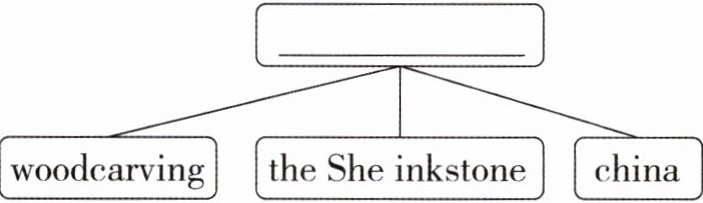
A.Chinese folk art
B.Chinese history
C.Chinese knots
D.Chinese craftspeople
A
A.Chinese folk art
B.Chinese history
C.Chinese knots
D.Chinese craftspeople
答案:11. A 解析:A 项"Chinese folk art"(中国民间艺术);B 项"Chinese history"(中国历史);C 项"Chinese knots"(中国结);D 项"Chinese craftspeople"(中国手艺人)。图片中"woodcarving"(木雕)、"the She inkstone"(歙砚)、"china"(瓷器)均属于民间艺术,故选 A。
Ⅳ. 句子翻译
1. 事实上,她认为任何人都可以尝试剪纸。
2. 埃米的作品是花和鱼的形状。
3. 春节时,我们在窗户上贴剪纸以求好运。
At the Spring Festival, we
4. 京剧是一种充满生命力的艺术形式。
Beijing opera is
5. 我们不需要太多就可以开始工作。
We don't
6. 我们学芭蕾舞要花很多年的时间。
It
1. 事实上,她认为任何人都可以尝试剪纸。
In fact
,she thinks anyone can try paper-cutting
.2. 埃米的作品是花和鱼的形状。
Amy's works are in the shape of
flowers and fish.3. 春节时,我们在窗户上贴剪纸以求好运。
At the Spring Festival, we
put up paper-cuts
on windows for good luck
.4. 京剧是一种充满生命力的艺术形式。
Beijing opera is
an art form full of life
.5. 我们不需要太多就可以开始工作。
We don't
need much to start working
.6. 我们学芭蕾舞要花很多年的时间。
It
takes years for us to learn
ballet.答案:Ⅳ. 1. In fact; anyone can try paper-cutting
2. Amy's works are in the shape of
3. put up paper-cuts on windows for good luck
4. an art form full of life
5. need much to start working
6. takes years for us to learn
2. Amy's works are in the shape of
3. put up paper-cuts on windows for good luck
4. an art form full of life
5. need much to start working
6. takes years for us to learn
解析:
【解析】
1. 第一空对应“事实上”,是固定短语In fact;第二空对应“任何人都可以尝试剪纸”,翻译为anyone can try paper-cutting,符合句子结构。
2. 对应“埃米的作品是……的形状”,使用固定搭配in the shape of,完整表述为Amy's works are in the shape of。
3. 第一部分对应“贴剪纸”是put up paper-cuts,第二部分对应“在窗户上以求好运”,翻译为on windows for good luck,符合语境和语法。
4. 对应“一种充满生命力的艺术形式”,使用固定结构full of作后置定语,表述为an art form full of life。
5. 对应“不需要太多就可以开始工作”,翻译为need much to start working,符合助动词don't后接动词原形的规则。
6. 本题使用It takes sb. some time to do sth.的固定句型,对应“花很多年的时间让我们学习”,表述为takes years for us to learn。
【答案】
1. In fact; anyone can try paper-cutting
2. Amy's works are in the shape of
3. put up paper-cuts; on windows for good luck
4. an art form full of life
5. need much to start working
6. takes years for us to learn
【知识点】
固定短语搭配;常用英语句型;汉译英基础
【点评】
本题考查基础的汉译英填空,侧重日常核心短语和常用句型的识记,难度适中,学生需要牢记相关固定表达,注意句子的语法一致性即可顺利完成。
【难度系数】
0.7
1. 第一空对应“事实上”,是固定短语In fact;第二空对应“任何人都可以尝试剪纸”,翻译为anyone can try paper-cutting,符合句子结构。
2. 对应“埃米的作品是……的形状”,使用固定搭配in the shape of,完整表述为Amy's works are in the shape of。
3. 第一部分对应“贴剪纸”是put up paper-cuts,第二部分对应“在窗户上以求好运”,翻译为on windows for good luck,符合语境和语法。
4. 对应“一种充满生命力的艺术形式”,使用固定结构full of作后置定语,表述为an art form full of life。
5. 对应“不需要太多就可以开始工作”,翻译为need much to start working,符合助动词don't后接动词原形的规则。
6. 本题使用It takes sb. some time to do sth.的固定句型,对应“花很多年的时间让我们学习”,表述为takes years for us to learn。
【答案】
1. In fact; anyone can try paper-cutting
2. Amy's works are in the shape of
3. put up paper-cuts; on windows for good luck
4. an art form full of life
5. need much to start working
6. takes years for us to learn
【知识点】
固定短语搭配;常用英语句型;汉译英基础
【点评】
本题考查基础的汉译英填空,侧重日常核心短语和常用句型的识记,难度适中,学生需要牢记相关固定表达,注意句子的语法一致性即可顺利完成。
【难度系数】
0.7
Ⅴ. 阅读理解
Since the Zhou Dynasty (1046 BCE—256 BCE), a complete etiquette system has been set. Today, many of these rules are not as strict (严格的) as before. However, some are still followed on important occasions (场合) and are thought of as good examples of good manners.
Walking Etiquette
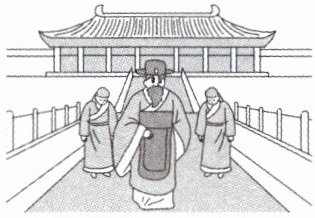
① In ancient China, while walking with someone with a higher status (地位) or an old person, one should lower one's head, bend down, and walk a little bit behind them. If three people walk together, the elder or a teacher should be in the middle. One should bow down and walk fast using smaller steps when passing by an elder or a teacher.
Sitting Etiquette and Seating Rules
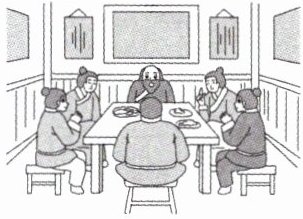
② Everyone should be sitting in a proper position (位置) at dining tables. It is based on their titles, ranks, or ages. If someone doesn't know the exact position, they should wait and follow the host's lead. The best seat is the one that faces the east or the door. Hosts usually sit facing the west.
Bow, and Fist - and - Palm Salute (抱拳)
③ Bow, in Chinese Yi Li or Zuo Yi, means having their hands folded (折叠) in front in different ways. Today, however, the simplest Zuo Yi gesture is good enough, as well as nodding, smiling, and handshaking.
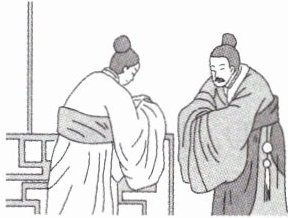
④ The Fist - and - Palm Salute is another type of Yi Li, with the fist's right hand covered by the left hand. It first appeared in the army when people held weapons (武器) while showing respect to others. So, people always use the left hand to cover the right hand that holds weapons.
1. In ancient China, which place should your teacher be when walking with you and your classmate?
A. In the middle.
B. On the left.
C. On the right.
D. At the back.
2. Where can we put the sentence “The seating order is still widely used in family and business dinners.” in the passage?
A. ①
B. ②
C. ③
D. ④
3. Which of the following pictures CORRECTLY describes “the Fist - and - Palm Salute”?
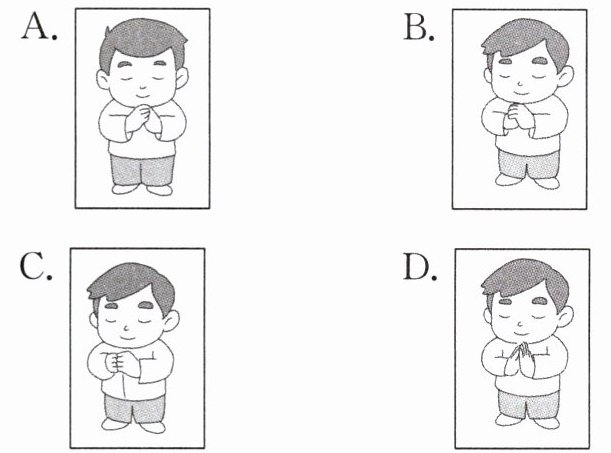
A.
B.
C.
D.
4. Why is the underlined sentence included in the last paragraph?
A. To give an example.
B. To set the order.
C. To add more information.
D. To show a result.
5. What may the writer talk about in the following paragraph?
A. Another kind of Chinese etiquette.
B. Another kind of Western etiquette.
C. Differences among the three kinds of etiquette.
D. Differences between Chinese and Western etiquette.
Since the Zhou Dynasty (1046 BCE—256 BCE), a complete etiquette system has been set. Today, many of these rules are not as strict (严格的) as before. However, some are still followed on important occasions (场合) and are thought of as good examples of good manners.
Walking Etiquette
① In ancient China, while walking with someone with a higher status (地位) or an old person, one should lower one's head, bend down, and walk a little bit behind them. If three people walk together, the elder or a teacher should be in the middle. One should bow down and walk fast using smaller steps when passing by an elder or a teacher.
Sitting Etiquette and Seating Rules
② Everyone should be sitting in a proper position (位置) at dining tables. It is based on their titles, ranks, or ages. If someone doesn't know the exact position, they should wait and follow the host's lead. The best seat is the one that faces the east or the door. Hosts usually sit facing the west.
Bow, and Fist - and - Palm Salute (抱拳)
③ Bow, in Chinese Yi Li or Zuo Yi, means having their hands folded (折叠) in front in different ways. Today, however, the simplest Zuo Yi gesture is good enough, as well as nodding, smiling, and handshaking.
④ The Fist - and - Palm Salute is another type of Yi Li, with the fist's right hand covered by the left hand. It first appeared in the army when people held weapons (武器) while showing respect to others. So, people always use the left hand to cover the right hand that holds weapons.
1. In ancient China, which place should your teacher be when walking with you and your classmate?
A. In the middle.
B. On the left.
C. On the right.
D. At the back.
2. Where can we put the sentence “The seating order is still widely used in family and business dinners.” in the passage?
A. ①
B. ②
C. ③
D. ④
3. Which of the following pictures CORRECTLY describes “the Fist - and - Palm Salute”?
A.
B.
C.
D.
4. Why is the underlined sentence included in the last paragraph?
A. To give an example.
B. To set the order.
C. To add more information.
D. To show a result.
5. What may the writer talk about in the following paragraph?
A. Another kind of Chinese etiquette.
B. Another kind of Western etiquette.
C. Differences among the three kinds of etiquette.
D. Differences between Chinese and Western etiquette.
答案:Ⅴ. 1.A 2.B 3.B 4.C 5.A
【语篇解读】本文是一篇说明文,主要介绍了中国古代的三种礼仪规范:行走礼仪、坐席礼仪和抱拳礼,并提及部分礼仪在现代的简化应用。
1. A 解析:细节理解题。根据"If three people walk together, the elder or a teacher should be in the middle."可知,在古代,老师应走在"我"和"我"的同学之间。故选 A。
2. B 解析:补全文章题。根据"The seating order is still widely used in family and business dinners."可知,此句与座位规则有关;又根据"Everyone should be sitting in a proper position at dining tables."可知,此处也与座位规则有关,故②处适合放此句子。故选 B。
3. B 解析:图示理解题。根据"The Fist-and-Palm Salute is another type of Yi Li, with the fist's right hand covered by the left hand."可知,抱拳礼为右手握拳、左手覆于其上,图片需体现左手在上、右手在下的动作。选项中仅 B 符合描述。故选 B。
4. C 解析:写作意图题。画线句中"people always use the left hand to cover the right hand that holds weapons"进一步解释抱拳礼的军事起源细节,属于补充信息。故选 C。
5. A 解析:推理判断题。通读全文可知,全文围绕中国古代礼仪展开,末段提及抱拳礼后,下文最可能延续同类主题,即介绍另一种中国礼仪。故选 A。
【语篇解读】本文是一篇说明文,主要介绍了中国古代的三种礼仪规范:行走礼仪、坐席礼仪和抱拳礼,并提及部分礼仪在现代的简化应用。
1. A 解析:细节理解题。根据"If three people walk together, the elder or a teacher should be in the middle."可知,在古代,老师应走在"我"和"我"的同学之间。故选 A。
2. B 解析:补全文章题。根据"The seating order is still widely used in family and business dinners."可知,此句与座位规则有关;又根据"Everyone should be sitting in a proper position at dining tables."可知,此处也与座位规则有关,故②处适合放此句子。故选 B。
3. B 解析:图示理解题。根据"The Fist-and-Palm Salute is another type of Yi Li, with the fist's right hand covered by the left hand."可知,抱拳礼为右手握拳、左手覆于其上,图片需体现左手在上、右手在下的动作。选项中仅 B 符合描述。故选 B。
4. C 解析:写作意图题。画线句中"people always use the left hand to cover the right hand that holds weapons"进一步解释抱拳礼的军事起源细节,属于补充信息。故选 C。
5. A 解析:推理判断题。通读全文可知,全文围绕中国古代礼仪展开,末段提及抱拳礼后,下文最可能延续同类主题,即介绍另一种中国礼仪。故选 A。