三、阅读理解(共 15 小题;每小题 2 分,计 30 分)
第一节:阅读下面短文,从每题所给的 A、B、C、D 四个选项中,选出最佳选项。
A(2025·江苏宿迁泗洪期中)
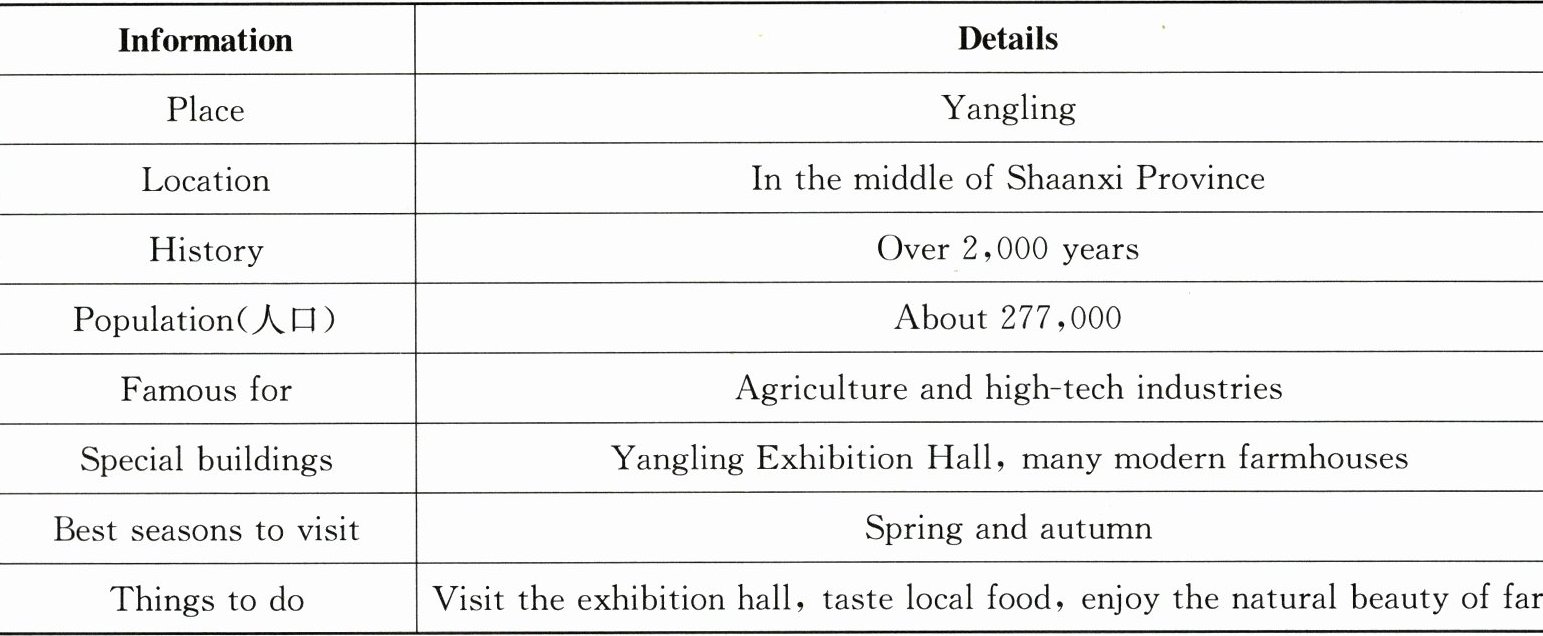
(
A. It has a population of over 2,000,000.
B. It has a history of more than 2,000 years.
C. It is famous for its art and culture.
D. It is in the northern part of Shaanxi Province.
(
A. Visit the modern art galleries.
B. Take part in high - tech industry seminars.
C. Visit the exhibition hall and enjoy local food.
D. Experience the nightlife in the city centre.
(
A. January or August.
B. July or February.
C. March or October.
D. April or December.
第一节:阅读下面短文,从每题所给的 A、B、C、D 四个选项中,选出最佳选项。
A(2025·江苏宿迁泗洪期中)
(
B
)1. Which of the following statements about Yangling is TRUE?A. It has a population of over 2,000,000.
B. It has a history of more than 2,000 years.
C. It is famous for its art and culture.
D. It is in the northern part of Shaanxi Province.
(
C
)2. What can visitors do when they visit Yangling?A. Visit the modern art galleries.
B. Take part in high - tech industry seminars.
C. Visit the exhibition hall and enjoy local food.
D. Experience the nightlife in the city centre.
(
C
)3. When is the best time to visit Yangling?A. January or August.
B. July or February.
C. March or October.
D. April or December.
答案:三、1. B 【点拨】根据“History”中“Over 2,000 years”可知,杨凌有 2000 多年的历史。故选 B。
2. C 【点拨】根据“Visit the exhibition hall, taste local food, enjoy the natural beauty of farms”可知,游客可以参观展览厅及品尝当地食物。故选 C。
3. C 【点拨】根据“Best seasons to visit”及“Spring and autumn”可知,春秋季节是最佳参观季节,因此三月或十月是最佳参观时间。故选 C。
2. C 【点拨】根据“Visit the exhibition hall, taste local food, enjoy the natural beauty of farms”可知,游客可以参观展览厅及品尝当地食物。故选 C。
3. C 【点拨】根据“Best seasons to visit”及“Spring and autumn”可知,春秋季节是最佳参观季节,因此三月或十月是最佳参观时间。故选 C。
B
“Hometown” is a word full of warmth and beauty. How would you show your love for your hometown? At the final of a national English - speaking competition, contestants from all over China shared their own stories.
Wang Siqi from Nanjing International School, Jiangsu, talked about her hometown Nanjing. “I used to live in the US, and my parents kept telling me everything about Nanjing. When I came back at age 9, I felt even closer to this city. Tasting its foods and hanging around in its universities, I was like a child who had missed her mum for too long,” said Wang. “The competition gave me a great chance to show my love for Nanjing.”
Lan Yunjie, 15, from Shanghai Starriver Bilingual School, tried to change people's stereotypes(刻板印象) about his hometown, Shanghai. “When talking about Shanghai, many people would think of words like ‘fast - paced(快节奏的)’ and ‘indifferent(冷漠的)’, but in fact, it's a city full of kindness. I want to show others a different side of Shanghai, so I told stories of how people helped each other during Shanghai's lockdown,” said Lan. “I believe this is the power of public speaking,” Lan added. “By using logic and emotion, you can better share your opinions, promoting(增进) understanding and removing prejudice(消除偏见).”
Yang Zihan, 14, born in Hong Kong, she mainly lives in Shenzhen. “Unlike other people who are so familiar with their hometown, my hometown is a ‘stranger’ to me. But thanks to the competition, I did a lot of research about Hong Kong and found out about its sad colonial(殖民地的) history and the local people's brave fight. That spirit of patriotism has become the most valuable thing my hometown gives to me, and I'm glad to share it with everyone,” said Yang.
(
A. A tourist exploring a new city.
B. A child who had missed her mum for too long.
C. A student studying abroad.
D. A chef tasting local foods.
(
A. To complain about the city's fast - paced life.
B. To prove Shanghai is indifferent.
C. To change people's stereotypes about his hometown and show its kindness.
D. To compare Shanghai with other cities.
(
A. Love for one's country.
B. Fear of strangers.
C. Interest in colonial history.
D. Curiosity about Shenzhen.
(
A. To compare their hometowns.
B. To express personal achievements.
C. To share and celebrate their hometowns' unique qualities.
D. To encourage people to move to big cities.
“Hometown” is a word full of warmth and beauty. How would you show your love for your hometown? At the final of a national English - speaking competition, contestants from all over China shared their own stories.
Wang Siqi from Nanjing International School, Jiangsu, talked about her hometown Nanjing. “I used to live in the US, and my parents kept telling me everything about Nanjing. When I came back at age 9, I felt even closer to this city. Tasting its foods and hanging around in its universities, I was like a child who had missed her mum for too long,” said Wang. “The competition gave me a great chance to show my love for Nanjing.”
Lan Yunjie, 15, from Shanghai Starriver Bilingual School, tried to change people's stereotypes(刻板印象) about his hometown, Shanghai. “When talking about Shanghai, many people would think of words like ‘fast - paced(快节奏的)’ and ‘indifferent(冷漠的)’, but in fact, it's a city full of kindness. I want to show others a different side of Shanghai, so I told stories of how people helped each other during Shanghai's lockdown,” said Lan. “I believe this is the power of public speaking,” Lan added. “By using logic and emotion, you can better share your opinions, promoting(增进) understanding and removing prejudice(消除偏见).”
Yang Zihan, 14, born in Hong Kong, she mainly lives in Shenzhen. “Unlike other people who are so familiar with their hometown, my hometown is a ‘stranger’ to me. But thanks to the competition, I did a lot of research about Hong Kong and found out about its sad colonial(殖民地的) history and the local people's brave fight. That spirit of patriotism has become the most valuable thing my hometown gives to me, and I'm glad to share it with everyone,” said Yang.
(
B
)4. What did Wang Siqi compare herself to when she returned to Nanjing at age 9?A. A tourist exploring a new city.
B. A child who had missed her mum for too long.
C. A student studying abroad.
D. A chef tasting local foods.
(
C
)5. Why did Lan Yunjie share stories about Shanghai's lockdown?A. To complain about the city's fast - paced life.
B. To prove Shanghai is indifferent.
C. To change people's stereotypes about his hometown and show its kindness.
D. To compare Shanghai with other cities.
(
A
)6. In Yang Zihan's quote, what does the underlined word “patriotism” most likely mean?A. Love for one's country.
B. Fear of strangers.
C. Interest in colonial history.
D. Curiosity about Shenzhen.
(
C
)7. What is the purpose(目的) of the national English - speaking competition?A. To compare their hometowns.
B. To express personal achievements.
C. To share and celebrate their hometowns' unique qualities.
D. To encourage people to move to big cities.
答案:4. B 【点拨】根据文中 Wang Siqi 的话“I was like a child who had missed her mum for too long”可知,她将自己比作一个久别母亲的孩子。故选 B。
5. C 【点拨】根据“so I told stories of how people helped each other during Shanghai's lockdown”以及“to change people's stereotypes(刻板印象)about his hometown”可知,他是为了改变人们对上海冷漠的刻板印象,展示其善良的一面。故选 C。
6. A 【点拨】根据“found out about its sad colonial(殖民地的)history and the local people's brave fight”可知,她从家乡的历史中感受到了爱国精神,故“patriotism”意为“爱国主义”。故选 A。
7. C 【点拨】根据全文内容可知,选手们都在通过演讲表达对家乡的热爱和理解,分享其独特之处,目的正是为了庆祝并分享家乡的魅力。故选 C。
5. C 【点拨】根据“so I told stories of how people helped each other during Shanghai's lockdown”以及“to change people's stereotypes(刻板印象)about his hometown”可知,他是为了改变人们对上海冷漠的刻板印象,展示其善良的一面。故选 C。
6. A 【点拨】根据“found out about its sad colonial(殖民地的)history and the local people's brave fight”可知,她从家乡的历史中感受到了爱国精神,故“patriotism”意为“爱国主义”。故选 A。
7. C 【点拨】根据全文内容可知,选手们都在通过演讲表达对家乡的热爱和理解,分享其独特之处,目的正是为了庆祝并分享家乡的魅力。故选 C。