9. It seems that is a worldwide way to greet someone for the first time.
A.nodding
B.hugging
C.bowing
D.shaking hands
A.nodding
B.hugging
C.bowing
D.shaking hands
答案:9. D 解析:A 选项 nodding、B 选项 hugging、C 选项 bowing 均是部分地区的问候方式,并非全世界通用;D 选项 shaking hands 是世界范围内初次见面常用的问候方式,故选 D。
解析:
【分析】
首先要明确题目核心:找出全世界范围内初次见面通用的问候方式。我们可以逐个分析选项对应的问候方式的适用范围:A选项nodding(点头)仅在部分地区使用,不具备全球性;B选项hugging(拥抱)主要流行于欧美等部分国家,并非所有地区都适用;C选项bowing(鞠躬)是日本、韩国等东亚国家的特色问候方式,也不属于全球通用;而D选项shaking hands(握手)是被世界大多数国家认可和使用的初次见面问候方式,符合题意。
【解析】
题目询问哪种是全世界初次见面通用的问候方式,对各选项分析如下:
A选项nodding(点头):仅在部分地区作为问候方式,不具备全球性;
B选项hugging(拥抱):主要流行于欧美等部分国家,并非全球通用;
C选项bowing(鞠躬):是日本、韩国等东亚国家的特色问候方式,不属于全世界通用;
D选项shaking hands(握手):被世界绝大多数国家认可,是初次见面时普遍使用的问候方式。
综上,答案选D。
【答案】
D
【知识点】
日常交际礼仪、词汇词义辨析
【点评】
本题考查英语文化常识与词汇辨析,需要学生了解不同国家的交际礼仪差异,掌握常见问候方式的英文表达及适用场景,注重对西方文化及日常交际知识的积累。
【难度系数】
0.7
首先要明确题目核心:找出全世界范围内初次见面通用的问候方式。我们可以逐个分析选项对应的问候方式的适用范围:A选项nodding(点头)仅在部分地区使用,不具备全球性;B选项hugging(拥抱)主要流行于欧美等部分国家,并非所有地区都适用;C选项bowing(鞠躬)是日本、韩国等东亚国家的特色问候方式,也不属于全球通用;而D选项shaking hands(握手)是被世界大多数国家认可和使用的初次见面问候方式,符合题意。
【解析】
题目询问哪种是全世界初次见面通用的问候方式,对各选项分析如下:
A选项nodding(点头):仅在部分地区作为问候方式,不具备全球性;
B选项hugging(拥抱):主要流行于欧美等部分国家,并非全球通用;
C选项bowing(鞠躬):是日本、韩国等东亚国家的特色问候方式,不属于全世界通用;
D选项shaking hands(握手):被世界绝大多数国家认可,是初次见面时普遍使用的问候方式。
综上,答案选D。
【答案】
D
【知识点】
日常交际礼仪、词汇词义辨析
【点评】
本题考查英语文化常识与词汇辨析,需要学生了解不同国家的交际礼仪差异,掌握常见问候方式的英文表达及适用场景,注重对西方文化及日常交际知识的积累。
【难度系数】
0.7
10. We students should be polite when visiting some places of interest. So, we should when travelling.
①be quiet when visiting a museum
②pick up litter on the ground
③jump over a wall when visiting a park
④often say "hello" or "thanks" to others
⑤throw things here and there
A.②③④
B.①③⑤
C.①②④
D.①②⑤
①be quiet when visiting a museum
②pick up litter on the ground
③jump over a wall when visiting a park
④often say "hello" or "thanks" to others
⑤throw things here and there
A.②③④
B.①③⑤
C.①②④
D.①②⑤
答案:10. C 解析:①“参观博物馆时保持安静”是礼貌行为;②“捡起地上的垃圾”是礼貌行为;③“参观公园时翻墙”是不礼貌行为;④“经常向别人问好或道谢”是礼貌行为;⑤“到处扔东西”是不礼貌行为。综上,①②④正确,故选 C。
解析:
【分析】
首先,题目要求选出学生旅行时应践行的礼貌行为。解题思路为:先明确公共场所礼貌行为的准则,再逐一分析题干中的5种行为是否符合礼仪要求,排除不礼貌行为后,匹配包含所有正确行为的选项。具体来看:①参观博物馆保持安静,契合公共场所礼仪;②捡起地上垃圾,是爱护环境的文明行为;③公园翻墙是破坏规则的不礼貌行为;④主动问好道谢是基本礼貌;⑤乱扔东西是不文明行为。排除③和⑤后,剩下的①②④对应选项C。
【解析】
我们逐个分析每个行为是否属于礼貌行为:
①“参观博物馆时保持安静”,博物馆需要安静的环境,这是符合礼仪的礼貌行为;
②“捡起地上的垃圾”,这是爱护公共环境的文明礼貌行为;
③“参观公园时翻墙”,这是破坏公园规则、不文明的行为;
④“经常向别人问好或道谢”,这是人际交往中的基本礼貌行为;
⑤“到处扔东西”,这是破坏公共环境的不文明行为。
综上,①②④是正确的礼貌行为,对应选项C。
【答案】
C
【知识点】
礼貌行为辨析、情景交际
【点评】
本题结合旅行场景考查学生对日常礼貌行为的判断,贴近生活实际,既需要学生区分文明与不文明行为,也能引导学生养成良好的公共行为习惯。
【难度系数】
0.8
首先,题目要求选出学生旅行时应践行的礼貌行为。解题思路为:先明确公共场所礼貌行为的准则,再逐一分析题干中的5种行为是否符合礼仪要求,排除不礼貌行为后,匹配包含所有正确行为的选项。具体来看:①参观博物馆保持安静,契合公共场所礼仪;②捡起地上垃圾,是爱护环境的文明行为;③公园翻墙是破坏规则的不礼貌行为;④主动问好道谢是基本礼貌;⑤乱扔东西是不文明行为。排除③和⑤后,剩下的①②④对应选项C。
【解析】
我们逐个分析每个行为是否属于礼貌行为:
①“参观博物馆时保持安静”,博物馆需要安静的环境,这是符合礼仪的礼貌行为;
②“捡起地上的垃圾”,这是爱护公共环境的文明礼貌行为;
③“参观公园时翻墙”,这是破坏公园规则、不文明的行为;
④“经常向别人问好或道谢”,这是人际交往中的基本礼貌行为;
⑤“到处扔东西”,这是破坏公共环境的不文明行为。
综上,①②④是正确的礼貌行为,对应选项C。
【答案】
C
【知识点】
礼貌行为辨析、情景交际
【点评】
本题结合旅行场景考查学生对日常礼貌行为的判断,贴近生活实际,既需要学生区分文明与不文明行为,也能引导学生养成良好的公共行为习惯。
【难度系数】
0.8
Ⅳ. 情境翻译
1. 我会分享一些关于中国餐桌礼仪的建议。
2. 首先,要等到所有人都准备好才能开始用餐。
3. 英国人会用一个大大的拥抱来问候彼此。
4. 当你准备离开时,别忘了说"谢谢"。
5. 在中餐厅里给小费并不常见。
6. 我希望你会觉得我的建议有帮助。
1. 我会分享一些关于中国餐桌礼仪的建议。
I'm going to/I'll share some advice on table manners in China.
2. 首先,要等到所有人都准备好才能开始用餐。
Firstly/First of all, you shouldn't start eating until everyone is ready.
3. 英国人会用一个大大的拥抱来问候彼此。
British people greet one another with a big hug.
4. 当你准备离开时,别忘了说"谢谢"。
Don't forget to say "thank you" when you are about to leave.
5. 在中餐厅里给小费并不常见。
It's not common to leave a tip at a Chinese restaurant.
6. 我希望你会觉得我的建议有帮助。
I hope that you will find my advice helpful.
答案:Ⅳ. 1. I'm going to/I'll share some advice on table manners in China.
2. Firstly/First of all, you shouldn't start eating until everyone is ready.
3. British people greet one another with a big hug.
4. Don't forget to say "thank you" when you are about to leave.
5. It's not common to leave a tip at a Chinese restaurant.
6. I hope that you will find my advice helpful.
2. Firstly/First of all, you shouldn't start eating until everyone is ready.
3. British people greet one another with a big hug.
4. Don't forget to say "thank you" when you are about to leave.
5. It's not common to leave a tip at a Chinese restaurant.
6. I hope that you will find my advice helpful.
解析:
【分析】
这是一组围绕跨文化礼仪的情境翻译题,解题时需结合句子语境确定合适的时态、句式,同时注意英语中的固定表达与搭配:
1. 第一句表达“将要分享”的将来动作,可用一般将来时(will/be going to),“关于……的建议”用固定搭配“advice on”,“中国餐桌礼仪”译为“table manners in China”;
2. 第二句“首先”可用“Firstly/First of all”引出要点,“直到……才”需用英语常用的“not...until”结构来体现逻辑;
3. 第三句描述英国人的日常问候习惯,用一般现在时,“问候彼此”是“greet one another”,“用……方式”用介词“with”;
4. 第四句“别忘了做某事”是固定祈使句型“Don't forget to do sth”,“准备离开”用“be about to leave”;
5. 第五句为避免句子头重脚轻,采用it作形式主语的句型“It's + 形容词 + to do sth”,“给小费”译为“leave a tip”;
6. 第六句“希望……”用宾语从句“I hope that...”,“觉得……有帮助”是固定表达“find sth helpful”。
【解析】
1. 确定用一般将来时表达将来的动作,“一些关于中国餐桌礼仪的建议”译为“some advice on table manners in China”,组合得:I'm going to/I'll share some advice on table manners in China.
2. 用“Firstly/First of all”引出第一条建议,借助“not...until”结构翻译“直到所有人都准备好才能开始用餐”,组合得:Firstly/First of all, you shouldn't start eating until everyone is ready.
3. 用一般现在时描述客观习惯,“英国人”译为“British people”,“问候彼此”是“greet one another”,“用一个大大的拥抱”用“with a big hug”,组合得:British people greet one another with a big hug.
4. 用祈使句“Don't forget to say "thank you"”表达提醒,加上时间状语“when you are about to leave”,组合得:Don't forget to say "thank you" when you are about to leave.
5. 采用it作形式主语的句型,真正主语是“在中餐厅里给小费”,译为“to leave a tip at a Chinese restaurant”,“并不常见”译为“not common”,组合得:It's not common to leave a tip at a Chinese restaurant.
6. 用“I hope that...”引导宾语从句,从句部分“你会觉得我的建议有帮助”译为“you will find my advice helpful”,组合得:I hope that you will find my advice helpful.
【答案】
Ⅳ. 1. I'm going to/I'll share some advice on table manners in China.
2. Firstly/First of all, you shouldn't start eating until everyone is ready.
3. British people greet one another with a big hug.
4. Don't forget to say "thank you" when you are about to leave.
5. It's not common to leave a tip at a Chinese restaurant.
6. I hope that you will find my advice helpful.
【知识点】
1. 一般将来时用法
2. 固定短语搭配
3. it作形式主语句型
【点评】
这组翻译题聚焦中西方交际与餐桌礼仪,涵盖日常高频英语表达,既考查基础时态、核心句型的运用,也涉及跨文化交际相关词汇,掌握这些内容能提升英语实用交际能力,帮助理解中西方文化差异。
【难度系数】
0.7
这是一组围绕跨文化礼仪的情境翻译题,解题时需结合句子语境确定合适的时态、句式,同时注意英语中的固定表达与搭配:
1. 第一句表达“将要分享”的将来动作,可用一般将来时(will/be going to),“关于……的建议”用固定搭配“advice on”,“中国餐桌礼仪”译为“table manners in China”;
2. 第二句“首先”可用“Firstly/First of all”引出要点,“直到……才”需用英语常用的“not...until”结构来体现逻辑;
3. 第三句描述英国人的日常问候习惯,用一般现在时,“问候彼此”是“greet one another”,“用……方式”用介词“with”;
4. 第四句“别忘了做某事”是固定祈使句型“Don't forget to do sth”,“准备离开”用“be about to leave”;
5. 第五句为避免句子头重脚轻,采用it作形式主语的句型“It's + 形容词 + to do sth”,“给小费”译为“leave a tip”;
6. 第六句“希望……”用宾语从句“I hope that...”,“觉得……有帮助”是固定表达“find sth helpful”。
【解析】
1. 确定用一般将来时表达将来的动作,“一些关于中国餐桌礼仪的建议”译为“some advice on table manners in China”,组合得:I'm going to/I'll share some advice on table manners in China.
2. 用“Firstly/First of all”引出第一条建议,借助“not...until”结构翻译“直到所有人都准备好才能开始用餐”,组合得:Firstly/First of all, you shouldn't start eating until everyone is ready.
3. 用一般现在时描述客观习惯,“英国人”译为“British people”,“问候彼此”是“greet one another”,“用一个大大的拥抱”用“with a big hug”,组合得:British people greet one another with a big hug.
4. 用祈使句“Don't forget to say "thank you"”表达提醒,加上时间状语“when you are about to leave”,组合得:Don't forget to say "thank you" when you are about to leave.
5. 采用it作形式主语的句型,真正主语是“在中餐厅里给小费”,译为“to leave a tip at a Chinese restaurant”,“并不常见”译为“not common”,组合得:It's not common to leave a tip at a Chinese restaurant.
6. 用“I hope that...”引导宾语从句,从句部分“你会觉得我的建议有帮助”译为“you will find my advice helpful”,组合得:I hope that you will find my advice helpful.
【答案】
Ⅳ. 1. I'm going to/I'll share some advice on table manners in China.
2. Firstly/First of all, you shouldn't start eating until everyone is ready.
3. British people greet one another with a big hug.
4. Don't forget to say "thank you" when you are about to leave.
5. It's not common to leave a tip at a Chinese restaurant.
6. I hope that you will find my advice helpful.
【知识点】
1. 一般将来时用法
2. 固定短语搭配
3. it作形式主语句型
【点评】
这组翻译题聚焦中西方交际与餐桌礼仪,涵盖日常高频英语表达,既考查基础时态、核心句型的运用,也涉及跨文化交际相关词汇,掌握这些内容能提升英语实用交际能力,帮助理解中西方文化差异。
【难度系数】
0.7
Ⅴ. 阅读理解
For centuries, China has been known as "a state of ceremony", which means Liyi Zhibang. There was much greeting etiquette in ancient China. And the fist-and-palm salute(拱手礼) was quite a classic example. Today, although Chinese people usually shake hands when meeting friends and relatives, people still make fist-and-palm salutes when they are paying a visit to someone during the Spring Festival or attending someone's wedding or birthday party.
The fist-and-palm salute has a history of more than 3,000 years. Since the Western Zhou Dynasty, people had already performed it when meeting peers(同辈). In ancient times, if people met a stranger, they would prepare for a fight if necessary, and their hands were always ready for holding any weapon(武器). Holding hands together pointed towards themselves was a gesture of saying "relax", meaning "I'm not with any weapon and I'm not here to pick a fight". Later, it became the etiquette when people met each other or showed thanks.
So, how should people do the fist-and-palm salute properly? Firstly, stand at attention. If you're a man, make a half fist(拳) with your right hand, then hold the right hand with your left hand in front of your chest, look at the person, raise both hands to the eyebrows(眉毛), bend down and shake hands gently three times. At the same time, you can also say some lucky greeting words. If you're a woman, you should do it the other way which should be the right hand on the top.
People may be more familiar with the hold-fist salute, called bao quan li in Chinese. It is widely used among the kung fu masters and students. This gesture is formed by holding the right fist very tightly closed and covering it with the left hand open, and extending both arms a little forward in front of the chest. Make sure the left thumb(拇指) is close to the index finger(食指) and don't point it at yourself, as it shows impoliteness.
1. What does the underlined word "etiquette" in Paragraph 1 mean?
A. Need.
B. Manners.
C. Dances.
D. Groups.
2. Which picture shows the CORRECT way for women to do the fist-and-palm salute?
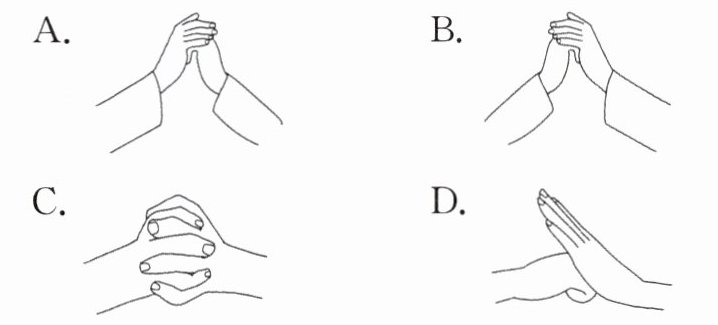
A.
B.
C.
D.
3. If Mike wants to do the hold-fist salute, he should .
A. keep his right hand open
B. put his right hand on his left hand
C. not point his left thumb at himself
D. not hold out his arms
4. What can we learn from the passage?
A. There are no standards for these two salutes.
B. The fist-and-palm salute is more common in kung fu.
C. Now, people celebrate one's birthday with the hold-fist salute.
D. These two salutes seem similar, but they are quite different.
For centuries, China has been known as "a state of ceremony", which means Liyi Zhibang. There was much greeting etiquette in ancient China. And the fist-and-palm salute(拱手礼) was quite a classic example. Today, although Chinese people usually shake hands when meeting friends and relatives, people still make fist-and-palm salutes when they are paying a visit to someone during the Spring Festival or attending someone's wedding or birthday party.
The fist-and-palm salute has a history of more than 3,000 years. Since the Western Zhou Dynasty, people had already performed it when meeting peers(同辈). In ancient times, if people met a stranger, they would prepare for a fight if necessary, and their hands were always ready for holding any weapon(武器). Holding hands together pointed towards themselves was a gesture of saying "relax", meaning "I'm not with any weapon and I'm not here to pick a fight". Later, it became the etiquette when people met each other or showed thanks.
So, how should people do the fist-and-palm salute properly? Firstly, stand at attention. If you're a man, make a half fist(拳) with your right hand, then hold the right hand with your left hand in front of your chest, look at the person, raise both hands to the eyebrows(眉毛), bend down and shake hands gently three times. At the same time, you can also say some lucky greeting words. If you're a woman, you should do it the other way which should be the right hand on the top.
People may be more familiar with the hold-fist salute, called bao quan li in Chinese. It is widely used among the kung fu masters and students. This gesture is formed by holding the right fist very tightly closed and covering it with the left hand open, and extending both arms a little forward in front of the chest. Make sure the left thumb(拇指) is close to the index finger(食指) and don't point it at yourself, as it shows impoliteness.
1. What does the underlined word "etiquette" in Paragraph 1 mean?
A. Need.
B. Manners.
C. Dances.
D. Groups.
2. Which picture shows the CORRECT way for women to do the fist-and-palm salute?
A.
B.
C.
D.
3. If Mike wants to do the hold-fist salute, he should .
A. keep his right hand open
B. put his right hand on his left hand
C. not point his left thumb at himself
D. not hold out his arms
4. What can we learn from the passage?
A. There are no standards for these two salutes.
B. The fist-and-palm salute is more common in kung fu.
C. Now, people celebrate one's birthday with the hold-fist salute.
D. These two salutes seem similar, but they are quite different.
答案:Ⅴ. 1 - 4 BACD
【语篇解读】本文是一篇说明文,主要介绍了拱手礼与抱拳礼。
1. B 解析:词义猜测题。根据“There was much greeting etiquette in ancient China. And the fist - and - palm salute was quite a classic example.”可知拱手礼是一个相当经典的例子,因此画线词所在句是指古代中国有许多问候礼仪。etiquette 与 manners 词义相近。故选 B。
2. A 解析:图示理解题。根据“Firstly,stand at attention. If you're a man,make a half fist with your right hand,then hold the right hand with your left hand in front of your chest... If you're a woman,you should do it the other way which should be the right hand on the top.”可知如果你是男人,用你的右手握半个拳头,然后左手放在胸前握住右手,如果你是女人,你应该用另一种方式来做,所以应该是右手放在上面。故选 A。
3. C 解析:细节理解题。根据“People may be more familiar with the hold - fist salute... Make sure the left thumb is close to the index finger and don't point it at yourself,as it shows impoliteness.”可知确保左手拇指靠近食指,不要指向自己,因为这是不礼貌的表现。故选 C。
4. D 解析:推理判断题。根据文章第三段和第四段对拱手礼和抱拳礼动作的描述可推知,两者看起来很像,但是是相当不同的。故选 D。
【语篇解读】本文是一篇说明文,主要介绍了拱手礼与抱拳礼。
1. B 解析:词义猜测题。根据“There was much greeting etiquette in ancient China. And the fist - and - palm salute was quite a classic example.”可知拱手礼是一个相当经典的例子,因此画线词所在句是指古代中国有许多问候礼仪。etiquette 与 manners 词义相近。故选 B。
2. A 解析:图示理解题。根据“Firstly,stand at attention. If you're a man,make a half fist with your right hand,then hold the right hand with your left hand in front of your chest... If you're a woman,you should do it the other way which should be the right hand on the top.”可知如果你是男人,用你的右手握半个拳头,然后左手放在胸前握住右手,如果你是女人,你应该用另一种方式来做,所以应该是右手放在上面。故选 A。
3. C 解析:细节理解题。根据“People may be more familiar with the hold - fist salute... Make sure the left thumb is close to the index finger and don't point it at yourself,as it shows impoliteness.”可知确保左手拇指靠近食指,不要指向自己,因为这是不礼貌的表现。故选 C。
4. D 解析:推理判断题。根据文章第三段和第四段对拱手礼和抱拳礼动作的描述可推知,两者看起来很像,但是是相当不同的。故选 D。
解析:
【分析】
1. 第1题:这是词义猜测题,解题时先定位画线词所在句子,根据后文“拱手礼是经典例子”,可知画线词是和问候相关的礼仪类词汇,结合选项推断词义。
2. 第2题:这是图示理解题,需回到原文找到女性拱手礼的动作描述,原文指出男性是左手握右手,女性则相反,右手在上,据此匹配对应的图片。
3. 第3题:这是细节理解题,要找到文中关于抱拳礼的动作要求,定位到相关语句后,对比选项选出符合要求的内容。
4. 第4题:这是推理判断题,需通读文中对拱手礼和抱拳礼的动作描述,对比两者的差异,从而推断出正确结论。
【解析】
1. 第1题:词义猜测题。根据“There was much greeting etiquette in ancient China. And the fist-and-palm salute was quite a classic example.”可知,拱手礼是问候礼仪的经典例子,因此画线词“etiquette”意为“礼仪、礼貌”,与“manners”词义相近。故选B。
2. 第2题:图示理解题。根据文中描述“ If you're a man, make a half fist(拳) with your right hand, then hold the right hand with your left hand in front of your chest... If you're a woman, you should do it the other way which should be the right hand on the top.”可知,男性拱手礼是左手握住右手,女性则是右手在上,对应图A。故选A。
3. 第3题:细节理解题。根据“People may be more familiar with the hold-fist salute... Make sure the left thumb(拇指) is close to the index finger(食指) and don't point it at yourself, as it shows impoliteness.”可知,行抱拳礼时,左手拇指不能指向自己。故选C。
4. 第4题:推理判断题。对比文中第三段对拱手礼、第四段对抱拳礼的动作描述,可推知这两种礼仪看起来相似,但实际有很大区别。故选D。
【答案】
BACD
【知识点】
词义猜测、细节理解、推理判断
【点评】
本文是一篇说明文,介绍了中国传统的拱手礼和抱拳礼的起源、适用场景及正确姿势。题目考查了多种阅读技能,需要学生准确提取原文信息、结合语境推断词义并进行合理推理,有助于提升学生的阅读理解能力和对传统文化的认知。
【难度系数】
0.6
1. 第1题:这是词义猜测题,解题时先定位画线词所在句子,根据后文“拱手礼是经典例子”,可知画线词是和问候相关的礼仪类词汇,结合选项推断词义。
2. 第2题:这是图示理解题,需回到原文找到女性拱手礼的动作描述,原文指出男性是左手握右手,女性则相反,右手在上,据此匹配对应的图片。
3. 第3题:这是细节理解题,要找到文中关于抱拳礼的动作要求,定位到相关语句后,对比选项选出符合要求的内容。
4. 第4题:这是推理判断题,需通读文中对拱手礼和抱拳礼的动作描述,对比两者的差异,从而推断出正确结论。
【解析】
1. 第1题:词义猜测题。根据“There was much greeting etiquette in ancient China. And the fist-and-palm salute was quite a classic example.”可知,拱手礼是问候礼仪的经典例子,因此画线词“etiquette”意为“礼仪、礼貌”,与“manners”词义相近。故选B。
2. 第2题:图示理解题。根据文中描述“ If you're a man, make a half fist(拳) with your right hand, then hold the right hand with your left hand in front of your chest... If you're a woman, you should do it the other way which should be the right hand on the top.”可知,男性拱手礼是左手握住右手,女性则是右手在上,对应图A。故选A。
3. 第3题:细节理解题。根据“People may be more familiar with the hold-fist salute... Make sure the left thumb(拇指) is close to the index finger(食指) and don't point it at yourself, as it shows impoliteness.”可知,行抱拳礼时,左手拇指不能指向自己。故选C。
4. 第4题:推理判断题。对比文中第三段对拱手礼、第四段对抱拳礼的动作描述,可推知这两种礼仪看起来相似,但实际有很大区别。故选D。
【答案】
BACD
【知识点】
词义猜测、细节理解、推理判断
【点评】
本文是一篇说明文,介绍了中国传统的拱手礼和抱拳礼的起源、适用场景及正确姿势。题目考查了多种阅读技能,需要学生准确提取原文信息、结合语境推断词义并进行合理推理,有助于提升学生的阅读理解能力和对传统文化的认知。
【难度系数】
0.6