A
School gardening 1.
The children don't have to sit at 4. ______ (they) desks all day. The gardening lessons teach them something that they can't learn in the classroom. Also, they have a chance 5. ______ (move) outside and get their hands dirty. Teachers ask students to take gardening 6. ______ (serious). In gardens, students watch carefully with a purpose. They can see the 7. ______ (begin), the middle and the end of the project. However, some schools don't have enough space for a garden, so the lessons can be 8. ______ (give) in the community gardens or parks.
"Gardening is an 9.
B
[2025 南通市如皋市期中]An encyclopaedia(百科全书) is a useful special book. It covers many different subjects, or it can deeply focus on one subject. Online encyclopaedias are like 1.
What 5.
However, for more exact information, we must use online encyclopaedias 7.
All in all, online encyclopaedias are 10.
C 外刊视野
A recent study has changed what scientists 1.
The SPA basin is the 3.
Before this study, scientists 5.
If the study's results are right, lots of chemicals from under the Moon's surface would have 7.
(素材选自 The Week Junior)
D 跨学科 语文
Boys and girls, have you ever heard of the saying "If winter comes, can spring be far behind?"
Spring is a fine season. It lights up 1.
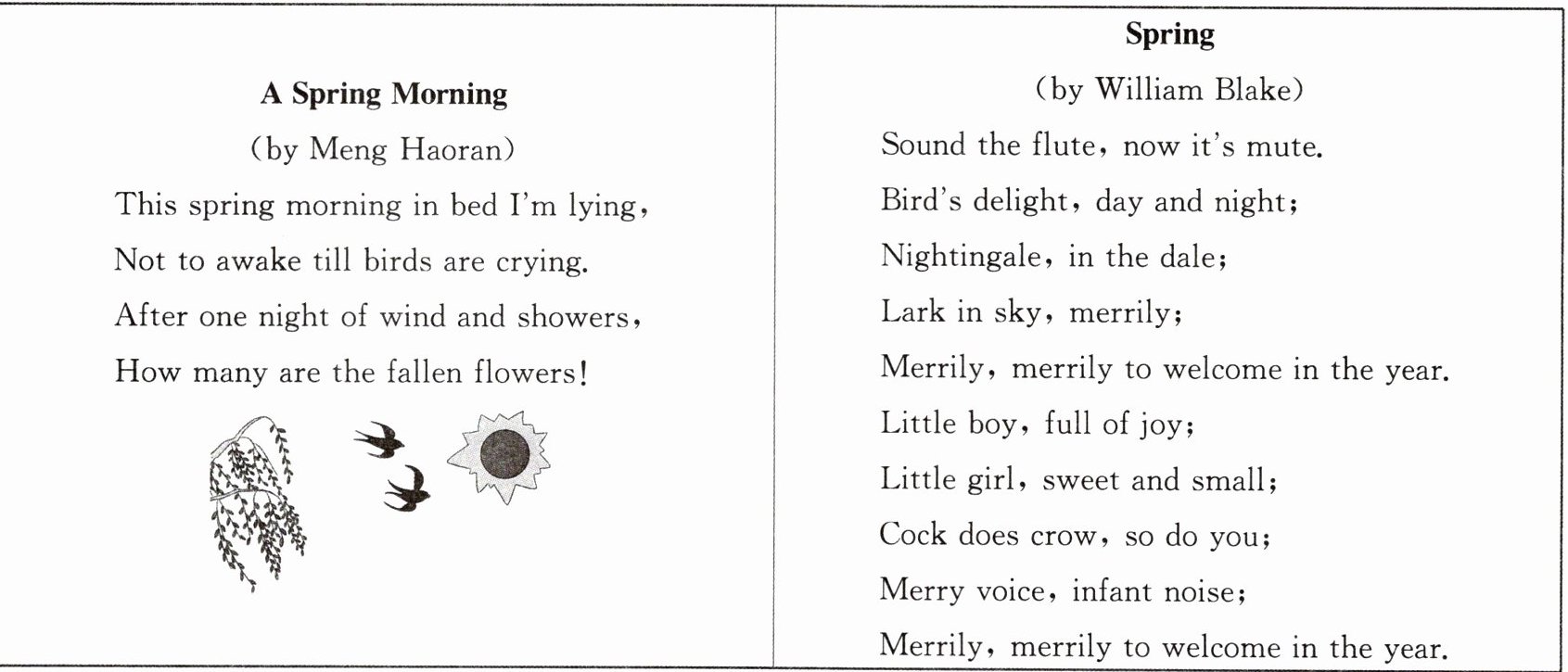
The first poem may be one of the 3.
William Blake's poem celebrates the coming of spring as a way 8. ______ (bring) us joy. As spring comes, nature jumps into a new life. This means the 9. ______ (begin) of the new year. The birds in the poem are joyful day and night. It seems that the boys and girls speak of all the things so 10. ______ (active). Through "merrily", the poet shows how happy he and others are to welcome spring.
School gardening 1.
is
(be) now very popular. Parents and teachers all like these hands-on lessons very much. Students are 2. excited
(excite) about the gardening lessons too. The lessons give them a new way of 3. learning
(learn) and help them relax.The children don't have to sit at 4. ______ (they) desks all day. The gardening lessons teach them something that they can't learn in the classroom. Also, they have a chance 5. ______ (move) outside and get their hands dirty. Teachers ask students to take gardening 6. ______ (serious). In gardens, students watch carefully with a purpose. They can see the 7. ______ (begin), the middle and the end of the project. However, some schools don't have enough space for a garden, so the lessons can be 8. ______ (give) in the community gardens or parks.
"Gardening is an 9.
important
(importance) subject," a teacher says. "It not only lets students 10. know
(know) where our food comes from, but also makes them have more love for the earth. Gardening is not just a hobby. It's a life skill."B
[2025 南通市如皋市期中]An encyclopaedia(百科全书) is a useful special book. It covers many different subjects, or it can deeply focus on one subject. Online encyclopaedias are like 1.
countless
(count) treasure boxes. These treasure boxes are 2. filled
(fill) with valuable information and unknown wonders on the internet. Wherever you are, as long as you have a computer, tablet, or smartphone, you can open them 3. to search
(search) for a world of information. You can learn about the great leaders in history, the 4. newest
(new) findings in science and so on.What 5.
makes
(make) online encyclopaedias special is that they can be kept updated. Information on online encyclopaedias can change every day. For example, when a new planet is discovered in space, details about it 6. will show
(show) up online soon.However, for more exact information, we must use online encyclopaedias 7.
carefully
(careful). Sometimes, people might write 8. incorrect
(correct) information by accident, or some content may not be fully checked. So, if you use the information from online encyclopaedias for homework or research, pay more attention to 9. checking
(check) it with other trusted resources.All in all, online encyclopaedias are 10.
amazing
(amaze) tools. They help us learn quickly and satisfy our curiosity. With smart use, they will be our best friends on the learning journey.C 外刊视野
A recent study has changed what scientists 1.
thought
(think) about a special place on the Moon's south pole. It 2. is called
(call) the South Pole-Aitken(SPA) basin(盆地). The findings may help NASA's new Artemis Ⅲ mission(任务). This mission plans to land astronauts near the Moon's south pole.The SPA basin is the 3.
biggest
(big) impact crater(撞击坑) on the Moon. Scientists think it formed around 4.3 billion 4. years
(year) ago. A huge asteroid(小行星) hit the Moon back then. The strong crash also let out chemicals from under the Moon's surface.Before this study, scientists 5.
believed
(believe) the asteroid came from the south when it hit the Moon and made the SPA basin. But in the new study, a group from the University of Arizona found something new. The SPA basin looks like a teardrop. It gets narrower at its 6. southern
(south) end. This shows the asteroid probably came from the north and moved south when it hit.If the study's results are right, lots of chemicals from under the Moon's surface would have 7.
quietly
(quiet) stayed at the Moon's south pole. Artemis astronauts will land close by in 2027. These valuable chemicals will be collected and studied by the astronauts 8. to learn
(learn) more about the Moon. This may answer questions about the Moon's 9. growth
(grow). For example, it can explain why the Moon's far side is thicker than 10. its
(it) smooth near side that we can see from the earth.(素材选自 The Week Junior)
D 跨学科 语文
Boys and girls, have you ever heard of the saying "If winter comes, can spring be far behind?"
Spring is a fine season. It lights up 1.
people's
(people) feelings and brings us hope. When you enjoy yourself in the warm spring wind, what comes into your mind? Let's see what poets Meng Haoran and William Blake 2. wrote
(write) about spring long ago.The first poem may be one of the 3.
most famous
(famous) poems about spring in China. It's so simple that people can 4. easily
(easy) remember it. The poet doesn't say how much he loves spring. Instead, he writes that the birds are singing, the wind is blowing and the flowers 5. are falling
(fall) down. The way he talks about these things shows us the 6. happiness
(happy) during springtime. He hears birds singing in the morning and remembers the sounds of the wind and rain at night. Writing about these sounds lets 7. readers
(read) feel the beauty of spring.William Blake's poem celebrates the coming of spring as a way 8. ______ (bring) us joy. As spring comes, nature jumps into a new life. This means the 9. ______ (begin) of the new year. The birds in the poem are joyful day and night. It seems that the boys and girls speak of all the things so 10. ______ (active). Through "merrily", the poet shows how happy he and others are to welcome spring.
答案:A 1. is 2. excited 3. learning 4. their 5. to move
6. seriously 7. beginning 8. given 9. important
10. know
B 1. countless 2. filled 3. to search 4. newest 5. makes
6. will show 7. carefully 8. incorrect 9. checking
10. amazing
C 1. thought 2. is called 3. biggest 4. years 5. believed
6. southern 7. quietly 8. to learn 9. growth 10. its
D 1. people's 2. wrote 3. most famous 4. easily 5. are falling 6. happiness 7. readers 8. to bring 9. beginning
10. actively
6. seriously 7. beginning 8. given 9. important
10. know
B 1. countless 2. filled 3. to search 4. newest 5. makes
6. will show 7. carefully 8. incorrect 9. checking
10. amazing
C 1. thought 2. is called 3. biggest 4. years 5. believed
6. southern 7. quietly 8. to learn 9. growth 10. its
D 1. people's 2. wrote 3. most famous 4. easily 5. are falling 6. happiness 7. readers 8. to bring 9. beginning
10. actively
解析:
【分析】
本题为英语语法填空题,包含A、B、C、D四个语篇,考查不同语境下的词汇变形与语法运用。解题思路:先通读语篇把握主旨,再分析每个空格的句子结构、语法成分,结合所给单词的词性,通过时态变化、语态转换、词性转换、非谓语动词变形等方式,使填入内容符合语境与语法规则。
【解析】
A部分:
1. 主语“A School gardening”为单数,句子是一般现在时,be动词用is。
2. 主语“Students”指人,修饰人用ed结尾的形容词excited。
3. 介词of后需接动名词,learn的动名词形式为learning。
4. 修饰名词desks需用形容词性物主代词their。
5. 固定搭配“have a chance to do sth”,故用不定式to move。
6. 固定搭配“take sth seriously”,用副词seriously修饰动词take。
7. 定冠词the后需接名词,begin的名词形式为beginning。
8. 主语lessons与give是被动关系,被动语态结构为“be+过去分词”,故用given。
9. 修饰名词subject需用形容词important。
10. 固定搭配“let sb do sth”,故用动词原形know。
B部分:
1. 修饰名词treasure boxes需用形容词countless(无数的)。
2. 固定搭配“be filled with”,故用filled。
3. 此处表目的,用不定式to search。
4. 定冠词the后接形容词最高级newest。
5. 主语为从句作整体,谓语动词用单数makes。
6. 时间状语从句用一般现在时,主句用一般将来时,故用will show。
7. 修饰动词use需用副词carefully。
8. 结合语境,此处指错误的信息,故用incorrect。
9. 介词to后接动名词checking。
10. 修饰名词tools需用形容词amazing。
C部分:
1. 主句为现在完成时,从句用一般过去时,think的过去式为thought。
2. 主语It与call是被动关系,一般现在时被动语态为is called。
3. 定冠词the后接形容词最高级biggest。
4. 4.3 billion后接名词复数years。
5. “before this study”表过去时间,用一般过去时believed。
6. 修饰名词end需用形容词southern。
7. 修饰动词stayed需用副词quietly。
8. 此处表目的,用不定式to learn。
9. 名词所有格Moon's后接名词growth。
10. 修饰名词side需用形容词性物主代词its。
D部分:
1. 修饰名词feelings需用名词所有格people's。
2. “long ago”表过去时间,用一般过去时wrote。
3. 定冠词the后接形容词最高级most famous。
4. 修饰动词remember需用副词easily。
5. 表示正在发生的动作,用现在进行时are falling。
6. 定冠词the后接名词happiness。
7. 动词lets后接名词作宾语,read的名词形式为readers(读者)。
8. 固定搭配“a way to do sth”,故用to bring。
9. 定冠词the后接名词beginning。
10. 修饰动词speak需用副词actively。
【答案】
A: 1. is 2. excited 3. learning 4. their 5. to move 6. seriously 7. beginning 8. given 9. important 10. know
B: 1. countless 2. filled 3. to search 4. newest 5. makes 6. will show 7. carefully 8. incorrect 9. checking 10. amazing
C: 1. thought 2. is called 3. biggest 4. years 5. believed 6. southern 7. quietly 8. to learn 9. growth 10. its
D: 1. people's 2. wrote 3. most famous 4. easily 5. are falling 6. happiness 7. readers 8. to bring 9. beginning 10. actively
【知识点】
动词时态、词性转换、非谓语动词、被动语态
【点评】
本题为初中英语常见的语法填空题,围绕不同主题语篇,综合考查学生对基础语法(时态、语态、非谓语动词等)和词汇变形的掌握,要求学生结合语境灵活运用语言知识,注重基础知识的综合应用能力。
【难度系数】
0.6
本题为英语语法填空题,包含A、B、C、D四个语篇,考查不同语境下的词汇变形与语法运用。解题思路:先通读语篇把握主旨,再分析每个空格的句子结构、语法成分,结合所给单词的词性,通过时态变化、语态转换、词性转换、非谓语动词变形等方式,使填入内容符合语境与语法规则。
【解析】
A部分:
1. 主语“A School gardening”为单数,句子是一般现在时,be动词用is。
2. 主语“Students”指人,修饰人用ed结尾的形容词excited。
3. 介词of后需接动名词,learn的动名词形式为learning。
4. 修饰名词desks需用形容词性物主代词their。
5. 固定搭配“have a chance to do sth”,故用不定式to move。
6. 固定搭配“take sth seriously”,用副词seriously修饰动词take。
7. 定冠词the后需接名词,begin的名词形式为beginning。
8. 主语lessons与give是被动关系,被动语态结构为“be+过去分词”,故用given。
9. 修饰名词subject需用形容词important。
10. 固定搭配“let sb do sth”,故用动词原形know。
B部分:
1. 修饰名词treasure boxes需用形容词countless(无数的)。
2. 固定搭配“be filled with”,故用filled。
3. 此处表目的,用不定式to search。
4. 定冠词the后接形容词最高级newest。
5. 主语为从句作整体,谓语动词用单数makes。
6. 时间状语从句用一般现在时,主句用一般将来时,故用will show。
7. 修饰动词use需用副词carefully。
8. 结合语境,此处指错误的信息,故用incorrect。
9. 介词to后接动名词checking。
10. 修饰名词tools需用形容词amazing。
C部分:
1. 主句为现在完成时,从句用一般过去时,think的过去式为thought。
2. 主语It与call是被动关系,一般现在时被动语态为is called。
3. 定冠词the后接形容词最高级biggest。
4. 4.3 billion后接名词复数years。
5. “before this study”表过去时间,用一般过去时believed。
6. 修饰名词end需用形容词southern。
7. 修饰动词stayed需用副词quietly。
8. 此处表目的,用不定式to learn。
9. 名词所有格Moon's后接名词growth。
10. 修饰名词side需用形容词性物主代词its。
D部分:
1. 修饰名词feelings需用名词所有格people's。
2. “long ago”表过去时间,用一般过去时wrote。
3. 定冠词the后接形容词最高级most famous。
4. 修饰动词remember需用副词easily。
5. 表示正在发生的动作,用现在进行时are falling。
6. 定冠词the后接名词happiness。
7. 动词lets后接名词作宾语,read的名词形式为readers(读者)。
8. 固定搭配“a way to do sth”,故用to bring。
9. 定冠词the后接名词beginning。
10. 修饰动词speak需用副词actively。
【答案】
A: 1. is 2. excited 3. learning 4. their 5. to move 6. seriously 7. beginning 8. given 9. important 10. know
B: 1. countless 2. filled 3. to search 4. newest 5. makes 6. will show 7. carefully 8. incorrect 9. checking 10. amazing
C: 1. thought 2. is called 3. biggest 4. years 5. believed 6. southern 7. quietly 8. to learn 9. growth 10. its
D: 1. people's 2. wrote 3. most famous 4. easily 5. are falling 6. happiness 7. readers 8. to bring 9. beginning 10. actively
【知识点】
动词时态、词性转换、非谓语动词、被动语态
【点评】
本题为初中英语常见的语法填空题,围绕不同主题语篇,综合考查学生对基础语法(时态、语态、非谓语动词等)和词汇变形的掌握,要求学生结合语境灵活运用语言知识,注重基础知识的综合应用能力。
【难度系数】
0.6