三、阅读理解。(共 15 小题;每小题 2 分,计 30 分)
A 传统文化
Dragon Head-raising Day
People believe that getting a haircut during the first Chinese lunar(农历)month is not a good idea. After a month's wait, people usually cut their hair on Dragon Head-raising Day—the second day of the second Chinese lunar month. It was once a tradition to line up outside the barber shops(理发店)on this day.
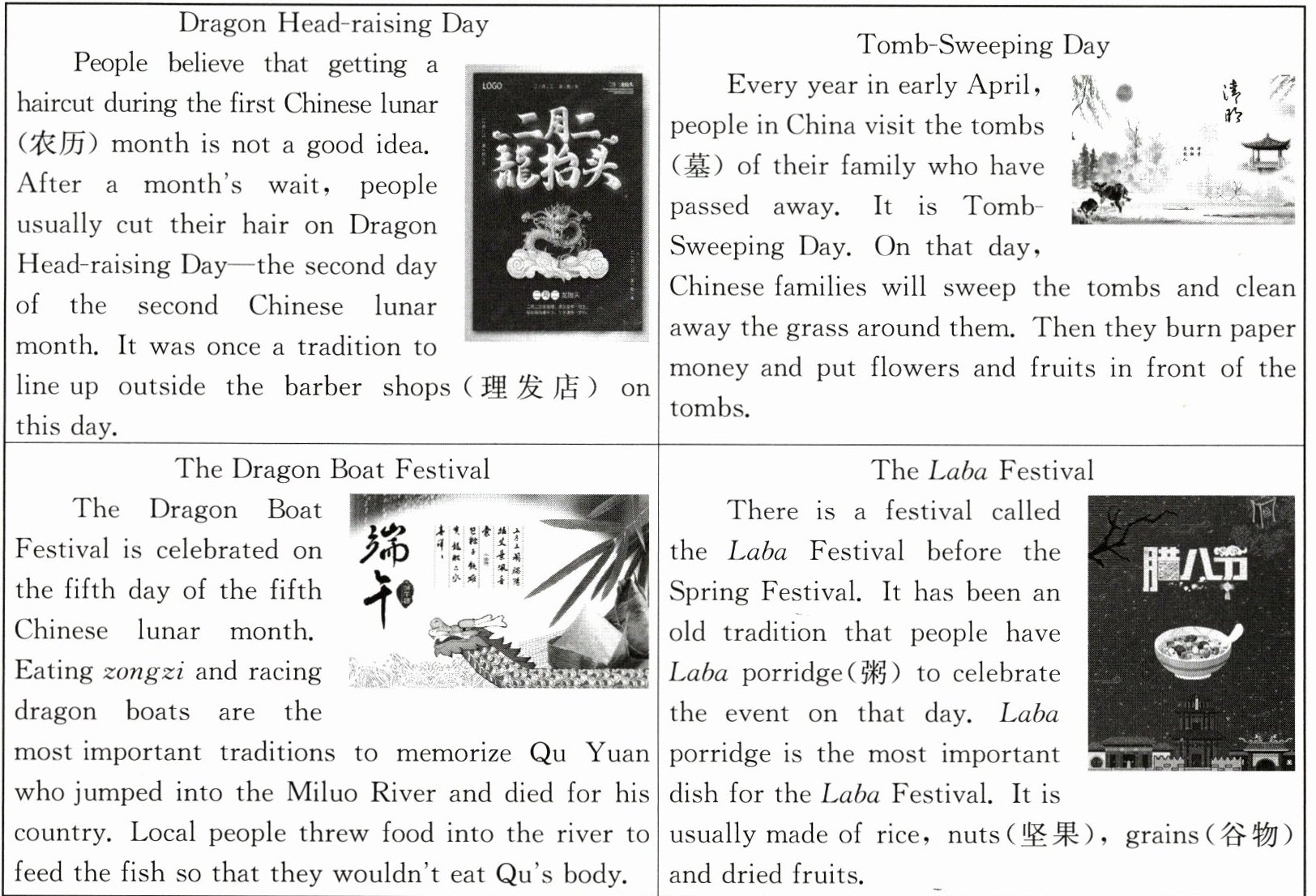
Tomb-Sweeping Day
Every year in early April, people in China visit the tombs(墓)of their family who have passed away. It is Tomb-Sweeping Day. On that day, Chinese families will sweep the tombs and clean away the grass around them. Then they burn paper money and put flowers and fruits in front of the tombs.
The Dragon Boat Festival
The Dragon Boat Festival is celebrated on the fifth day of the fifth Chinese lunar month. Eating zongzi and racing dragon boats are the most important traditions to memorize Qu Yuan who jumped into the Miluo River and died for his country. Local people threw food into the river to feed the fish so that they wouldn't eat Qu's body.
The Laba Festival
There is a festival called the Laba Festival before the Spring Festival. It has been an old tradition that people have Laba porridge(粥) to celebrate the event on that day. Laba porridge is the most important dish for the Laba Festival. It is usually made of rice, nuts(坚果), grains(谷物)and dried fruits.
(
A. Don't buy new things.
B. Don't wash their hair.
C. Don't cut their hair.
D. Don't clean the houses.
(
A. Sweep the floors.
B. Burn paper money.
C. Clean the tombs.
D. Put flowers in front of the tombs.
(
A. Because they wanted to feed the fish.
B. Because it had been a tradition before.
C. Because it was Qu Yuan's favourite food.
D. Because they wanted to protect Qu's body.
A 传统文化
Dragon Head-raising Day
People believe that getting a haircut during the first Chinese lunar(农历)month is not a good idea. After a month's wait, people usually cut their hair on Dragon Head-raising Day—the second day of the second Chinese lunar month. It was once a tradition to line up outside the barber shops(理发店)on this day.
Tomb-Sweeping Day
Every year in early April, people in China visit the tombs(墓)of their family who have passed away. It is Tomb-Sweeping Day. On that day, Chinese families will sweep the tombs and clean away the grass around them. Then they burn paper money and put flowers and fruits in front of the tombs.
The Dragon Boat Festival
The Dragon Boat Festival is celebrated on the fifth day of the fifth Chinese lunar month. Eating zongzi and racing dragon boats are the most important traditions to memorize Qu Yuan who jumped into the Miluo River and died for his country. Local people threw food into the river to feed the fish so that they wouldn't eat Qu's body.
The Laba Festival
There is a festival called the Laba Festival before the Spring Festival. It has been an old tradition that people have Laba porridge(粥) to celebrate the event on that day. Laba porridge is the most important dish for the Laba Festival. It is usually made of rice, nuts(坚果), grains(谷物)and dried fruits.
(
C
)1. What should people pay attention to during the first Chinese lunar month?A. Don't buy new things.
B. Don't wash their hair.
C. Don't cut their hair.
D. Don't clean the houses.
(
A
)2. Which of the following is NOT the tradition of Tomb-Sweeping Day?A. Sweep the floors.
B. Burn paper money.
C. Clean the tombs.
D. Put flowers in front of the tombs.
(
D
)3. Why did local people throw food into the river at the Dragon Boat Festival?A. Because they wanted to feed the fish.
B. Because it had been a tradition before.
C. Because it was Qu Yuan's favourite food.
D. Because they wanted to protect Qu's body.
答案:1. C 【点拨】根据“People believe that getting a haircut during the first Chinese lunar(农历)month is not a good idea.”可知,人们认为农历的第一个月剪头发不好,故推断人们在农历的第一个月应该注意不要剪头发。故选 C。
2. A 【点拨】根据“On that day, Chinese families will sweep the tombs and clean away the grass around them. Then they burn paper money and put flowers and fruits in front of the tombs.”可知,人们会在清明节扫墓、清理墓边的杂草、烧纸钱、在墓前献祭鲜花和水果,并没有扫地这一传统。故选 A。
3. D 【点拨】根据“Local people threw food into the river to feed the fish so that they wouldn't eat Qu's body.”可知,当地人把食物扔进河里是为了让屈原的身体不被鱼吃。故选 D。
2. A 【点拨】根据“On that day, Chinese families will sweep the tombs and clean away the grass around them. Then they burn paper money and put flowers and fruits in front of the tombs.”可知,人们会在清明节扫墓、清理墓边的杂草、烧纸钱、在墓前献祭鲜花和水果,并没有扫地这一传统。故选 A。
3. D 【点拨】根据“Local people threw food into the river to feed the fish so that they wouldn't eat Qu's body.”可知,当地人把食物扔进河里是为了让屈原的身体不被鱼吃。故选 D。
解析:
【分析】
做这类阅读理解细节题,需先根据题干关键词定位原文对应段落,再将选项与原文信息逐一比对,排除错误选项得出答案。第1题关键词为“first Chinese lunar month”,定位龙抬头段落;第2题关键词为“Tomb-Sweeping Day tradition”,定位清明节段落;第3题关键词为“Dragon Boat Festival throw food into river reason”,定位端午节段落。
【解析】
1. 根据原文“People believe that getting a haircut during the first Chinese lunar month is not a good idea.”可知,农历正月剪头发不是好主意,因此人们要注意不要剪头发,对应选项C。
2. 根据原文“On that day, Chinese families will sweep the tombs and clean away the grass around them. Then they burn paper money and put flowers and fruits in front of the tombs.”可知,清明节传统包含扫坟墓、清理墓边杂草、烧纸钱、在墓前放花和水果,无扫地活动,对应选项A。
3. 根据原文“Local people threw food into the river to feed the fish so that they wouldn't eat Qu's body.”可知,当地人往河里扔食物是为了不让鱼吃屈原的身体,对应选项D。
【答案】
1.C 2.A 3.D
【知识点】
阅读理解细节题、中国传统节日
【点评】
本题为阅读理解细节题,考查学生定位原文信息并匹配选项的能力,涉及中国传统节日知识,难度较低,仔细阅读原文即可解答。
【难度系数】
0.8
做这类阅读理解细节题,需先根据题干关键词定位原文对应段落,再将选项与原文信息逐一比对,排除错误选项得出答案。第1题关键词为“first Chinese lunar month”,定位龙抬头段落;第2题关键词为“Tomb-Sweeping Day tradition”,定位清明节段落;第3题关键词为“Dragon Boat Festival throw food into river reason”,定位端午节段落。
【解析】
1. 根据原文“People believe that getting a haircut during the first Chinese lunar month is not a good idea.”可知,农历正月剪头发不是好主意,因此人们要注意不要剪头发,对应选项C。
2. 根据原文“On that day, Chinese families will sweep the tombs and clean away the grass around them. Then they burn paper money and put flowers and fruits in front of the tombs.”可知,清明节传统包含扫坟墓、清理墓边杂草、烧纸钱、在墓前放花和水果,无扫地活动,对应选项A。
3. 根据原文“Local people threw food into the river to feed the fish so that they wouldn't eat Qu's body.”可知,当地人往河里扔食物是为了不让鱼吃屈原的身体,对应选项D。
【答案】
1.C 2.A 3.D
【知识点】
阅读理解细节题、中国传统节日
【点评】
本题为阅读理解细节题,考查学生定位原文信息并匹配选项的能力,涉及中国传统节日知识,难度较低,仔细阅读原文即可解答。
【难度系数】
0.8