When it comes to Chinese literature works about a mother's love, few can compete with Tang Dynasty poet Meng Jiao's poem "Song of the Travelling Son". The poem presents a mother who sews clothes for her son by hand. Bathed in candlelight, she also worries about his travel away from home.
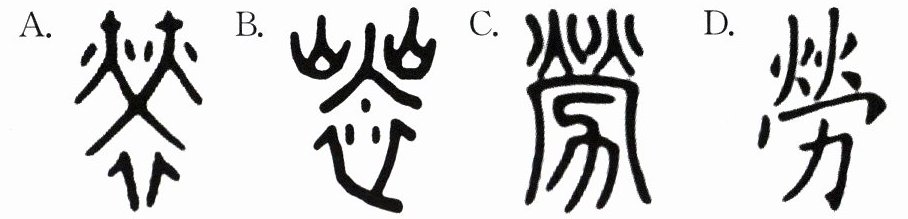
Meng's description of the mother shows the composition of the earliest form of the Chinese character "劳(labour)". Found on oracle bones(甲骨) from over 3,000 years ago, it was made up of three parts. There was "火(fire)" on top and "衣(clothes)" below, with three dots(点) that look like stitches(针脚). The lower part was later replaced by "力(strength)", and a form symbolizing a house appeared above. The Analytical Dictionary of Chinese Characters explains the form as "When a house is on fire, it takes hard work to put it out".
While the form of the character has been simplified, its meaning has expanded to refer to work, labour or toil. It is also associated with feelings like fatigue(疲劳). Since ancient times, Chinese society has looked down upon those who sponge off others. In modern times, the idea that labour is glorious(光荣的) has taken root. People who work hard and make great contributions to their community or country are respected as model workers.
Since the 1980s, "劳" has become one of the five key qualities that China's education system seeks to cultivate in students, along with "德(virtue)" "智(intelligence)" "体(physical fitness)" and "美(appreciation for beauty)". Primary and middle school students typically have at least one hour of labour class each week for labour theory and skills.
However, cognitive(认知的) labour and manual(体力的) labour are not always considered equal. As ancient Chinese philosopher Mencius said, "Those who labour with their minds govern(统治), while those who labour with their strength are governed." Throughout history, many Chinese writers have had pity on people who worked hard to survive as poor farmers. In his poem "Watching the Wheat Harvest", the famous poet Bai Juyi expressed his shame at taking hundreds of kilograms of grain every year as his pay without doing any farm work.
No matter it is cognitive labour or manual labour, overwork can have serious results, which can cause illness or even death. To avoid such things, people are encouraged to achieve a balance between work and rest.
(
(
A. Laugh at.
B. Learn from.
C. Look after.
D. Depend on.
(
A. The character "劳" meant fatigue in the very beginning.
B. Bai Juyi governed the poor farmers without getting paid.
C. Cognitive labour is considered to be equal to manual labour.
D. Chinese students are expected to have the five key qualities.
(
A. discuss the different types of labour in China
B. explore the cultural meaning of labour in China
C. introduce the history of the Chinese character "劳"
D. compare ancient and modern Chinese literature works
Meng's description of the mother shows the composition of the earliest form of the Chinese character "劳(labour)". Found on oracle bones(甲骨) from over 3,000 years ago, it was made up of three parts. There was "火(fire)" on top and "衣(clothes)" below, with three dots(点) that look like stitches(针脚). The lower part was later replaced by "力(strength)", and a form symbolizing a house appeared above. The Analytical Dictionary of Chinese Characters explains the form as "When a house is on fire, it takes hard work to put it out".
While the form of the character has been simplified, its meaning has expanded to refer to work, labour or toil. It is also associated with feelings like fatigue(疲劳). Since ancient times, Chinese society has looked down upon those who sponge off others. In modern times, the idea that labour is glorious(光荣的) has taken root. People who work hard and make great contributions to their community or country are respected as model workers.
Since the 1980s, "劳" has become one of the five key qualities that China's education system seeks to cultivate in students, along with "德(virtue)" "智(intelligence)" "体(physical fitness)" and "美(appreciation for beauty)". Primary and middle school students typically have at least one hour of labour class each week for labour theory and skills.
However, cognitive(认知的) labour and manual(体力的) labour are not always considered equal. As ancient Chinese philosopher Mencius said, "Those who labour with their minds govern(统治), while those who labour with their strength are governed." Throughout history, many Chinese writers have had pity on people who worked hard to survive as poor farmers. In his poem "Watching the Wheat Harvest", the famous poet Bai Juyi expressed his shame at taking hundreds of kilograms of grain every year as his pay without doing any farm work.
No matter it is cognitive labour or manual labour, overwork can have serious results, which can cause illness or even death. To avoid such things, people are encouraged to achieve a balance between work and rest.
(
B
)37. (创新考法·图片理解)Which of the following is the earliest form of the Chinese character "劳"?(
D
)38. What does the underlined phrase "sponge off" in Paragraph 3 probably mean?A. Laugh at.
B. Learn from.
C. Look after.
D. Depend on.
(
D
)39. What can you learn from the passage?A. The character "劳" meant fatigue in the very beginning.
B. Bai Juyi governed the poor farmers without getting paid.
C. Cognitive labour is considered to be equal to manual labour.
D. Chinese students are expected to have the five key qualities.
(
B
)40. The main purpose of this passage is to .A. discuss the different types of labour in China
B. explore the cultural meaning of labour in China
C. introduce the history of the Chinese character "劳"
D. compare ancient and modern Chinese literature works
答案:37. B
38. D 词义猜测题。根据“Since ancient times, Chinese society has looked down upon those who sponge off others.”并结合语境可知,古代社会看不起那些依赖他人、不劳而获的人,sponge off意思可能是“依赖”。
39. D
40. B 推理判断题。通读全文可知,文章以汉字“劳”为引子,介绍劳动在中国文化中的含义、社会对劳动的看法等,主要目的是探索劳动在中国的文化意义。
38. D 词义猜测题。根据“Since ancient times, Chinese society has looked down upon those who sponge off others.”并结合语境可知,古代社会看不起那些依赖他人、不劳而获的人,sponge off意思可能是“依赖”。
39. D
40. B 推理判断题。通读全文可知,文章以汉字“劳”为引子,介绍劳动在中国文化中的含义、社会对劳动的看法等,主要目的是探索劳动在中国的文化意义。
解析:
【分析】
37题需根据原文对“劳”最早甲骨文形式的描述匹配图片,原文明确最早的“劳”由上方“火”、下方“衣”及三个针脚状的点构成,据此判断选项;38题需结合上下文语境推测“sponge off”的含义,结合“古代社会看不起不劳而获的人”的语境分析;39题需逐一核对选项与原文细节;40题需通读全文梳理作者写作目的。
【解析】
37题:根据原文第二段“Found on oracle bones from over 3,000 years ago, it was made up of three parts. There was '火(fire)' on top and '衣(clothes)' below, with three dots that look like stitches.”可知,最早的“劳”甲骨文符合选项B的结构,故选B。
38题:根据第三段“Since ancient times, Chinese society has looked down upon those who sponge off others.”及“不劳而获”的语境,“sponge off”意为“依赖”,对应选项D,故选D。
39题:A项“劳”最初含义不是疲劳,错误;B项白居易是表达羞愧而非统治农民,错误;C项原文提到脑力与体力劳动并不总是平等,错误;D项原文指出“劳”是五育之一,学生需培养,正确,故选D。
40题:文章以“劳”的汉字起源为引子,介绍其含义演变、社会对劳动的看法、劳动教育等,核心是探索劳动在中国的文化意义,故选B。
【答案】
37. B 38. D 39. D 40. B
【知识点】
词义猜测、细节理解、主旨大意
【点评】
本题结合汉字文化与阅读理解,题型多样,既考查学生的阅读能力,又渗透了汉字文化知识,需学生仔细分析原文细节与语境。
【难度系数】
0.5
37题需根据原文对“劳”最早甲骨文形式的描述匹配图片,原文明确最早的“劳”由上方“火”、下方“衣”及三个针脚状的点构成,据此判断选项;38题需结合上下文语境推测“sponge off”的含义,结合“古代社会看不起不劳而获的人”的语境分析;39题需逐一核对选项与原文细节;40题需通读全文梳理作者写作目的。
【解析】
37题:根据原文第二段“Found on oracle bones from over 3,000 years ago, it was made up of three parts. There was '火(fire)' on top and '衣(clothes)' below, with three dots that look like stitches.”可知,最早的“劳”甲骨文符合选项B的结构,故选B。
38题:根据第三段“Since ancient times, Chinese society has looked down upon those who sponge off others.”及“不劳而获”的语境,“sponge off”意为“依赖”,对应选项D,故选D。
39题:A项“劳”最初含义不是疲劳,错误;B项白居易是表达羞愧而非统治农民,错误;C项原文提到脑力与体力劳动并不总是平等,错误;D项原文指出“劳”是五育之一,学生需培养,正确,故选D。
40题:文章以“劳”的汉字起源为引子,介绍其含义演变、社会对劳动的看法、劳动教育等,核心是探索劳动在中国的文化意义,故选B。
【答案】
37. B 38. D 39. D 40. B
【知识点】
词义猜测、细节理解、主旨大意
【点评】
本题结合汉字文化与阅读理解,题型多样,既考查学生的阅读能力,又渗透了汉字文化知识,需学生仔细分析原文细节与语境。
【难度系数】
0.5