C 核心素养 中华优秀传统文化
① Do you wear clothes with colourful patterns? People usually use machines to make these patterns. But how did ancient people make them?
② Ancient people used tie dyeing(扎染). Tie dyeing is a very old way of dyeing clothes in China. It is popular in Yunnan. People first put cloth(布料) into the blue dye(染料). Some parts of the cloth become blue, but other parts have a lighter colour. When you open the cloth, you'll see beautiful patterns.
③ In 2006, tie dyeing was listed as China's national intangible cultural heritage. Anning in Yunnan is famous for tie dyeing.
④ Yang Cheng learned the skill from his mother in the 1980s. Yang got the old skills. At the same time, he studied tie dyeing in other countries, such as Japan, India and France. It once took Yang about two years to make two dresses! He used many skills of Anning tie dyeing. Some patterns on the dresses are traditional, while others are modern. He added elements of Dianchi Lake and eight popular flowers in Yunnan. “I want to put all the beautiful things into tie dyeing works,” Yang said.
⑤ Now Yang teaches tie dyeing in schools, communities and companies. More than 100,000 people have learned from him.
⑥ Some might worry that tie dyeing will be replaced by machines. But Yang said, “Machines can't take the place of our creative hands.”
()33. What can tie dyeing help people do?
A. Make cloth. B. Grow popular flowers.
C. Make colourful patterns. D. Practise skills.
()34. According to the passage, which of the following is true?
A. Tie dyeing is going to die out.
B. We can find tie dyeing only in China.
C. Yang Cheng uses not only traditional patterns but also modern ones.
D. Yang Cheng only passes down the skill to his families.
()35. The last paragraph shows that tie dyeing is .
A. not so useful as before B. popular with young people
C. hard to see in other places D. still meaningful to us
()36. Which of the following best shows the structure of this passage?
A.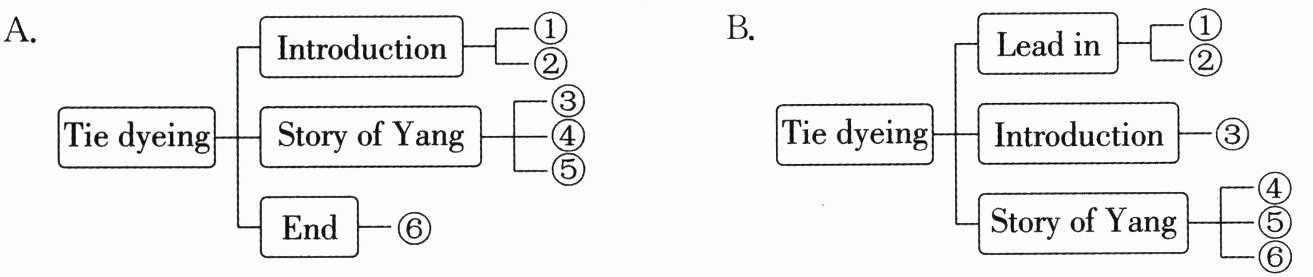
C.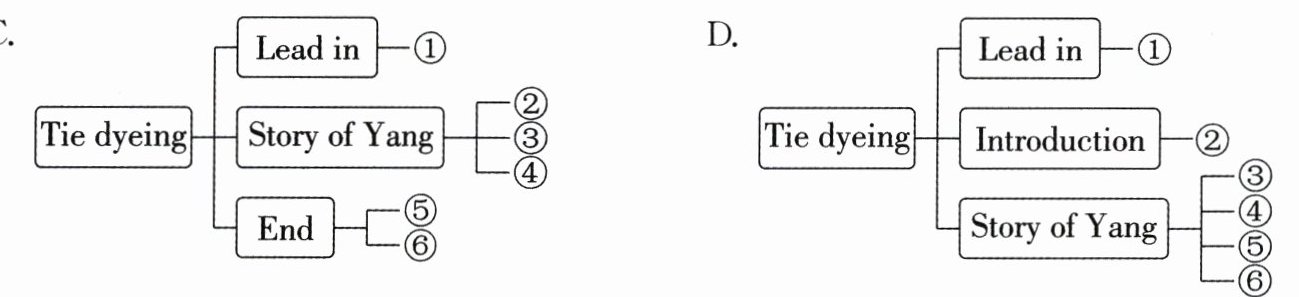
① Do you wear clothes with colourful patterns? People usually use machines to make these patterns. But how did ancient people make them?
② Ancient people used tie dyeing(扎染). Tie dyeing is a very old way of dyeing clothes in China. It is popular in Yunnan. People first put cloth(布料) into the blue dye(染料). Some parts of the cloth become blue, but other parts have a lighter colour. When you open the cloth, you'll see beautiful patterns.
③ In 2006, tie dyeing was listed as China's national intangible cultural heritage. Anning in Yunnan is famous for tie dyeing.
④ Yang Cheng learned the skill from his mother in the 1980s. Yang got the old skills. At the same time, he studied tie dyeing in other countries, such as Japan, India and France. It once took Yang about two years to make two dresses! He used many skills of Anning tie dyeing. Some patterns on the dresses are traditional, while others are modern. He added elements of Dianchi Lake and eight popular flowers in Yunnan. “I want to put all the beautiful things into tie dyeing works,” Yang said.
⑤ Now Yang teaches tie dyeing in schools, communities and companies. More than 100,000 people have learned from him.
⑥ Some might worry that tie dyeing will be replaced by machines. But Yang said, “Machines can't take the place of our creative hands.”
()33. What can tie dyeing help people do?
A. Make cloth. B. Grow popular flowers.
C. Make colourful patterns. D. Practise skills.
()34. According to the passage, which of the following is true?
A. Tie dyeing is going to die out.
B. We can find tie dyeing only in China.
C. Yang Cheng uses not only traditional patterns but also modern ones.
D. Yang Cheng only passes down the skill to his families.
()35. The last paragraph shows that tie dyeing is .
A. not so useful as before B. popular with young people
C. hard to see in other places D. still meaningful to us
()36. Which of the following best shows the structure of this passage?
A.
C.
答案:33.C 34.C 35.D 36.D
解析:
【分析】
1. 第33题:需定位原文关于扎染作用的描述,结合扎染的定义判断其功能;
2. 第34题:为细节判断题,需将每个选项与原文内容逐一比对,排除错误选项;
3. 第35题:需理解最后一段的核心含义,提炼扎染的现实意义;
4. 第36题:需梳理各段落的主旨,分析文章整体结构。
【解析】
33题:根据原文第①段提到的“colourful patterns”及第②段对扎染的介绍,扎染是制作彩色图案的方法,故选C。
34题:A项原文未提及扎染将消失,反而被列为国家级非遗,错误;B项原文第④段提到杨成研究日本、印度等国的扎染,说明不止中国有,错误;C项原文第④段明确指出“Some patterns on the dresses are traditional, while others are modern”,正确;D项原文第⑤段提到杨成在学校、社区、公司教扎染,并非仅传给家人,错误,故选C。
35题:最后一段杨成强调“Machines can't take the place of our creative hands”,说明扎染仍有不可替代的意义,故选D。
36题:文章结构为:①引出扎染的问题;②介绍扎染的基本情况;③扎染的地位;④杨成对扎染的传承与创新;⑤杨成推广扎染;⑥强调扎染的价值,对应选项D,故选D。
【答案】
33.C 34.C 35.D 36.D
【知识点】
阅读理解、细节理解、文章结构
【点评】
本文围绕中国传统技艺扎染展开,结合中华优秀传统文化核心素养,考查学生对阅读细节、信息判断、段落主旨及文章结构的理解,题型常规,难度适中。
【难度系数】
0.5
1. 第33题:需定位原文关于扎染作用的描述,结合扎染的定义判断其功能;
2. 第34题:为细节判断题,需将每个选项与原文内容逐一比对,排除错误选项;
3. 第35题:需理解最后一段的核心含义,提炼扎染的现实意义;
4. 第36题:需梳理各段落的主旨,分析文章整体结构。
【解析】
33题:根据原文第①段提到的“colourful patterns”及第②段对扎染的介绍,扎染是制作彩色图案的方法,故选C。
34题:A项原文未提及扎染将消失,反而被列为国家级非遗,错误;B项原文第④段提到杨成研究日本、印度等国的扎染,说明不止中国有,错误;C项原文第④段明确指出“Some patterns on the dresses are traditional, while others are modern”,正确;D项原文第⑤段提到杨成在学校、社区、公司教扎染,并非仅传给家人,错误,故选C。
35题:最后一段杨成强调“Machines can't take the place of our creative hands”,说明扎染仍有不可替代的意义,故选D。
36题:文章结构为:①引出扎染的问题;②介绍扎染的基本情况;③扎染的地位;④杨成对扎染的传承与创新;⑤杨成推广扎染;⑥强调扎染的价值,对应选项D,故选D。
【答案】
33.C 34.C 35.D 36.D
【知识点】
阅读理解、细节理解、文章结构
【点评】
本文围绕中国传统技艺扎染展开,结合中华优秀传统文化核心素养,考查学生对阅读细节、信息判断、段落主旨及文章结构的理解,题型常规,难度适中。
【难度系数】
0.5