4.已知$△ ACD$和$△ BCE$都是等腰直角三角形,$∠ ACD=∠ BCE=90°$.
【初步探索】(1)如图①摆放$△ ACD$和$△ BCE$(点$A,C,B$在同一条直线上,点$E$在$CD$上),连接$AE,BD$,判断线段$AE$与$BD$的数量关系和位置关系;
【拓展延伸】(2)如图②摆放$△ ACD$和$△ BCE$,连接$AE,BD$,(1)中的结论是否仍然成立?请说明理由.
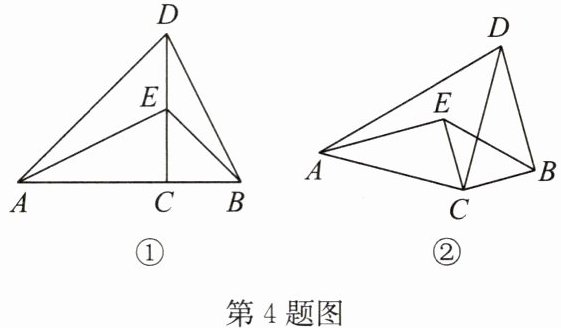
【初步探索】(1)如图①摆放$△ ACD$和$△ BCE$(点$A,C,B$在同一条直线上,点$E$在$CD$上),连接$AE,BD$,判断线段$AE$与$BD$的数量关系和位置关系;
【拓展延伸】(2)如图②摆放$△ ACD$和$△ BCE$,连接$AE,BD$,(1)中的结论是否仍然成立?请说明理由.
答案:
(1)如答图①,延长$AE$交$BD$于点$F$.
在$△ ACE$和$△ DCB$中,$\begin{cases} AC=DC,\\ ∠ ACE=∠ DCB,\\ CE=CB, \end{cases}$
$\therefore △ ACE≌△ DCB(\mathrm{SAS})$,
$\therefore AE=BD$,$∠ CAE=∠ CDB$.
$\because ∠ CDB+∠ DBC=90°$,$\therefore ∠ CAE+∠ DBC=90°$,
$\therefore ∠ AFB=90°$,$\therefore AE⊥ BD$.
(2)(1)中的结论仍然成立,$AE=BD$,$AE⊥ BD$.理由如下:
如答图②,延长$AE$交$BD$于点$M$,交$CD$于点$G$.
$\because ∠ ACD=∠ BCE=90°$,
$\therefore ∠ ACD-∠ ECD=∠ BCE-∠ ECD$,即$∠ ACE=∠ DCB$.
在$△ ACE$和$△ DCB$中,$\begin{cases} AC=DC,\\ ∠ ACE=∠ DCB,\\ CE=CB, \end{cases}$
$\therefore △ ACE≌△ DCB(\mathrm{SAS})$,$\therefore AE=BD$,$∠ CAE=∠ CDB$.
$\because ∠ CAE+∠ AGC=90°$,$∠ AGC=∠ DGM$,
$\therefore ∠ CDB+∠ DGM=90°$,$\therefore ∠ AMD=90°$,$\therefore AE⊥ BD$.
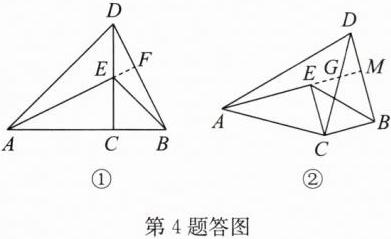
(1)如答图①,延长$AE$交$BD$于点$F$.
在$△ ACE$和$△ DCB$中,$\begin{cases} AC=DC,\\ ∠ ACE=∠ DCB,\\ CE=CB, \end{cases}$
$\therefore △ ACE≌△ DCB(\mathrm{SAS})$,
$\therefore AE=BD$,$∠ CAE=∠ CDB$.
$\because ∠ CDB+∠ DBC=90°$,$\therefore ∠ CAE+∠ DBC=90°$,
$\therefore ∠ AFB=90°$,$\therefore AE⊥ BD$.
(2)(1)中的结论仍然成立,$AE=BD$,$AE⊥ BD$.理由如下:
如答图②,延长$AE$交$BD$于点$M$,交$CD$于点$G$.
$\because ∠ ACD=∠ BCE=90°$,
$\therefore ∠ ACD-∠ ECD=∠ BCE-∠ ECD$,即$∠ ACE=∠ DCB$.
在$△ ACE$和$△ DCB$中,$\begin{cases} AC=DC,\\ ∠ ACE=∠ DCB,\\ CE=CB, \end{cases}$
$\therefore △ ACE≌△ DCB(\mathrm{SAS})$,$\therefore AE=BD$,$∠ CAE=∠ CDB$.
$\because ∠ CAE+∠ AGC=90°$,$∠ AGC=∠ DGM$,
$\therefore ∠ CDB+∠ DGM=90°$,$\therefore ∠ AMD=90°$,$\therefore AE⊥ BD$.
5.(2025·莱西期末)在学习全等三角形的知识时,数学兴趣小组发现这样一个模型:它是由两个共顶点且顶角相等的等腰三角形构成的,在相对位置变化的同时,始终存在一对全等三角形.兴趣小组成员经过研讨给出定义:如果两个等腰三角形的顶角相等,且顶角的顶点互相重合,那么称此图形为“手拉手全等模型”.如图①,△ABC与△ADE都是等腰三角形,其中∠BAC=∠DAE,则△ABD≌△ACE(SAS).
【初步把握】(1)如图②,△ABC与△ADE都是等腰三角形,AB=AC,AD=AE,且∠BAC=∠DAE,请直接写出图中的一对全等三角形.
【深入研究】(2)如图③,已知△ABC,分别以AB,AC为边向外作等边△ABD和等边△ACE,BE,CD交于点Q.求∠DQB的大小,并证明:BE=CD.
【拓展延伸】(3)如图④,在两个等腰直角△ABC和△ADE中,AB=AC,AE=AD,∠BAC=∠DAE=90°,连接BD,CE交于点P,请判断BD和CE的关系,并说明理由.
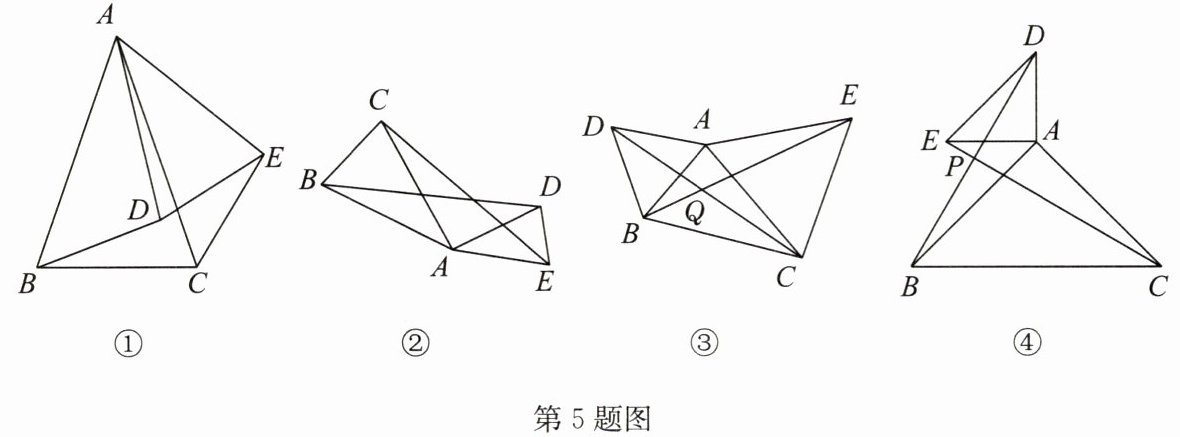
【初步把握】(1)如图②,△ABC与△ADE都是等腰三角形,AB=AC,AD=AE,且∠BAC=∠DAE,请直接写出图中的一对全等三角形.
【深入研究】(2)如图③,已知△ABC,分别以AB,AC为边向外作等边△ABD和等边△ACE,BE,CD交于点Q.求∠DQB的大小,并证明:BE=CD.
【拓展延伸】(3)如图④,在两个等腰直角△ABC和△ADE中,AB=AC,AE=AD,∠BAC=∠DAE=90°,连接BD,CE交于点P,请判断BD和CE的关系,并说明理由.
答案:(1)$△ BAD≌△ CAE$.
(2)$\because △ ABD$和$△ ACE$都是等边三角形,
$\therefore AB=AD$,$AE=AC$,$∠ BAD=∠ CAE=60°$,
$\therefore ∠ BAD+∠ BAC=∠ CAE+∠ BAC$,即$∠ DAC=∠ BAE$.
在$△ ABE$和$△ ADC$中,$\begin{cases} AB=AD,\\ ∠ BAE=∠ DAC,\\ AE=AC, \end{cases}$
$\therefore △ ABE≌△ ADC(\mathrm{SAS})$,
$\therefore BE=CD$,$∠ ADC=∠ ABE$.
$\because ∠ BQD+∠ ABE=∠ BAD+∠ ADC$,
$\therefore ∠ DQB=∠ DAB=60°$.
(3)$BD=CE$,$BD⊥ CE$,理由如下:
$\because ∠ BAC=∠ DAE=90°$,
$\therefore ∠ BAC+∠ BAE=∠ DAE+∠ BAE$,
即$∠ CAE=∠ BAD$.
在$△ ABD$和$△ ACE$中,$\begin{cases} AB=AC,\\ ∠ BAD=∠ CAE,\\ AD=AE, \end{cases}$
$\therefore △ ABD≌△ ACE(\mathrm{SAS})$,
$\therefore BD=CE$,$∠ ABD=∠ ACE$.
$\because ∠ BPC+∠ ABD=∠ BAC+∠ ACE$,
$\therefore ∠ BPC=∠ BAC=90°$,$\therefore BD⊥ CE$.
(2)$\because △ ABD$和$△ ACE$都是等边三角形,
$\therefore AB=AD$,$AE=AC$,$∠ BAD=∠ CAE=60°$,
$\therefore ∠ BAD+∠ BAC=∠ CAE+∠ BAC$,即$∠ DAC=∠ BAE$.
在$△ ABE$和$△ ADC$中,$\begin{cases} AB=AD,\\ ∠ BAE=∠ DAC,\\ AE=AC, \end{cases}$
$\therefore △ ABE≌△ ADC(\mathrm{SAS})$,
$\therefore BE=CD$,$∠ ADC=∠ ABE$.
$\because ∠ BQD+∠ ABE=∠ BAD+∠ ADC$,
$\therefore ∠ DQB=∠ DAB=60°$.
(3)$BD=CE$,$BD⊥ CE$,理由如下:
$\because ∠ BAC=∠ DAE=90°$,
$\therefore ∠ BAC+∠ BAE=∠ DAE+∠ BAE$,
即$∠ CAE=∠ BAD$.
在$△ ABD$和$△ ACE$中,$\begin{cases} AB=AC,\\ ∠ BAD=∠ CAE,\\ AD=AE, \end{cases}$
$\therefore △ ABD≌△ ACE(\mathrm{SAS})$,
$\therefore BD=CE$,$∠ ABD=∠ ACE$.
$\because ∠ BPC+∠ ABD=∠ BAC+∠ ACE$,
$\therefore ∠ BPC=∠ BAC=90°$,$\therefore BD⊥ CE$.