三、阅读理解(16分)
A
It is usually not too hot or too cold in Suzhou. Sometimes summer can be hot and wet. Winter can be a little cold, but not too cold if the wind is not too strong.
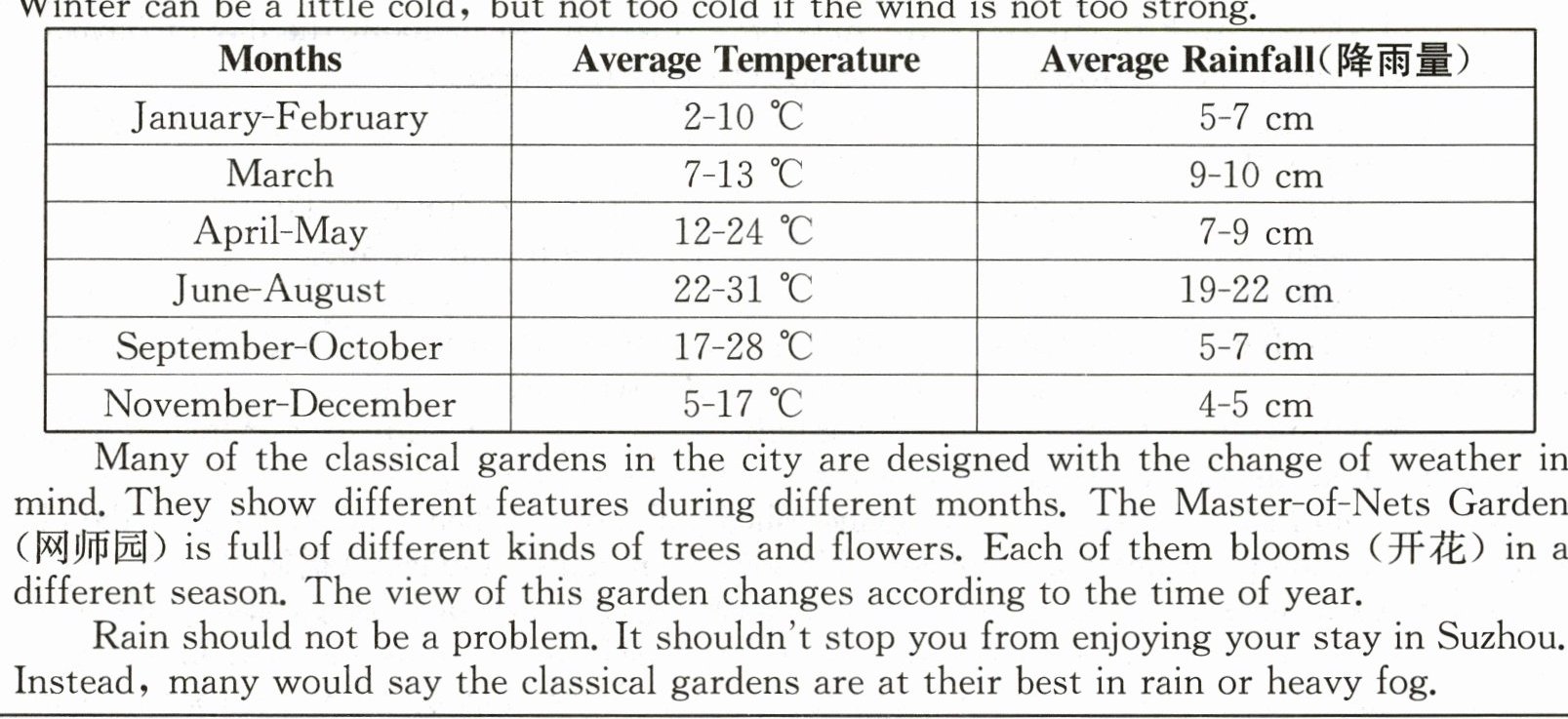
(
A. 2-10 ℃. B. 7-13 ℃. C. 12-24 ℃. D. 5-17 ℃.
(
A. March. B. December. C. August. D. May.
(
A. gives an example B. asks a question
C. makes a survey D. lists some numbers
(
A. Gardens in Suzhou B. Rain in Suzhou
C. Seasons in Suzhou D. Weather in Suzhou
A
It is usually not too hot or too cold in Suzhou. Sometimes summer can be hot and wet. Winter can be a little cold, but not too cold if the wind is not too strong.
(
B
)1. What's the average temperature in Suzhou in March?A. 2-10 ℃. B. 7-13 ℃. C. 12-24 ℃. D. 5-17 ℃.
(
B
)2. In which month might Suzhou have the least rain?A. March. B. December. C. August. D. May.
(
A
)3. To better tell the design features of the gardens, the writer .A. gives an example B. asks a question
C. makes a survey D. lists some numbers
(
D
)4. What's the best title for the text?A. Gardens in Suzhou B. Rain in Suzhou
C. Seasons in Suzhou D. Weather in Suzhou
答案:1.B 2.B 3.A 4.D
解析:
【分析】本题为英语阅读理解题,共4道选择题,分别考查细节查找、信息对比、写作手法判断及主旨大意归纳。解题时需结合表格数据和文章内容,逐一对应题目要求:第1题查找三月平均气温;第2题对比各月降雨量找最少的月份;第3题判断作者说明园林设计特点的方法;第4题提炼文章核心主题。
【解析】1. 题目询问苏州三月的平均气温,查看表格中“March”对应的“Average Temperature”为7-13℃,对应选项B,故答案为B。2. 题目问苏州哪个月降雨量最少,对比表格中各月平均降雨量:January-February(5-7cm)、March(9-10cm)、April-May(7-9cm)、June-August(19-22cm)、September-October(5-7cm)、November-December(4-5cm),最少的是November-December,选项中December属于该区间,故答案为B。3. 题目问作者说明园林设计特点的方法,文中以“网师园”为例阐述园林随季节变化的特点,属于举例子的手法,对应选项A,故答案为A。4. 文章围绕苏州的天气(温度、降雨量)展开,同时提及天气对古典园林的影响,核心主题是苏州的天气,对应选项D,故答案为D。
【答案】1.B 2.B 3.A 4.D
【知识点】阅读理解、细节理解、主旨大意
【点评】本题结合表格数据与文本内容,考查学生提取信息、分析写作手法及归纳主旨的能力,题型常规,难度适中。
【难度系数】0.6
【解析】1. 题目询问苏州三月的平均气温,查看表格中“March”对应的“Average Temperature”为7-13℃,对应选项B,故答案为B。2. 题目问苏州哪个月降雨量最少,对比表格中各月平均降雨量:January-February(5-7cm)、March(9-10cm)、April-May(7-9cm)、June-August(19-22cm)、September-October(5-7cm)、November-December(4-5cm),最少的是November-December,选项中December属于该区间,故答案为B。3. 题目问作者说明园林设计特点的方法,文中以“网师园”为例阐述园林随季节变化的特点,属于举例子的手法,对应选项A,故答案为A。4. 文章围绕苏州的天气(温度、降雨量)展开,同时提及天气对古典园林的影响,核心主题是苏州的天气,对应选项D,故答案为D。
【答案】1.B 2.B 3.A 4.D
【知识点】阅读理解、细节理解、主旨大意
【点评】本题结合表格数据与文本内容,考查学生提取信息、分析写作手法及归纳主旨的能力,题型常规,难度适中。
【难度系数】0.6
B
With spring soon coming to an end, people in China are looking forward to the first solar term of summer, lixia. Lixia, or the Start of Summer, is the seventh of the 24 Chinese solar terms. It symbolizes the passing from spring to summer.
Because of the hot weather of summer, plants will grow faster. The crops also welcome the fast growing season. Therefore, farmers are usually happy to welcome the arrival of lixia. This is the best time of the year to plant early rice in the south of China. There are a lot of ancient Chinese idioms(习语)that warn people not to stay free during this period of time.
▲ For example, in some places people cook “Five-Coloured Rice”. It is usually made from five kinds of beans, including mung beans, red beans, yellow beans, black beans and green beans. It stands for people’s good wishes for a colourful life. In some areas, children will wear a bag with an egg around their necks. This is believed to help prevent abdominal distension(腹胀). It’s an ordinary illness among ancient Chinese children during summer.
On the day of lixia, people also have the tradition of eating three kinds of food: cherries, green plums, and green wheat. As there are so many different kinds of fresh fruits and vegetables from which to choose, what gets eaten during this time can affect the country. In ancient times, during lixia, emperors would give ice to their ministers(大臣).
Other lixia traditions include the singing of many kinds of folk songs. People also weigh themselves on lixia. When the summer passes, they'll weigh themselves again to see how many kilos they have lost during the hot season.
(
A. Because they can harvest crops.
B. Because they are free at home.
C. Because it is the best time to plant.
D. Because it is the first solar term of summer.
(
A. People celebrate the day of lixia in different ways in China.
B. People want to know what they should prepare for the day of lixia.
C. People sing many kinds of folk music to celebrate the day of lixia.
D. People in different areas of China have different ideas about the day of lixia.
(
A. ①/②/③④⑤ B. ①②③/④/⑤ C. ①/②③④/⑤ D. ①②/③④/⑤
(
A. Different Food in Summer B. Enjoy the Summer Time
C. Welcome to Summer D. Activities in Summer
With spring soon coming to an end, people in China are looking forward to the first solar term of summer, lixia. Lixia, or the Start of Summer, is the seventh of the 24 Chinese solar terms. It symbolizes the passing from spring to summer.
Because of the hot weather of summer, plants will grow faster. The crops also welcome the fast growing season. Therefore, farmers are usually happy to welcome the arrival of lixia. This is the best time of the year to plant early rice in the south of China. There are a lot of ancient Chinese idioms(习语)that warn people not to stay free during this period of time.
▲ For example, in some places people cook “Five-Coloured Rice”. It is usually made from five kinds of beans, including mung beans, red beans, yellow beans, black beans and green beans. It stands for people’s good wishes for a colourful life. In some areas, children will wear a bag with an egg around their necks. This is believed to help prevent abdominal distension(腹胀). It’s an ordinary illness among ancient Chinese children during summer.
On the day of lixia, people also have the tradition of eating three kinds of food: cherries, green plums, and green wheat. As there are so many different kinds of fresh fruits and vegetables from which to choose, what gets eaten during this time can affect the country. In ancient times, during lixia, emperors would give ice to their ministers(大臣).
Other lixia traditions include the singing of many kinds of folk songs. People also weigh themselves on lixia. When the summer passes, they'll weigh themselves again to see how many kilos they have lost during the hot season.
(
C
)5. Why are the farmers happy to welcome the arrival of lixia?A. Because they can harvest crops.
B. Because they are free at home.
C. Because it is the best time to plant.
D. Because it is the first solar term of summer.
(
A
)6. Which of the following sentences may be put in “▲”?A. People celebrate the day of lixia in different ways in China.
B. People want to know what they should prepare for the day of lixia.
C. People sing many kinds of folk music to celebrate the day of lixia.
D. People in different areas of China have different ideas about the day of lixia.
(
A
)7. Which of the following shows the structure of the passage?A. ①/②/③④⑤ B. ①②③/④/⑤ C. ①/②③④/⑤ D. ①②/③④/⑤
(
C
)8. What is the best title for the text?A. Different Food in Summer B. Enjoy the Summer Time
C. Welcome to Summer D. Activities in Summer
答案:5.C 6.A 7.A 8.C
解析:
【分析】
本题为英语阅读理解题,包含细节理解、句子还原、文章结构、主旨大意四类题型,解题思路如下:
1. 第5题(细节理解):需定位原文中农民欢迎立夏的原因,找到对应语句即可选出答案;
2. 第6题(句子还原):需分析空格后举例的内容(不同地区的立夏习俗),匹配符合上下文逻辑的句子;
3. 第7题(文章结构):需梳理各段落的核心内容,划分文章结构;
4. 第8题(主旨大意):需概括全文围绕立夏(夏季第一个节气)展开的核心内容,选出最贴合的标题。
【解析】
1. 第5题:定位原文第二段最后两句“Therefore, farmers are usually happy to welcome the arrival of lixia. This is the best time of the year to plant early rice in the south of China.”可知,农民开心是因为立夏是种植早稻的最佳时间,对应选项C;
2. 第6题:空格后举例“不同地区做五色饭、挂蛋”均为立夏的不同庆祝方式,选项A“中国各地以不同方式庆祝立夏”符合上下文举例的逻辑,故选A;
3. 第7题:梳理段落:①段总起介绍立夏是夏季第一个节气;②段讲农民欢迎立夏的原因;③④⑤段分别介绍立夏的各类传统习俗,故结构为①/②/③④⑤,选A;
4. 第8题:全文围绕立夏(夏季第一个节气)的相关内容展开,核心是“迎接夏天”,选项C“Welcome to Summer”最贴合,故选C。
【答案】
5.C 6.A 7.A 8.C
【知识点】
英语阅读理解、细节理解题、主旨大意题
【点评】
本题以中国传统节气立夏为话题,考查学生对英语阅读中细节、逻辑、结构、主旨的理解能力,题型全面,难度适中,需学生结合原文信息分析作答。
【难度系数】
0.5
本题为英语阅读理解题,包含细节理解、句子还原、文章结构、主旨大意四类题型,解题思路如下:
1. 第5题(细节理解):需定位原文中农民欢迎立夏的原因,找到对应语句即可选出答案;
2. 第6题(句子还原):需分析空格后举例的内容(不同地区的立夏习俗),匹配符合上下文逻辑的句子;
3. 第7题(文章结构):需梳理各段落的核心内容,划分文章结构;
4. 第8题(主旨大意):需概括全文围绕立夏(夏季第一个节气)展开的核心内容,选出最贴合的标题。
【解析】
1. 第5题:定位原文第二段最后两句“Therefore, farmers are usually happy to welcome the arrival of lixia. This is the best time of the year to plant early rice in the south of China.”可知,农民开心是因为立夏是种植早稻的最佳时间,对应选项C;
2. 第6题:空格后举例“不同地区做五色饭、挂蛋”均为立夏的不同庆祝方式,选项A“中国各地以不同方式庆祝立夏”符合上下文举例的逻辑,故选A;
3. 第7题:梳理段落:①段总起介绍立夏是夏季第一个节气;②段讲农民欢迎立夏的原因;③④⑤段分别介绍立夏的各类传统习俗,故结构为①/②/③④⑤,选A;
4. 第8题:全文围绕立夏(夏季第一个节气)的相关内容展开,核心是“迎接夏天”,选项C“Welcome to Summer”最贴合,故选C。
【答案】
5.C 6.A 7.A 8.C
【知识点】
英语阅读理解、细节理解题、主旨大意题
【点评】
本题以中国传统节气立夏为话题,考查学生对英语阅读中细节、逻辑、结构、主旨的理解能力,题型全面,难度适中,需学生结合原文信息分析作答。
【难度系数】
0.5