1. 一次函数$y=kx-2k+3(k≠0)$的图象过定点________;点$(a+1,2a-3)$一定在直线________上。
答案:1. $(2,3)\ \ y=2x-5$ 点拨:$\because y=kx-2k+3=k(x-2)+3$,
$\therefore$当$x=2$时,$y=3$,
$\therefore$直线$y=kx-2k+3$必过定点$(2,3)$。
$\because 2a-3=2(a+1)-5$,
$\therefore$点$(a+1,2a-3)$一定在直线$y=2x-5$上。
$\therefore$当$x=2$时,$y=3$,
$\therefore$直线$y=kx-2k+3$必过定点$(2,3)$。
$\because 2a-3=2(a+1)-5$,
$\therefore$点$(a+1,2a-3)$一定在直线$y=2x-5$上。
解析:
【分析】
第一问求一次函数过的定点:定点的含义是无论参数k取何非零值,函数图象都经过该点,即点坐标代入解析式后等式与k无关,因此只需将解析式中含k的项合并,令k的系数为0消去k,即可求出定点的横、纵坐标。第二问问点一定在的直线:点的横、纵坐标都含参数a,只需消去参数a,得到x和y的固定函数关系,对应的解析式就是所求直线。
【解析】
1. 求一次函数$y=kx-2k+3(k≠0)$的定点:
对解析式变形得:$y=k(x-2)+3$,
要使式子的值与k无关,需满足k的系数为0,即$x-2=0$,解得$x=2$,
将$x=2$代入解析式,得$y=3$,
因此该一次函数图象过定点$(2,3)$。
2. 求点$(a+1,2a-3)$所在的定直线:
设该点横坐标$x=a+1$,纵坐标$y=2a-3$,
对纵坐标变形:$y=2a-3=2(a+1)-2-3=2(a+1)-5$,
将$x=a+1$代入上式,可得$y=2x-5$,
因此该点一定在直线$y=2x-5$上。
【答案】
$(2,3)$;$y=2x-5$
【知识点】
一次函数图象性质;函数定点求法;参数消元
【点评】
本题是一次函数的典型基础题型,核心是理解“定”的含义:定点与参数k无关,定直线与参数a无关,掌握合并含参项消参的方法即可快速解题。
【难度系数】
0.7
第一问求一次函数过的定点:定点的含义是无论参数k取何非零值,函数图象都经过该点,即点坐标代入解析式后等式与k无关,因此只需将解析式中含k的项合并,令k的系数为0消去k,即可求出定点的横、纵坐标。第二问问点一定在的直线:点的横、纵坐标都含参数a,只需消去参数a,得到x和y的固定函数关系,对应的解析式就是所求直线。
【解析】
1. 求一次函数$y=kx-2k+3(k≠0)$的定点:
对解析式变形得:$y=k(x-2)+3$,
要使式子的值与k无关,需满足k的系数为0,即$x-2=0$,解得$x=2$,
将$x=2$代入解析式,得$y=3$,
因此该一次函数图象过定点$(2,3)$。
2. 求点$(a+1,2a-3)$所在的定直线:
设该点横坐标$x=a+1$,纵坐标$y=2a-3$,
对纵坐标变形:$y=2a-3=2(a+1)-2-3=2(a+1)-5$,
将$x=a+1$代入上式,可得$y=2x-5$,
因此该点一定在直线$y=2x-5$上。
【答案】
$(2,3)$;$y=2x-5$
【知识点】
一次函数图象性质;函数定点求法;参数消元
【点评】
本题是一次函数的典型基础题型,核心是理解“定”的含义:定点与参数k无关,定直线与参数a无关,掌握合并含参项消参的方法即可快速解题。
【难度系数】
0.7
2.在平面直角坐标系$xOy$中,直线$y=-2x+2$与坐标轴交于点$A$和点$B$,$P(m+1,2m)$是平面内一点,且$m<0$.若$△ ABP$的面积等于$6$,则$m$的值为
-3
.答案:
2. $-3$ 点拨:$\because$直线$y=-2x+2$与坐标轴交于点$A$和点$B$,
$\therefore$不妨设与$x$轴的交点为$A$,与$y$轴的交点为$B$,
$\therefore A(1,0),B(0,2)$。
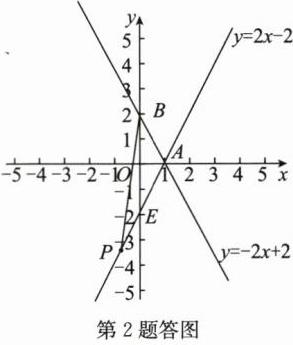
$\because P(m+1,2m),\therefore$令$x=m+1,y=2m$,则$y=2(x-1)=2x-2$,即点$P$在直线$y=2x-2$上,作图如答图所示。设直线$AP$与$y$轴交点为$E$,$\therefore E(0,-2)$,$\therefore BE=4$。
$\because S_{△ ABP}=6>2$,且$m<0$,$\therefore$点$P$位于直线$AE$在第三象限的部分上,
$\therefore S_{△ ABP}=S_{△ BEP}+S_{△ BEA}=\frac{1}{2}BE· |x_P|+\frac{1}{2}BE· AO=\frac{1}{2}×4×(-m-1)+\frac{1}{2}×4×1=-2m-2+2=6$,
解得$m=-3$。
2. $-3$ 点拨:$\because$直线$y=-2x+2$与坐标轴交于点$A$和点$B$,
$\therefore$不妨设与$x$轴的交点为$A$,与$y$轴的交点为$B$,
$\therefore A(1,0),B(0,2)$。
$\because P(m+1,2m),\therefore$令$x=m+1,y=2m$,则$y=2(x-1)=2x-2$,即点$P$在直线$y=2x-2$上,作图如答图所示。设直线$AP$与$y$轴交点为$E$,$\therefore E(0,-2)$,$\therefore BE=4$。
$\because S_{△ ABP}=6>2$,且$m<0$,$\therefore$点$P$位于直线$AE$在第三象限的部分上,
$\therefore S_{△ ABP}=S_{△ BEP}+S_{△ BEA}=\frac{1}{2}BE· |x_P|+\frac{1}{2}BE· AO=\frac{1}{2}×4×(-m-1)+\frac{1}{2}×4×1=-2m-2+2=6$,
解得$m=-3$。
解析:
【分析】
解题时首先求出直线$y=-2x+2$与坐标轴的交点$A$、$B$的坐标;接着分析点$P$的坐标特征,消去参数$m$确定点$P$所在的定直线,求出该直线与$y$轴的交点$E$,计算出$BE$的长度;再结合$m<0$的条件判断点$P$的位置,利用割补法将$△ ABP$的面积拆分为$△ BEP$和$△ BEA$的面积之和,最后根据面积为6列方程求解$m$的值即可。
【解析】
解:1. 求$A$、$B$两点坐标:
对于直线$y=-2x+2$,
令$y=0$,得$-2x+2=0$,解得$x=1$,$\therefore A(1,0)$;
令$x=0$,得$y=2$,$\therefore B(0,2)$。
2. 确定点$P$所在直线:
$\because P(m+1,2m)$,设$x=m+1$,$y=2m$,则$m=x-1$,代入$y$得$y=2(x-1)=2x-2$,即点$P$在直线$y=2x-2$上。
3. 求直线$y=2x-2$与$y$轴交点$E$:
令$x=0$,得$y=-2$,$\therefore E(0,-2)$,则$BE=2-(-2)=4$。
4. 根据面积列方程求解:
$\because m<0$,$\therefore$点$P$横坐标$m+1<1$,又$S_{△ ABP}=6>S_{△ ABE}=\frac{1}{2}×4×1=2$,$\therefore$点$P$在第三象限的直线$y=2x-2$上,横坐标的绝对值为$-(m+1)$。
由割补法得$S_{△ ABP}=S_{△ BEP}+S_{△ BEA}$,代入面积公式:
$\frac{1}{2}×4×(-m-1)+\frac{1}{2}×4×1=6$
化简得$-2m=6$,解得$m=-3$。
【答案】
$-3$
【知识点】
一次函数交点求法;割补法求面积;一次函数点的坐标特征
【点评】
本题将一次函数性质与三角形面积计算结合,解题关键是先判断出动点$P$所在的定直线,再通过割补法将不规则三角形转化为易计算面积的图形,解题时注意结合$m<0$的限制条件确定点的位置,避免出现增根。
【难度系数】
0.6
解题时首先求出直线$y=-2x+2$与坐标轴的交点$A$、$B$的坐标;接着分析点$P$的坐标特征,消去参数$m$确定点$P$所在的定直线,求出该直线与$y$轴的交点$E$,计算出$BE$的长度;再结合$m<0$的条件判断点$P$的位置,利用割补法将$△ ABP$的面积拆分为$△ BEP$和$△ BEA$的面积之和,最后根据面积为6列方程求解$m$的值即可。
【解析】
解:1. 求$A$、$B$两点坐标:
对于直线$y=-2x+2$,
令$y=0$,得$-2x+2=0$,解得$x=1$,$\therefore A(1,0)$;
令$x=0$,得$y=2$,$\therefore B(0,2)$。
2. 确定点$P$所在直线:
$\because P(m+1,2m)$,设$x=m+1$,$y=2m$,则$m=x-1$,代入$y$得$y=2(x-1)=2x-2$,即点$P$在直线$y=2x-2$上。
3. 求直线$y=2x-2$与$y$轴交点$E$:
令$x=0$,得$y=-2$,$\therefore E(0,-2)$,则$BE=2-(-2)=4$。
4. 根据面积列方程求解:
$\because m<0$,$\therefore$点$P$横坐标$m+1<1$,又$S_{△ ABP}=6>S_{△ ABE}=\frac{1}{2}×4×1=2$,$\therefore$点$P$在第三象限的直线$y=2x-2$上,横坐标的绝对值为$-(m+1)$。
由割补法得$S_{△ ABP}=S_{△ BEP}+S_{△ BEA}$,代入面积公式:
$\frac{1}{2}×4×(-m-1)+\frac{1}{2}×4×1=6$
化简得$-2m=6$,解得$m=-3$。
【答案】
$-3$
【知识点】
一次函数交点求法;割补法求面积;一次函数点的坐标特征
【点评】
本题将一次函数性质与三角形面积计算结合,解题关键是先判断出动点$P$所在的定直线,再通过割补法将不规则三角形转化为易计算面积的图形,解题时注意结合$m<0$的限制条件确定点的位置,避免出现增根。
【难度系数】
0.6
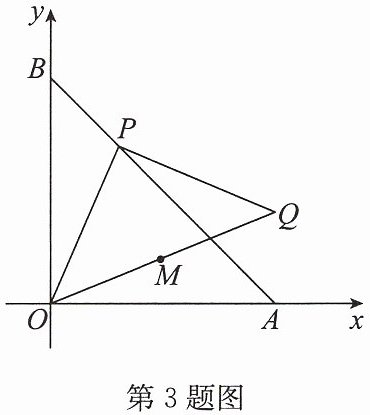
3. 如图,$A(4,0),B(0,4)$,点$P$在线段$AB$上运动,$PQ⊥ PO$且$PQ=PO$.
(1) 试说明点$Q$在某一确定的直线上;
(2) $M$是线段$OQ$的中点,当点$P$从点$A$运动到点$B$时,求点$M$运动的路径长.
(1) 试说明点$Q$在某一确定的直线上;
(2) $M$是线段$OQ$的中点,当点$P$从点$A$运动到点$B$时,求点$M$运动的路径长.
答案:
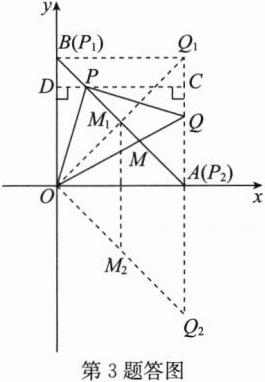
3. 解:(1)如答图,过点$P$作$CD⊥ y$轴于点$D$,过点$Q$作$QC⊥ CD$于点$C$,则点$Q$的横坐标为线段$CD$的长。
设$PD=m,DO=n$,则$P(m,n)$。
$\because A(4,0),B(0,4)$,
$\therefore$设直线$AB$的函数表达式为$y=kx+4$,
则$4k+4=0$,解得$k=-1$,
$\therefore$直线$AB$的函数表达式为$y=-x+4$,
$\therefore n=-m+4$,$\therefore m+n=4$。
$\because PD⊥ OD,PC⊥ CQ,OP⊥ PQ$,
$\therefore ∠ ODP=∠ PCQ=∠ OPQ=90°$,
$\therefore ∠ DOP+∠ DPO=∠ DPO+∠ CPQ=90°$,
$\therefore ∠ DOP=∠ CPQ$。
又$\because PQ=PO$,$\therefore △ ODP≌ △ PCQ(\mathrm{AAS})$,$\therefore PC=DO$。
$\because CD=CP+PD$,$\therefore CD=OD+PD=m+n=4$,
$\therefore$点$Q$的横坐标为4,
$\therefore$当点$P$在线段$AB$上运动时,点$Q$的横坐标始终为4,
$\therefore$点$Q$在确定的直线$x=4$上。
(2)由(1)知,当点$P(m,n)$在线段$AB$上运动时,点$Q$的横坐标为4,
由题意知$M$是线段$OQ$的中点,设$M(a,b)$,则$a=\frac{0+4}{2}=2$,
$\therefore$点$M$在直线$x=2$上。
当点$P$运动到与点$A$重合时,由答图可知,点$Q$与点$Q_2(4,-4)$重合,此时$a=2,b=\frac{0-4}{2}=-2$,
$\therefore$点$M$与点$M_2(2,-2)$重合。
同理,当点$P$运动到与点$B$重合时,点$M$与点$M_1(2,2)$重合。
$\therefore$当点$P$从点$A$运动到点$B$时,点$M$运动的路径长就是线段$M_1M_2$的长。
$\because M_1M_2=2-(-2)=4$,
$\therefore$点$P$从点$A$运动到点$B$时,点$M$运动的路径长为4。
3. 解:(1)如答图,过点$P$作$CD⊥ y$轴于点$D$,过点$Q$作$QC⊥ CD$于点$C$,则点$Q$的横坐标为线段$CD$的长。
设$PD=m,DO=n$,则$P(m,n)$。
$\because A(4,0),B(0,4)$,
$\therefore$设直线$AB$的函数表达式为$y=kx+4$,
则$4k+4=0$,解得$k=-1$,
$\therefore$直线$AB$的函数表达式为$y=-x+4$,
$\therefore n=-m+4$,$\therefore m+n=4$。
$\because PD⊥ OD,PC⊥ CQ,OP⊥ PQ$,
$\therefore ∠ ODP=∠ PCQ=∠ OPQ=90°$,
$\therefore ∠ DOP+∠ DPO=∠ DPO+∠ CPQ=90°$,
$\therefore ∠ DOP=∠ CPQ$。
又$\because PQ=PO$,$\therefore △ ODP≌ △ PCQ(\mathrm{AAS})$,$\therefore PC=DO$。
$\because CD=CP+PD$,$\therefore CD=OD+PD=m+n=4$,
$\therefore$点$Q$的横坐标为4,
$\therefore$当点$P$在线段$AB$上运动时,点$Q$的横坐标始终为4,
$\therefore$点$Q$在确定的直线$x=4$上。
(2)由(1)知,当点$P(m,n)$在线段$AB$上运动时,点$Q$的横坐标为4,
由题意知$M$是线段$OQ$的中点,设$M(a,b)$,则$a=\frac{0+4}{2}=2$,
$\therefore$点$M$在直线$x=2$上。
当点$P$运动到与点$A$重合时,由答图可知,点$Q$与点$Q_2(4,-4)$重合,此时$a=2,b=\frac{0-4}{2}=-2$,
$\therefore$点$M$与点$M_2(2,-2)$重合。
同理,当点$P$运动到与点$B$重合时,点$M$与点$M_1(2,2)$重合。
$\therefore$当点$P$从点$A$运动到点$B$时,点$M$运动的路径长就是线段$M_1M_2$的长。
$\because M_1M_2=2-(-2)=4$,
$\therefore$点$P$从点$A$运动到点$B$时,点$M$运动的路径长为4。
解析:
【分析】
(1) 要证明点Q在定直线上,可推导点Q的横/纵坐标为定值。首先先求出直线AB的解析式,得到P点横、纵坐标的数量关系;再结合OP⊥PQ且OP=PQ的条件,通过作垂线构造全等三角形,转化线段关系,推导Q点的坐标特征即可得结论。
(2) 求中点M的运动路径长,先根据Q点的坐标特征得到M点的轨迹为定直线,再找到P在起止点A、B时对应的M点位置,计算两点间的距离即为所求路径长。
【解析】
(1) 如答图,过点$P$作$CD⊥ y$轴于点$D$,过点$Q$作$QC⊥ CD$于点$C$。
设$PD=m,DO=n$,则$P(m,n)$。
$\because A(4,0),B(0,4)$,设直线$AB$的函数表达式为$y=kx+4$,
将$A(4,0)$代入得$4k+4=0$,解得$k=-1$,
$\therefore$直线$AB$的函数表达式为$y=-x+4$,
$\therefore n=-m+4$,即$m+n=4$。
$\because PD⊥ OD,PC⊥ CQ,OP⊥ PQ$,
$\therefore ∠ ODP=∠ PCQ=∠ OPQ=90°$,
$\therefore ∠ DOP+∠ DPO=∠ DPO+∠ CPQ=90°$,
$\therefore ∠ DOP=∠ CPQ$。
又$\because PQ=PO$,
$\therefore △ ODP≌ △ PCQ(\mathrm{AAS})$,
$\therefore PC=DO=n$。
$\because CD=CP+PD=m+n=4$,
$\therefore$点$Q$的横坐标恒为4,即点$Q$在确定的直线$x=4$上。
(2) 设$M(a,b)$,$\because M$是线段$OQ$的中点,$Q$的横坐标恒为4,
$\therefore a=\frac{0+4}{2}=2$,即点$M$在直线$x=2$上。
当点$P$与点$A$重合时,点$Q$坐标为$(4,-4)$,此时$M$坐标为$(\frac{0+4}{2},\frac{0-4}{2})=(2,-2)$,记为$M_2(2,-2)$;
当点$P$与点$B$重合时,点$Q$坐标为$(4,4)$,此时$M$坐标为$(\frac{0+4}{2},\frac{0+4}{2})=(2,2)$,记为$M_1(2,2)$。
$\therefore$点$M$运动的路径长为线段$M_1M_2$的长度,$M_1M_2=2-(-2)=4$。
【答案】
(1) 点$Q$在定直线$\boldsymbol{x=4}$上;
(2) 点$M$运动的路径长为$\boldsymbol{4}$。
【知识点】
一次函数解析式求解;全等三角形的判定与性质;动点路径计算
【点评】
本题属于一次函数综合题,将全等三角形、一次函数性质与动点轨迹问题结合,核心是通过构造全等三角形得到动点的坐标特征,进而确定定直线,再通过起止点计算路径长度,侧重考查数形结合思想和转化思想,是一次函数动点类问题的典型考法。
【难度系数】
0.6
(1) 要证明点Q在定直线上,可推导点Q的横/纵坐标为定值。首先先求出直线AB的解析式,得到P点横、纵坐标的数量关系;再结合OP⊥PQ且OP=PQ的条件,通过作垂线构造全等三角形,转化线段关系,推导Q点的坐标特征即可得结论。
(2) 求中点M的运动路径长,先根据Q点的坐标特征得到M点的轨迹为定直线,再找到P在起止点A、B时对应的M点位置,计算两点间的距离即为所求路径长。
【解析】
(1) 如答图,过点$P$作$CD⊥ y$轴于点$D$,过点$Q$作$QC⊥ CD$于点$C$。
设$PD=m,DO=n$,则$P(m,n)$。
$\because A(4,0),B(0,4)$,设直线$AB$的函数表达式为$y=kx+4$,
将$A(4,0)$代入得$4k+4=0$,解得$k=-1$,
$\therefore$直线$AB$的函数表达式为$y=-x+4$,
$\therefore n=-m+4$,即$m+n=4$。
$\because PD⊥ OD,PC⊥ CQ,OP⊥ PQ$,
$\therefore ∠ ODP=∠ PCQ=∠ OPQ=90°$,
$\therefore ∠ DOP+∠ DPO=∠ DPO+∠ CPQ=90°$,
$\therefore ∠ DOP=∠ CPQ$。
又$\because PQ=PO$,
$\therefore △ ODP≌ △ PCQ(\mathrm{AAS})$,
$\therefore PC=DO=n$。
$\because CD=CP+PD=m+n=4$,
$\therefore$点$Q$的横坐标恒为4,即点$Q$在确定的直线$x=4$上。
(2) 设$M(a,b)$,$\because M$是线段$OQ$的中点,$Q$的横坐标恒为4,
$\therefore a=\frac{0+4}{2}=2$,即点$M$在直线$x=2$上。
当点$P$与点$A$重合时,点$Q$坐标为$(4,-4)$,此时$M$坐标为$(\frac{0+4}{2},\frac{0-4}{2})=(2,-2)$,记为$M_2(2,-2)$;
当点$P$与点$B$重合时,点$Q$坐标为$(4,4)$,此时$M$坐标为$(\frac{0+4}{2},\frac{0+4}{2})=(2,2)$,记为$M_1(2,2)$。
$\therefore$点$M$运动的路径长为线段$M_1M_2$的长度,$M_1M_2=2-(-2)=4$。
【答案】
(1) 点$Q$在定直线$\boldsymbol{x=4}$上;
(2) 点$M$运动的路径长为$\boldsymbol{4}$。
【知识点】
一次函数解析式求解;全等三角形的判定与性质;动点路径计算
【点评】
本题属于一次函数综合题,将全等三角形、一次函数性质与动点轨迹问题结合,核心是通过构造全等三角形得到动点的坐标特征,进而确定定直线,再通过起止点计算路径长度,侧重考查数形结合思想和转化思想,是一次函数动点类问题的典型考法。
【难度系数】
0.6