B
Hainan gibbons are the world's rarest primates. They only live in Hainan. Their daily life begins with the male heads of the five remaining families' high and beautiful whistling. It can reach villages down in the valleys which are 800 to 1,200 metres below.
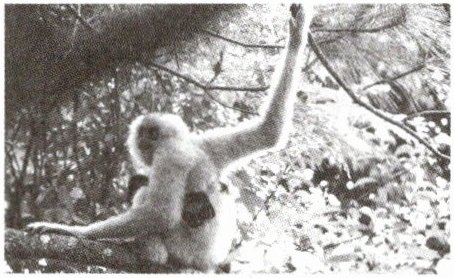
Sadly, gibbons once nearly died out. With the efforts of the researchers, their number has increased from less than 10 in two families to 35 in five families.
Although gibbons can look at people curiously from a few metres away, it's difficult to follow the gibbons. The best way to follow the gibbons is by sound at present. Like
humans, gibbons produce vocal cues. With the help of the advanced cameras, we will learn more about their lifestyle and the way they express feelings like joy, anger and sadness.
For the next six months, 11 researchers will work with other experts to study the information collected over the last year. Then they will finish a report on the voice characteristics of the gibbons, and try to explain their daily behaviour.
The database is expected to be completed in three years. It will play a major role in researching and protecting gibbons and other rare plants and animals. The project is the first of its kind in China. It's designed to follow all major rare plants and animals in a single protected area. Researchers suggested that we can explain not only gibbons' simple communication but also their behaviour in the future because of research into Hainan gibbon protection.
The growth of Hainan gibbon population gives the whole world confidence to protect the endangered primates in the future.
词汇
gibbon /'gɪbən/ n. 长臂猿
primate /'praɪmeɪt/ n. 灵长目动物
whistling /'wɪslɪŋ/ n. 哨声;呼啸声
vocal cue 声音提示
database /'deɪtəbeɪs/ n. 数据库
rare /reə(r)/ adj. 稀罕的,珍贵的
remaining /rɪ'meɪnɪŋ/ adj. 剩下的,剩余的
valley /'væli/ n. 山谷
characteristic /ˌkærəktə'rɪstɪk/ n. 特征
理解
1. How can the researchers follow the gibbons?
2. What can we do to protect the endangered animals?
Hainan gibbons are the world's rarest primates. They only live in Hainan. Their daily life begins with the male heads of the five remaining families' high and beautiful whistling. It can reach villages down in the valleys which are 800 to 1,200 metres below.
Sadly, gibbons once nearly died out. With the efforts of the researchers, their number has increased from less than 10 in two families to 35 in five families.
Although gibbons can look at people curiously from a few metres away, it's difficult to follow the gibbons. The best way to follow the gibbons is by sound at present. Like
humans, gibbons produce vocal cues. With the help of the advanced cameras, we will learn more about their lifestyle and the way they express feelings like joy, anger and sadness.
For the next six months, 11 researchers will work with other experts to study the information collected over the last year. Then they will finish a report on the voice characteristics of the gibbons, and try to explain their daily behaviour.
The database is expected to be completed in three years. It will play a major role in researching and protecting gibbons and other rare plants and animals. The project is the first of its kind in China. It's designed to follow all major rare plants and animals in a single protected area. Researchers suggested that we can explain not only gibbons' simple communication but also their behaviour in the future because of research into Hainan gibbon protection.
The growth of Hainan gibbon population gives the whole world confidence to protect the endangered primates in the future.
词汇
gibbon /'gɪbən/ n. 长臂猿
primate /'praɪmeɪt/ n. 灵长目动物
whistling /'wɪslɪŋ/ n. 哨声;呼啸声
vocal cue 声音提示
database /'deɪtəbeɪs/ n. 数据库
rare /reə(r)/ adj. 稀罕的,珍贵的
remaining /rɪ'meɪnɪŋ/ adj. 剩下的,剩余的
valley /'væli/ n. 山谷
characteristic /ˌkærəktə'rɪstɪk/ n. 特征
理解
1. How can the researchers follow the gibbons?
The best way to follow the gibbons is by sound at present.
2. What can we do to protect the endangered animals?
First, we should learn more about their habits by doing research work. Second, we should try to protect their living areas and food.
答案:1. The best way to follow the gibbons is by sound at present.
2. First, we should learn more about their habits by doing research work. Second, we should try to protect their living areas and food.
2. First, we should learn more about their habits by doing research work. Second, we should try to protect their living areas and food.
解析:
【分析】本题为英语阅读理解题,考查学生从文本中提取关键信息、结合内容总结答案的能力。第1题需定位文章中关于追踪长臂猿方式的语句,直接提取信息;第2题需结合文章中长臂猿保护的相关内容,合理总结保护濒危动物的做法。
【解析】第1题:根据文章第三段“The best way to follow the gibbons is by sound at present.”,可直接提取该句作为答案。第2题:结合文章中对长臂猿的研究(如收集信息、建立数据库研究其习性等),以及保护濒危动物的合理方向,总结出两点做法:一是通过研究了解动物习性,二是保护其生存区域和食物。
【答案】1. The best way to follow the gibbons is by sound at present.
2. First, we should learn more about their habits by doing research work. Second, we should try to protect their living areas and food.
【知识点】英语阅读理解、信息提取、文本总结
【点评】本题难度适中,主要考查学生的英语阅读细节查找和内容归纳能力,需仔细阅读文本定位关键内容。
【难度系数】0.5
【解析】第1题:根据文章第三段“The best way to follow the gibbons is by sound at present.”,可直接提取该句作为答案。第2题:结合文章中对长臂猿的研究(如收集信息、建立数据库研究其习性等),以及保护濒危动物的合理方向,总结出两点做法:一是通过研究了解动物习性,二是保护其生存区域和食物。
【答案】1. The best way to follow the gibbons is by sound at present.
2. First, we should learn more about their habits by doing research work. Second, we should try to protect their living areas and food.
【知识点】英语阅读理解、信息提取、文本总结
【点评】本题难度适中,主要考查学生的英语阅读细节查找和内容归纳能力,需仔细阅读文本定位关键内容。
【难度系数】0.5