(
—I’d love to, but my uncle asks me to finish my homework first.
A.What about
B.Why not
C.Why don’t
D.Shall we
A
)20.(2024南京玄武外国语学校期中)— going shopping with us, Susan?—I’d love to, but my uncle asks me to finish my homework first.
A.What about
B.Why not
C.Why don’t
D.Shall we
答案:20. A
解析:
【分析】本题考查英语提建议的句型辨析,需根据空格后的动词形式(动名词going)判断正确选项,回忆各选项的用法规则即可快速解题。
【解析】逐一分析选项:A. What about用于提建议,后接名词、代词或动名词(doing形式),与空格后going的形式匹配;B. Why not后接动词原形,结构为Why not do sth.,不符合;C. Why don’t后需加主语(如you)再接动词原形,结构为Why don’t sb. do sth.,不符合;D. Shall we后接动词原形,结构为Shall we do sth.,不符合。因此选A。
【答案】A
【知识点】提建议句型
【点评】本题为基础句型辨析题,考查常见提建议句型的结构差异,学生牢记各句型搭配规则即可作答,属于易得分题。
【难度系数】0.8
【解析】逐一分析选项:A. What about用于提建议,后接名词、代词或动名词(doing形式),与空格后going的形式匹配;B. Why not后接动词原形,结构为Why not do sth.,不符合;C. Why don’t后需加主语(如you)再接动词原形,结构为Why don’t sb. do sth.,不符合;D. Shall we后接动词原形,结构为Shall we do sth.,不符合。因此选A。
【答案】A
【知识点】提建议句型
【点评】本题为基础句型辨析题,考查常见提建议句型的结构差异,学生牢记各句型搭配规则即可作答,属于易得分题。
【难度系数】0.8
Ⅴ. (2025 连云港) 阅读理解
Hello from nature's foodies
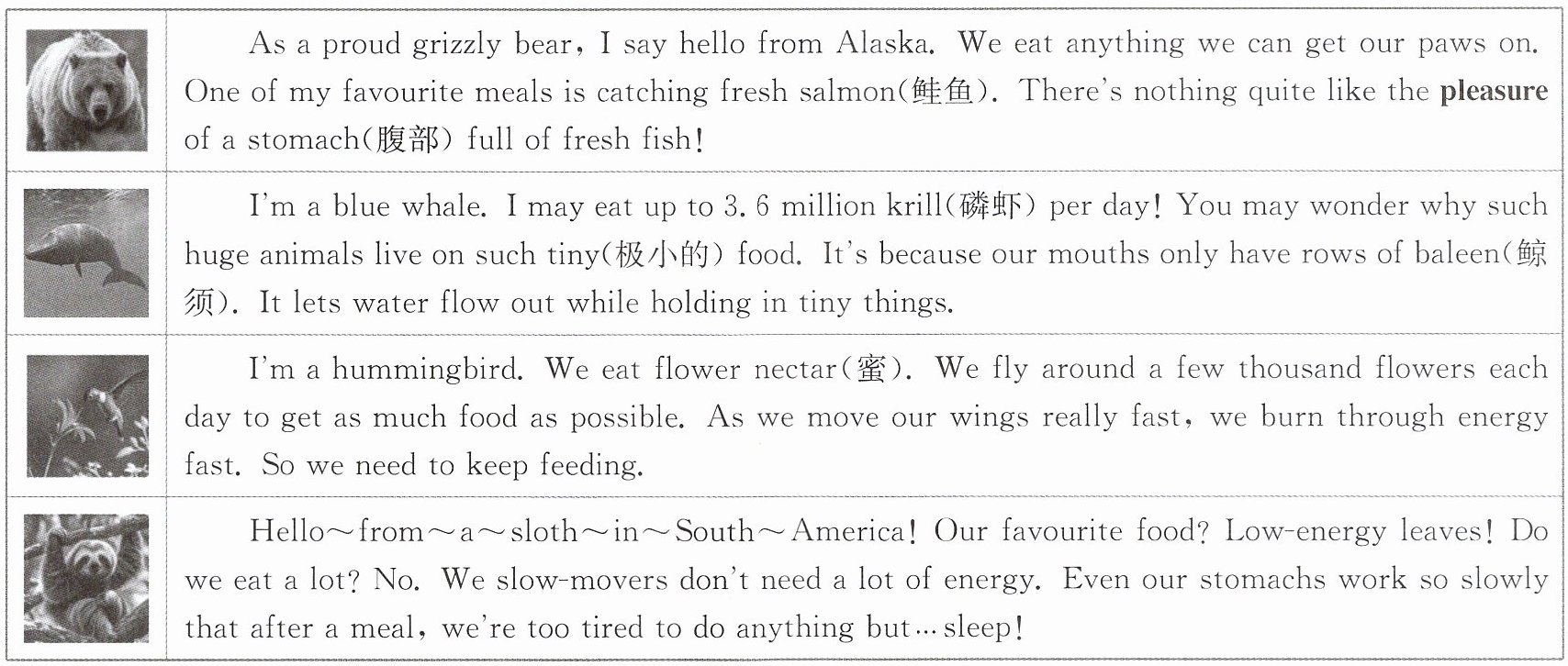
As a proud grizzly bear, I say hello from Alaska. We eat anything we can get our paws on. One of my favourite meals is catching fresh salmon(鲑鱼). There's nothing quite like the pleasure of a stomach(腹部) full of fresh fish!
I'm a blue whale. I may eat up to 3.6 million krill(磷虾) per day! You may wonder why such huge animals live on such tiny(极小的) food. It's because our mouths only have rows of baleen(鲸须). It lets water flow out while holding in tiny things.
I'm a hummingbird. We eat flower nectar(蜜). We fly around a few thousand flowers each day to get as much food as possible. As we move our wings really fast, we burn through energy fast. So we need to keep feeding.
Hello~from~a~sloth~in~South~America! Our favourite food? Low-energy leaves! Do we eat a lot? No. We slow-movers don't need a lot of energy. Even our stomachs work so slowly that after a meal, we're too tired to do anything but…sleep!
(
A. Because it is the largest sea animal. B. Because it is too slow to catch large fish.
C. Because it only has baleen instead of teeth. D. Because it likes a stomach full of tiny food.
(
A. Living places. B. Diet lists. C. Daily activities. D. Body sizes.
(
A. Wildlife. B. Landscapes. C. Travelling. D. Photography.
Hello from nature's foodies
As a proud grizzly bear, I say hello from Alaska. We eat anything we can get our paws on. One of my favourite meals is catching fresh salmon(鲑鱼). There's nothing quite like the pleasure of a stomach(腹部) full of fresh fish!
I'm a blue whale. I may eat up to 3.6 million krill(磷虾) per day! You may wonder why such huge animals live on such tiny(极小的) food. It's because our mouths only have rows of baleen(鲸须). It lets water flow out while holding in tiny things.
I'm a hummingbird. We eat flower nectar(蜜). We fly around a few thousand flowers each day to get as much food as possible. As we move our wings really fast, we burn through energy fast. So we need to keep feeding.
Hello~from~a~sloth~in~South~America! Our favourite food? Low-energy leaves! Do we eat a lot? No. We slow-movers don't need a lot of energy. Even our stomachs work so slowly that after a meal, we're too tired to do anything but…sleep!
(
C
)21. Why does a blue whale live on tiny living things?A. Because it is the largest sea animal. B. Because it is too slow to catch large fish.
C. Because it only has baleen instead of teeth. D. Because it likes a stomach full of tiny food.
(
C
)22. What decide how much hummingbirds and sloths eat?A. Living places. B. Diet lists. C. Daily activities. D. Body sizes.
(
A
)23. Which part of a magazine is the text probably from?A. Wildlife. B. Landscapes. C. Travelling. D. Photography.
答案:21. C
22. C
23. A
22. C
23. A
解析:
【分析】
本题为阅读理解题,需通过定位原文关键信息解答各小题:
1. 第21题:定位蓝鲸的段落,找到其以微小生物为食的原因,匹配对应选项;
2. 第22题:分别定位蜂鸟和树懒的进食量相关描述,分析影响进食量的因素;
3. 第23题:根据文章介绍动物食性的核心内容,判断所属杂志板块。
【解析】
21题:根据蓝鲸段落中的“It's because our mouths only have rows of baleen(鲸须). It lets water flow out while holding in tiny things.”可知,蓝鲸只有鲸须而非牙齿,只能滤食微小生物,对应选项C,故答案为C。
22题:蜂鸟段落提到“move our wings really fast, we burn through energy fast. So we need to keep feeding”,树懒段落提到“We slow-movers don't need a lot of energy”,二者的进食量均由日常活动(蜂鸟快速振翅、树懒行动缓慢)决定,对应选项C,故答案为C。
23题:文章核心内容是介绍四种野生动物的食性特点,属于野生动物主题,对应杂志的Wildlife板块,故答案为A。
【答案】
21.C;22.C;23.A
【知识点】
细节理解题;主旨大意题
【点评】
本文以拟人化的方式介绍四种动物的食性,考查学生快速定位细节信息和归纳主旨的能力,题型为常规阅读理解题,难度适中。
【难度系数】
0.6
本题为阅读理解题,需通过定位原文关键信息解答各小题:
1. 第21题:定位蓝鲸的段落,找到其以微小生物为食的原因,匹配对应选项;
2. 第22题:分别定位蜂鸟和树懒的进食量相关描述,分析影响进食量的因素;
3. 第23题:根据文章介绍动物食性的核心内容,判断所属杂志板块。
【解析】
21题:根据蓝鲸段落中的“It's because our mouths only have rows of baleen(鲸须). It lets water flow out while holding in tiny things.”可知,蓝鲸只有鲸须而非牙齿,只能滤食微小生物,对应选项C,故答案为C。
22题:蜂鸟段落提到“move our wings really fast, we burn through energy fast. So we need to keep feeding”,树懒段落提到“We slow-movers don't need a lot of energy”,二者的进食量均由日常活动(蜂鸟快速振翅、树懒行动缓慢)决定,对应选项C,故答案为C。
23题:文章核心内容是介绍四种野生动物的食性特点,属于野生动物主题,对应杂志的Wildlife板块,故答案为A。
【答案】
21.C;22.C;23.A
【知识点】
细节理解题;主旨大意题
【点评】
本文以拟人化的方式介绍四种动物的食性,考查学生快速定位细节信息和归纳主旨的能力,题型为常规阅读理解题,难度适中。
【难度系数】
0.6
Ⅵ. 选用方框内的单词或词组填空,其中有一个单词或词组是多余选项
favourite, a few, unhappy, of course, because, excited
A: Hey, Bruce! You seem 24.
B: Yes. I came back from the zoo just now.
A: Did you see your 25.
B: Yes. But they didn't look well.
A: Why?
B: 26.
A: I'm sorry to hear that. I think they should go back to forests or mountains.
B: Even worse, 27.
A: That's too bad. Did you stop them?
B: 28.
词汇积累
pleasure /ˈpleʒə(r)/ n.
favourite, a few, unhappy, of course, because, excited
A: Hey, Bruce! You seem 24.
unhappy
. Didn't you go to the zoo?B: Yes. I came back from the zoo just now.
A: Did you see your 25.
favourite
tigers?B: Yes. But they didn't look well.
A: Why?
B: 26.
Because
they had to stay in cages and they were dirty.A: I'm sorry to hear that. I think they should go back to forests or mountains.
B: Even worse, 27.
a few
children threw something at them.A: That's too bad. Did you stop them?
B: 28.
Of course
. Protecting them is protecting ourselves.词汇积累
pleasure /ˈpleʒə(r)/ n.
答案:24. unhappy
25. favourite
26. Because
27. a few
28. Of course
词汇积累:高兴;满意
25. favourite
26. Because
27. a few
28. Of course
词汇积累:高兴;满意
解析:
【分析】
首先通读对话,理解对话围绕Bruce从动物园返回后的经历展开,结合方框内的单词/词组及上下文语境逐一分析:
1. 第24空:A询问Bruce是否没去动物园,结合后文提到老虎状态不好,可知Bruce看起来不开心,需选表情绪的形容词;
2. 第25空:修饰名词tigers,需用形容词表“最喜欢的”,符合语境;
3. 第26空:前文用Why提问原因,需用Because引导原因状语;
4. 第27空:修饰可数名词复数children,需用表“几个”的限定词;
5. 第28空:A询问是否阻止了扔东西的孩子,结合后文观点,需用肯定回应的词组;最后完成词汇积累的词义填写。
【解析】
根据对话语境及词汇用法逐一解答:
24. 由后文“they didn't look well”可知Bruce情绪不佳,填unhappy;
25. 修饰名词tigers,用形容词favourite表“最喜欢的”,填favourite;
26. 前文用Why提问原因,用Because回答,填Because;
27. 修饰可数名词复数children,a few表“几个”,填a few;
28. 对“Did you stop them?”的肯定回应用Of course,填Of course;
词汇积累:pleasure意为“高兴;满意”。
【答案】
24. unhappy;25. favourite;26. Because;27. a few;28. Of course;词汇积累:高兴;满意
【知识点】
词汇运用;词义辨析
【点评】
本题考查日常对话中的基础词汇运用,要求结合语境选择合适的单词/词组,注重词汇在实际场景中的运用,难度适中。
【难度系数】
0.6
首先通读对话,理解对话围绕Bruce从动物园返回后的经历展开,结合方框内的单词/词组及上下文语境逐一分析:
1. 第24空:A询问Bruce是否没去动物园,结合后文提到老虎状态不好,可知Bruce看起来不开心,需选表情绪的形容词;
2. 第25空:修饰名词tigers,需用形容词表“最喜欢的”,符合语境;
3. 第26空:前文用Why提问原因,需用Because引导原因状语;
4. 第27空:修饰可数名词复数children,需用表“几个”的限定词;
5. 第28空:A询问是否阻止了扔东西的孩子,结合后文观点,需用肯定回应的词组;最后完成词汇积累的词义填写。
【解析】
根据对话语境及词汇用法逐一解答:
24. 由后文“they didn't look well”可知Bruce情绪不佳,填unhappy;
25. 修饰名词tigers,用形容词favourite表“最喜欢的”,填favourite;
26. 前文用Why提问原因,用Because回答,填Because;
27. 修饰可数名词复数children,a few表“几个”,填a few;
28. 对“Did you stop them?”的肯定回应用Of course,填Of course;
词汇积累:pleasure意为“高兴;满意”。
【答案】
24. unhappy;25. favourite;26. Because;27. a few;28. Of course;词汇积累:高兴;满意
【知识点】
词汇运用;词义辨析
【点评】
本题考查日常对话中的基础词汇运用,要求结合语境选择合适的单词/词组,注重词汇在实际场景中的运用,难度适中。
【难度系数】
0.6