四、阅读短文,从方框中选出能填入文中空白处的最佳选项,选项中有两项为多余选项
In Chinese culture, red is a popular colour. It stands for luck, happiness, joy and many other good things. 36 Why?
In ancient times, red was the symbol of power. Not everyone could write with red pens—only emperors. 37 Their replies were known as zhupi (朱批).
38 In ancient China, the criminals (罪犯) who were sentenced (判刑) to death signed their names with red pens. 39 So remember not to do it when writing to friends and family.
40 Teachers mark students’ homework with red pens. So do editors (编辑) who need to correct mistakes in newspapers and magazines. But writing names or letters with red pens is still a bad idea to many people.
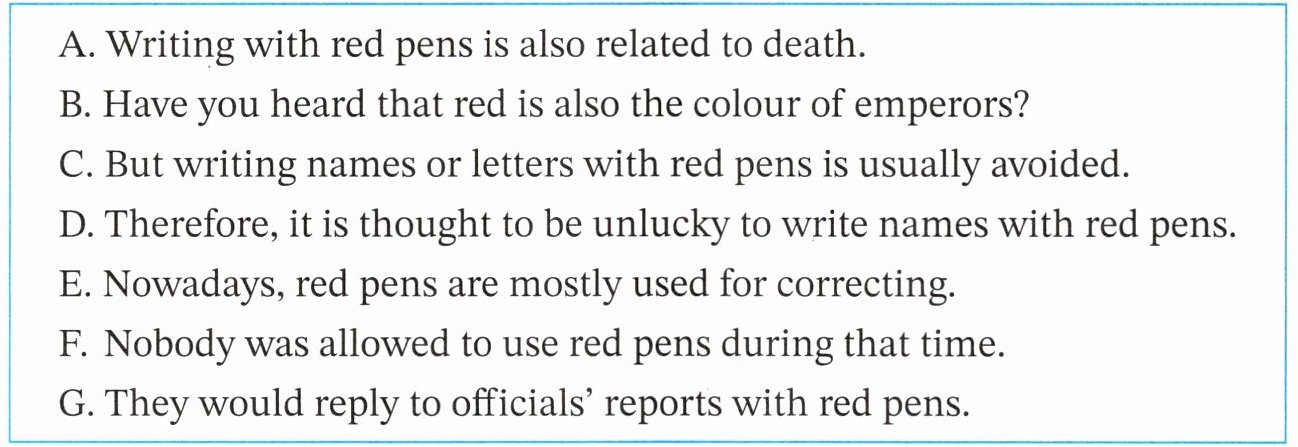
36. 37. 38. 39. 40.
In Chinese culture, red is a popular colour. It stands for luck, happiness, joy and many other good things. 36 Why?
In ancient times, red was the symbol of power. Not everyone could write with red pens—only emperors. 37 Their replies were known as zhupi (朱批).
38 In ancient China, the criminals (罪犯) who were sentenced (判刑) to death signed their names with red pens. 39 So remember not to do it when writing to friends and family.
40 Teachers mark students’ homework with red pens. So do editors (编辑) who need to correct mistakes in newspapers and magazines. But writing names or letters with red pens is still a bad idea to many people.
36. 37. 38. 39. 40.
答案:36.C 37.G 38.A 39.D 40.E
解析:
【分析】
本题为英语阅读七选五题型,需结合上下文语境与句子间的逻辑关系(转折、因果、顺承等)选择合适选项。解题时先通读全文,明确文章围绕“红笔在中国文化中的不同含义(古代皇帝使用、与死亡关联、现代用途)”展开,再逐个分析每个空格前后内容,匹配对应选项:36题前讲红色的正面意义,后问原因,需选转折引出红笔使用禁忌的句子;37题前说仅皇帝能用红笔,后提“朱批”,需选皇帝用红笔回复官员报告的句子;38题后讲死刑犯用红笔签名,需选引出红笔与死亡关联的句子;39题前讲死刑犯的情况,后提醒不要用红笔写名字,需选得出红笔写名字不吉利的因果句;40题后讲红笔用于批改作业等,需选现代红笔主要用途的句子。
【解析】
1. 36空:前文提到红色代表好运等积极意义,后文问“为什么”,需转折引出红笔使用的禁忌,选项C“ But writing names or letters with red pens is usually avoided.” 符合逻辑,故36选C。
2. 37空:前文说明古代仅皇帝能用红笔,后文提到“他们的回复叫朱批”,选项G“They would reply to officials’ reports with red pens.” 衔接皇帝用红笔的具体行为,对应“朱批”,故37选G。
3. 38空:后文讲古代死刑犯用红笔签名,需引出红笔与死亡的关联,选项A“Writing with red pens is also related to death.” 符合,故38选A。
4. 39空:前文讲死刑犯用红笔的情况,后文提醒不要用红笔写名字,需因果句得出结论,选项D“Therefore, it is thought to be unlucky to write names with red pens.” 符合,故39选D。
5. 40空:后文讲老师、编辑用红笔批改,需说明现代红笔的主要用途,选项E“Nowadays, red pens are mostly used for correcting.” 符合,故40选E。
【答案】
36.C 37.G 38.A 39.D 40.E
【知识点】
英语阅读七选五、语篇逻辑衔接
【点评】
本题考查学生对语篇上下文逻辑关系的理解与运用,属于常见的英语阅读题型,需把握句子间的转折、因果、顺承等逻辑,难度适中,需结合文化背景辅助理解。
【难度系数】
0.6
本题为英语阅读七选五题型,需结合上下文语境与句子间的逻辑关系(转折、因果、顺承等)选择合适选项。解题时先通读全文,明确文章围绕“红笔在中国文化中的不同含义(古代皇帝使用、与死亡关联、现代用途)”展开,再逐个分析每个空格前后内容,匹配对应选项:36题前讲红色的正面意义,后问原因,需选转折引出红笔使用禁忌的句子;37题前说仅皇帝能用红笔,后提“朱批”,需选皇帝用红笔回复官员报告的句子;38题后讲死刑犯用红笔签名,需选引出红笔与死亡关联的句子;39题前讲死刑犯的情况,后提醒不要用红笔写名字,需选得出红笔写名字不吉利的因果句;40题后讲红笔用于批改作业等,需选现代红笔主要用途的句子。
【解析】
1. 36空:前文提到红色代表好运等积极意义,后文问“为什么”,需转折引出红笔使用的禁忌,选项C“ But writing names or letters with red pens is usually avoided.” 符合逻辑,故36选C。
2. 37空:前文说明古代仅皇帝能用红笔,后文提到“他们的回复叫朱批”,选项G“They would reply to officials’ reports with red pens.” 衔接皇帝用红笔的具体行为,对应“朱批”,故37选G。
3. 38空:后文讲古代死刑犯用红笔签名,需引出红笔与死亡的关联,选项A“Writing with red pens is also related to death.” 符合,故38选A。
4. 39空:前文讲死刑犯用红笔的情况,后文提醒不要用红笔写名字,需因果句得出结论,选项D“Therefore, it is thought to be unlucky to write names with red pens.” 符合,故39选D。
5. 40空:后文讲老师、编辑用红笔批改,需说明现代红笔的主要用途,选项E“Nowadays, red pens are mostly used for correcting.” 符合,故40选E。
【答案】
36.C 37.G 38.A 39.D 40.E
【知识点】
英语阅读七选五、语篇逻辑衔接
【点评】
本题考查学生对语篇上下文逻辑关系的理解与运用,属于常见的英语阅读题型,需把握句子间的转折、因果、顺承等逻辑,难度适中,需结合文化背景辅助理解。
【难度系数】
0.6
五、根据首字母提示完成短文,每空一词
Did Chinese people in the p41 have three meals a day as we do now? In fact, until the Qin and Han Dynasties, most people had two meals a day. They didn't have enough food b42 food production was low at that time. Usually, people had breakfast b437 and 9 a.m. Their breakfast, as their main meal, was nicer than their afternoon meal. It was r44 that some rich people had three meals a day.
But poor people didn't u45 do it.
Three meals a day became common d46 the Sui and Tang Dynasties as agriculture (农业) developed and the country became richer. People had lunch instead of b47 as the main meal of the day. We can see many records of lunch at that time. For example, Bai Juyi and Jia Dao b48 wrote about lunch in their poems.
The number of meals people eat a day depends on many things, i49 the economic system, social status (地位) and customs. I50 you lived hundreds of years ago, how many meals would you like to eat a day?
41. 42. 43. 44. 45.
46. 47. 48. 49. 50.
Did Chinese people in the p41 have three meals a day as we do now? In fact, until the Qin and Han Dynasties, most people had two meals a day. They didn't have enough food b42 food production was low at that time. Usually, people had breakfast b437 and 9 a.m. Their breakfast, as their main meal, was nicer than their afternoon meal. It was r44 that some rich people had three meals a day.
But poor people didn't u45 do it.
Three meals a day became common d46 the Sui and Tang Dynasties as agriculture (农业) developed and the country became richer. People had lunch instead of b47 as the main meal of the day. We can see many records of lunch at that time. For example, Bai Juyi and Jia Dao b48 wrote about lunch in their poems.
The number of meals people eat a day depends on many things, i49 the economic system, social status (地位) and customs. I50 you lived hundreds of years ago, how many meals would you like to eat a day?
41. 42. 43. 44. 45.
46. 47. 48. 49. 50.
答案:41. past 42. because 43. between
44. reported 45. usually 46. during
47. breakfast 48. both 49. including
50. If
44. reported 45. usually 46. during
47. breakfast 48. both 49. including
50. If
解析:
【分析】
这是一道根据首字母提示完成短文的题目,解题思路如下:首先通读全文,把握文章主旨(介绍中国人一日三餐的历史演变);接着逐句分析每个空格的上下文逻辑、固定搭配或语法结构,结合给出的首字母提示确定合适的单词;最后填完后通读检查,确保语句通顺、符合语境。
【解析】
41. 句意:过去中国人一天吃三餐吗?固定短语“in the past”表示“在过去”,结合首字母p,填past。
42. 句意:他们没有足够的食物,因为当时粮食产量低。前后为因果关系,结合首字母b,填because。
43. 句意:通常人们在早上7点到9点之间吃早餐。固定搭配“between...and...”表示“在……和……之间”,结合首字母b,填between。
44. 句意:据报道一些富人一天吃三餐。固定句式“It was reported that...”表示“据报道……”,结合首字母r,填reported。
45. 句意:但穷人通常不这样做。结合语境及首字母u,填usually(通常)。
46. 句意:在隋唐期间,随着农业发展,一天三餐变得普遍。表示“在……期间”用介词during,结合首字母d,填during。
47. 句意:人们把午餐代替早餐作为一天的主餐。结合前文提到的早餐,结合首字母b,填breakfast。
48. 句意:例如,白居易和贾岛都在诗中写过午餐。表示“两者都”用both,结合首字母b,填both。
49. 句意:人们一天吃几顿饭取决于很多因素,包括经济体系、社会地位和习俗。介词including表示“包括”,结合首字母i,填including。
50. 句意:如果你生活在几百年前,你一天想吃几顿饭?引导条件状语从句用If,结合首字母I,填If。
【答案】
41. past 42. because 43. between 44. reported 45. usually 46. during 47. breakfast 48. both 49. including 50. If
【知识点】
首字母填空、固定搭配、介词连词用法
【点评】
本题考查基础词汇、固定搭配及语境理解,需结合文章主旨和语法知识作答,注重基础知识的运用,难度适中。
【难度系数】
0.6
这是一道根据首字母提示完成短文的题目,解题思路如下:首先通读全文,把握文章主旨(介绍中国人一日三餐的历史演变);接着逐句分析每个空格的上下文逻辑、固定搭配或语法结构,结合给出的首字母提示确定合适的单词;最后填完后通读检查,确保语句通顺、符合语境。
【解析】
41. 句意:过去中国人一天吃三餐吗?固定短语“in the past”表示“在过去”,结合首字母p,填past。
42. 句意:他们没有足够的食物,因为当时粮食产量低。前后为因果关系,结合首字母b,填because。
43. 句意:通常人们在早上7点到9点之间吃早餐。固定搭配“between...and...”表示“在……和……之间”,结合首字母b,填between。
44. 句意:据报道一些富人一天吃三餐。固定句式“It was reported that...”表示“据报道……”,结合首字母r,填reported。
45. 句意:但穷人通常不这样做。结合语境及首字母u,填usually(通常)。
46. 句意:在隋唐期间,随着农业发展,一天三餐变得普遍。表示“在……期间”用介词during,结合首字母d,填during。
47. 句意:人们把午餐代替早餐作为一天的主餐。结合前文提到的早餐,结合首字母b,填breakfast。
48. 句意:例如,白居易和贾岛都在诗中写过午餐。表示“两者都”用both,结合首字母b,填both。
49. 句意:人们一天吃几顿饭取决于很多因素,包括经济体系、社会地位和习俗。介词including表示“包括”,结合首字母i,填including。
50. 句意:如果你生活在几百年前,你一天想吃几顿饭?引导条件状语从句用If,结合首字母I,填If。
【答案】
41. past 42. because 43. between 44. reported 45. usually 46. during 47. breakfast 48. both 49. including 50. If
【知识点】
首字母填空、固定搭配、介词连词用法
【点评】
本题考查基础词汇、固定搭配及语境理解,需结合文章主旨和语法知识作答,注重基础知识的运用,难度适中。
【难度系数】
0.6