B
A. What do you do in the evening?
B. Do you have any bad habits?
C. I don’t like taking notes in class.
D. I can’t get up early.
E. I wash dishes and clean my room.
F. I like reading books in bed.
Liu Jia: You’re late for school again!
Xiao Hua: Yes. 1. I always go to bed late.
Liu Jia: Well, that’s not a good habit. 2.
Xiao Hua: I do some chores at home. 3. Then I get my school things ready.
Liu Jia: Wow! You do so many things. But you should go to bed early.
Xiao Hua: Yes, you’re right. 4.
Liu Jia: Yes. 5. I can’t write fast.
Xiao Hua: I can help you! First, you should listen to the teacher carefully in class. And you can learn the new words before class.
Liu Jia: I’d like to have a try. Thank you, Xiao Hua.
A. What do you do in the evening?
B. Do you have any bad habits?
C. I don’t like taking notes in class.
D. I can’t get up early.
E. I wash dishes and clean my room.
F. I like reading books in bed.
Liu Jia: You’re late for school again!
Xiao Hua: Yes. 1. I always go to bed late.
Liu Jia: Well, that’s not a good habit. 2.
Xiao Hua: I do some chores at home. 3. Then I get my school things ready.
Liu Jia: Wow! You do so many things. But you should go to bed early.
Xiao Hua: Yes, you’re right. 4.
Liu Jia: Yes. 5. I can’t write fast.
Xiao Hua: I can help you! First, you should listen to the teacher carefully in class. And you can learn the new words before class.
Liu Jia: I’d like to have a try. Thank you, Xiao Hua.
答案:【解析】:这是一则关于谈论日常习惯的情景对话,我们可以根据上下文逻辑逐一确定答案:
1. 第一空:前文提到小华上学迟到,后文说明自己总是睡得晚,D选项“我没法早起”是迟到的直接原因,符合语境。
2. 第二空:后文小华回答自己在家做家务,是对所做事情的回应,A选项“你晚上都做什么?”是对应的提问,符合对话逻辑。
3. 第三空:前文提到小华在家做家务,E选项“我洗碗、打扫我的房间”是具体的家务内容,自然衔接后文“然后我准备我的学习用品”。
4. 第四空:后文刘佳用“Yes”作答,说明此处是一般疑问句,B选项“你有一些坏习惯吗?”符合问答逻辑。
5. 第五空:前文刘佳承认自己也有坏习惯,后文提到自己写字不快,C选项“我课上不喜欢记笔记”是对应的坏习惯,也和后文小华给出的课堂认真听讲的建议相呼应。
剩余的F选项为干扰项,不符合对话位置逻辑。
【答案】:1. D
2. A
3. E
4. B
5. C
1. 第一空:前文提到小华上学迟到,后文说明自己总是睡得晚,D选项“我没法早起”是迟到的直接原因,符合语境。
2. 第二空:后文小华回答自己在家做家务,是对所做事情的回应,A选项“你晚上都做什么?”是对应的提问,符合对话逻辑。
3. 第三空:前文提到小华在家做家务,E选项“我洗碗、打扫我的房间”是具体的家务内容,自然衔接后文“然后我准备我的学习用品”。
4. 第四空:后文刘佳用“Yes”作答,说明此处是一般疑问句,B选项“你有一些坏习惯吗?”符合问答逻辑。
5. 第五空:前文刘佳承认自己也有坏习惯,后文提到自己写字不快,C选项“我课上不喜欢记笔记”是对应的坏习惯,也和后文小华给出的课堂认真听讲的建议相呼应。
剩余的F选项为干扰项,不符合对话位置逻辑。
【答案】:1. D
2. A
3. E
4. B
5. C
五、阅读理解。
A. 阅读下列句子,选择相应的安全指示牌。
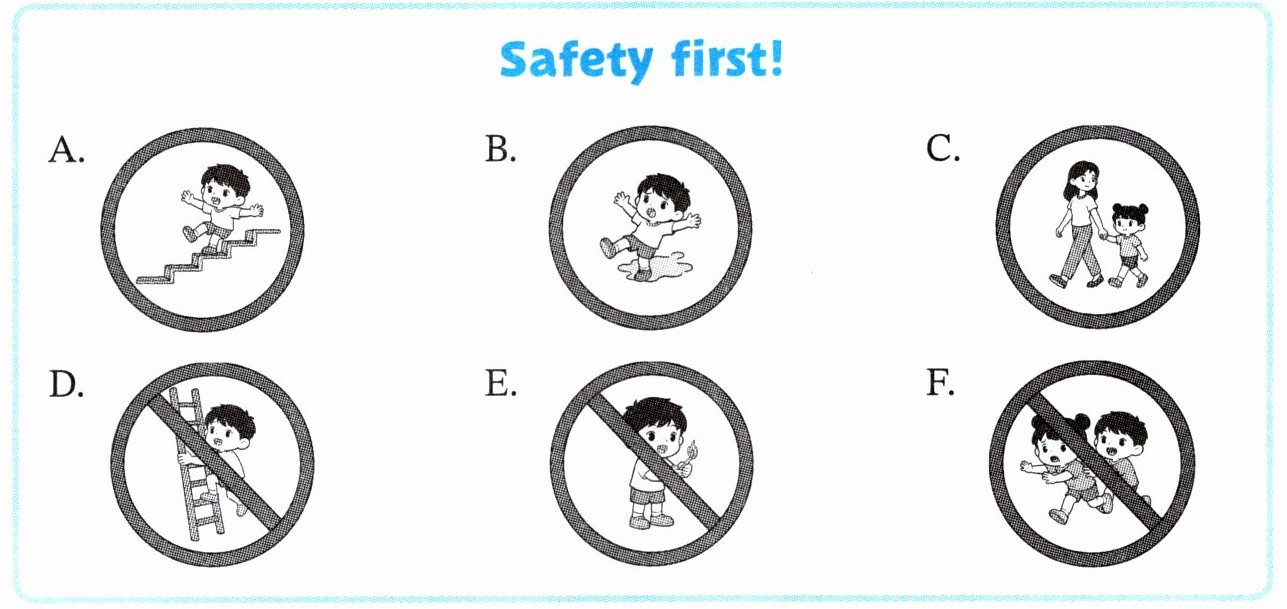
() 1. There’s some water on the floor. Please walk carefully.
() 2. Please don’t climb. It’s very dangerous.
() 3. Be careful of fire!
() 4. You should take care of your child.
() 5. You should be careful on the stairs.
() 6. Don’t push others. You may hurt other people.
A. 阅读下列句子,选择相应的安全指示牌。
() 1. There’s some water on the floor. Please walk carefully.
() 2. Please don’t climb. It’s very dangerous.
() 3. Be careful of fire!
() 4. You should take care of your child.
() 5. You should be careful on the stairs.
() 6. Don’t push others. You may hurt other people.
答案:1.B 2.D 3.E 4.C 5.A 6.F
解析:
我们先理解每句话的含义,再匹配对应的安全指示牌:
1. 句子意为:地板上有水,请小心行走,对应B图里地面有水渍、提醒防滑的标识。
2. 句子意为:请不要攀爬,这非常危险,对应D图里禁止攀爬梯子的标识。
3. 句子意为:小心用火!对应E图里禁止手持火种的防火标识。
4. 句子意为:你应当照看好你的孩子,对应C图里家长牵好小孩的标识。
5. 句子意为:在楼梯上你要小心,对应A图里提醒楼梯区域注意安全的标识。
6. 句子意为:不要推挤他人,你可能会伤到别人,对应F图里禁止推搡跑闹的标识。
1. 句子意为:地板上有水,请小心行走,对应B图里地面有水渍、提醒防滑的标识。
2. 句子意为:请不要攀爬,这非常危险,对应D图里禁止攀爬梯子的标识。
3. 句子意为:小心用火!对应E图里禁止手持火种的防火标识。
4. 句子意为:你应当照看好你的孩子,对应C图里家长牵好小孩的标识。
5. 句子意为:在楼梯上你要小心,对应A图里提醒楼梯区域注意安全的标识。
6. 句子意为:不要推挤他人,你可能会伤到别人,对应F图里禁止推搡跑闹的标识。
B. 阅读对话,选择填空。
Wang Jun: What are you reading, Li Ling?
Li Ling: I'm reading a book about Stephen Hawking (史蒂夫·霍金).
Wang Jun: Oh, I know him! He's a great British (英国的) scientist.
Li Ling: That's right. He's very clever and brave. He can't walk or speak. But he never gives up learning.
Wang Jun: What does he like doing?
Li Ling: He likes listening to music when he feels bad. He also likes reading and writing. He writes a lot of books.
Wang Jun: One of his famous (有名的) books is A Brief History of Time. Right?
Li Ling: Yes. Do you want to read it? You can borrow (借) it from this library.
Wang Jun: Great! Thank you!
() 1. They are talking about .
A. reading books B. different hobbies C. a famous person
() 2. The underlined word "scientist" means "" in Chinese.
A. 科学家 B. 作家 C. 音乐家
() 3. What does Hawking like doing when he feels bad?
A. He reads books. B. He writes books. C. He listens to music.
() 4. Where are the two children?
A. In the Science Club. B. In a library. C. On the sports ground.
Wang Jun: What are you reading, Li Ling?
Li Ling: I'm reading a book about Stephen Hawking (史蒂夫·霍金).
Wang Jun: Oh, I know him! He's a great British (英国的) scientist.
Li Ling: That's right. He's very clever and brave. He can't walk or speak. But he never gives up learning.
Wang Jun: What does he like doing?
Li Ling: He likes listening to music when he feels bad. He also likes reading and writing. He writes a lot of books.
Wang Jun: One of his famous (有名的) books is A Brief History of Time. Right?
Li Ling: Yes. Do you want to read it? You can borrow (借) it from this library.
Wang Jun: Great! Thank you!
() 1. They are talking about .
A. reading books B. different hobbies C. a famous person
() 2. The underlined word "scientist" means "" in Chinese.
A. 科学家 B. 作家 C. 音乐家
() 3. What does Hawking like doing when he feels bad?
A. He reads books. B. He writes books. C. He listens to music.
() 4. Where are the two children?
A. In the Science Club. B. In a library. C. On the sports ground.
答案:1. C 2. A 3. C 4. B
解析:
1. 整段对话围绕著名人物史蒂芬·霍金展开,介绍了他的身份、性格、爱好和相关著作,因此他们谈论的是一位名人,选C。
2. 划线单词scientist的中文意思是“科学家”,对应选项A。
3. 对话中明确提到“He likes listening to music when he feels bad”,可以直接得出答案,选C。
4. 从Li Ling的表述“You can borrow it from this library”能够判断两人此刻就在图书馆里,选B。
2. 划线单词scientist的中文意思是“科学家”,对应选项A。
3. 对话中明确提到“He likes listening to music when he feels bad”,可以直接得出答案,选C。
4. 从Li Ling的表述“You can borrow it from this library”能够判断两人此刻就在图书馆里,选B。