四、阅读短文,从方框中选择合适的单词或短语补全短文。
smart list needs How much two
saves money habit anything good
Yang Ling wants to buy some school things. She is a 1.
She sees nice rulers and pens in the shop. She asks the assistant, “4.
Shopping smartly is a 9.
smart list needs How much two
saves money habit anything good
Yang Ling wants to buy some school things. She is a 1.
smart
shopper. She makes a shopping 2. list
first, and only buys things she really 3. needs
.She sees nice rulers and pens in the shop. She asks the assistant, “4.
How much
are the rulers?” The assistant says, “They’re six yuan each.” Yang Ling buys 5. two
rulers for herself and her deskmate. She also buys pens she needs. She 6. saves
a lot of 7. money
because she doesn’t buy 8. anything
she doesn’t need.Shopping smartly is a 9.
good
10. habit
for everyone. It helps us not spend too much money. We should all learn to shop smartly!答案:1. smart 2. list 3. needs 4. How much
5. two 6. saves 7. money 8. anything
9. good 10. habit
5. two 6. saves 7. money 8. anything
9. good 10. habit
解析:
【分析】
本题为选词补全短文题,解题思路如下:1. 先通读全文,把握短文核心内容(杨玲的聪明购物方式);2. 结合每个空格前后的语境、语法结构,从方框给出的单词/短语中匹配合适选项;3. 填完后通读全文,验证语句通顺性与逻辑合理性。
【解析】
1. 空格修饰名词shopper,需形容词,方框中smart(聪明的)符合语境,指杨玲是聪明的购物者;
2. 固定搭配shopping list(购物清单),故填list;
3. 句意“只买真正需要的东西”,主语she为第三人称单数,动词用needs;
4. 下文回答价格,此处需用How much询问价格;
5. 后文提到“给她和同桌”,故买两把尺子,填two;
6. 句意“她节省很多”,主语she为第三人称单数,动词用saves;
7. 固定搭配save money(省钱),故填money;
8. 否定句中用anything,表“任何东西”,指不买不需要的任何物品;
9. 形容词修饰名词habit,good(好的)符合,指聪明购物是好习惯;
10. 前面有不定冠词a,需单数名词habit,构成固定搭配good habit。
【答案】1. smart 2. list 3. needs 4. How much 5. two 6. saves 7. money 8. anything 9. good 10. habit
【知识点】英语词汇运用、选词填空
【点评】本题围绕日常购物话题展开,考察常用词汇在语境中的理解与运用,属于基础题型,适合巩固词汇基础。
【难度系数】0.8
本题为选词补全短文题,解题思路如下:1. 先通读全文,把握短文核心内容(杨玲的聪明购物方式);2. 结合每个空格前后的语境、语法结构,从方框给出的单词/短语中匹配合适选项;3. 填完后通读全文,验证语句通顺性与逻辑合理性。
【解析】
1. 空格修饰名词shopper,需形容词,方框中smart(聪明的)符合语境,指杨玲是聪明的购物者;
2. 固定搭配shopping list(购物清单),故填list;
3. 句意“只买真正需要的东西”,主语she为第三人称单数,动词用needs;
4. 下文回答价格,此处需用How much询问价格;
5. 后文提到“给她和同桌”,故买两把尺子,填two;
6. 句意“她节省很多”,主语she为第三人称单数,动词用saves;
7. 固定搭配save money(省钱),故填money;
8. 否定句中用anything,表“任何东西”,指不买不需要的任何物品;
9. 形容词修饰名词habit,good(好的)符合,指聪明购物是好习惯;
10. 前面有不定冠词a,需单数名词habit,构成固定搭配good habit。
【答案】1. smart 2. list 3. needs 4. How much 5. two 6. saves 7. money 8. anything 9. good 10. habit
【知识点】英语词汇运用、选词填空
【点评】本题围绕日常购物话题展开,考察常用词汇在语境中的理解与运用,属于基础题型,适合巩固词汇基础。
【难度系数】0.8
五、阅读短文,完成任务。
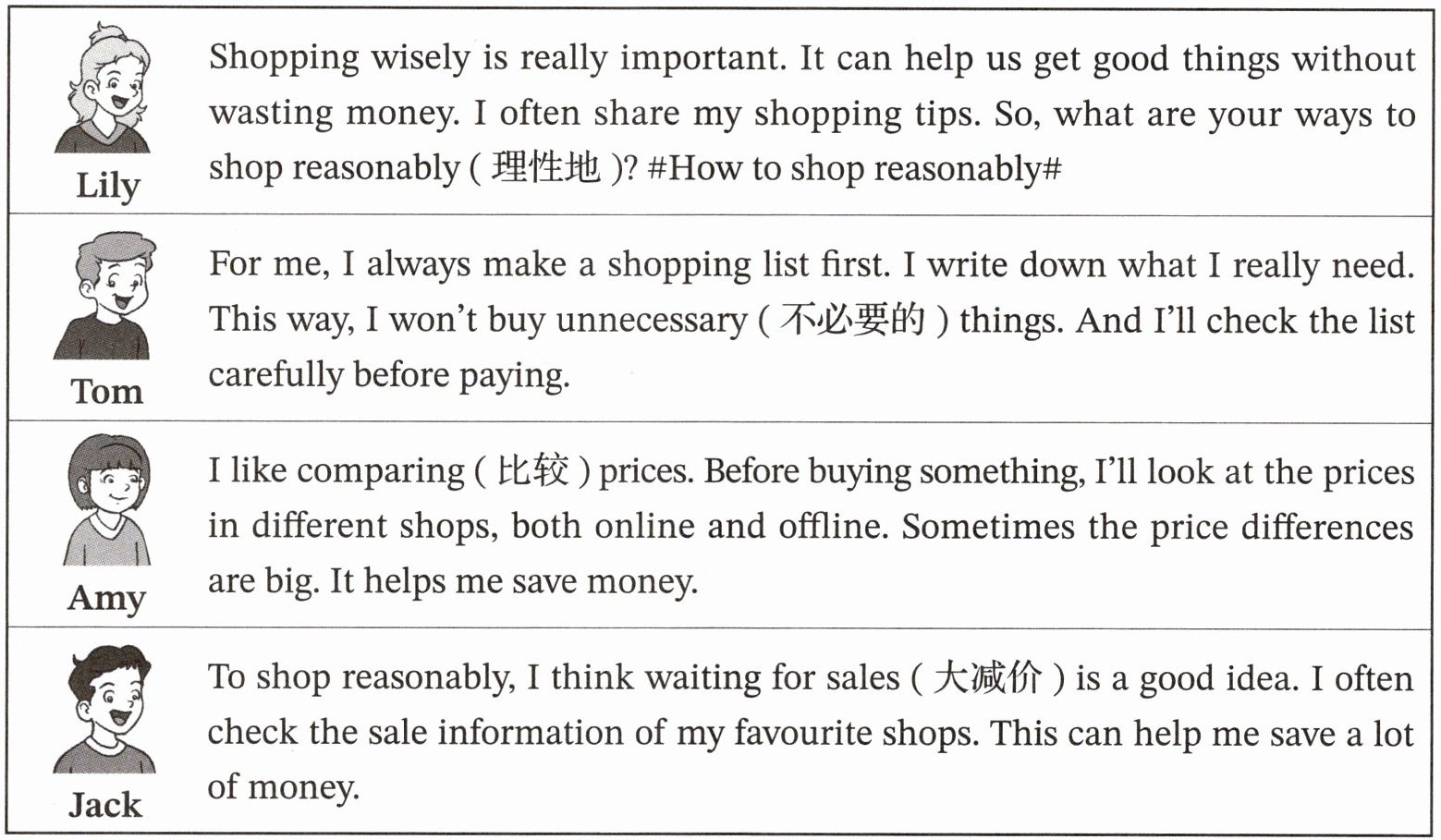
A. 根据短文内容,判断下列句子正 (T) 误 (F)。
(
(
(
B. 根据短文内容,结合生活实际,回答问题。
1. How does Jack shop reasonably?
2. What can you do to use your money wisely?
A. 根据短文内容,判断下列句子正 (T) 误 (F)。
(
F
) 1. Lily thinks shopping wisely is not important.(
T
) 2. Tom makes a shopping list to avoid (避免) buying unnecessary things.(
F
) 3. Amy only compares prices in online shops.B. 根据短文内容,结合生活实际,回答问题。
1. How does Jack shop reasonably?
He waits for sales. / He checks the sale information of his favourite shops.
2. What can you do to use your money wisely?
I only buy things I need.
答案:A. 1. F 2. T 3. F
B. (答案仅供参考) 1. He waits for sales. / He checks the sale information of his favourite shops.
2. I only buy things I need.
B. (答案仅供参考) 1. He waits for sales. / He checks the sale information of his favourite shops.
2. I only buy things I need.
解析:
【分析】
首先处理A部分的判断正误题,需定位原文对应人物的表述,对比题目句子判断对错;B部分的回答问题,需从原文提取Jack的合理购物方式,结合自身实际回答第二题。具体步骤:1. 针对A1,查找Lily关于购物是否重要的表述;A2查找Tom做购物清单的目的;A3查找Amy比较价格的范围;2. 针对B1,定位Jack的购物方法;B2结合生活实际,表述合理用钱的做法。
【解析】
A. 1. 定位原文Lily的第一句“Shopping wisely is really important.”,题目表述“shopping wisely is not important”与原文矛盾,故填F;
2. 定位原文Tom的表述“I always make a shopping list first... I won’t buy unnecessary things.”,说明做购物清单是为了避免买不必要的东西,与题目一致,故填T;
3. 定位原文Amy的表述“I’ll look at the prices in different shops, both online and offline.”,题目表述“only compares prices in online shops”与原文“both online and offline”矛盾,故填F;
B. 1. 定位原文Jack的表述“waiting for sales is a good idea. I often check the sale information of my favourite shops.”,提取核心内容回答;
2. 结合生活实际,合理表述即可,如只买需要的东西。
【答案】
A. 1. F 2. T 3. F
B. 1. He waits for sales. / He checks the sale information of his favourite shops.
2. I only buy things I need.
【知识点】
阅读理解细节、判断正误、回答问题
【点评】
本题考查学生对短文细节信息的提取与理解,分为判断正误和回答问题两类题型,贴近日常购物话题,难度适中,适合巩固基础阅读理解能力。
【难度系数】
0.6
首先处理A部分的判断正误题,需定位原文对应人物的表述,对比题目句子判断对错;B部分的回答问题,需从原文提取Jack的合理购物方式,结合自身实际回答第二题。具体步骤:1. 针对A1,查找Lily关于购物是否重要的表述;A2查找Tom做购物清单的目的;A3查找Amy比较价格的范围;2. 针对B1,定位Jack的购物方法;B2结合生活实际,表述合理用钱的做法。
【解析】
A. 1. 定位原文Lily的第一句“Shopping wisely is really important.”,题目表述“shopping wisely is not important”与原文矛盾,故填F;
2. 定位原文Tom的表述“I always make a shopping list first... I won’t buy unnecessary things.”,说明做购物清单是为了避免买不必要的东西,与题目一致,故填T;
3. 定位原文Amy的表述“I’ll look at the prices in different shops, both online and offline.”,题目表述“only compares prices in online shops”与原文“both online and offline”矛盾,故填F;
B. 1. 定位原文Jack的表述“waiting for sales is a good idea. I often check the sale information of my favourite shops.”,提取核心内容回答;
2. 结合生活实际,合理表述即可,如只买需要的东西。
【答案】
A. 1. F 2. T 3. F
B. 1. He waits for sales. / He checks the sale information of his favourite shops.
2. I only buy things I need.
【知识点】
阅读理解细节、判断正误、回答问题
【点评】
本题考查学生对短文细节信息的提取与理解,分为判断正误和回答问题两类题型,贴近日常购物话题,难度适中,适合巩固基础阅读理解能力。
【难度系数】
0.6