1. 朗读 Cartoon time 和 Story time,找一找与例句相似的句子并写下来。
(1) Will you join me?
(2) What else will you do to take care of the Earth?
(1) Will you join me?
(2) What else will you do to take care of the Earth?
答案:(1) 示例:Will you draw or write on the poster, Sam?
(2) 示例:What will you draw, Billy?
(2) 示例:What will you draw, Billy?
解析:
【解析】
(1) 例句"Will you join me?"是will引导的一般疑问句,从指定的Cartoon time和Story time板块中找出同结构的一般疑问句即可,参考示例为符合结构的课文原句。
(2) 例句"What else will you do to take care of the Earth?"是包含will的特殊疑问句,从指定板块中找出同结构的特殊疑问句即可,参考示例为符合结构的课文原句。
【答案】
(1) 示例:Will you draw or write on the poster, Sam?
(2) 示例:What will you draw, Billy?
【知识点】
一般疑问句
特殊疑问句
一般将来时
【点评】
本题结合课本阅读板块考查一般将来时的疑问句句型识别与摘抄,既巩固了相关语法结构,也引导学生回归课本内容,题型基础灵活。
【难度系数】
0.7
(1) 例句"Will you join me?"是will引导的一般疑问句,从指定的Cartoon time和Story time板块中找出同结构的一般疑问句即可,参考示例为符合结构的课文原句。
(2) 例句"What else will you do to take care of the Earth?"是包含will的特殊疑问句,从指定板块中找出同结构的特殊疑问句即可,参考示例为符合结构的课文原句。
【答案】
(1) 示例:Will you draw or write on the poster, Sam?
(2) 示例:What will you draw, Billy?
【知识点】
一般疑问句
特殊疑问句
一般将来时
【点评】
本题结合课本阅读板块考查一般将来时的疑问句句型识别与摘抄,既巩固了相关语法结构,也引导学生回归课本内容,题型基础灵活。
【难度系数】
0.7
2. 选择与对话内容相符的图片。
()(1) —Will you go shopping with me?
—Sure.
()(2) —Will he write something on the paper?
—Yes, he will.
()(3) —How will you go to school tomorrow?
—I’ll walk to school.
()(4) —What will we do to take care of the Earth?
—We will draw a poster first.
A.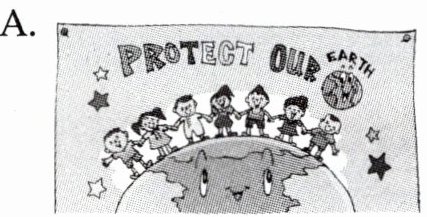
B.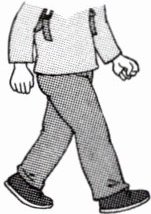
()(1) —Will you go shopping with me?
—Sure.
()(2) —Will he write something on the paper?
—Yes, he will.
()(3) —How will you go to school tomorrow?
—I’ll walk to school.
()(4) —What will we do to take care of the Earth?
—We will draw a poster first.
A.
B.
答案:(1)D (2)C (3)B (4)A
解析:
1. 第一组对话表示相约去购物,对应标注超市的图片D;2. 第二组对话表示要在纸上书写内容,对应人物伏案在纸上写字的图片C;3. 第三组对话表示步行去上学,对应人物行走的图片B;4. 第四组对话表示要制作保护地球的海报,对应保护地球主题海报的图片A。
1. 读句子,选择正确的答案。
()(1) —Will you go shopping on Thursday morning? —
A. Yes, she will.
B. No, I won’t.
C. No, he won’t.
()(2) —What will you do? —
A. We’ll plant some trees.
B. I like taking a bus.
C. I can take a cloth bag.
()(3) —How will Mr Wang and his students go to the park? —
A. We’ll go by bus.
B. They’ll go on foot.
C. He’ll go by car.
()(4) —Why will you turn off the lights next Saturday? —
A. Keep our planet healthy and clean.
B. It won’t be great to help the Earth.
C. Because I’ll take part in Earth Hour.
()(1) —Will you go shopping on Thursday morning? —
A. Yes, she will.
B. No, I won’t.
C. No, he won’t.
()(2) —What will you do? —
A. We’ll plant some trees.
B. I like taking a bus.
C. I can take a cloth bag.
()(3) —How will Mr Wang and his students go to the park? —
A. We’ll go by bus.
B. They’ll go on foot.
C. He’ll go by car.
()(4) —Why will you turn off the lights next Saturday? —
A. Keep our planet healthy and clean.
B. It won’t be great to help the Earth.
C. Because I’ll take part in Earth Hour.
答案:(1) B (2) A (3) B (4) C
解析:
(1) 问句是"Will you..."引导的第二人称一般将来时疑问句,回答需要对应使用第一人称I,A选项主语是she、C选项主语是he,都不符合语境,只有B选项正确。
(2) 问句"What will you do?"是询问对方将要做什么,时态为一般将来时,A选项"We'll plant some trees."是一般将来时的回应,符合题意;B是表达喜好的一般现在时句子、C是表达能力的句子,都和问句不匹配。
(3) 问句的主语是"Mr Wang and his students",属于第三人称复数,回答需要用they来指代这个多人主体,A选项主语是we、C选项主语是he,都不能正确对应问句的主体,B选项符合要求。
(4) 问句用Why提问,是询问原因,需要用Because引导的语句回应,A选项是表达目的、B选项语义不符合常理,C选项正确回应了关灯的原因。
(2) 问句"What will you do?"是询问对方将要做什么,时态为一般将来时,A选项"We'll plant some trees."是一般将来时的回应,符合题意;B是表达喜好的一般现在时句子、C是表达能力的句子,都和问句不匹配。
(3) 问句的主语是"Mr Wang and his students",属于第三人称复数,回答需要用they来指代这个多人主体,A选项主语是we、C选项主语是he,都不能正确对应问句的主体,B选项符合要求。
(4) 问句用Why提问,是询问原因,需要用Because引导的语句回应,A选项是表达目的、B选项语义不符合常理,C选项正确回应了关灯的原因。