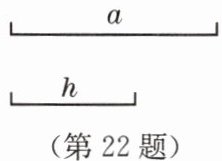
22. (6分)如图,已知线段$a$,$h$,求画等腰三角形$ABC$,使得底边$BC=a$,$BC$边上的高为$h$.(保留画图痕迹,不写画法)
答案:
22. 如图,$△ABC$为所求画的图形。
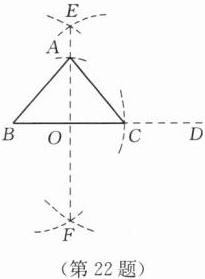
22. 如图,$△ABC$为所求画的图形。
解析:
【分析】
要画出符合条件的等腰三角形,可结合等腰三角形的性质思考:首先确定底边BC的长度为a,再根据等腰三角形“三线合一”的特点,底边上的高在底边的垂直平分线上,因此作出BC的垂直平分线后,在垂直平分线上截取长度为h的线段即可确定顶点A的位置,最后连接AB、AC就能得到所求三角形。
【解析】
作图步骤如下:
1. 画线段BC,使BC=a;
2. 作线段BC的垂直平分线EF,交BC于点O;
3. 在垂直平分线EF上截取OA=h;
4. 连接AB、AC,得到的△ABC即为所求作的等腰三角形。
【答案】
如图,$△ABC$为所求画的图形。
【知识点】
等腰三角形性质、尺规作线段、尺规作垂直平分线
【点评】
本题是基础的尺规作图类题目,重点考查对等腰三角形三线合一性质的理解应用,以及基本尺规作图的操作能力,掌握常见的基础作图方法是解决这类题的核心。
【难度系数】
0.8
要画出符合条件的等腰三角形,可结合等腰三角形的性质思考:首先确定底边BC的长度为a,再根据等腰三角形“三线合一”的特点,底边上的高在底边的垂直平分线上,因此作出BC的垂直平分线后,在垂直平分线上截取长度为h的线段即可确定顶点A的位置,最后连接AB、AC就能得到所求三角形。
【解析】
作图步骤如下:
1. 画线段BC,使BC=a;
2. 作线段BC的垂直平分线EF,交BC于点O;
3. 在垂直平分线EF上截取OA=h;
4. 连接AB、AC,得到的△ABC即为所求作的等腰三角形。
【答案】
如图,$△ABC$为所求画的图形。
【知识点】
等腰三角形性质、尺规作线段、尺规作垂直平分线
【点评】
本题是基础的尺规作图类题目,重点考查对等腰三角形三线合一性质的理解应用,以及基本尺规作图的操作能力,掌握常见的基础作图方法是解决这类题的核心。
【难度系数】
0.8
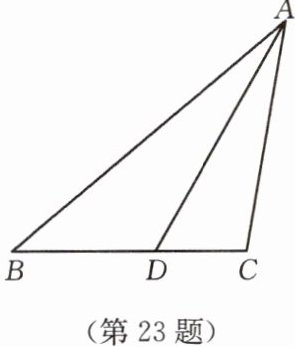
23.(8分)如图,在$△ ABC$中,$AC=BC$,$∠ ACB=100°$,$AD$是角平分线.求证:$AB=AD+CD$.
答案:
23. 证明:在$AB$上截取$AE=AC$,$AF=AD$,连接$DE$,$DF$。
在$△ACD$ 和$△AED$ 中,$\begin{cases} AC=AE, \\ ∠CAD=∠EAD, \\ AD=AD, \end{cases}$
$\therefore △ACD≌ △AED(\mathrm{SAS}). \therefore CD= ED, ∠C = ∠AED. \because ∠C=100°,\therefore ∠AED=100°.\therefore ∠DEF=80°. \because AC=BC,\therefore ∠BAC=∠B=40°. \because AD$是角平分线,$\therefore ∠DAE=20°. \because AD=AF,\therefore ∠AFD=∠ADF=80°. \therefore ∠DEF = ∠AFD,∠B = ∠FDB=40°$
$\therefore DE=DF,DF=BF. \therefore BF = CD. \therefore AB = AF + BF=AD+CD.$
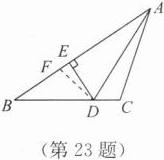
23. 证明:在$AB$上截取$AE=AC$,$AF=AD$,连接$DE$,$DF$。
在$△ACD$ 和$△AED$ 中,$\begin{cases} AC=AE, \\ ∠CAD=∠EAD, \\ AD=AD, \end{cases}$
$\therefore △ACD≌ △AED(\mathrm{SAS}). \therefore CD= ED, ∠C = ∠AED. \because ∠C=100°,\therefore ∠AED=100°.\therefore ∠DEF=80°. \because AC=BC,\therefore ∠BAC=∠B=40°. \because AD$是角平分线,$\therefore ∠DAE=20°. \because AD=AF,\therefore ∠AFD=∠ADF=80°. \therefore ∠DEF = ∠AFD,∠B = ∠FDB=40°$
$\therefore DE=DF,DF=BF. \therefore BF = CD. \therefore AB = AF + BF=AD+CD.$
解析:
【分析】
要证明AB=AD+CD,属于线段和差类证明问题,常用截长补短法求解。本题已知AD是角平分线,优先选择截长法:第一步在AB上截取AE=AC、AF=AD,先通过SAS证明△ACD和△AED全等,将CD转化为DE;第二步结合等腰△ABC的内角和计算各角的度数,推导得出△DEF、△BDF均为等腰三角形,依次将DE转化为DF、DF转化为BF;最后通过AB=AF+BF,代换相等线段即可得到待证结论。
【解析】
证明:在$AB$上截取$AE=AC$,$AF=AD$,连接$DE$,$DF$。
在$△ACD$ 和$△AED$ 中,$\begin{cases} AC=AE, \\ ∠CAD=∠EAD, \\ AD=AD, \end{cases}$
$\therefore △ACD≌ △AED(\mathrm{SAS})$,
$\therefore CD= ED, ∠C = ∠AED$,
$\because ∠C=100°,\therefore ∠AED=100°$,则$∠DEF=180°-100°=80°$,
$\because AC=BC,∠ACB=100°$,$\therefore ∠BAC=∠B=\frac{180°-100°}{2}=40°$,
$\because AD$是角平分线,$\therefore ∠DAE=\frac{1}{2}∠BAC=20°$,
$\because AD=AF,\therefore ∠AFD=∠ADF=\frac{180°-20°}{2}=80°$,
$\therefore ∠DEF = ∠AFD=80°$,故$DE=DF$,
又$∠ FDB=∠AFD-∠B=80°-40°=40°=∠B$,故$DF=BF$,
$\therefore BF = CD$,
$\therefore AB = AF + BF=AD+CD$。
【答案】
23. 证明:在$AB$上截取$AE=AC$,$AF=AD$,连接$DE$,$DF$。
在$△ACD$ 和$△AED$ 中,$\begin{cases} AC=AE, \\ ∠CAD=∠EAD, \\ AD=AD, \end{cases}$
$\therefore △ACD≌ △AED(\mathrm{SAS}). \therefore CD= ED, ∠C = ∠AED. \because ∠C=100°,\therefore ∠AED=100°.\therefore ∠DEF=80°. \because AC=BC,\therefore ∠BAC=∠B=40°. \because AD$是角平分线,$\therefore ∠DAE=20°. \because AD=AF,\therefore ∠AFD=∠ADF=80°. \therefore ∠DEF = ∠AFD,∠B = ∠FDB=40°$
$\therefore DE=DF,DF=BF. \therefore BF = CD. \therefore AB = AF + BF=AD+CD.$
【知识点】
全等三角形的判定与性质,等腰三角形的性质,角平分线的定义
【点评】
本题是典型的线段和差证明题,核心考查截长补短的辅助线构造方法,结合了全等三角形转化相等线段、等腰三角形等边对等角和等角对等边的性质,解题的关键是合理截取线段构造全等和等腰三角形,通过角度推导得到相等线段完成转化。
【难度系数】
0.6
要证明AB=AD+CD,属于线段和差类证明问题,常用截长补短法求解。本题已知AD是角平分线,优先选择截长法:第一步在AB上截取AE=AC、AF=AD,先通过SAS证明△ACD和△AED全等,将CD转化为DE;第二步结合等腰△ABC的内角和计算各角的度数,推导得出△DEF、△BDF均为等腰三角形,依次将DE转化为DF、DF转化为BF;最后通过AB=AF+BF,代换相等线段即可得到待证结论。
【解析】
证明:在$AB$上截取$AE=AC$,$AF=AD$,连接$DE$,$DF$。
在$△ACD$ 和$△AED$ 中,$\begin{cases} AC=AE, \\ ∠CAD=∠EAD, \\ AD=AD, \end{cases}$
$\therefore △ACD≌ △AED(\mathrm{SAS})$,
$\therefore CD= ED, ∠C = ∠AED$,
$\because ∠C=100°,\therefore ∠AED=100°$,则$∠DEF=180°-100°=80°$,
$\because AC=BC,∠ACB=100°$,$\therefore ∠BAC=∠B=\frac{180°-100°}{2}=40°$,
$\because AD$是角平分线,$\therefore ∠DAE=\frac{1}{2}∠BAC=20°$,
$\because AD=AF,\therefore ∠AFD=∠ADF=\frac{180°-20°}{2}=80°$,
$\therefore ∠DEF = ∠AFD=80°$,故$DE=DF$,
又$∠ FDB=∠AFD-∠B=80°-40°=40°=∠B$,故$DF=BF$,
$\therefore BF = CD$,
$\therefore AB = AF + BF=AD+CD$。
【答案】
23. 证明:在$AB$上截取$AE=AC$,$AF=AD$,连接$DE$,$DF$。
在$△ACD$ 和$△AED$ 中,$\begin{cases} AC=AE, \\ ∠CAD=∠EAD, \\ AD=AD, \end{cases}$
$\therefore △ACD≌ △AED(\mathrm{SAS}). \therefore CD= ED, ∠C = ∠AED. \because ∠C=100°,\therefore ∠AED=100°.\therefore ∠DEF=80°. \because AC=BC,\therefore ∠BAC=∠B=40°. \because AD$是角平分线,$\therefore ∠DAE=20°. \because AD=AF,\therefore ∠AFD=∠ADF=80°. \therefore ∠DEF = ∠AFD,∠B = ∠FDB=40°$
$\therefore DE=DF,DF=BF. \therefore BF = CD. \therefore AB = AF + BF=AD+CD.$
【知识点】
全等三角形的判定与性质,等腰三角形的性质,角平分线的定义
【点评】
本题是典型的线段和差证明题,核心考查截长补短的辅助线构造方法,结合了全等三角形转化相等线段、等腰三角形等边对等角和等角对等边的性质,解题的关键是合理截取线段构造全等和等腰三角形,通过角度推导得到相等线段完成转化。
【难度系数】
0.6
24. (11分)已知$△ ABC$是直角三角形,$∠ ACB=90°$,等腰直角三角形$DEF$的顶点$E,F$分别落在$△ ABC$的边$BC,AB$上,$∠ EDF=90°$。
(1) 如图(1),当点$D$落在$△ ABC$的边$AC$上时,若$∠ BAC=2∠ CDE$,
① 求证:$AD=AF$;
② 求证:$AB=AD+BE$。
(2) 如图(2),当点$E$与点$C$重合,点$D$落在$△ ABC$的内部时,延长$FD$交$BC$于点$P$,若点$P$恰好是边$BC$的中点,且$∠ ABC=2∠ ACF$,请探究$AB,AC$和$AF$之间的数量关系。
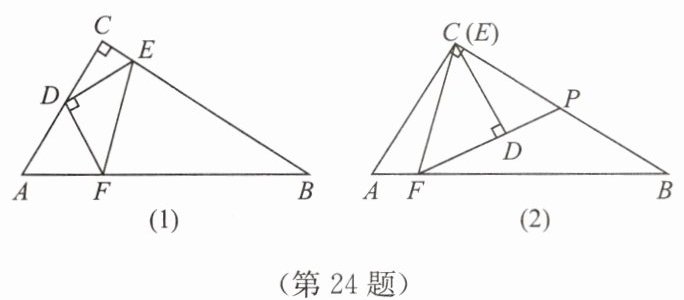
(1) 如图(1),当点$D$落在$△ ABC$的边$AC$上时,若$∠ BAC=2∠ CDE$,
① 求证:$AD=AF$;
② 求证:$AB=AD+BE$。
(2) 如图(2),当点$E$与点$C$重合,点$D$落在$△ ABC$的内部时,延长$FD$交$BC$于点$P$,若点$P$恰好是边$BC$的中点,且$∠ ABC=2∠ ACF$,请探究$AB,AC$和$AF$之间的数量关系。
答案:
24. (1) 证明:设$∠CDE=α$,则$∠BAC=2α$.
① $\because ∠EDF=90°,\therefore ∠ADF=90°-∠CDE=90°-α.$ 在$△ADF$中,$∠AFD=180°-∠A-∠ADF=90°-α,\therefore ∠ADF=∠AFD,\therefore AD=AF.$
② $\because △DEF$是等腰直角三角形,$\therefore ∠DEF=∠DFE=45°.$
$\because ∠CDE=α,\therefore ∠CED=90°-α,\therefore ∠BEF=180°-∠CED-∠DEF=45°+α.\because ∠BFE=180°-∠AFD-∠DFE = 45°+α,\therefore ∠BFE=∠BEF$
$\therefore BE=BF,\therefore AB=AF+BF=AD+BE.$
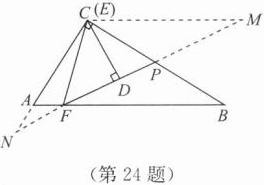
(2) $AB=2AF+AC$.理由如下:延长$PF$交$CA$延长线于点$N$,过点$C$作$CM// AB$交$FP$延长线于点$M$,则$∠M=∠BFP. \because$ 点$P$为$BC$中点,$\therefore CP=BP.$
在$△BFP$ 和$△CMP$ 中,$\begin{cases} ∠BFP=∠M, \\ ∠BPF=∠CPM, \\ BP=CP, \end{cases}$
$\therefore △BFP ≌ △CMP \ (\mathrm{AAS}), \therefore BF = CM.$ 设$∠ACF=α$,则$∠ABC=2∠ACF=2α,\therefore ∠CAF=90°-2α,\therefore ∠BFP=∠BFC-∠CFD=∠CAF+∠ACF-∠CFD=45°-α,\therefore ∠BFP=∠M=∠AFN=45°-α,\therefore ∠N=∠CAF-∠AFN=45°-α,\therefore ∠N=∠AFN=∠M,\therefore AF=AN,CN=CM=BF,\therefore AB=AF+BF=AF+CN=AF+AC+AN=AF+AC+AF=2AF+AC,即$ $AB=2AF+AC.$
24. (1) 证明:设$∠CDE=α$,则$∠BAC=2α$.
① $\because ∠EDF=90°,\therefore ∠ADF=90°-∠CDE=90°-α.$ 在$△ADF$中,$∠AFD=180°-∠A-∠ADF=90°-α,\therefore ∠ADF=∠AFD,\therefore AD=AF.$
② $\because △DEF$是等腰直角三角形,$\therefore ∠DEF=∠DFE=45°.$
$\because ∠CDE=α,\therefore ∠CED=90°-α,\therefore ∠BEF=180°-∠CED-∠DEF=45°+α.\because ∠BFE=180°-∠AFD-∠DFE = 45°+α,\therefore ∠BFE=∠BEF$
$\therefore BE=BF,\therefore AB=AF+BF=AD+BE.$
(2) $AB=2AF+AC$.理由如下:延长$PF$交$CA$延长线于点$N$,过点$C$作$CM// AB$交$FP$延长线于点$M$,则$∠M=∠BFP. \because$ 点$P$为$BC$中点,$\therefore CP=BP.$
在$△BFP$ 和$△CMP$ 中,$\begin{cases} ∠BFP=∠M, \\ ∠BPF=∠CPM, \\ BP=CP, \end{cases}$
$\therefore △BFP ≌ △CMP \ (\mathrm{AAS}), \therefore BF = CM.$ 设$∠ACF=α$,则$∠ABC=2∠ACF=2α,\therefore ∠CAF=90°-2α,\therefore ∠BFP=∠BFC-∠CFD=∠CAF+∠ACF-∠CFD=45°-α,\therefore ∠BFP=∠M=∠AFN=45°-α,\therefore ∠N=∠CAF-∠AFN=45°-α,\therefore ∠N=∠AFN=∠M,\therefore AF=AN,CN=CM=BF,\therefore AB=AF+BF=AF+CN=AF+AC+AN=AF+AC+AF=2AF+AC,即$ $AB=2AF+AC.$
解析:
【分析】
本题为三角形综合题,解题思路如下:
(1)① 已知角度倍数关系,设∠CDE=α,用α表示∠BAC,结合∠EDF=90°计算△ADF的两个内角,通过等角对等边证明AD=AF;
② 利用等腰直角三角形DEF的45°内角,推导∠BEF和∠BFE相等,得到BE=BF,再将AB拆分为AF+BF,结合①的结论即可完成证明;
(2) 探究线段数量关系时,先作辅助线:过C作CM//AB交FP延长线于M,延长PF交CA延长线于N,首先通过AAS证△BFP≌△CMP得BF=CM;再设∠ACF=α,推导角度得到AF=AN、CN=CM=BF,最后将AB=AF+BF中的BF用AC和AF替换,即可得到三者的数量关系。
【解析】
(1) 证明:设$∠ CDE=α$,则$∠ BAC=2α$。
① $\because ∠ EDF=90°$,$\therefore ∠ ADF=180°-∠ EDF-∠ CDE=90°-α$,
在$△ ADF$中,$∠ AFD=180°-∠ BAC-∠ ADF=180°-2α-(90°-α)=90°-α$,
$\therefore ∠ ADF=∠ AFD$,$\therefore AD=AF$。
② $\because △ DEF$是等腰直角三角形,$∠ EDF=90°$,
$\therefore ∠ DEF=∠ DFE=45°$,
$\because ∠ C=90°$,$∠ CDE=α$,$\therefore ∠ CED=90°-α$,
$\therefore ∠ BEF=180°-∠ CED-∠ DEF=180°-(90°-α)-45°=45°+α$,
又$\because ∠ BFE=180°-∠ AFD-∠ DFE=180°-(90°-α)-45°=45°+α$,
$\therefore ∠ BFE=∠ BEF$,$\therefore BE=BF$,
$\therefore AB=AF+BF=AD+BE$。
(2) 解:$AB=2AF+AC$,理由如下:
延长$PF$交$CA$的延长线于点$N$,过点$C$作$CM// AB$交$FP$的延长线于点$M$,
则$∠ M=∠ BFP$,
$\because$点$P$是$BC$的中点,$\therefore CP=BP$,
在$△ BFP$和$△ CMP$中:
$\begin{cases}∠ BFP=∠ M \\∠ BPF=∠ CPM \\BP=CP\end{cases}$
$\therefore △ BFP≌△ CMP(\mathrm{AAS})$,$\therefore BF=CM$。
设$∠ ACF=α$,则$∠ ABC=2∠ ACF=2α$,
$\because ∠ ACB=90°$,$\therefore ∠ BAC=90°-2α$,
$\because △ CDF$是等腰直角三角形,$\therefore ∠ CFD=45°$,
$\because ∠ BFC$是$△ AFC$的外角,$\therefore ∠ BFC=∠ BAC+∠ ACF=90°-2α+α=90°-α$,
$\therefore ∠ BFP=∠ BFC-∠ CFD=90°-α-45°=45°-α$,
$\therefore ∠ M=∠ BFP=45°-α$,$∠ AFN=∠ BFP=45°-α$,
在$△ AFN$中,$∠ BAC$是外角,$\therefore ∠ BAC=∠ N+∠ AFN$,
$\therefore ∠ N=∠ BAC-∠ AFN=(90°-2α)-(45°-α)=45°-α$,
$\therefore ∠ N=∠ AFN$,$∠ N=∠ M$,
$\therefore AF=AN$,$CN=CM$,
$\therefore BF=CM=CN=AC+AN=AC+AF$,
$\therefore AB=AF+BF=AF+AC+AF=2AF+AC$。
【答案】
(1) ①②证明见解析;(2) $\boldsymbol{AB=2AF+AC}$
【知识点】
1. 等腰三角形判定与性质
2. 全等三角形判定与性质
3. 三角形内角和与外角定理
【点评】
本题前两小问侧重角度计算和等腰三角形性质的基础应用,难度较低;第二问需要通过构造平行线得到全等三角形,实现线段的等量转换,对辅助线构造能力和逻辑推理能力有一定要求,整体考查几何知识的综合运用能力。
【难度系数】
0.4
本题为三角形综合题,解题思路如下:
(1)① 已知角度倍数关系,设∠CDE=α,用α表示∠BAC,结合∠EDF=90°计算△ADF的两个内角,通过等角对等边证明AD=AF;
② 利用等腰直角三角形DEF的45°内角,推导∠BEF和∠BFE相等,得到BE=BF,再将AB拆分为AF+BF,结合①的结论即可完成证明;
(2) 探究线段数量关系时,先作辅助线:过C作CM//AB交FP延长线于M,延长PF交CA延长线于N,首先通过AAS证△BFP≌△CMP得BF=CM;再设∠ACF=α,推导角度得到AF=AN、CN=CM=BF,最后将AB=AF+BF中的BF用AC和AF替换,即可得到三者的数量关系。
【解析】
(1) 证明:设$∠ CDE=α$,则$∠ BAC=2α$。
① $\because ∠ EDF=90°$,$\therefore ∠ ADF=180°-∠ EDF-∠ CDE=90°-α$,
在$△ ADF$中,$∠ AFD=180°-∠ BAC-∠ ADF=180°-2α-(90°-α)=90°-α$,
$\therefore ∠ ADF=∠ AFD$,$\therefore AD=AF$。
② $\because △ DEF$是等腰直角三角形,$∠ EDF=90°$,
$\therefore ∠ DEF=∠ DFE=45°$,
$\because ∠ C=90°$,$∠ CDE=α$,$\therefore ∠ CED=90°-α$,
$\therefore ∠ BEF=180°-∠ CED-∠ DEF=180°-(90°-α)-45°=45°+α$,
又$\because ∠ BFE=180°-∠ AFD-∠ DFE=180°-(90°-α)-45°=45°+α$,
$\therefore ∠ BFE=∠ BEF$,$\therefore BE=BF$,
$\therefore AB=AF+BF=AD+BE$。
(2) 解:$AB=2AF+AC$,理由如下:
延长$PF$交$CA$的延长线于点$N$,过点$C$作$CM// AB$交$FP$的延长线于点$M$,
则$∠ M=∠ BFP$,
$\because$点$P$是$BC$的中点,$\therefore CP=BP$,
在$△ BFP$和$△ CMP$中:
$\begin{cases}∠ BFP=∠ M \\∠ BPF=∠ CPM \\BP=CP\end{cases}$
$\therefore △ BFP≌△ CMP(\mathrm{AAS})$,$\therefore BF=CM$。
设$∠ ACF=α$,则$∠ ABC=2∠ ACF=2α$,
$\because ∠ ACB=90°$,$\therefore ∠ BAC=90°-2α$,
$\because △ CDF$是等腰直角三角形,$\therefore ∠ CFD=45°$,
$\because ∠ BFC$是$△ AFC$的外角,$\therefore ∠ BFC=∠ BAC+∠ ACF=90°-2α+α=90°-α$,
$\therefore ∠ BFP=∠ BFC-∠ CFD=90°-α-45°=45°-α$,
$\therefore ∠ M=∠ BFP=45°-α$,$∠ AFN=∠ BFP=45°-α$,
在$△ AFN$中,$∠ BAC$是外角,$\therefore ∠ BAC=∠ N+∠ AFN$,
$\therefore ∠ N=∠ BAC-∠ AFN=(90°-2α)-(45°-α)=45°-α$,
$\therefore ∠ N=∠ AFN$,$∠ N=∠ M$,
$\therefore AF=AN$,$CN=CM$,
$\therefore BF=CM=CN=AC+AN=AC+AF$,
$\therefore AB=AF+BF=AF+AC+AF=2AF+AC$。
【答案】
(1) ①②证明见解析;(2) $\boldsymbol{AB=2AF+AC}$
【知识点】
1. 等腰三角形判定与性质
2. 全等三角形判定与性质
3. 三角形内角和与外角定理
【点评】
本题前两小问侧重角度计算和等腰三角形性质的基础应用,难度较低;第二问需要通过构造平行线得到全等三角形,实现线段的等量转换,对辅助线构造能力和逻辑推理能力有一定要求,整体考查几何知识的综合运用能力。
【难度系数】
0.4