十、完形填空。(每小题1分,共5分)
Sam is a clever boy. He loves . He often spends hours with books in the library. He enjoys the world of stories and ideas. Sam is very organized(有条理的). He makes lists(清单) for everything and always keeps his room . He likes taking a long every evening. It helps him think and relax(放松). He likes listening to music, especially(尤其) while drawing. Sam's bring him much joy.
(
(
(
(
(
Sam is a clever boy. He loves . He often spends hours with books in the library. He enjoys the world of stories and ideas. Sam is very organized(有条理的). He makes lists(清单) for everything and always keeps his room . He likes taking a long every evening. It helps him think and relax(放松). He likes listening to music, especially(尤其) while drawing. Sam's bring him much joy.
(
C
) 1. A. reads B. read C. reading(
B
) 2. A. messy B. tidy C. small(
A
) 3. A. walk B. walks C. walking(
A
) 4. A. also B. too C. to(
C
) 5. A. hobby B. habit C. hobbies答案:1. C 2. B 3. A 4. A 5. C
解析:
【分析】
先通读全文,明确文章围绕Sam的爱好与习惯展开。第1空考查love的固定搭配;第2空结合前文“有条理的”语境辨析形容词;第3空是固定短语搭配;第4空辨析also和too的用法;第5空根据谓语动词形式判断名词单复数。
【解析】
1. 固定搭配“love doing sth”表示“喜欢做某事”,此处需用动名词,故选C(reading);
2. 前文提到Sam很有条理,因此房间应保持整洁,“tidy”(整洁的)符合语境,故选B;
3. 固定短语“take a walk”意为“散步”,a后接名词单数,故选A;
4. also用于句中,too用于句末,此处位于句中,故选A;
5. 谓语动词bring是原形,主语需为复数,hobby的复数是hobbies,故选C。
【答案】1.C 2.B 3.A 4.A 5.C
【知识点】动名词用法、形容词词义辨析、固定搭配、副词用法、名词单复数
【点评】本题为基础完形填空,考察初中阶段核心的固定搭配、词汇辨析及语法知识,难度适中,适合巩固基础。
【难度系数】0.7
先通读全文,明确文章围绕Sam的爱好与习惯展开。第1空考查love的固定搭配;第2空结合前文“有条理的”语境辨析形容词;第3空是固定短语搭配;第4空辨析also和too的用法;第5空根据谓语动词形式判断名词单复数。
【解析】
1. 固定搭配“love doing sth”表示“喜欢做某事”,此处需用动名词,故选C(reading);
2. 前文提到Sam很有条理,因此房间应保持整洁,“tidy”(整洁的)符合语境,故选B;
3. 固定短语“take a walk”意为“散步”,a后接名词单数,故选A;
4. also用于句中,too用于句末,此处位于句中,故选A;
5. 谓语动词bring是原形,主语需为复数,hobby的复数是hobbies,故选C。
【答案】1.C 2.B 3.A 4.A 5.C
【知识点】动名词用法、形容词词义辨析、固定搭配、副词用法、名词单复数
【点评】本题为基础完形填空,考察初中阶段核心的固定搭配、词汇辨析及语法知识,难度适中,适合巩固基础。
【难度系数】0.7
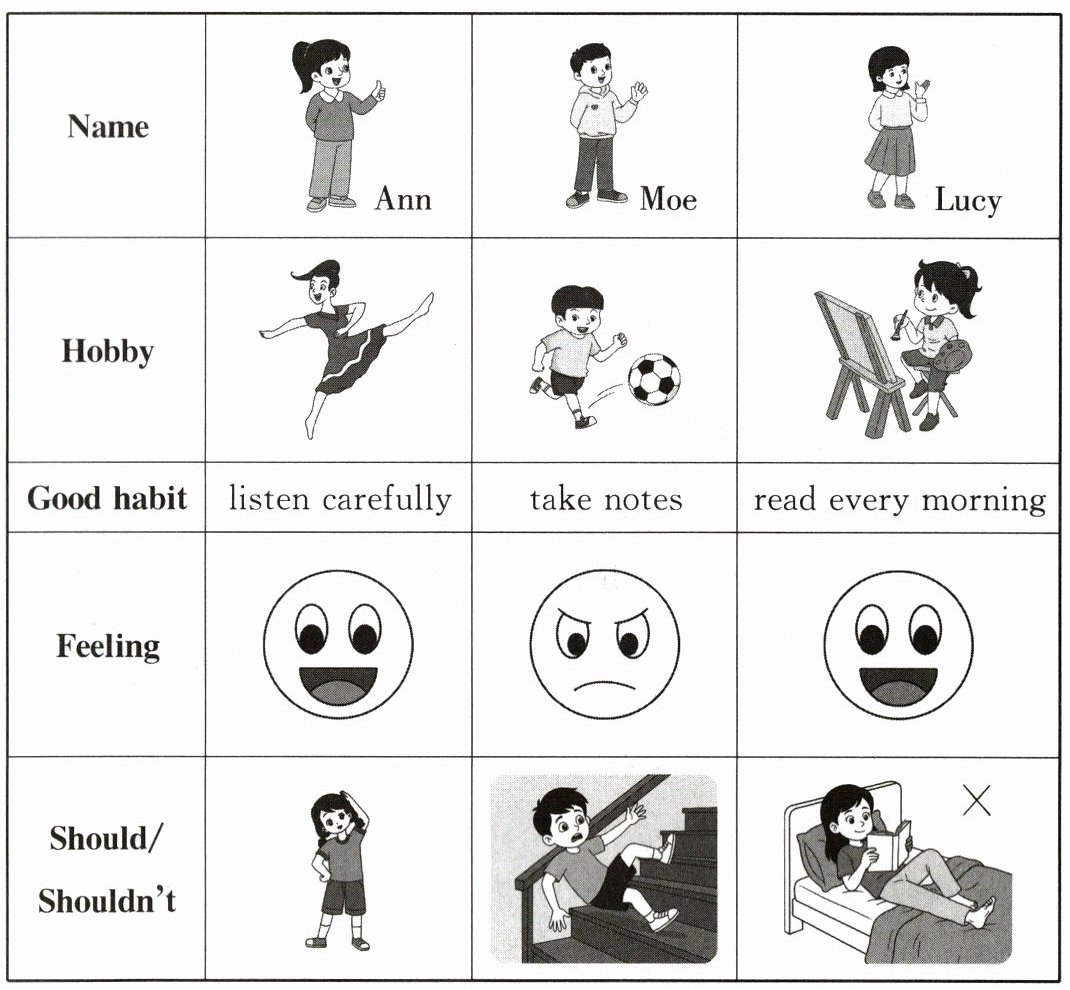
十一、新素材 阅读材料,判断正(T)误(F)。(每小题2分,共10分)
Name
Ann
Moe
Lucy
Hobby
listen carefully
 ake notes
read every morning
Feeling
Should/
Shouldn't
(
(
(
(
(
Name
Ann
Moe
Lucy
Hobby
listen carefully
ake notesread every morning
Feeling
Should/
Shouldn't
(
F
) 1. All the children feel happy.(
T
) 2. Ann always warms up before dancing.(
T
) 3. Moe takes notes in class. It's a good habit.(
F
) 4. Lucy likes reading. She should read in bed.(
T
) 5. Moe shouldn't run on the stairs.答案:1. F 2. T 3. T 4. F 5. T
解析:
【分析】
解题时需先明确表格各行列的含义:第一行是人物(Ann、Moe、Lucy),后续依次对应爱好、好习惯、情绪、应做/不应做的事。再逐个小题对应表格内容核对:1. 查看情绪行,确认是否所有孩子都开心;2. 对应Ann的爱好和应做行为判断;3. 核对Moe的好习惯描述;4. 结合Lucy的好习惯和应做行为判断;5. 对应Moe的危险行为判断。
【解析】
1. 表格Feeling行中,Moe的表情为愤怒,并非所有孩子都开心,故判断为F;
2. Ann的Hobby是跳舞,Should/Shouldn't行中Ann做热身动作,说明她跳舞前会热身,故判断为T;
3. Moe的Good habit是take notes(记笔记),属于好习惯,故判断为T;
4. Lucy的Good habit是每天早上读书,但Should/Shouldn't行中她在床上看书被打叉,说明不应在床上读书,故判断为F;
5. Moe在楼梯跑属于危险行为,所以他不该在楼梯跑,故判断为T。
【答案】
1.F 2.T 3.T 4.F 5.T
【知识点】
表格信息提取、阅读理解判断正误、日常习惯认知
【点评】
本题以表格形式呈现人物信息,考查学生提取关键信息并判断正误的能力,需仔细对应每一列的人物与内容,避免信息混淆,整体难度适中。
【难度系数】
0.3
解题时需先明确表格各行列的含义:第一行是人物(Ann、Moe、Lucy),后续依次对应爱好、好习惯、情绪、应做/不应做的事。再逐个小题对应表格内容核对:1. 查看情绪行,确认是否所有孩子都开心;2. 对应Ann的爱好和应做行为判断;3. 核对Moe的好习惯描述;4. 结合Lucy的好习惯和应做行为判断;5. 对应Moe的危险行为判断。
【解析】
1. 表格Feeling行中,Moe的表情为愤怒,并非所有孩子都开心,故判断为F;
2. Ann的Hobby是跳舞,Should/Shouldn't行中Ann做热身动作,说明她跳舞前会热身,故判断为T;
3. Moe的Good habit是take notes(记笔记),属于好习惯,故判断为T;
4. Lucy的Good habit是每天早上读书,但Should/Shouldn't行中她在床上看书被打叉,说明不应在床上读书,故判断为F;
5. Moe在楼梯跑属于危险行为,所以他不该在楼梯跑,故判断为T。
【答案】
1.F 2.T 3.T 4.F 5.T
【知识点】
表格信息提取、阅读理解判断正误、日常习惯认知
【点评】
本题以表格形式呈现人物信息,考查学生提取关键信息并判断正误的能力,需仔细对应每一列的人物与内容,避免信息混淆,整体难度适中。
【难度系数】
0.3
十二、传统文化 阅读短文,选择正确的答案。(每小题2分,共10分)
Confucius, a wise teacher, tells his students about the importance of both learning and thinking. He says, “Learning without thinking is useless, but thinking without learning is dangerous.” To explain this, he uses the example of a farmer who only learns how to plant seeds(种子). He plants them but doesn't think about how to take care of them. The seeds don't grow, and he has no harvest. On the other hand, if the farmer only thinks about how to take care of the seeds but doesn't plant any, he doesn't have any harvest either. Confucius teaches us that both learning and thinking are important for success(成功). We should study hard and think carefully.
(
A.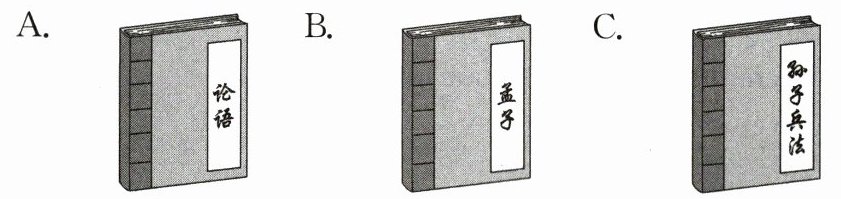
(
A. 见贤思齐焉,见不贤而内自省也。
B. 学而不思则罔,思而不学则殆。
C. 温故而知新,可以为师矣。
(
A. Learning is more important than thinking.
B. Thinking is more important than learning.
C. Learning is as important as thinking.
(
A. 种地
B. 浇水
C. 收获
(
A. To explain(说明) his thought.
B. To tell the farmer's story.
C. To teach his students how to plant seeds.
Confucius, a wise teacher, tells his students about the importance of both learning and thinking. He says, “Learning without thinking is useless, but thinking without learning is dangerous.” To explain this, he uses the example of a farmer who only learns how to plant seeds(种子). He plants them but doesn't think about how to take care of them. The seeds don't grow, and he has no harvest. On the other hand, if the farmer only thinks about how to take care of the seeds but doesn't plant any, he doesn't have any harvest either. Confucius teaches us that both learning and thinking are important for success(成功). We should study hard and think carefully.
(
A
)1. Confucius' thought is recorded in the book .A.
(
B
)2. The underlined sentence means “”.A. 见贤思齐焉,见不贤而内自省也。
B. 学而不思则罔,思而不学则殆。
C. 温故而知新,可以为师矣。
(
C
)3. Which is true?A. Learning is more important than thinking.
B. Thinking is more important than learning.
C. Learning is as important as thinking.
(
C
)4. What's the Chinese meaning of the underlined word “harvest”?A. 种地
B. 浇水
C. 收获
(
A
)5. Why does Confucius use the example of a farmer?A. To explain(说明) his thought.
B. To tell the farmer's story.
C. To teach his students how to plant seeds.
答案:1. A 2. B 3. C 4. C 5. A
解析:
【分析】
本题是结合英语阅读与中国传统文化的题目,共5道小题。解题思路为:先通读短文理解核心内容(孔子强调学习与思考同等重要),再逐题分析:1题需明确《论语》记录孔子思想;2题匹配划线句对应的《论语》名句;3题根据短文结论判断学习与思考的关系;4题猜测单词“harvest”的含义;5题明确孔子用农民例子的目的。
【解析】
1. 孔子的思想主要记录在《论语》中,图A为《论语》,故选A。
2. 划线句意为“只学习不思考无用,只思考不学习危险”,对应《论语》中“学而不思则罔,思而不学则殆”,故选B。
3. 短文明确指出“both learning and thinking are important”,即学习和思考同等重要,故选C。
4. “harvest”意为“收获”,A选项“种地”对应plant seeds,B选项“浇水”对应water,故选C。
5. 短文提到“To explain this, he uses the example of a farmer”,说明用农民例子是为了解释观点,故选A。
【答案】
1. A 2. B 3. C 4. C 5. A
【知识点】
英语阅读理解、传统文化常识、词义猜测
【点评】
本题将英语阅读与中国传统文化结合,题目难度适中,侧重考查对短文的理解和基础的传统文化知识,适合学生巩固阅读能力与文化常识。
【难度系数】
0.7
本题是结合英语阅读与中国传统文化的题目,共5道小题。解题思路为:先通读短文理解核心内容(孔子强调学习与思考同等重要),再逐题分析:1题需明确《论语》记录孔子思想;2题匹配划线句对应的《论语》名句;3题根据短文结论判断学习与思考的关系;4题猜测单词“harvest”的含义;5题明确孔子用农民例子的目的。
【解析】
1. 孔子的思想主要记录在《论语》中,图A为《论语》,故选A。
2. 划线句意为“只学习不思考无用,只思考不学习危险”,对应《论语》中“学而不思则罔,思而不学则殆”,故选B。
3. 短文明确指出“both learning and thinking are important”,即学习和思考同等重要,故选C。
4. “harvest”意为“收获”,A选项“种地”对应plant seeds,B选项“浇水”对应water,故选C。
5. 短文提到“To explain this, he uses the example of a farmer”,说明用农民例子是为了解释观点,故选A。
【答案】
1. A 2. B 3. C 4. C 5. A
【知识点】
英语阅读理解、传统文化常识、词义猜测
【点评】
本题将英语阅读与中国传统文化结合,题目难度适中,侧重考查对短文的理解和基础的传统文化知识,适合学生巩固阅读能力与文化常识。
【难度系数】
0.7