1. strange
【感知】
» Yaming saw the Guest-Greeting Pine, the Sea of Clouds, lots of strange rocks, and many ancient buildings.(教材第2页)亚明看到了迎客松、云海、许多奇石和众多古建筑。
» I went to a strange city.
我去了一个陌生的城市。
» Don't speak to strangers.
不要与陌生人交谈。
【探究】
(1)strange 形容词,意为“奇怪的”,还可表示“
(2)其名词形式为
【应用】
①完成句子:昨天我们爬山的时候,我偶然发现了一块奇怪的石头。
I found a
②用所给单词的适当形式填空:Parents often tell their children not to talk to
【感知】
» Yaming saw the Guest-Greeting Pine, the Sea of Clouds, lots of strange rocks, and many ancient buildings.(教材第2页)亚明看到了迎客松、云海、许多奇石和众多古建筑。
» I went to a strange city.
我去了一个陌生的城市。
» Don't speak to strangers.
不要与陌生人交谈。
【探究】
(1)strange 形容词,意为“奇怪的”,还可表示“
陌生的
”。(2)其名词形式为
stranger
,意为“陌生人”。【应用】
①完成句子:昨天我们爬山的时候,我偶然发现了一块奇怪的石头。
I found a
strange
stone
by accident when we climbed the mountain yesterday.②用所给单词的适当形式填空:Parents often tell their children not to talk to
strangers
(strange).答案:1. [探究](1)陌生的 (2)stranger
[应用]①strange stone ②strangers
[应用]①strange stone ②strangers
解析:
【分析】本题考查形容词strange的词义、词性转换及名词的用法。解题时先结合感知板块的例句,明确strange的不同含义,再根据词性变化规则确定其名词形式,最后结合应用板块的句子语境,选择正确的词形填空。
【解析】
探究部分:
(1) 由感知中“I went to a strange city.”(我去了一个陌生的城市)可知,strange作形容词除“奇怪的”外,还可表示“陌生的”;
(2) strange的名词形式为stranger,意为“陌生人”。
应用部分:
① 中文“奇怪的石头”对应英文strange stone,故填strange stone;
② talk to后接名词,此处表泛指“陌生人”,需用strange的名词复数形式strangers,故填strangers。
【答案】
[探究](1)陌生的 (2)stranger
[应用]①strange stone ②strangers
【知识点】
形容词词义、词性转换、名词复数
【点评】
本题围绕strange一词的基础用法展开,结合例句帮助理解词义,考查学生对词汇多义性及词性转换的掌握,属于基础词汇题。
【难度系数】
0.6
【解析】
探究部分:
(1) 由感知中“I went to a strange city.”(我去了一个陌生的城市)可知,strange作形容词除“奇怪的”外,还可表示“陌生的”;
(2) strange的名词形式为stranger,意为“陌生人”。
应用部分:
① 中文“奇怪的石头”对应英文strange stone,故填strange stone;
② talk to后接名词,此处表泛指“陌生人”,需用strange的名词复数形式strangers,故填strangers。
【答案】
[探究](1)陌生的 (2)stranger
[应用]①strange stone ②strangers
【知识点】
形容词词义、词性转换、名词复数
【点评】
本题围绕strange一词的基础用法展开,结合例句帮助理解词义,考查学生对词汇多义性及词性转换的掌握,属于基础词汇题。
【难度系数】
0.6
2. vacation
【感知】
» Where did Yaming go on vacation?(教材第2页)亚明去哪儿度假了?
» The thing is, I don't have time to take a vacation. 问题是我没有时间去度假。
» The students of Class 4 will visit Mount Huangshan this winter vacation.
今年寒假,四班的学生将游览黄山。
【探究】
vacation 名词,意为“假期;度假”。
①
②(be) on vacation 在度假(强调状态)
③
④winter/summer vacation 寒/暑假
【应用】
完成句子
①我去度假时,你能照顾我的狗吗?
Could you look after my dog when I
②大多数人会在七月或八月的某个时候休假。
Most people
【感知】
» Where did Yaming go on vacation?(教材第2页)亚明去哪儿度假了?
» The thing is, I don't have time to take a vacation. 问题是我没有时间去度假。
» The students of Class 4 will visit Mount Huangshan this winter vacation.
今年寒假,四班的学生将游览黄山。
【探究】
vacation 名词,意为“假期;度假”。
①
go on vacation
去度假(强调出发度假)②(be) on vacation 在度假(强调状态)
③
take a vacation
去度假(强调安排休假)④winter/summer vacation 寒/暑假
【应用】
完成句子
①我去度假时,你能照顾我的狗吗?
Could you look after my dog when I
go/am
on
vacation
?②大多数人会在七月或八月的某个时候休假。
Most people
take
a
vacation
sometime in July or August.答案:2. [探究]①go on vacation
③take a vacation
[应用]①go/am on vacation
②take a vacation
③take a vacation
[应用]①go/am on vacation
②take a vacation
解析:
【分析】本题考查与vacation相关的固定短语搭配,解题时需先明确各短语的含义与用法:go on vacation侧重“出发去度假”的动作,take a vacation侧重“安排休假”的动作,be on vacation侧重“处于度假”的状态;再结合应用句的语境,第一句是时间状语从句,描述“我去度假”的情况,第二句主语为复数,对应短语的正确形式即可。
【解析】[探究]①“去度假(强调出发度假)”对应固定短语go on vacation;③“去度假(强调安排休假)”对应固定短语take a vacation。[应用]①when引导的时间状语从句,主语为I,结合语境可填go on vacation或am on vacation;②主语为Most people,表达“休假”的安排,填take a vacation。
【答案】[探究]①go on vacation;③take a vacation;[应用]①go/am on vacation;②take a vacation
【知识点】英语固定短语搭配;动词短语辨析
【点评】本题围绕vacation的常用短语展开,考查学生对基础短语的掌握及语境运用能力,属于英语基础题型。
【难度系数】0.8
【解析】[探究]①“去度假(强调出发度假)”对应固定短语go on vacation;③“去度假(强调安排休假)”对应固定短语take a vacation。[应用]①when引导的时间状语从句,主语为I,结合语境可填go on vacation或am on vacation;②主语为Most people,表达“休假”的安排,填take a vacation。
【答案】[探究]①go on vacation;③take a vacation;[应用]①go/am on vacation;②take a vacation
【知识点】英语固定短语搭配;动词短语辨析
【点评】本题围绕vacation的常用短语展开,考查学生对基础短语的掌握及语境运用能力,属于英语基础题型。
【难度系数】0.8
3. anywhere
【感知】
» Did you go anywhere interesting?(教材第3页)你去过什么有趣的地方吗?
» I don't have anywhere to stay.
我没有可以待的地方。
» I have seen him somewhere before.
我以前在哪儿见过他。
» Teng Fei is not tidy. His things are everywhere.
滕飞不整洁。他的东西到处都是。
【探究】
(1) anywhere 作不定副词,意为“在任何地方”,当 anywhere 等不定副词与形容词连用时,形容词必须
(2) anywhere 还可作不定代词,意为“任何地方”,用于泛指非特定地点。
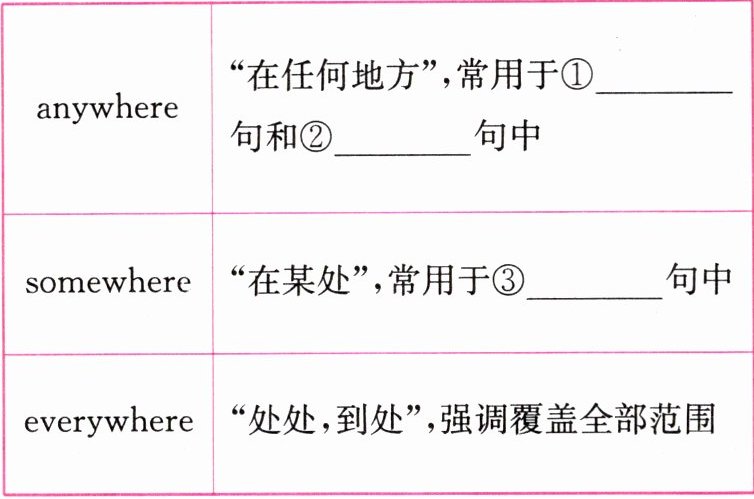
(3)anywhere,somewhere 与 everywhere 的用法辨析
【应用】
完成句子或对话
①I'm considering going
②—Where did you go last night?
—I
③Don't let your pet
【感知】
» Did you go anywhere interesting?(教材第3页)你去过什么有趣的地方吗?
» I don't have anywhere to stay.
我没有可以待的地方。
» I have seen him somewhere before.
我以前在哪儿见过他。
» Teng Fei is not tidy. His things are everywhere.
滕飞不整洁。他的东西到处都是。
【探究】
(1) anywhere 作不定副词,意为“在任何地方”,当 anywhere 等不定副词与形容词连用时,形容词必须
后置
(前置/后置)。(2) anywhere 还可作不定代词,意为“任何地方”,用于泛指非特定地点。
(3)anywhere,somewhere 与 everywhere 的用法辨析
【应用】
完成句子或对话
①I'm considering going
somewhere
beautiful
(美丽的地方)for the summer holiday.②—Where did you go last night?
—I
didn't
go
anywhere
(哪儿都没去). I only stayed at home.③Don't let your pet
run
everywhere
(到处跑).答案:3. [探究](1)后置 (3)①否定 ②疑问
③肯定
[应用]①somewhere beautiful
②didn't go anywhere ③run everywhere
③肯定
[应用]①somewhere beautiful
②didn't go anywhere ③run everywhere
解析:
【分析】
本题考查anywhere、somewhere、everywhere等不定副词/代词的用法,需结合语法规则和语境判断:不定副词与形容词连用时形容词后置;anywhere常用于疑问句和否定句,somewhere常用于肯定句;应用部分需根据句式和语义选择正确表达。
【解析】
探究部分:
(1) 不定副词与形容词连用时,形容词需后置,如“anywhere interesting”,故填后置。
(3) 用法辨析:anywhere表“任何地方”,用于疑问句和否定句;somewhere表“某处”,用于肯定句;everywhere表“到处”。
应用部分:
① 肯定句中用somewhere,形容词beautiful后置,故填somewhere beautiful。
② 否定句中表达“哪儿都没去”,用didn't go anywhere。
③ 表达“到处跑”,用run everywhere。
【答案】
[探究](1)后置 (3)①否定 ②疑问 ③肯定
[应用]①somewhere beautiful ②didn't go anywhere ③run everywhere
【知识点】
不定副词用法;形容词后置;不定代词辨析
【点评】
本题考查初中英语基础的不定副词用法,需牢记不同不定副词的句式搭配及与形容词的位置规则,属于基础题型。
【难度系数】
0.6
本题考查anywhere、somewhere、everywhere等不定副词/代词的用法,需结合语法规则和语境判断:不定副词与形容词连用时形容词后置;anywhere常用于疑问句和否定句,somewhere常用于肯定句;应用部分需根据句式和语义选择正确表达。
【解析】
探究部分:
(1) 不定副词与形容词连用时,形容词需后置,如“anywhere interesting”,故填后置。
(3) 用法辨析:anywhere表“任何地方”,用于疑问句和否定句;somewhere表“某处”,用于肯定句;everywhere表“到处”。
应用部分:
① 肯定句中用somewhere,形容词beautiful后置,故填somewhere beautiful。
② 否定句中表达“哪儿都没去”,用didn't go anywhere。
③ 表达“到处跑”,用run everywhere。
【答案】
[探究](1)后置 (3)①否定 ②疑问 ③肯定
[应用]①somewhere beautiful ②didn't go anywhere ③run everywhere
【知识点】
不定副词用法;形容词后置;不定代词辨析
【点评】
本题考查初中英语基础的不定副词用法,需牢记不同不定副词的句式搭配及与形容词的位置规则,属于基础题型。
【难度系数】
0.6