三、阅读理解(16分)
A
Totally
Wild
Hotel
WHERE: Kenya, Africa
WHY IT'S SPECIAL:
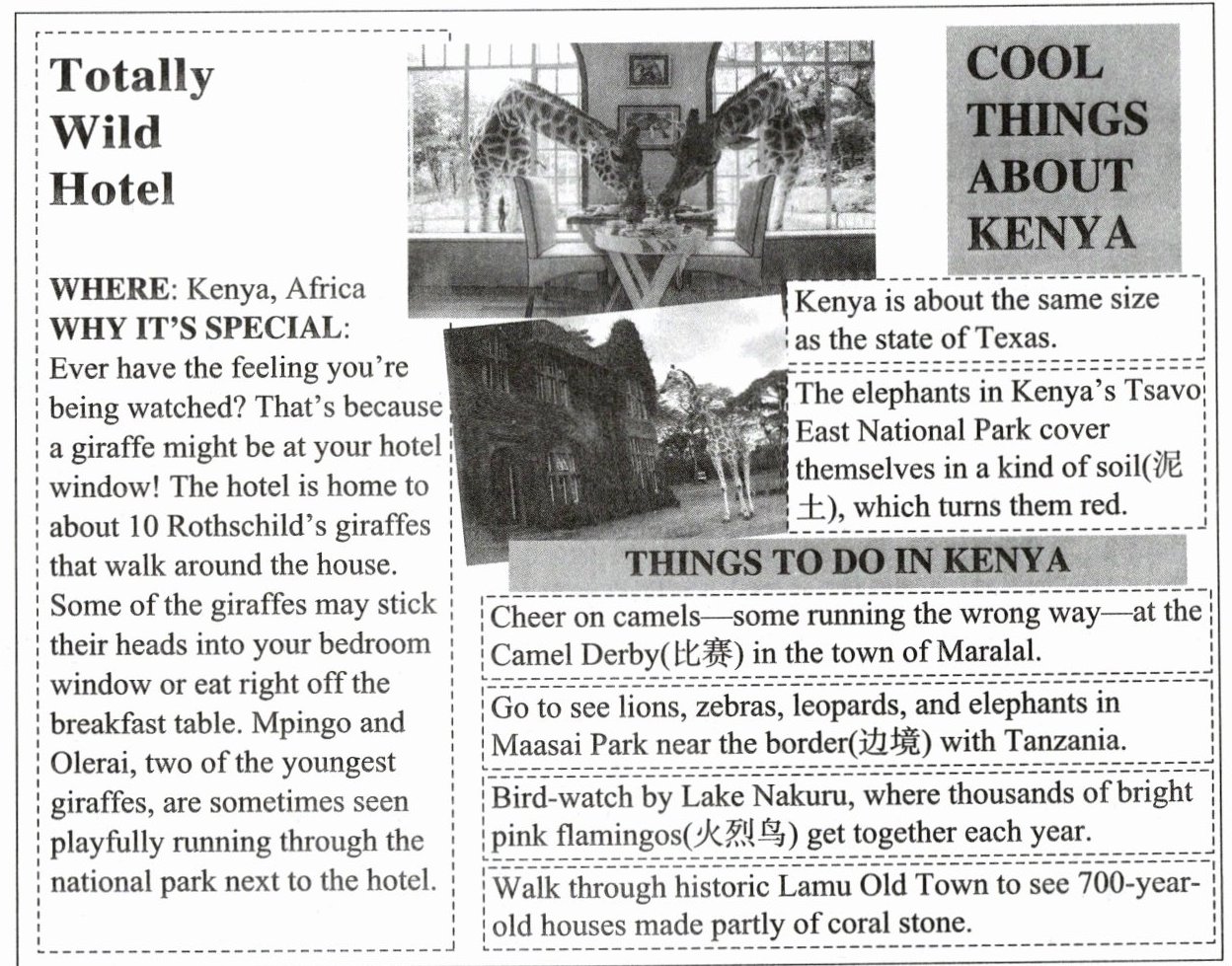
Ever have the feeling you're
being watched? That's because
a giraffe might be at your hotel
window! The hotel is home to
about 10 Rothschild's giraffes
that walk around the house.
Some of the giraffes may stick
their heads into your bedroom
window or eat right off the
breakfast table. Mpingo and
Olerai, two of the youngest
giraffes, are sometimes seen
playfully running through the
national park next to the hotel.
COOL
THINGS
ABOUT
KENYA
Kenya is about the same size
as the state of Texas.
The elephants in Kenya's Tsavo
East National Park cover
themselves in a kind of soil(泥
土), which turns them red.
THINGS TO DO IN KENYA
Cheer on camels—some running the wrong way—at the
Camel Derby(比赛) in the town of Maralal.
Go to see lions, zebras, leopards, and elephants in
Maasai Park near the border(边境) with Tanzania.
Bird-watch by Lake Nakuru, where thousands of bright
pink flamingos(火烈鸟) get together each year.
Walk through historic Lamu Old Town to see 700-year-
old houses made partly of coral stone.
(
A. It's in Africa. B. It's in Texas.
C. It's in Tanzania. D. It's by Lake Nakuru.
(
A. its tall trees B. its good breakfast C. the lovely giraffes D. the old buildings
(
A. Swim with zebras in a lake. B. Watch the Camel Derby in Maralal.
C. Run with giraffes in the hotel. D. Take a boat to see the flamingos.
(
A. To introduce a special hotel. B. To talk about wildlife in Kenya.
C. To organize an animal show. D. To attract visitors to Kenya.
B
A
Totally
Wild
Hotel
WHERE: Kenya, Africa
WHY IT'S SPECIAL:
Ever have the feeling you're
being watched? That's because
a giraffe might be at your hotel
window! The hotel is home to
about 10 Rothschild's giraffes
that walk around the house.
Some of the giraffes may stick
their heads into your bedroom
window or eat right off the
breakfast table. Mpingo and
Olerai, two of the youngest
giraffes, are sometimes seen
playfully running through the
national park next to the hotel.
COOL
THINGS
ABOUT
KENYA
Kenya is about the same size
as the state of Texas.
The elephants in Kenya's Tsavo
East National Park cover
themselves in a kind of soil(泥
土), which turns them red.
THINGS TO DO IN KENYA
Cheer on camels—some running the wrong way—at the
Camel Derby(比赛) in the town of Maralal.
Go to see lions, zebras, leopards, and elephants in
Maasai Park near the border(边境) with Tanzania.
Bird-watch by Lake Nakuru, where thousands of bright
pink flamingos(火烈鸟) get together each year.
Walk through historic Lamu Old Town to see 700-year-
old houses made partly of coral stone.
(
A
) 1. Where is Kenya?A. It's in Africa. B. It's in Texas.
C. It's in Tanzania. D. It's by Lake Nakuru.
(
C
) 2. Totally Wild Hotel is special because of .A. its tall trees B. its good breakfast C. the lovely giraffes D. the old buildings
(
B
) 3. What activity can guests do in Kenya according to the material?A. Swim with zebras in a lake. B. Watch the Camel Derby in Maralal.
C. Run with giraffes in the hotel. D. Take a boat to see the flamingos.
(
D
) 4. What is the purpose (目的) of the material?A. To introduce a special hotel. B. To talk about wildlife in Kenya.
C. To organize an animal show. D. To attract visitors to Kenya.
B
答案:1. A
2. C
3. B
4. D
2. C
3. B
4. D
解析:
【分析】
本题是一篇介绍肯尼亚的广告类阅读理解,包含特色酒店、特色信息及可参与的活动。解题时需根据题目要求,快速定位原文对应内容:第1题找肯尼亚的位置,第2题找酒店特别的原因,第3题找肯尼亚可做的活动,第4题判断材料主旨。
【解析】
1. 细节理解题:根据文中“WHERE: Kenya, Africa”可知,肯尼亚位于非洲,A选项正确;B选项Texas是与肯尼亚面积相当的美国州,并非肯尼亚位置;C选项Tanzania是肯尼亚的邻国;D选项Lake Nakuru是观火烈鸟的地点,均错误。
2. 细节理解题:根据“WHY IT'S SPECIAL”段落,酒店的特别之处是有约10只罗斯柴尔德长颈鹿,它们会出现在窗边、餐桌等,C选项(可爱的长颈鹿)符合;A选项高树、B选项好早餐、D选项老建筑均未提及,错误。
3. 细节理解题:根据“THINGS TO DO IN KENYA”中的“Cheer on camels—some running the wrong way—at the Camel Derby in the town of Maralal”,可知可在Maralal观看骆驼德比,B选项正确;A选项和斑马游泳、C选项和长颈鹿跑、D选项乘船看火烈鸟均未提及,错误。
4. 主旨大意题:材料介绍了肯尼亚的特色酒店、特色动物、可参与的活动等,目的是吸引游客前往肯尼亚,D选项正确;A选项仅介绍酒店不全面,B选项仅提及野生动物不全面,C选项组织动物表演与原文不符,均排除。
【答案】
1.A 2.C 3.B 4.D
【知识点】
英语阅读理解、细节理解题、主旨大意题
【点评】
本题为广告类阅读理解,考查学生快速定位信息和理解主旨的能力,题目难度适中,需学生仔细阅读原文,对应选项找依据。
【难度系数】
0.6
本题是一篇介绍肯尼亚的广告类阅读理解,包含特色酒店、特色信息及可参与的活动。解题时需根据题目要求,快速定位原文对应内容:第1题找肯尼亚的位置,第2题找酒店特别的原因,第3题找肯尼亚可做的活动,第4题判断材料主旨。
【解析】
1. 细节理解题:根据文中“WHERE: Kenya, Africa”可知,肯尼亚位于非洲,A选项正确;B选项Texas是与肯尼亚面积相当的美国州,并非肯尼亚位置;C选项Tanzania是肯尼亚的邻国;D选项Lake Nakuru是观火烈鸟的地点,均错误。
2. 细节理解题:根据“WHY IT'S SPECIAL”段落,酒店的特别之处是有约10只罗斯柴尔德长颈鹿,它们会出现在窗边、餐桌等,C选项(可爱的长颈鹿)符合;A选项高树、B选项好早餐、D选项老建筑均未提及,错误。
3. 细节理解题:根据“THINGS TO DO IN KENYA”中的“Cheer on camels—some running the wrong way—at the Camel Derby in the town of Maralal”,可知可在Maralal观看骆驼德比,B选项正确;A选项和斑马游泳、C选项和长颈鹿跑、D选项乘船看火烈鸟均未提及,错误。
4. 主旨大意题:材料介绍了肯尼亚的特色酒店、特色动物、可参与的活动等,目的是吸引游客前往肯尼亚,D选项正确;A选项仅介绍酒店不全面,B选项仅提及野生动物不全面,C选项组织动物表演与原文不符,均排除。
【答案】
1.A 2.C 3.B 4.D
【知识点】
英语阅读理解、细节理解题、主旨大意题
【点评】
本题为广告类阅读理解,考查学生快速定位信息和理解主旨的能力,题目难度适中,需学生仔细阅读原文,对应选项找依据。
【难度系数】
0.6
Recently, many people have fallen in love with the cute marmots(土拨鼠)because of the online short videos about their fighting. This led a group of people to buy real marmots online as pets. However, many organizations have quickly warned(警告)people that these seemingly lovely wild animals are actually high-risk carriers of the plague(瘟疫).
Marmots are common rodents(啮齿目动物)in North-west China. Listed as a second-class protected animals in China, they always choose cool mountain grasslands, open deserts, and rocky hills as their homes. They are good at digging(挖)holes, which are usually deep and each hole has a different use. Fresh grass, juicy plants, and treats like apples or lettuce fill their diet. Living in family groups, these social animals work together and share information often to stay alive in the difficult environment.
Marmots may look harmless, but these furry animals carry plague bacteria(鼠疫杆菌), which cause a disease(病)that killed over 100 million people like the Black Death in the 14th century. The disease can spread through small cuts or even breath drops, causing high fever, painful lumps(肿块)under the skin, and bleeding. Without treatment(治疗), it is highly dangerous with the chances of staying alive as low as zero.
The National Health Commission advises:
● Keep safe distance(距离)when meeting wild marmots.
● Never keep them as pets, touch, or feed them.
● Report animals to wildlife experts(专家)instead of helping them directly.
● Go to hospital in time if you develop a fever or lumps after touching them.
The recent online videos of feeding and touching marmots have raised warning. While their round faces might make us want to get close, health organizations warn everyone that cuteness isn't worth risking lives. Protecting both wildlife and public health means watching animals safely from a faraway place.
(
A. A report about marmots. B. Some funny short videos online.
C. A new study on marmots. D. Government protection laws.
(
A. Take it home for medical care. B. Leave it alone and avoid touching.
C. Share its photo online. D. Report it to wildlife experts in time.
(
A. the disease is not serious B. marmots can be really dangerous
C. how marmots develop D. old medical care was not good
(
A. Marmots: Cute Animals or Silent Killers? B. Online Videos of Marmots
C. History of the Black Death D. How to Protect Wild Rodents
Marmots are common rodents(啮齿目动物)in North-west China. Listed as a second-class protected animals in China, they always choose cool mountain grasslands, open deserts, and rocky hills as their homes. They are good at digging(挖)holes, which are usually deep and each hole has a different use. Fresh grass, juicy plants, and treats like apples or lettuce fill their diet. Living in family groups, these social animals work together and share information often to stay alive in the difficult environment.
Marmots may look harmless, but these furry animals carry plague bacteria(鼠疫杆菌), which cause a disease(病)that killed over 100 million people like the Black Death in the 14th century. The disease can spread through small cuts or even breath drops, causing high fever, painful lumps(肿块)under the skin, and bleeding. Without treatment(治疗), it is highly dangerous with the chances of staying alive as low as zero.
The National Health Commission advises:
● Keep safe distance(距离)when meeting wild marmots.
● Never keep them as pets, touch, or feed them.
● Report animals to wildlife experts(专家)instead of helping them directly.
● Go to hospital in time if you develop a fever or lumps after touching them.
The recent online videos of feeding and touching marmots have raised warning. While their round faces might make us want to get close, health organizations warn everyone that cuteness isn't worth risking lives. Protecting both wildlife and public health means watching animals safely from a faraway place.
(
B
)5. What has recently caused people's interest in marmots?A. A report about marmots. B. Some funny short videos online.
C. A new study on marmots. D. Government protection laws.
(
D
)6. What should you do if you find an injured(受伤的)marmot in the wild?A. Take it home for medical care. B. Leave it alone and avoid touching.
C. Share its photo online. D. Report it to wildlife experts in time.
(
B
)7. The writer talks about the Black Death in Paragraph 3 to show .A. the disease is not serious B. marmots can be really dangerous
C. how marmots develop D. old medical care was not good
(
A
)8. What would be the best title for the article?A. Marmots: Cute Animals or Silent Killers? B. Online Videos of Marmots
C. History of the Black Death D. How to Protect Wild Rodents
答案:5. B
6. D
7. B
8. A
6. D
7. B
8. A
解析:
【分析】
做这类英语阅读理解题,需先根据题干关键词定位原文对应段落,再对比选项与原文信息,排除干扰项得出答案。第5题定位“人们对土拨鼠感兴趣的原因”,第6题定位“发现受伤土拨鼠的做法”,第7题定位“第三段黑死病的作用”,第8题需结合全文主旨判断标题。
【解析】
5. 题干问“什么引起人们对土拨鼠的兴趣”,定位原文第一段第一句“because of the online short videos about their fighting”,可知是线上短视频,对应选项B。A(报告)、C(研究)、D(保护法)均无原文依据,排除。
6. 题干问“发现受伤土拨鼠的做法”,定位原文健康建议中“Report animals to wildlife experts instead of helping them directly”,对应选项D。A(带回家)、B(不管)、C(分享照片)均不符合建议,排除。
7. 题干问“第三段提黑死病的目的”,第三段指出土拨鼠携带鼠疫杆菌,黑死病是鼠疫引发的大疾病,举黑死病是为了说明土拨鼠的危险性,对应选项B。A(疾病不严重)与原文“highly dangerous”矛盾,C(土拨鼠的发展)、D(旧医疗不好)均无依据,排除。
8. 题干问“最佳标题”,全文围绕土拨鼠“可爱但携带致命病菌”展开,对应选项A。B(短视频)只是引子,C(黑死病历史)是举例内容,D(保护啮齿动物)偏离主旨,排除。
【答案】
5. B
6. D
7. B
8. A
【知识点】
英语阅读理解、细节理解题、主旨大意题
【点评】
本文是科普类英语阅读理解,侧重考查学生信息定位与主旨归纳能力,题目多为基础细节题,需学生仔细阅读原文,精准匹配选项与原文内容,避免被无关选项干扰。
【难度系数】
0.3
做这类英语阅读理解题,需先根据题干关键词定位原文对应段落,再对比选项与原文信息,排除干扰项得出答案。第5题定位“人们对土拨鼠感兴趣的原因”,第6题定位“发现受伤土拨鼠的做法”,第7题定位“第三段黑死病的作用”,第8题需结合全文主旨判断标题。
【解析】
5. 题干问“什么引起人们对土拨鼠的兴趣”,定位原文第一段第一句“because of the online short videos about their fighting”,可知是线上短视频,对应选项B。A(报告)、C(研究)、D(保护法)均无原文依据,排除。
6. 题干问“发现受伤土拨鼠的做法”,定位原文健康建议中“Report animals to wildlife experts instead of helping them directly”,对应选项D。A(带回家)、B(不管)、C(分享照片)均不符合建议,排除。
7. 题干问“第三段提黑死病的目的”,第三段指出土拨鼠携带鼠疫杆菌,黑死病是鼠疫引发的大疾病,举黑死病是为了说明土拨鼠的危险性,对应选项B。A(疾病不严重)与原文“highly dangerous”矛盾,C(土拨鼠的发展)、D(旧医疗不好)均无依据,排除。
8. 题干问“最佳标题”,全文围绕土拨鼠“可爱但携带致命病菌”展开,对应选项A。B(短视频)只是引子,C(黑死病历史)是举例内容,D(保护啮齿动物)偏离主旨,排除。
【答案】
5. B
6. D
7. B
8. A
【知识点】
英语阅读理解、细节理解题、主旨大意题
【点评】
本文是科普类英语阅读理解,侧重考查学生信息定位与主旨归纳能力,题目多为基础细节题,需学生仔细阅读原文,精准匹配选项与原文内容,避免被无关选项干扰。
【难度系数】
0.3