三、阅读理解(16分)
A
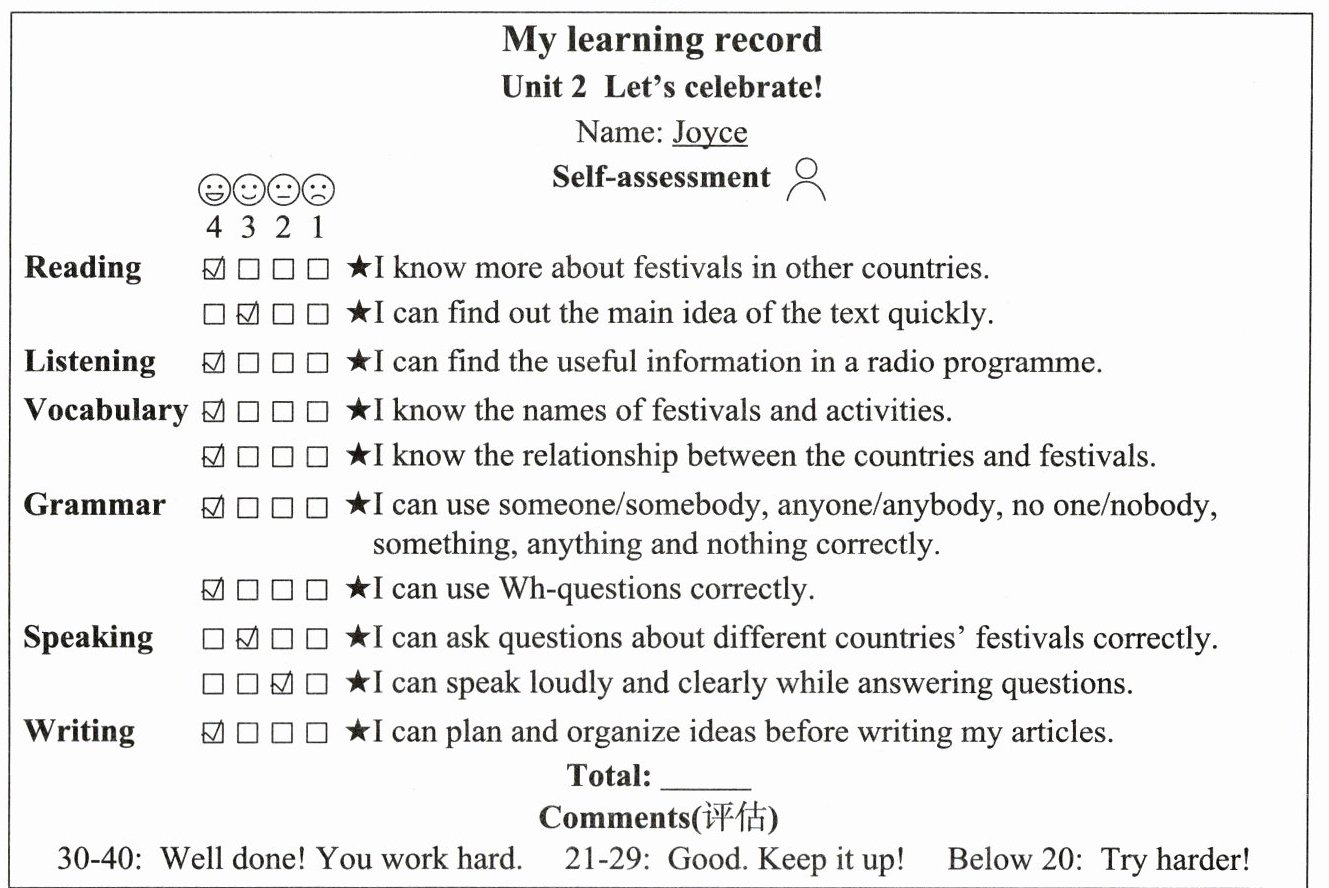
My learning record
Unit 2 Let’s celebrate!
Name: Joyce
Self-assessment ☿
☺☺☹☹
4 3 2 1
Reading
☑ ★I know more about festivals in other countries.
☑ ★I can find out the main idea of the text quickly.
Listening
☑ ★I can find the useful information in a radio programme.
Vocabulary
☑ ★I know the names of festivals and activities.
☑ ★I know the relations between the countries and festivals.
Grammar
☑ ★I can use someone/somebody, anyone/anybody, no one/nobody, something, anything and nothing correctly.
☑ ★I can use Wh-questions correctly.
Speaking
☑ ★I can ask questions about different countries’ festivals correctly.
☑ ★I can speak loudly and clearly while answering questions.
Writing
☑ ★I can plan and organize ideas before writing my articles.
Total:
Comments(评估)
30-40: Well done! You work hard. 21-29: Good. Keep it up! Below 20: Try harder!
(
A. Speaking. B. Reading. C. Writing. D. Vocabulary.
(
A. Good. B. Try harder!
C. Keep it up! D. Well done! You work hard.
(
A. to show why they have passed the test
B. to check if they have learnt the knowledge(知识)well
C. to tell their parents what they’ve done at school
D. to know about how they can use the grammar correctly
A
My learning record
Unit 2 Let’s celebrate!
Name: Joyce
Self-assessment ☿
☺☺☹☹
4 3 2 1
Reading
☑ ★I know more about festivals in other countries.
☑ ★I can find out the main idea of the text quickly.
Listening
☑ ★I can find the useful information in a radio programme.
Vocabulary
☑ ★I know the names of festivals and activities.
☑ ★I know the relations between the countries and festivals.
Grammar
☑ ★I can use someone/somebody, anyone/anybody, no one/nobody, something, anything and nothing correctly.
☑ ★I can use Wh-questions correctly.
Speaking
☑ ★I can ask questions about different countries’ festivals correctly.
☑ ★I can speak loudly and clearly while answering questions.
Writing
☑ ★I can plan and organize ideas before writing my articles.
Total:
Comments(评估)
30-40: Well done! You work hard. 21-29: Good. Keep it up! Below 20: Try harder!
(
A
)1. Which should Joyce do better in?A. Speaking. B. Reading. C. Writing. D. Vocabulary.
(
D
)2. Which of the following comments is for Joyce?A. Good. B. Try harder!
C. Keep it up! D. Well done! You work hard.
(
B
)3. The main reason why students use “My learning record” is .A. to show why they have passed the test
B. to check if they have learnt the knowledge(知识)well
C. to tell their parents what they’ve done at school
D. to know about how they can use the grammar correctly
答案:1. A
2. D
3. B
2. D
3. B
B
Professor(教授) Jemima Gryaznov answers some questions about memory (记忆).
Q1: Why can I remember events in my childhood but not what happened last week?
A1: We remember things that have strong relations (关联) in our mind, especially emotional (情绪的) ones. Childhood memories are often these, because when we experience things for the first time, we often have strong feelings of fear (害怕) or excitement. Also, interesting or funny childhood stories are often told again and again. As a result, we remember them much better, as retelling (复述) events helps fix experiences in our memories. So when remembering something new, find its relation to our emotions, or retell it to others.
Q2: Do some people really have a photographic memory (过目不忘的记忆)?
A2: A person with a photographic memory could remember everything of a picture, a book or an event many years later, but no one knows if there is this kind of person. However, some people do have amazing memories. For example, Daniel Tammet can remember the first 22 514 digits (数位) of $pi$ and Stephen Wiltshire can draw a detailed picture of a city from memory after flying over it in a plane. They are both good at remembering things. As most of us do not have amazing memories like them, a good way to remember things is to group similar ideas or information together.
Q3: Why do I forget the new words that I learnt yesterday?
A3: Don't worry. This is natural for many people. In 1885, Hermann Ebbinghaus showed us a famous forgetting curve (遗忘曲线). According to him, the quickest loss (丢失) of memory happens during the very early time after learning, and then it gradually (逐渐地) slows down. This means that going through (复习) what we have learned in time can help us to remember the information better.
(
A. has strong feelings of excitement
B. remembers details clearly years later
C. forgets what he has learned quickly
D. likes retelling stories to others
(

A. 1: Reasons; 2: Results
B. 1: Reasons; 2: Advice
C. 1: Advice; 2: Results
D. 1: Results; 2: Advice
(
A. grouping similar information together
B. finding relations between things and emotions
C. going through what we have learned
D. drawing a picture of the things we have learned
(

(
A. Travelling.
B. Learning.
C. Health.
D. Nature.
Professor(教授) Jemima Gryaznov answers some questions about memory (记忆).
Q1: Why can I remember events in my childhood but not what happened last week?
A1: We remember things that have strong relations (关联) in our mind, especially emotional (情绪的) ones. Childhood memories are often these, because when we experience things for the first time, we often have strong feelings of fear (害怕) or excitement. Also, interesting or funny childhood stories are often told again and again. As a result, we remember them much better, as retelling (复述) events helps fix experiences in our memories. So when remembering something new, find its relation to our emotions, or retell it to others.
Q2: Do some people really have a photographic memory (过目不忘的记忆)?
A2: A person with a photographic memory could remember everything of a picture, a book or an event many years later, but no one knows if there is this kind of person. However, some people do have amazing memories. For example, Daniel Tammet can remember the first 22 514 digits (数位) of $pi$ and Stephen Wiltshire can draw a detailed picture of a city from memory after flying over it in a plane. They are both good at remembering things. As most of us do not have amazing memories like them, a good way to remember things is to group similar ideas or information together.
Q3: Why do I forget the new words that I learnt yesterday?
A3: Don't worry. This is natural for many people. In 1885, Hermann Ebbinghaus showed us a famous forgetting curve (遗忘曲线). According to him, the quickest loss (丢失) of memory happens during the very early time after learning, and then it gradually (逐渐地) slows down. This means that going through (复习) what we have learned in time can help us to remember the information better.
(
B
) 4. According to the text, a person with photographic memory .A. has strong feelings of excitement
B. remembers details clearly years later
C. forgets what he has learned quickly
D. likes retelling stories to others
(
B
) 5. Which two words are the best for the mind map of Q1 and A1?A. 1: Reasons; 2: Results
B. 1: Reasons; 2: Advice
C. 1: Advice; 2: Results
D. 1: Results; 2: Advice
(
D
) 6. To remember things better, is NOT talked about in the passage.A. grouping similar information together
B. finding relations between things and emotions
C. going through what we have learned
D. drawing a picture of the things we have learned
(
A
) 7. best shows the forgetting curve.(
B
) 8. In which part of a magazine can we read the text?A. Travelling.
B. Learning.
C. Health.
D. Nature.
答案:4. B
5. B
6. D
7. A
8. B
5. B
6. D
7. A
8. B