听第一段对话,回答第 11~12 小题。
11. What are the speakers talking about?
A. A big hot-air balloon.
B. A colourful kite.
C. A Kongming lantern.
12. What does Peter think of making it?
A. Very easy.
B. Very difficult.
C. Really interesting.
11. What are the speakers talking about?
A. A big hot-air balloon.
B. A colourful kite.
C. A Kongming lantern.
12. What does Peter think of making it?
A. Very easy.
B. Very difficult.
C. Really interesting.
答案:11. C
12. A
12. A
听第二段独白,完成信息记录表格第 13~15 小题。
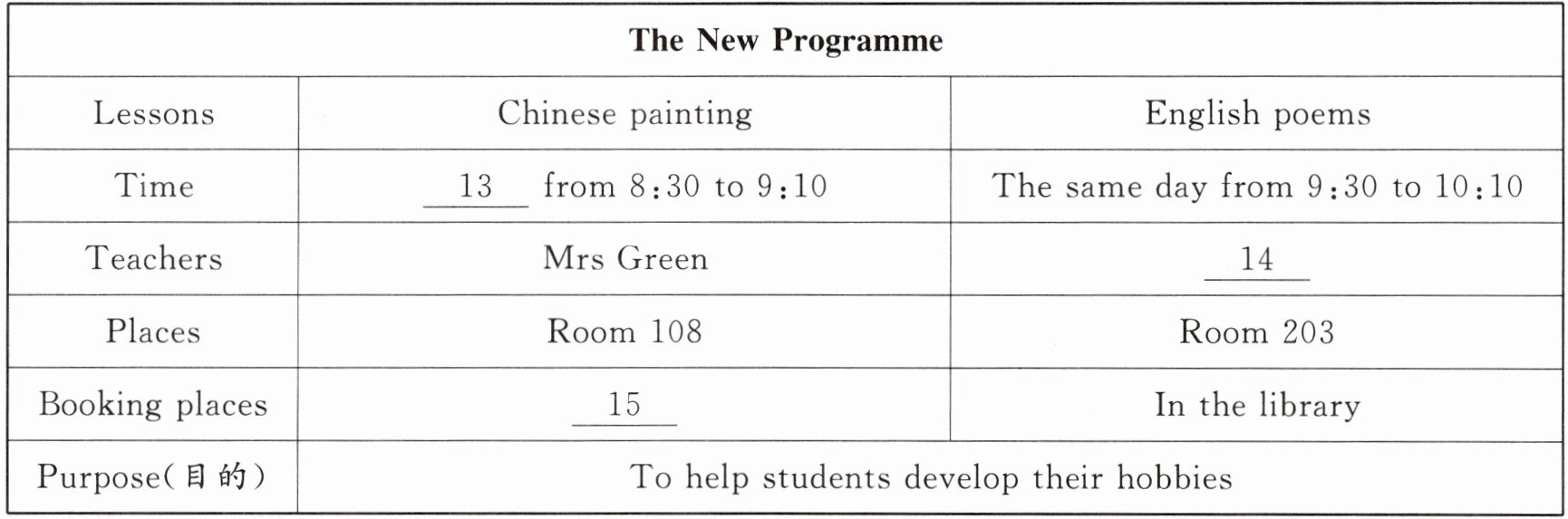
13. A. Every Thursday afternoon
B. Every Sunday evening
C. Every Saturday morning
14. A. Mr Green
B. Mr Black
C. Mrs White
15. A. In the meeting room
B. In the art room
C. In the hall
13. A. Every Thursday afternoon
B. Every Sunday evening
C. Every Saturday morning
14. A. Mr Green
B. Mr Black
C. Mrs White
15. A. In the meeting room
B. In the art room
C. In the hall
答案:13. C
14. B
15. C
14. B
15. C
听第三段独白,回答第 16~20 小题。
16. Where does Li Baofeng come from?
A. The south-east of China.
B. The north-east of China.
C. The east of China.
17. How does Li tell Chinese stories?
A. By paper.
B. By paper-cutting.
C. By drawing.
18. What are Li's works rich in?
A. Shape.
B. Size.
C. Colour.
19. What are most of Li's works about?
A. Traditional Chinese culture.
B. Beautiful seas.
C. Tall buildings.
20. Which work tells stories of red lanterns and traditional dresses?
A. Silk Road.
B. Dunhuang.
C. Chinese Red.
答案:16. B
17. B
18. C
19. A
20. C
17. B
18. C
19. A
20. C